Xilin Tang, Jerrod Windham, Joyce Thomas (2025). Human-AI Collaboration within Industrial Design: The Argyle Design Framework. In: Interdisciplinary Practice in Industrial Design. AHFE Open Access, vol. 183, pp. 40–50. https://doi.org/10.54941/ahfe1006425
Generative Artificial Intelligence (AI) is increasingly influencing industrial design workflows, becoming a catalyst for creativity and efficiency. This paper explores how generative AI tools amplify the creative potential of designers and streamline the process from early conception to prototyping. We study the design workflow through the lens of the Double Diamond Framework (a traditional design process model), evaluating the effectiveness of AI at each stage and identifying challenges in managing the large volume of ideas generated by AI. To address these challenges, we propose an alternative Argyle Design Framework that integrates iterative divergence and convergence cycles to better align with AI-driven workflows. The main findings of our research propose that AI tools can significantly expand research conceptual exploration and enhance design efficiency (e.g., shorter design cycles and higher productivity (Surrao, 2024)). However, without a structured process, the vast output of AI can overwhelm designers, highlighting the necessity for human-guided convergence. The Argyle Design Framework aims to leverage the advantages of AI—high output and rapid iteration—while introducing systematic filtering and refinement. We propose that using the Argyle Design Framework’s iterative approach can enhance creative outcomes, make workflows more manageable, and provide direction for effectively integrating generative AI into product design practices.
Generative AI is rapidly transforming product and industrial design, fundamentally altering how designers create and iterate ideas. Recent research highlights the explosive growth in generative AI applications across various industries (McKinsey & Company, 2023). In design specifically, image and text generation tools enable innovation teams to enhance ideation processes and gain deeper market and user insights (Marion et al., 2023). These AI systems can generate numerous concept variants within minutes, enabling designers to explore a broader design space than previously possible. This capability enhances creativity by allowing designers to discover novel ideas and unexpected solutions with AI assistance. Indeed, research demonstrates that incorporating advanced AI models (such as GPT-4) into
Human-AI Collaboration Within Industrial Design: The Argyle Design Framework 41
creative product development can improve ideation performance compared to purely human efforts (Marion et al., 2023).
Simultaneously, generative AI significantly improves design workflow efficiency by accelerating iterations and shortening development cycles. A recent industry survey found that implementing generative AI in product development can reduce design cycle time (accelerating launch timelines by approximately 5%) while substantially increasing productivity (by up to 40% for certain tasks) (Surrao, 2024). AI tools achieve these efficiency gains by automating routine tasks, enabling designers to iterate more rapidly and identify novel connections between concepts (McKinsey & Company, 2024).
Despite these benefits, integrating AI into design processes presents significant challenges. A primary concern involves the quality and originality of AI-generated content. Researchers have found that while the use of image-generating AI in product design is increasing, it raises important questions about originality and ethics (Bartlett & Camba, 2024). Designers must ensure that AI-generated concepts are not merely derivatives of existing designs in training datasets and must address critical issues of intellectual property and inherent biases. Additionally, there is risk of design fixation, where designers may become overly reliant on AI suggestions, potentially limiting their creative exploration—a phenomenon currently attracting significant attention in HCI research on AI-assisted creativity (Sarsenbayeva et al., 2025). Moreover, AI systems may produce misleading or technically unfeasible outputs, requiring careful human evaluation and domain expertise to distinguish viable ideas from impractical ones.
In light of these opportunities and challenges, we must reconsider how traditional design process models can adapt to accommodate generative AI capabilities. The Double Diamond Model, introduced by the UK Design Council in 2005, structures the design process into four stages: Discover, Define, Develop, and Deliver (Design Council UK, 2005). This widely taught and practiced framework emphasizes a structured approach with two main cycles: divergent thinking (broad exploration) and convergent thinking (narrowing down), providing clear stages for identifying appropriate problems and developing effective solutions. However, the emergence of generative AI prompts a reassessment of the Double Diamond Model’s applicability. Designers can now employ AI tools to introduce unprecedented speed and conceptual richness into the design process, which may not align optimally with the linear sequence of only two divergent-convergent cycles. Recent discussions within the design community suggest that the classic Double Diamond model appears increasingly rigid in an era demanding greater agility and real-time iteration (Gil, 2024).
Given these considerations, our research aims to analyze generative AI’s impact across various stages of the design workflow, using the Double Diamond model as an initial framework. We selected the Double Diamond for its clear delineation of divergent and convergent phases, aligning with our initial hypothesis that AI would excel in divergent
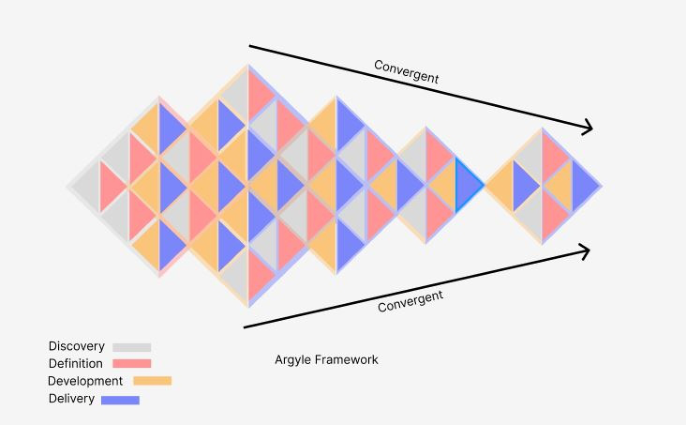
idea generation while human designers should lead convergent refinement and decision-making. We evaluate which aspects of the process AI can enhance (regarding creativity and efficiency) and which it may potentially undermine. Based on these insights, we propose the Argyle Design Framework—a refined design approach integrating iterative cycles of divergence and convergence throughout the workflow—effectively extending the Double Diamond model for the AI era (Tang et al., 2024). The Argyle Design Framework is named for its overlapping diamond pattern, symbolizing repeated creative cycles. We hypothesize that this approach will better accommodate AI capabilities, ensuring designers can fully leverage generative AI while maintaining essential human control and strategic guidance.
METHODOLOGY OVERVIEW Building on our previous research conducted in 2024, we developed a structured approach to systematically integrate generative AI into product design workflows. Our investigation began by deconstructing the design process according to the traditional Double Diamond framework, examining each of its four stages—Discover, Define, Develop, and Deliver—to identify optimal integration points for AI technologies.
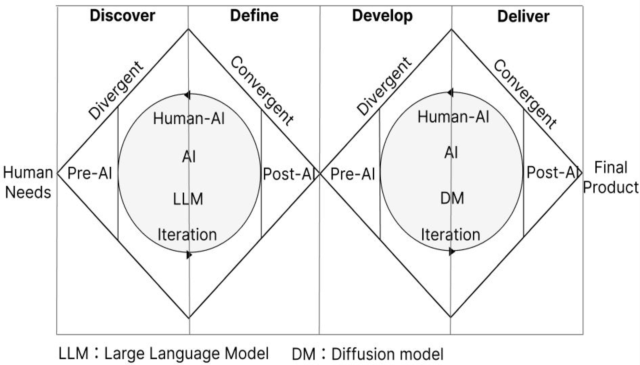
In our 2024 study (Tang et al., 2024), we conceptualized an “AI Double Diamond” approach that distinguishes between Pre-AI and Post-AI phases within each diamond of the framework (Figure 1). This distinction helped us evaluate AI assistance from initial problem discovery through to final prototyping, providing clear boundaries for when human-led versus AI- assisted work would be most effective.
The Pre-AI (primarily divergent) and Post-AI (primarily convergent) phases were designed to integrate contemporary AI tools—including ChatGPT, DALL·E, Midjourney, and Vizcom—into an industrial design curriculum structured around the Double Diamond model. Our preliminary findings indicated that compared to the traditional approach—which emphasizes human hands-on creativity and fundamental design skills—AI-driven approaches can significantly accelerate both the generation and refinement of promising concepts throughout the design process.
For example, two student case studies (a golf cart concept and a concept car) demonstrated that balancing human creativity with AI-generated suggestions fostered innovation while preserving the critical role of human judgment in the design process. This observation aligns with our broader findings: once design briefs and constraints are clearly defined, generative AI excels at rapidly producing diverse options, but human involvement remains essential for ensuring ethical considerations, originality, and strategic decision-making remain intact.
Human-AI Collaboration Within Industrial Design: The Argyle Design Framework 43
INTEGRATING AI INTO THE DOUBLE DIAMOND MODEL Having established our methodological approach, we now turn to a detailed examination of how generative AI can be integrated into each stage of the traditional Double Diamond model, highlighting both the opportunities and challenges that emerge at each phase.
Discover (Divergent Phase 1/Pre-AI Focus): In the discover phase, designers seek to understand the problem space, gather user insights, and identify opportunities. As part of this initial Pre-AI phase, manual ideation and foundational design skills play a crucial role: designers rely on core skills such as observation, problem identification, and synthesis to establish clear objectives and initial design directions without undue influence from AI suggestions. By separating this foundational work, the team preserves the richness of human creativity and intuition.
Definition (Convergent Phase 1/Post-AI Refinement): In the definition phase, the team begins to converge on a specific problem statement or design brief. Designers employ a human-centered synthesis approach—grouping insights, forming themes, and distilling the essence of the problem, often using basic charts or storyboards to define clear design criteria and finalize the problem definition. AI tools can support but not replace these decisions; the final direction of the project depends on human judgment to weigh pros and cons, consider user perspectives, and align with strategic goals. In this convergent stage, human designers shape the design criteria that will guide subsequent development.
Development (Divergent Phase 2/Pre-AI Emphasis): During the development phase, the design process transitions from being purely human- led to a Pre-AI–augmented approach. After clearly defining the problem and criteria in the discover and definition phases, AI tools now become central to increasing the quantity and diversity of design concepts. However, initial human-led design work at this stage (e.g. hand-drawn sketches or
low-fidelity prototypes) helps clarify design goals and constraints for the AI. For example, designers might feed their sketches into an image-generating AI, which then produces various aesthetic interpretations based on them.
At this phase, a range of AI tools may be utilized: image generation models (e.g. Midjourney) can create concept art and renderings from text prompts; 3D generation tools (e.g. Tripo AI) can produce CAD models or structural designs based on functional requirements; and large language models (e.g. GPT-4) can assist by brainstorming new feature sets or user scenarios. This Pre-AI approach leverages the capabilities of AI across multiple modalities, enabling designers to quickly and directionally explore numerous solution avenues. The result is a much broader conceptual space compared to a design team relying solely on hand-drawn sketches. However, it must be emphasized that human participation is crucial to ensure the feasibility, originality, and ethical soundness of AI-generated ideas.
Delivery (Convergent Phase 2/Post-AI Integration): Finally, in the delivery phase, the Post-AI approach helps to refine and test the selected ideas. For example, AI-driven code generation assistants (such as GitHub Copilot for developing interactive prototypes) or generative 3D tools (such as Tripo AI) can accelerate the prototyping and testing process. AI can also sift through large amounts of user feedback or testing data to discover trends or pinpoint areas needing improvement. Subsequently, the design team must apply human judgment to decide which AI-suggested iterations or adjustments should be incorporated into the product and to make the final design decisions. Artificial intelligence thus enhances the integrated workflow by generating plentiful data and supporting structured decision- making. However, the design team is still responsible for filtering out unfeasible or inaccurate AI ideas and integrating the best solutions into the final delivery. Ultimately, the final design outcomes are refined and validated by human designers.
CASE STUDY To evaluate this integrated approach, we tested generative AI tools within a controlled design project — designing a smart kitchen appliance (Figure 2). We recorded quantitative metrics (e.g. time spent, number of concepts generated) and qualitative assessments (e.g. practicality of concepts, alignment with user requirements). According to Tang et al. (2024), adopting distinct Pre-AI (human-centric ideation) and Post-AI (AI-driven optimization and integration) phases plays a particularly valuable role in managing a large volume of ideas and ensuring human creativity and ethical responsibility in outcomes. Unlike previous studies that emphasize technical integration details or ethical issues, our balanced approach — distinguishing clear pre- AI and post-AI phases — demonstrated how AI can be effectively integrated into design practice to enhance innovation while preserving human intuition and ethical standards. The structured Double Diamond perspective helped elucidate how humans and AI should interact at each stage of design, ultimately harnessing AI’s potential without compromising core design principles.
Human-AI Collaboration Within Industrial Design: The Argyle Design Framework 45
STUDENT FEEDBACK AND OBSERVATIONS We surveyed seven industrial design students in our AI-focused design course to gather insights on the role of generative AI in conceptual design and product development. The survey included Likert-scale questions on several topics:
AI Usage: Participants were asked about their current use of AI tools in design (whether they have used AI tools and which specific tools).
Perceived Benefits and Challenges: Participants indicated whether AI has helped them discover new design directions or perspectives, and if they have felt overwhelmed by the number of ideas generated.
Impact on Workflow: Participants rated how AI affects their overall workflow (e.g., saving time, inspiring creativity).
Initial Impressions of Argyle: After a short presentation introducing the Argyle Framework, participants evaluated its perceived usefulness.
We received feedback from all seven students. Although the sample size is small, the responses provided both quantitative and qualitative insights that complement our hands-on experiments with AI tools. The main conclusions from the survey are as follows: Widespread Adoption: 7/7 of respondents indicated that they are currently using, or have tried, AI tools for generative design and conceptual design tasks. The most frequently mentioned tools were ChatGPT and Midjourney, with some students also citing DALL·E or other specialized AI design software.
Perceived Benefits: 6/7 agreed that AI “helped me find new directions or perspectives that I otherwise would not have discovered,” with most rating this impact as 4 or 5 out of 5 on a Likert scale. This suggests that the vast majority found AI broadened their creative exploration and inspired ideas beyond their usual reach.
Mass Output: 3/7 reported that AI can generate such a large number of ideas that they have experienced situations of “too many possibilities,”
making it difficult to quickly integrate or filter these ideas. In other words, a significant subset encountered the problem of having an overwhelming volume of concepts from AI.
Time Saving: 5/7 believe that using AI can reduce overall design time by at least 25%. Notably, 2/7 estimated time savings of 50% or more on certain tasks, indicating that AI tools can substantially accelerate portions of the design process.
Concerns: 2/7 expressed concerns about potential “design fixation” or ethical issues resulting from AI-generated outputs (for example, worry that the AI may be recombining existing designs or that designers might become too dependent on AI suggestions). Although a minority, these concerns highlight the need to monitor over-reliance on AI and maintain originality.
Positive Perception: 6/7 strongly agreed that AI is highly beneficial in the early conceptual stages of design. In particular, they concurred that AI “accelerates or enhances discovery and ideation.” This widespread positive perception aligns with our own experience that generative AI is especially effective for initial ideation and exploration.
High Output Challenges: 3/7 mentioned that when faced with multiple divergent directions generated by AI, they occasionally feel “overwhelmed” or “unsure how to filter” the options. This feedback reflects the convergence challenge we also observed in our process: having many ideas is valuable, but deciding which ones to pursue requires additional structure.
Need for Guidance: In free-response comments, several participants expressed a desire for more structured processes to manage the large number of AI-generated concepts. One respondent wrote, “It’s amazing to have so many options available immediately, but I need a way to select and optimize the best options without missing anything.” Another noted, “The time we spend organizing AI output might be more than the time we would spend drafting fewer ideas ourselves.” These comments underscore the importance of guidance and filtering when working with AI outputs.
Inspiring Creativity: Similar to the responses on time saving, 5/7 believe that AI stimulates their creativity by proposing ideas they might not have conceived on their own. However, 2/7 cautioned that designers could become overly reliant on machine-generated ideas (a form of “design fixation”), emphasizing the need to use AI as a creative partner rather than a crutch.
Collectively, these survey results support our core argument, designers welcome the benefits of generative AI in the early stages (new perspectives and efficiency), but once a wealth of ideas has been produced, they face difficulties in managing the quantity and making decisions. Simply adding AI tools to the classic Double Diamond process is not enough to resolve this issue—designers clearly desire more structure for convergence. These insights provide valuable context and motivation for developing an iterative process model (such as the Argyle Design Framework) that can harness AI’s rich output without becoming overwhelming. In other words, there is a need for a new approach that allows teams to fully leverage AI’s creativity without becoming overly reliant on it or losing focus due to an excess of ideas.
Human-AI Collaboration Within Industrial Design: The Argyle Design Framework 47
THE ARGYLE DESIGN FRAMEWORK Based on our empirical findings and stakeholder feedback, we propose the Argyle Design Framework as an evolution of traditional design methodologies, specifically tailored to accommodate the affordances and challenges of generative AI integration. Named for the characteristic cross- diamond pattern of argyle fabric, this framework symbolizes a series of overlapping and matrixed divergence-convergence phases that extend beyond the conventional Double Diamond structure.
Unlike the Double Diamond model’s sequential two-diamond structure (where one diamond addresses problem definition and the next focuses on solution development), the Argyle Framework employs a multi-diamond sequence that enables design teams to invoke additional divergence- convergence cycles as needed throughout a project’s lifecycle (Figure 3). This approach maintains the essential distinction between expansive (divergent) and focused (convergent) thinking modes while offering substantially greater flexibility in their implementation timing and frequency.
Each individual “diamond” within the Argyle sequence corresponds to a specific design sub-problem or task, encompassing its own cycle of broad exploration followed by targeted refinement. In practice, diamonds occurring earlier in a project typically emphasize problem definition (discovery and framing), while later diamonds focus more on solution refinement and implementation. This progressive distribution ensures comprehensive problem exploration upfront while enabling iterative solution development and refinement in later stages.
FRAMEWORK PRINCIPLES The Argyle Design Framework is governed by four core principles that distinguish it from traditional design approaches:
Adaptive Divergence and Convergence: The framework enables design teams to initiate new divergent exploration cycles whenever unexpected insights or promising directions emerge, rather than constraining exploration to predetermined phases (as in the traditional Double Diamond). This adaptability allows designers to immediately pursue promising new directions by launching focused ideation cycles, eliminating the need to delay exploration until reaching a designated “phase” in a linear process.
Structured Iteration: Following each period of AI-generated ideation, the Argyle Framework mandates a convergence step to systematically evaluate, categorize, and refine the generated concepts. This structured approach prevents “endless ideation” by establishing regular filtering and synthesis points that guide the project toward concrete deliverables. The alternating rhythm of expansion and contraction maintains creative momentum while ensuring progress toward implementation.
Human-AI Collaboration: Within this framework, designers retain ultimate decision-making authority while leveraging AI as a creative partner throughout the process. AI systems can contribute to both divergent thinking (generating diverse alternatives) and convergent activities (clustering similar concepts or summarizing information patterns). The iterative cycles capitalize on AI’s capacity for rapid, high- volume idea generation during divergent phases, while human designers guide selection, evaluation, and development during convergence.
Accelerated Learning: By significantly reducing the time required to generate and evaluate new concepts, the Argyle Framework enables multiple small-scale iterations throughout a project’s duration. Design teams can quickly identify and eliminate unproductive directions while initiating new exploration cycles without compromising overall timelines. This accelerated learning approach facilitates the rapid integration of insights from prototyping and user feedback, continuously refining solutions through multiple iteration cycles.
COMPARISON WITH THE DOUBLE DIAMOND MODEL The Argyle Design Framework preserves the fundamental concepts of divergence and convergence from the Double Diamond model, it rejects the notion that these modes occur only twice in a predetermined sequence. Instead, the Argyle approach recognizes that AI-enhanced design processes benefit from continuous iteration with multiple expansion- contraction cycles. By implementing a matrixed series of diamonds, the framework accommodates emergent insights and new design directions that frequently arise when AI continually generates novel options and combinations.
Human-AI Collaboration Within Industrial Design: The Argyle Design Framework 49
Illustrative Workflow In a project following the Argyle Framework, a design team might begin with an initial divergent phase during a “Discover” diamond—conducting comprehensive user research and broadly exploring the problem space— before converging to clearly define core issues and requirements. The team would then diverge again in a “Develop” diamond to generate multiple solution concepts.
However, if during development an unexpected insight emerges—perhaps revealed through AI analysis or late-stage user feedback—the team can immediately initiate another focused cycle of research or prototyping. This flexibility essentially inserts an additional “diamond” into the process flow, rather than forcing the team to wait for a predetermined phase transition. These adaptive mini-cycles ensure valuable opportunities are pursued regardless of their timing within the overall project structure.
Advantages of the Argyle Framework
Managing High Output: By embedding convergence steps after each AI generation phase, Argyle helps teams systematically filter and evaluate a large number of ideas. This makes it feasible to incorporate generative AI without overwhelming the decision-making process.
Supporting Creative Breakthroughs: If a later-stage prototype or user test yields an unexpected insight, Argyle provides a framework to re- diverge and explore that new direction, then reconverge to integrate the findings. This ability to loop back supports creative breakthroughs and mid-project course corrections.
Balancing Efficiency and Exploration: Argyle prevents the “fountain of creativity” provided by AI from overflowing. By intentionally spacing out cycles of divergence and convergence, the framework ensures that innovation is continuously advanced without stifling it. Designers can maintain an open, exploratory mindset for longer periods, but within controlled limits that keep the project on track.
CONCLUSION
Generative AI enhances design creativity and efficiency but requires new methodological approaches. Our research reveals that while AI excels at expanding possibilities and accelerating tasks, it also creates challenges in managing the abundance of generated ideas. The Argyle Design Framework addresses these challenges through multiple cycles of divergence and convergence, allowing teams to leverage AI’s capabilities while maintaining human direction. This iterative approach enables more flexible responses to new insights while keeping projects focused on implementation.
Future research should extend this work by testing the Argyle Framework across different industries, developing AI tools for idea filtering and clustering, creating evaluation frameworks for AI-generated content, and evolving design education to prepare students for effective AI collaboration. As generative AI transforms design practice, frameworks like Argyle will help
designers balance creative exploration with strategic direction in this new era of human-AI collaboration.
REFERENCES
Bartlett, K. A. & Camba, J. D. (2024). Generative artificial intelligence in product design education: Navigating concerns of originality and ethics. International Journal of Interactive Multimedia and Artificial Intelligence, 8(5), 55–64. Boston Consulting Group. (2023, September). How people can create—and
destroy—value with generative AI. (White paper). Design Council UK. (2005). The Double Diamond design process model. (Design Council Report). Engineering and Management. Andrew Sage, series editor. Hoboken, NJ: Wiley. Gil, J. (2024, January). Outgrowing the double diamond: How the AI-powered
adaptive loop revolutionizes modern design. Medium. (Online article). Marion, T. J., Srour, M., Austin, R. D., et al. (2023, July). When generative AI meets product development. MIT Sloan Management Review. McKinsey & Company. (2023). The state of AI in 2023: Generative AI’s breakout
year. McKinsey Global Survey. McKinsey & Company. (2024). How to use generative AI in product design.
McKinsey Digital Insights. Sarsenbayeva, S., Jung, J., Zhang, X., et al. (2025). Understanding design fixation in generative AI. arXiv preprint arXiv:2502.05870. Surrao, A. (2024, September 13). Generative AI enhances every phase of product
development – from discovery to viability to build. Narratize Blog. (Online) Retrieved from https://www.narratize.com/blogs/gen-ai-enhances-every-phase-of- product-development. Tang, X., Windham, J., & Bush, B. (2024). Pre-AI and post-AI design: Balancing human creativity and AI tools in the industrial design process. In AIFE ‘24: Proceedings of the 2024 International Conference on Artificial Intelligence and Future Education (pp. 100–108). ACM. https://doi.org/10.1145/ 3708394.3708413
LISTED IN THE AHFE DIGITAL BOOKSTORE CATALOGUE
Explore the complete digital volume
Interdisciplinary Practice in Industrial Design
Read this individual research paper free through the original publisher, or explore the full digital proceedings book.
ISBN 978-1-964867-59-5
Explore this ISBN in the AHFE Bookstore ↗Listed in the July 2026 bookstore catalogue; search by ISBN to confirm current availability · Digital book purchase optional