Taskscape analysis is a little-known systematic method that has substantial potential to highlight important details related to a target product. Although taskscape analysis has been used in design practice, for example, towards placemaking (Dunkley, 2009), ferry design (Vannini, 2011), and clothing design (Tullio-Pow & Strickfaden 2020) its use has not been reported often in teaching and learning. The aims of this paper are to: define taskscape analysis; establish how taskscape has and can be used in teaching and learning; report on how taskscape analysis was used as a critical design thinking method; and establish the value of using taskscape analysis in design education. Taskscape analysis is elaborated upon through four projects completed across three years at two universities used to support students (n=105) in their designing processes. Taskscape analysis reveals product attributes by breaking down the immediate context of a product that relate to the tasks performed (that often require certain capabilities) while engaging with the landscape (or context) of objects and spatial environments. As such, students learn to complicate the use-scenarios of their target products by considering networks of human and non-human actors that touch or encounter one another throughout the process. The main values of using taskscape analysis are students: have better understandings of the true scope of design problems; can imbue their designs with deeper thought resulting in more refined and detailed concepts; can aid in creating guidance (i.e., design criteria, value proposition) to focus target designs; and engage in critical thinking in design. By creating an opportunity for students to work through design problems using this systematic method, along with other design thinking methods, students are encouraged to embody tangible considerations and elements into their final projects while developing their designing abilities.
Encouraging students to seek depth in product development can be a challenging process. Provoking depth of thinking in designing can be approached through engaging experts in the design process, encouraging research into products and people, using various design thinking methods during a project, and more. Design thinking methods have gained popularity
and have been picked up in different ways (Dorst, 2011) since the 1980s (Dorst, 2015; Rowe, 1987), but can be traced back in design studies to participatory, user-centred, strategic, and human-centred design (Cross, 1993). Furthermore, innovation companies such as IDEO (IDEO, 2015), business studies (Brown, 2019), and other fields (e.g., Lewrick et al., 2018) have also applied design thinking towards enhancing products or services. Design thinking methods predominantly take an arts-based approach (Leavy, 2015) that are fun, playful, engaging and compel people to think more divergently. Furthermore, design thinking has undergone some criticism, which has led design studies scholars to begin to think about the relationship between critical thinking and design thinking (Ericson, 2022). When critical thinking and design thinking colide, it can be called critical design thinking. According to Ericson (ibid) the common ground between critical thinking and design thinking includes: observing to understand; developing empathy and feeling; wondering and experimenting; drawing inferences and making decisions; and consulting with other parties. As such, critical design thinking involves these characteristics and others, such as, being an embodied activity, being collaborative, and involving imagining the future.
This paper delves into a critical design thinking method that has evolved from anthropologist Ingold (1993) who presents the concept of how tasks are performed with a ‘scape’ or ‘landscape’; and Kirsh (1996) who further elaborates on the vague proposition of taskscape through the ‘task environment’. Ingold describes taskscape as an embodied “…pattern of activities ‘collapsed’ into an array of features” (1993, 162) that are “unending” and in constantly in a process of building and unbuilding (ibid). Taskscape analysis is presented here as a method, moving beyond Ingold and Kirsh’s explorations of taskscape as a theory, for looking into the tasks people perform within specific environments, leading to a deeper understanding of user needs, value propositions, and ultimately, more effective and innovative design solutions.
We continue this paper from here by defining and elaborating on taskscape analysis. Second we establish how taskscape has and can be used in teaching and learning. Third we report on how taskscape analysis was used as a critical design thinking method through four design projects at two different universities. And we conclude by establishing the value of using taskscape analysis in design education, and why we believe it to be a critical design thinking method.
TASKSCAPE DEFINED The concept of taskscape comes from the two words: task and scape. Tasks are naturally linked to human capability and are performative and dynamic. Tasks are also linked to specific activities, tools and contexts. For instance, a classic example can be described through the cooking scenario where a person engages in ‘tasks’ including chopping vegetables, cutting meat, opening tins, putting things in bowls or pots, opening bottles, using spices, putting raw ingredients into pans/pots, turning on the stove, combining different ingredients, stirring food, serving food in plates, and more. The ‘scape’,
Taskscape Analysis: Provoking Depth in Product Development 101
as noted earlier, is linked to the idea of a landscape. A scape is the place, context, or use-scenario where a variety of tasks take place. For instance, the scape of cooking is typically a kitchen environment. When put together, the taskscape is the entire set-up within the scape that supports doing the various tasks required to accomplish a defined goal (in this case, to cook a dish/meal). With the cooking scenario, the taskscape is the cooking station with workspace, countertop, cutting boards, knives, colander, bowls, meat, produce, oil, water, spices, pots, pans, and a cooking appliance (see Figure 1).
Within design studies, taskscape has been advanced as a theory to help guide some designs. The design problems that have considered taskscape have tended to be problems where dynamic tasks are central. As such, these problems are relatively complicated due to the entanglements of people, tasks, scape, and taskscapes. We highlight two examples that used taskscape theory: (1) Vannini (2011) who reports on the process of ferry travel from the perspective of the passengers; and (2) Tullio-Pow and Strickfaden (2022) who report on the deep analysis of clothing. Vannini elaborates on a complex network of humans (staff, crew) and nonhumans (weather, tides, alarm clocks, etc.) related to the initially thought-to-be mundane task of passenger travel on a ferry (Vannini, 2011). Tullio-Pow and Strickfaden (2022) describe two clothing design projects: a liquor store uniform and outdoor winter clothing for seated clients where they report on a framework developed called the ‘clothing taskscape’ that led to a detailed design criteria for each project described. The central take-aways from these works is a clearer understanding of how using taskscape as a lens complicates an object within its dynamic context and highlights a network of interfaces with other human and nonhuman things.
Taskscape is therefore aligned with a systems thinking approach, aiming to understand the interconnectedness of problems, issues and connections related to a design target. By analyzing the tasks, associated objects and their context, designers can identify subtle but crucial elements and challenges that
might otherwise be overlooked. This approach is valuable in situations where designers wish to understand the dynamic and multiple problems related to a product at hand, especially when involving design problems that are considered complicated.
TASKSCAPE IN TEACHING & LEARNING Using taskscape as a critical design thinking method differs from using other methods. For example, the method of Journey Mapping (e.g., Richardson, 2010; Fichter & Wisniewski, 2015) helps students to consider journeys or sequences relative to a product path (Strickfaden et al., 2024). Other methods that seem similar to taskscape analysis but are different, are ones represented on the IDEO cards (2003) including: Scenarios where contexts of use are considered for a product or service; Behavioral Mapping that encourages tracking “the positions and movements of people within a space over time” to discover patterns; and Activity Analysis where “tasks, actions, objects, performers, and interactions are listed or represented in a process” (https://www.ideo.com/journal/method-cards). The central difference among taskscape analysis and Journey Mapping, Scenarios, Behavioural Mapping, and Activity Analysis is that taskscape analysis brings together a variety of considerations related to a product and supports thinking critically about how these are working together. Although many methods are used in design teaching and learning, there is only one previous reporting on how to use taskscape analysis in teaching and learning (Strickfaden et al., 2024) and it’s not elaborated upon in great detail. Taskscape analysis, is described as a method that’s used to complicate “…the use-scenario by considering the network of human and non-human actors that touch or encounter one another throughout the process” (1).
Using taskscape in teaching and learning provides students with an analytical framework that examines tasks performed within specific environments or scenarios. It combines the analysis of individual tasks with the context (of the ‘scape’ or landscape) in which they occur. As such, it involves looking at the space, environment, and how tasks are chained together and/or entangled. When applied to a specific design project, students can observe, analyze and/or imagine different tasks that people perform around specific kinds of products being designed, while also considering a myriad of objects within the network of its context or environment. This initial scholarship on taskscape establishes the foundations for developing taskscape analysis as a critical design thinking tool.
FOUR DESIGN PROJECTS Four different projects were delivered to undergraduate students consecutively across three years at two universities in the USA and Canada. At the USA university two projects were delivered to 3rd year industrial design students (n = 28): one on ‘backyard experience’ and the second on ‘design out crime’ (Thomas & Strickfaden, 2025). At the Canadian university another two projects were delivered in a design foundation course to blended classes of 2nd, 3rd, and 4th year students (n = 77): one is ‘sports
Taskscape Analysis: Provoking Depth in Product Development 103
gear for seated clients’ and the second is a ‘boardgame for blind and sighted people’. All four projects (see Table 1) were delivered as design sprints (Thomas & Shin, 2016; Shin & Thomas, 2017; Thomas & Strickfaden, 2018) that engaged multiple design thinking methods including taskscape analysis across approximately five weeks of coursework. The taskscape analysis was completed once the students identified the direction of their projects. For instance, prior to engaging in a taskscape analysis the students working on the ‘backyard experience’ needed to identify the type of product (e.g., chair, play station), users (e.g., intergenerational, child, older adult), product context (e.g., backyard, public park, daycare), and character of context (e.g., flat or sloped area, water); and the students working on the ‘boardgame’ needed to identify the type of game (e.g., collaborative, competitive, educational), users (e.g., adults, seniors, youths, children), embodied engagements (e.g., sound, tactile), scale and context (e.g., table, floor, indoors, outdoors).
To launch taskscape analysis, for consistency the students in each class were given a lecture on taskscape created and delivered by author one. The lecture illustrated the founding concepts, presented a definition, elaborated upon the goals related to taskscape, showed several examples including the cooking taskscape (see Figure 1) and the clothing taskscape (see Tullio-Pow & Strickfaden, 2022), and provided pointers on how to do a taskscape analysis.
Table 1: Four projects descriptions with design thinking methods used.
Table available in the original PDF paper.
Location Project Description Design thinking methods used USA (n = 16) Backyard experience Various rotationally
molded products that can be used in an outdoor space in various climates such as a treehouse, putting green, and a water chair.
USA (n = 12) Design out crime Various products that discourage crime such as locking devices, home security, and medical equipment.
Defining backyard spaces and crimes within USA
Empathic modelling
Habits of mind
Engaging experts
Interviewing users
Voices of the users through media
Market & precedent research
Journey mapping
Storyboarding
Writing personas
Project canvas brief
Value proposition
Low fidelity modelling Continued
Table 1: Continued Location Project Description Design thinking methods used
Table available in the original PDF paper.
Equation reproduced from the original PDF.
Various products that clients support folks with disabilities to engage in summer outdoor sporting activities such as water sports, cycling, and trailriding.
Equation reproduced from the original PDF.
Various table top and and sighted floor games including all physical items to play the game and playing instructions.
Self-knowing (3-4 exercises)
Empathic modelling
Engaging with experts
Interviewing users
Researching sports or board games
Voices of user through media
Market & Precedent research
Multiple IDEO methods (minimum of 3 per team)
Writing personas
Creating a design criteria
Sketch modelling
After the introductory lecture we gave the students an exercise to begin to think about how to conduct a taskscape analysis. This exercise involved asking the students to go to a public restroom within the building. They were asked to engage in the ordinary tasks related to going to the restroom and to map out the series of tasks performed. We asked them to be attentive to moving from the classroom and down the hallway, opening the door, and entering the space. Once in the space, they needed to be attentive to navigation within the space and engagement with all of the objects within (doors, toilet, sink, faucet, etc.). We asked them to engage in a toileting activity where they needed to partially undress, sit down, toilet, stand up, and then re-dress again. They also needed to document how they engaged with the sink, faucet, water, air dryers, and paper towels. Finally, they needed to navigate back through the door, into the hallway, and back to the classroom for a discussion on what they learned. By asking the students to map out the toileting taskscape in situ, they become aware of the series or sequence of tasks, and the objects and spatial elements linked together within a specific environment.
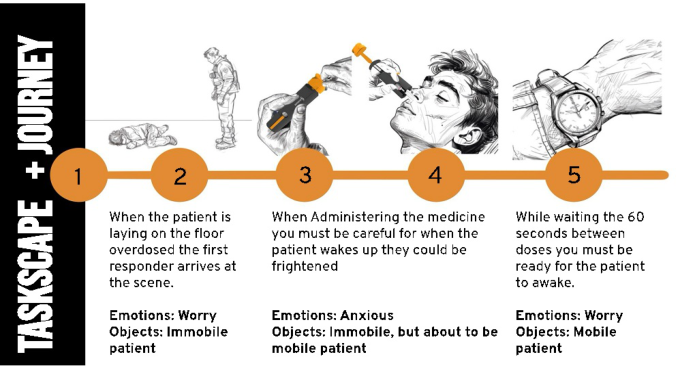
Next, the students were asked to develop a taskscape analysis related to their potential product that included tasks, the network of objects, use-scenario and environment. Each student’s taskscape analysis differed considerably. Some looked like lists of tasks within a scenario, while others blended various information about their project such as emotion, journeys, tasks, and more (see Figure 2).
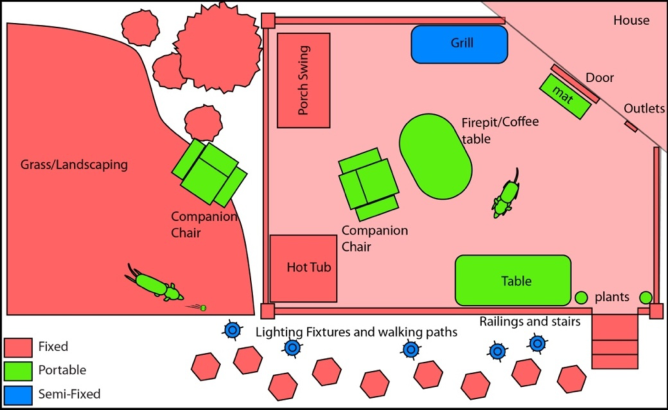
Other students interpreted the taskscape analysis quite literally by creating a kind of map of objects related to their target design that could be filled out later with the tasks associated with the object they were designing (see Figure 3).
Taskscape Analysis: Provoking Depth in Product Development 105
Figure 2: Taskscape analysis for a proposed Narcan multi-dose dispenser responding to the ‘design out crime’ brief.Figure 3: Taskscape analysis for a dog companion chair responding to the ‘backyard experience’ brief.
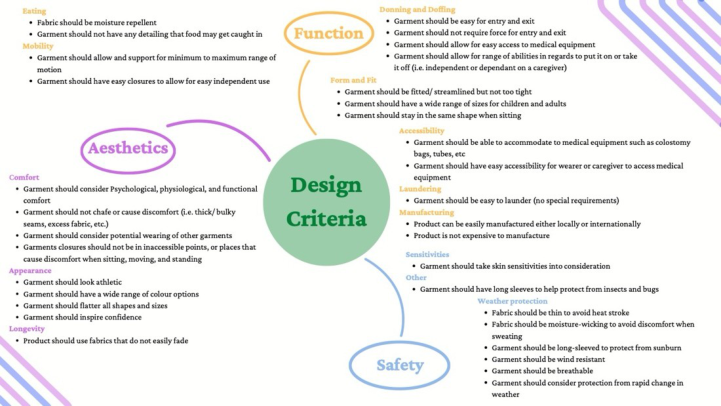
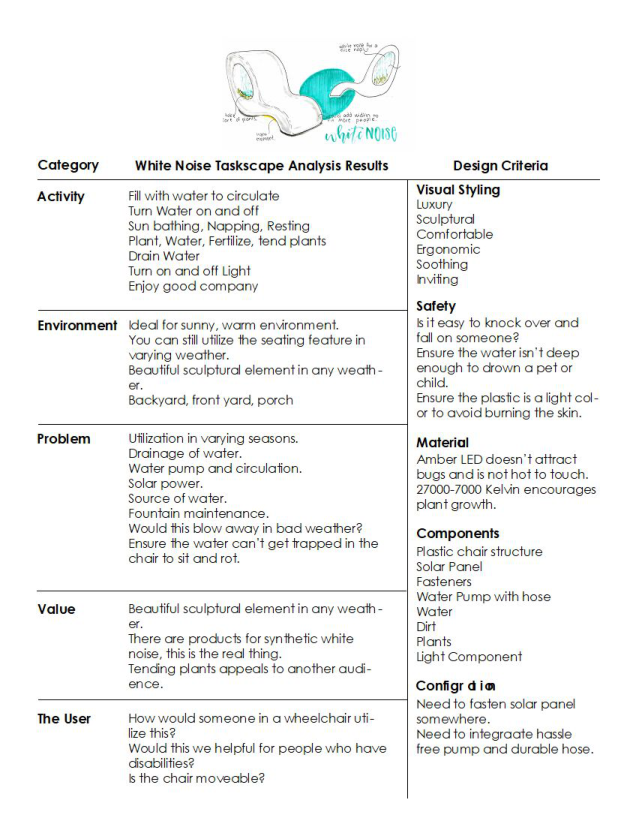
We noted that using taskscape analysis provoked some of the students to develop a detailed design criteria (see Figures 4 & 5) for the project at hand. This list or map of design requirements captures essential considerations for the target design, guiding students throughout their design process to test concepts and to further refine their designs.
The students seemed to appreciate creating a design criteria because it made elements that they learned about from their taskscape analysis into something tangible and useable. Documenting information about the human
and nonhuman actors, the use-scenario, and the tasks associated with their target product supported the creation of a detailed design criteria. The design criteria also helped to focus the project at hand on the needs and interactions identified within the taskscape, and the students were able to prioritize design details more easily due to having a broad list of design considerations. Along with creating a design criteria, some of the Canadian students also created personal logbooks to understand the taskscape of their target product in even more detail.
Figure 4: Design criteria for cycling shorts responding to the ‘sports gear for seated clients’ brief.
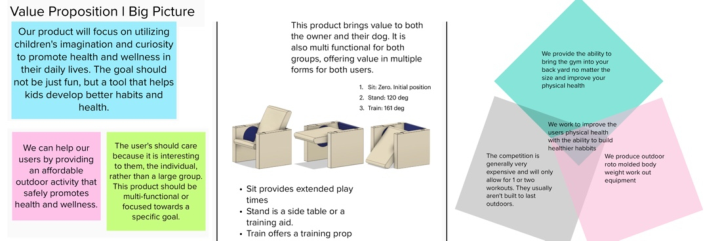
The taskscape analysis completed by the USA students also led to a clearer understanding of their ‘value proposition’ related to their target users and use-scenario (see Figure 6). While developing a design criteria can be quite extensive, the value proposition is a concise statement that articulates the core benefit and value that the product provides. It shifts the focus from product features to the core value the product provides, like capturing moments in time. A value proposition can be powerful because it is a short statement about the value of a product rather than a long-detailed description.
Through the four design projects we were able to establish a systematic way to guide students towards doing a taskscape analysis and to develop taskscape analysis as a critical design thinking method. As a method, taskscape analysis has the potential to provoke students to move their target product further, faster, and with more detail along the design process.
Taskscape Analysis: Provoking Depth in Product Development 107
Figure 5: Combined taskscape analysis and design criteria for a solar powered water chair responding to the ‘backyard experience’ brief.Figure 6: Value propositions created by three student responding to the ‘backyard experience’ brief.
TASKCAPE AS A CRITICAL DESIGN THINKING METHOD The aims of using taskscape analysis were: (1) to explore how it could augment other design thinking methods towards a target design at approximately the mid-point of their concept development process; (2) to push the students to think more deeply and follow through with concept refinement; (3) to provide the students with a tool that supported critical thinking in design. Furthermore, the taskscape analysis method helps students to gain a more holistic view of the design problem by considering the various other objects, tools, and environmental factors; and to consider the series of chained tasks including how these are influenced by and influence the contextual situation. The attributes that make taskscape analysis a critical design thinking method are that students are required to observe, feel, speculate, experiment, and make decisions towards better understanding their target design.
As a critical design thinking tool, taskscape analysis certainly supported the students to think more deeply while also helping them to establish a hierarchy of importance among different design considerations. Through observation and analysis of user interactions, designers can determine which aspects, such as safety, aesthetics, or functionality, are most critical to the user’s experience and prioritize their efforts accordingly. Taskscape analysis also supported students to ask more questions about how people engage or might use their product within a context; including questions about dynamic use, misuse, and safety. Students began to see gaps in knowledge about potential things to investigate, such as the need to observe people interacting in different environments or to seek out more precedent research. In sum, students began to prioritize more accurately and to see that various design issues are intertwined and inseparable.
As a critical design thinking method, our students used taskscape analysis at the beginning of the design process to: define the problem parameters, the problem space, and the project focus; begin concept development; and to develop the design criteria and value proposition. However, taskscape analysis can also be used later in the design process to refine concepts, work out details around use and context, inform storyboarding or journey mapping, and inform messaging around the target design. As such, it is possible to use taskscape multiple times in a project to continue to iterate on the design and make sure that it meets clients, users, and project goals.
CONCLUSION
Our exploration into taskscape analysis through four projects at two universities has provided the opportunity to reflect on taskscape analysis as a critical design thinking method in relation to other commonly used design thinking methods. Through this reflection we are able to highlight the value of taskscape analysis, and to further explore how critical thinking comes together with design thinking. We know that taskscape analysis emphasizes the importance of considering both the task and the environment, and provides a structured approach to understanding user needs within specific contexts in a more holistic way when working on a target project. As
Taskscape Analysis: Provoking Depth in Product Development 109
a method, it encourages students to engage in deep thinking that reveals multiple perspectives and highlights important details. Taskscape facilitates the creation of a design criteria that guides the design process and helps define the product’s value proposition. It can be applied at various stages of the design process, from initial concept development to final refinement. The findings of this work illustrates some of the ways that teaching and learning through taskscape analysis has the potential to get student to engage in systems thinking and expand the project at hand into a more complex product profile. Although there are limits to taskscape as a critical design thinking method, we are left with opportunities to further explore how taskscape analysis can be used in different teaching and learning situations. We look forward to continuing to apply and test taskscape analysis as a robust critical design thinking method.
ACKNOWLEDGMENT
The authors would like to acknowledge the students who took part in the four projects at Auburn University and the University of Alberta.
REFERENCES
Brown, T. (2019). Change by Design: How Design Thinking Transforms Organizations and Inspires Innovation. Harper Business. Dorst, K. (2015). Frame Innovation: Create New Thinking by Design. The MIT Press. Dorst, K. (2011). The core of “design thinking” and its application. Design Studies,
32(6), 521–532. Dunkley, C. (2009). A therapeutic taskscape: Theorizing place-making and care at a camp for troubled youth. Health & Place, 15, 88–96. doi:10.1016/ j.healthplace.2008.02.006. Ericson, J. D. (2022). Mapping the Relationship Between Critical Thinking and
Design Thinking. Journal of Knowledge Economy, 13, 406–429. Fichter, D., & Wisniewski, J. (2015). Customer journey mapping. Online Searcher, 39(4). Retrieved from http://www.infotoday.com/OnlineSearcher/Issue/ 5440-July-August-2015.shtml. IDEO (2015). The Field guide to Human-Centred Design (1st Edition). Canada: IDO.org/DesignKit. Ingold, T. (1993). The temporality of the landscape. World Archaeology, 25(2),
152–174. Kelley, T., & Littman, J. (2001). The Art of Innovation. New York, NY: Random House Kirsh, D. (1996). Adapting the Environment Instead of Oneself. Adaptive Behavior,
4(3/4), 415–452. Leavy, P (2015). Method Meets Arts: Arts-Based Research Practice, NY: The Guilford Press. Lewrick, M., Link, P., Leifer, L. (2018). The Design Thinking Playbook: Mindful
Digital Transformation of Teams, Products, Services, Businesses and Ecosystems. Wiley. Richardson, A. (2010, November 15). Using customer journey maps to improve customer experience. Harvard Business Review. Retrieved from https://hbr.org/ 2010/11/usingcustomer-journey-maps-to/.
Rowe, P. (1987). Design Thinking. MIT Press. Shin, C., Thomas, J (2017). Exploring Two Design Processes: Fast and Slow. In: Chung W., Shin C. (eds) Advances in Affective and Pleasurable Design. AHFE 2017. Advances in Intelligent Systems and Computing, vol 585. Springer, Cham pp. 3–15. Strickfaden, M., Thomas, J., & Tullio-Pow, S. (2024). Teaching to Innovate with
Taskscape. International Textile & Apparel Association, ITAA Proceedings #81, Long Beach California, 1–3. Thomas J and Shin C (2016). Implementing design sprints in the education of industrial designers. Design Principles and Practices: An International Journal — Annual Review, Volume 10, pp. 59–73. Thomas, J and Strickfaden, M (2025). Define, Design, Repeat, Refine. Advances
in Interdisciplinary Practice in Industrial Design, In this volume, AHFE (2025) International Conference. Thomas, J and Strickfaden, M (2018). From Industrial Design Education to Practice: Creating Discipline Through Design Sprints. In M., W. Chung and C. S. Shin (Eds.): Advances in Interdisciplinary Practice in Industrial Design, AHFE 2018, AISC 790, pp. 111–121, 2019. https://doi.org/10.1007/978-3-319-94601-6_13 Tullio-Pow, S., & Strickfaden, M. (2022). Clothing Taskscape as an Approach
Toward Assessment of User Needs. Clothing and Textiles Research Journal, 40(1), 19–36. https://doi.org/10.1177/0887302X20968818 Vannini, P. (2011). The techne of making a ferry: A non-representational approach to passengers’ gathering taskscapes. Journal of Transport Geography, 19(5), 1031–1036. doi: 10.1016/j.jtrangeo.2010.10.007.
LISTED IN THE AHFE DIGITAL BOOKSTORE CATALOGUE
Explore the complete digital volume
Interdisciplinary Practice in Industrial Design
Read this individual research paper free through the original publisher, or explore the full digital proceedings book.
ISBN 978-1-964867-59-5
Explore this ISBN in the AHFE Bookstore ↗Listed in the July 2026 bookstore catalogue; search by ISBN to confirm current availability · Digital book purchase optional