Joon Park (2025). Cohesive Design: A Desire-Driven Framework for Transformative Innovation. In: Interdisciplinary Practice in Industrial Design. AHFE Open Access, vol. 183, pp. 121–132. https://doi.org/10.54941/ahfe1006433
Industrial design has evolved from a focus on functional performance and mass production efficiency to embracing human-centered practices and sustainability. However, traditional approaches that concentrate on explicit user needs may overlook the deeper, often unarticulated desires that truly drive innovation. This paper proposes a cohesive design methodology that integrates the Jobs-To-Be-Done (JTBD) theory with a novel Desire Segmentation approach to uncover latent desires. Using the laundry domain as a case study, the paper demonstrates how designing with an emphasis on desire—not merely on explicit needs—can yield transformative innovations that redefine user experiences.
Design practice has continually expanded its scope—from basic functionality and aesthetics to increasingly holistic considerations, such as usability, user experience (UX), and sustainability. While User-Centered Design (UCD) has focused on meeting explicit needs and improving usability, society’s growing complexity demands design approaches that address not only the current user base but also the broader ecosystem of potential users and stakeholders. Consequently, many practitioners are moving beyond UCD toward more encompassing frameworks like Customer Experience (CX) design and systems thinking.
Nevertheless, focusing primarily on explicit needs may limit the scope of innovation to incremental improvements. This paper introduces Cohesive Design, a new methodology that places deeper user desires at the center of the design process. By integrating Jobs-to-Be-Done (JTBD) theory with a unique Desire Segmentation approach, Cohesive Design seeks to uncover latent aspirations that often remain hidden in conventional needs-based research.
To illustrate the approach, we present a case study on the home laundry domain—an everyday yet under-innovated field. We show how considering not just functionality but also underlying desires can open up transformative opportunities for product and service design. The paper is structured as
follows: (1) The Evolution of Industrial Design contextualizes the shift from functional design to desire-driven perspectives; (2) Theoretical Foundations outlines the core theories—JTBD, A(x4) Analysis, and the Opportunity Landscape; (3) Research Methodology details the integrated five-step process for desire-driven design; (4) Case Study demonstrates how this methodology was applied to laundry, focusing on the Effortless Cleaners segment; (5) Discussion addresses implications and limitations; and (6) Conclusion summarizes key insights and suggests directions for future research.
THE EVOLUTION OF INDUSTRIAL DESIGN: FROM FUNCTIONALITY TO DESIRE Industrial design emerged as a distinct discipline during the era of industrialization, where mass production demanded efficiency and streamlined functionality. Designers like Raymond Loewy underscored commercial success by blending form and function, famously remarking that “the most beautiful line is the one that sells” (Hanks, 1970). By the mid-20th century, design shifted toward a more user-centric paradigm, prioritizing emotional engagement alongside practicality. Donald Norman’s Human- Centered Design (Norman, 2013) epitomized this transition by insisting that products be tailored to users’ behaviors, needs, and experiences.
However, as user-centered approaches gained traction, they often concentrated on identifying and solving explicit needs—issues that users could easily articulate. While effective for incremental advancements, such methods sometimes fail to capture deeper, more enduring motivations that can trigger disruptive innovation. In contrast, underlying desires, which are less tied to the current technological or social context, can serve as powerful catalysts for transformative solutions. In this regard, Leitão (2022) distinguishes needs—focused on bridging the gap between a current state and an ideal state—from desires—driven by open-ended exploration and creativity that can spark entirely new possibilities. These deeper motivations resonate with the Jobs-to-Be-Done (JTBD) theory, which emphasizes that people “hire” products and services not merely to solve a visible problem but to fulfill broader life aspirations (Christensen et al., 2016). This understanding of both needs and desires lays the groundwork for the cohesive design methodology proposed in this paper.
THEORETICAL FOUNDATIONS AND METHODOLOGICAL FRAMEWORK Jobs-To-Be-Done (JTBD) Theory in Design
The Jobs-To-Be-Done (JTBD) framework posits that customers hire products or services to carry out specific “jobs” in their daily lives. Instead of focusing on product features, JTBD directs attention to the underlying goals or outcomes users seek. As Christensen et al. (2016) illustrate, a product like a milkshake can be “hired” by morning commuters looking for an easy-to- consume breakfast alternative, or by children in the afternoon seeking a fun
Cohesive Design: A Desire-Driven Framework for Transformative Innovation 123
treat. Even though the product is the same, the “jobs” differ significantly, underscoring the complexity of user motivations.
In practice, JTBD highlights functional tasks as well as emotional and social dimensions. By dissecting each step a customer takes to achieve a particular outcome, designers can gain insights into where existing solutions fall short and where new opportunities lie (Christensen, Anthony, & Roth, 2003). This paper integrates JTBD not simply as a market analysis tool but as a guiding principle for design, aiming to uncover the root causes—and deeper desires—behind user behavior.
Desire Segmentation Desire Segmentation is a novel approach introduced in this study to classify users based on underlying aspirations rather than solely on demographic, psychographic, or behavioral criteria. While traditional segmentation might categorize laundry customers by age or appliance type, Desire Segmentation aims to reveal why different user groups care about certain outcomes. This approach employs qualitative methods (e.g., in-depth interviews, contextual inquiry) and frameworks like A(x4) Analysis to unearth unspoken emotional drivers.
1. Desire Identification: Gather rich qualitative data on user aspirations, fears, and lifestyle values. 2. Pattern Recognition: Identify recurring themes or “desire clusters”across interviews and observations. 3. Segmentation: Group users into segments that share core desires— e.g., convenience, sustainability, emotional satisfaction—even if their demographics differ.
By shifting the focus from explicit needs to underlying motivations, Desire Segmentation can uncover novel angles for innovation that purely needs-based or demographic-based approaches might miss.
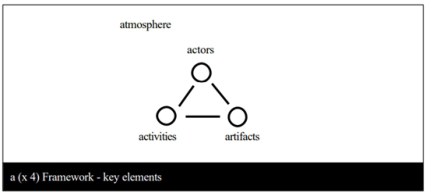
A(x4) Analysis Developed by Professor Paul Rothstein (2002), A(x4) Analysis examines Actor, Activity, Artifact, and Atmosphere, offering an ethnographic lens for observing how people interact with products and environments.
Figure 1: a4 Framework (image courtesy of Rothstein, 2002).
124 Park
By considering the interplay between these four elements, designers can spot hidden barriers or opportunities that emerge from the broader context— such as poorly designed storage spaces or emotional triggers related to specific chores. These insights enrich the JTBD exploration by ensuring that environmental and emotional factors are not overlooked.
The process typically begins by identifying a specific target customer group. Qualitative techniques such as observation and contextual inquiry are then employed to discover nuanced emotional drivers that may persist even as explicit needs evolve. In this study, we used the A(x4) methodology to select and analyze our target customer group. We then investigated the relevant objects and environment surrounding this group, using these findings as a foundation for developing the Job Map.
Job Map and Desire Diagram A Job Map deconstructs a customer’s overarching job into sequential steps (Ulwick, 2005). Indeed, Customer Journey Maps illustrate a user’s interactions and emotions throughout a service experience (Stickdorn and Schneider, 2012). Where a Customer Journey Map visually represents these interactions and emotional touchpoints, a Job Map breaks down the functional components: defining the objective, gathering resources, executing, monitoring, and concluding. Unlike a Customer Journey Map, which focuses on the sequence of interactions a customer has with a product or service, a Job Map centers on the underlying tasks customers aim to accomplish, independent of any specific solution (Kalbach, 2020). This differentiation highlights the contrast between mapping the touchpoints of an existing experience versus understanding the fundamental objectives driving customer behavior. For each step, we link the User Desires—the higher- level goals users strive for—creating a Desire Diagram that highlights why a specific step matters beyond its immediate functional requirement.
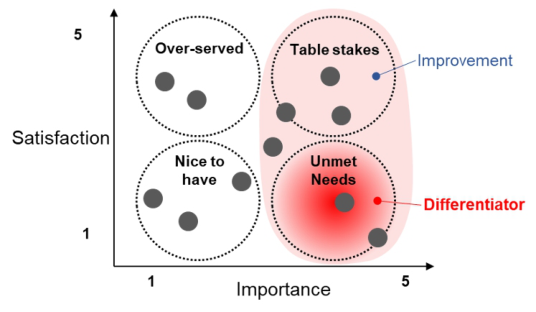
Opportunity Landscape Building on JTBD, Tony Ulwick’s Opportunity Landscape (Ulwick, 2002; 2005) uses surveys to gauge two dimensions:
1. Importance – How critical each User Desire is. 2. Satisfaction – How well existing solutions currently meet that outcome.
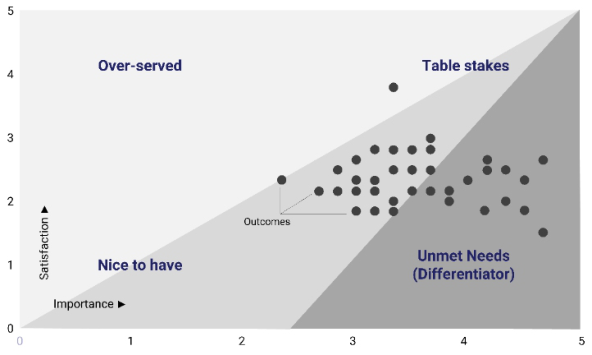
When these two factors are combined, the resulting “Opportunity Score” highlights areas of high importance but low satisfaction. According to Ulwick (2016), the Opportunity Score is a valuable tool for deriving new concepts because it helps to identify the most significant potential for customer satisfaction. By plotting these scores (Figure 2), designers uncover under-served areas—“white spaces” ripe for innovation. In this paper, the Opportunity Landscape not only guides concept generation but also ensures that ideas address the most impactful desires rather than mere superficial improvements.
Cohesive Design: A Desire-Driven Framework for Transformative Innovation 125
Figure 2: Opportunity landscape.
RESEARCH METHODOLOGY This study proposes a five-step design process that integrates JTBD theory with desire-driven insights to guide the design innovation process:
1. Domain Selection: Identify the design field (product or service) to be innovated. In this study, the focus is on the home laundry experience—a ubiquitous yet challenging everyday task. 2. Target Customer Identification: Building on the insights from the A(x4) analysis, a specific target group for the design process was defined. These personas represent the key actors involved in laundry scenarios, capturing distinct user needs, motivations, and challenges that inform subsequent design decisions. Qualitative methods—observation and contextual inquiry—were employed to uncover latent desires. The A(x4) Analysis framework was used to explore the interplay between actors, their activities, the artifacts they use, and the surrounding atmosphere. 3. Desire Diagram & Job Map Development: Systematically analyze the steps involved in the laundry process (pre-washing, washing, and post-washing) and document the User Desires at each stage. 4. Customer Survey & Opportunity Landscape: Conduct surveys to gather quantitative data on the importance and satisfaction levels associated with each User Desires. Calculate Opportunity Scores to identify areas where customers’ needs are under-served. 5. Concept Generation: Based on the insights from the Opportunity Landscape, develop innovative design concepts that address both functional requirements and underlying desires.
Data collection for this study included 119 customer interviews and online searches, which were analyzed to extract 50 distinct User Desires. An online survey of 30 US-based participants provided quantitative validation, enabling the creation of an Opportunity Landscape that guided the final design concepts.
126 Park
CASE STUDY: REIMAGING THE HOME LAUNDRY EXPERIENCE Background and Rationale
Despite ongoing technological enhancements in washing machines, the overall laundry process—sorting, measuring detergent, drying, folding—has remained cumbersome. The objective here was to apply our desire-driven approach to discover opportunities that transcend mere product tweaks. By focusing on the holistic “job”of laundry, we sought to create a more cohesive, efficient, and emotionally satisfying experience.
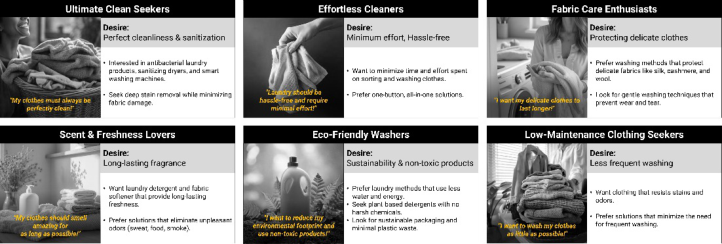
Desire Segmentation and Target Group Selection Initial research revealed six desire-based segments of laundry consumers:
Ultimate Clean Seekers, Effortless Cleaners, Fabric Care Enthusiasts, Scent & Freshness Lovers, Eco-Friendly Washers, and Low-Maintenance Clothing Seekers (Figure 3).
Unlike traditional market segmentation, which might group people by age or household size, these segments emerged from underlying motivations— identified via qualitative interviews and A(x4) Analysis. For example, Effortless Cleaners consistently expressed frustration with time-consuming tasks such as sorting, measuring detergent, and transferring clothes between units. They desired simplicity and convenience above all else, often citing an “out of sight, out of mind” mentality toward laundry.
Figure 3: Desire segmentation in home laundry.
Given the high level of dissatisfaction and strong desire for simplicity, we selected Effortless Cleaners for deeper exploration. Their clear pain points— limited space, tedious sorting, and detergent dosing confusion—aligned well with the concept of a transformative rather than incremental design solution. Furthermore, survey feedback indicated that Effortless Cleaners were significantly less satisfied (avg. satisfaction < 3.0 on a 5-point scale) with existing products, making them prime candidates for innovative concepts.
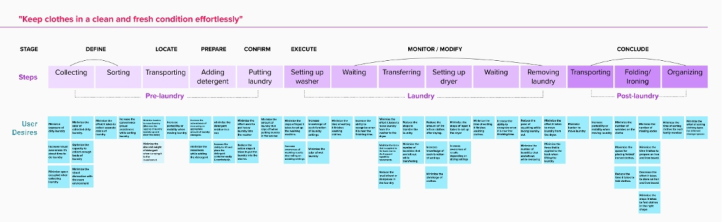
Constructing the Job Map, Desire Diagram, and Opportunity Landscape In the initial phase of this study, a Job Map was created to systematically break down the laundry process into distinct stages. The pre-wash stage
Cohesive Design: A Desire-Driven Framework for Transformative Innovation 127
encompasses tasks such as sorting clothes, accessing the appropriate detergent, and managing hamper space. The washing stage involves selecting machine settings, measuring and adding detergent, and monitoring the wash cycle. Finally, the post-wash stage includes drying clothes, folding, and organizing them for storage. By clearly delineating these phases, the research team identified key pain points and areas that often go overlooked in conventional laundry routines.
Figure 4: Job map and desire diagram.
Subsequently, these stages were mapped to a Desire Diagram to reveal the underlying user aspirations driving each task. For example, in detergent measurement, participants expressed a strong desire for quick and accurate dosing (“avoid mess/spills”); in the folding and organizing process, they noted a preference for minimal physical and mental effort (“reduce mental load”). By focusing on these User Desires—such as “minimize physical effort,” “avoid mess/spills,” “streamline garment care”— the study illuminated deeper motivations that go beyond simple functional requirements.
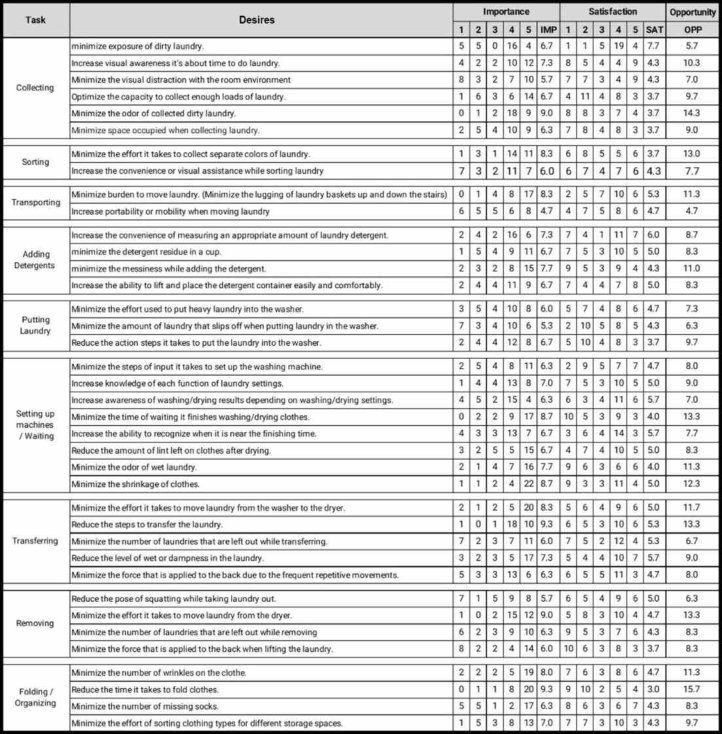
To quantify and prioritize these user desires, an Opportunity Landscape analysis was then conducted. A survey using a 5-point Likert scale (n = 30) measured both importance and current satisfaction for each User Desire. The results highlighted several areas with high importance but low satisfaction, resulting in notable gaps where innovation could yield a significant impact. Noteworthy examples included “quick and accurate detergent dosing,” “optimal use of limited space,” and “simplified loading and unloading.” These Opportunity Scores guided the subsequent concept generation process, focusing resources on solutions most likely to resonate with user desires.
Key Design Concepts Drawing on the insights gained from the Opportunity Landscape, this research proposes three design concepts that specifically address the most under-served desires identified in the survey data.
128 Park
Figure 5: Opportunity scores from user survey on desires for home laundry (n = 30).Figure 6: Opportunity landscape.
Cohesive Design: A Desire-Driven Framework for Transformative Innovation 129
1. Water-Soluble Detergent Bag:
Developed from Polyvinyl Alcohol (PVA), these bags dissolve in water, eliminating the need for manual detergent measurement. They also come in various colors corresponding to different fabric types or load sizes, helping users avoid errors and reduce mess.
Figure 7: Concept of a water-soluble detergent bag.
2. Smart Hamper with RFID:
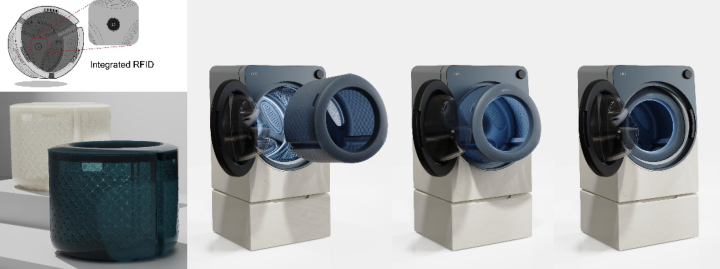
This silicone hamper is embedded with an RFID chip that communicates preset wash parameters to a connected washing machine. Divided sections within the hamper—potentially color-coded—further streamline sorting, decreasing the mental load associated with handling multiple laundry categories.
Figure 8: Concept of an integrated hamper system.
130 Park
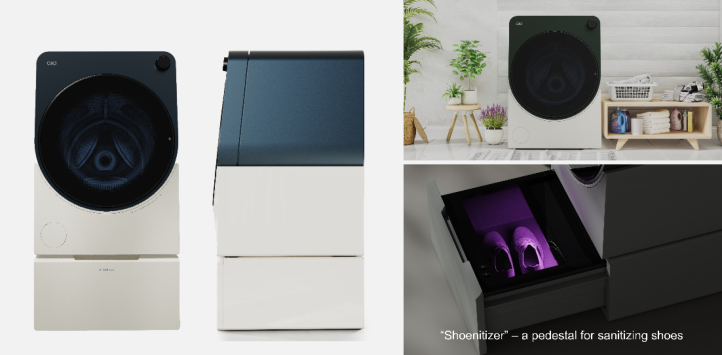
3. All-in-One Washer-Dryer Combo With “Shoenitizer”: By integrating washing and drying functions in a single appliance, this concept saves space and simplifies user interaction. An additional pedestal feature can sanitize shoes (or other items) between cycles, addressing hygiene concerns while removing the need for separate steps or devices.
Figure 9: Concept of an all-in-one washer-dryer combo with “Shoenitizer”.
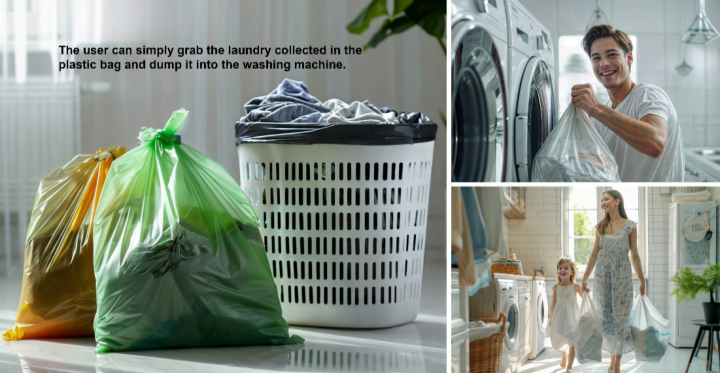
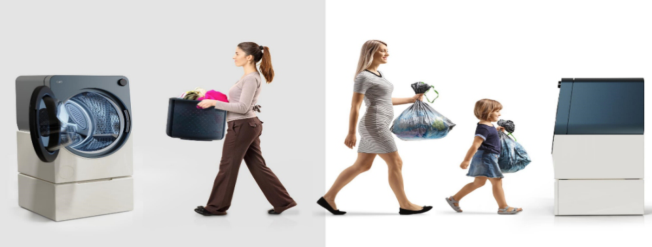
As shown in Figure 10, the developed concept allows users to collect laundry in the hamper and transfer it to the washing machine as a whole, or alternatively, gather laundry directly in the detergent bag and place only the filled bag into the washing machine without the need for a separate hamper. This design provides flexibility based on user convenience and preferences.
Figure 10: Flexible laundry system: supporting both hamper and detergent bag usage.
Cohesive Design: A Desire-Driven Framework for Transformative Innovation 131
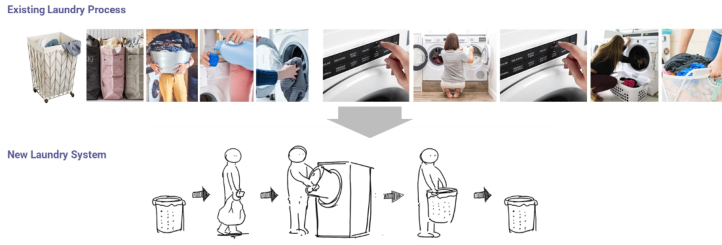
Figure 11: Comparison of existing laundry process and newly developed system.
DISCUSSION
This case study illustrates how Cohesive Design, underpinned by JTBD theory and Desire Segmentation, can uncover deep-seated aspirations often overlooked by needs-based frameworks. By mapping user desires rather than just their explicit problems, we identified under-served areas—such as detergent dosing and space optimization—that guided us toward innovative concepts capable of reimagining the laundry experience. The Effortless Cleaners segment, for instance, revealed the potential impact of focusing on convenience-driven desires, leading to solutions like water-soluble detergent packs and integrated washer-dryer systems.
Despite these promising insights, a few limitations warrant caution. First, the survey sample (n = 30) informing the Opportunity Landscape was relatively small, offering only preliminary insights. Future research would benefit from more extensive participant pools and broader demographic sampling—potentially including cross-cultural comparisons—to increase the reliability and generalizability of findings. Second, while this methodology was demonstrated in the laundry context, additional case studies in diverse domains (e.g., meal preparation, cleaning products, or personal fitness) are needed to confirm the flexibility and robustness of Desire Segmentation. Exploring how the framework adapts to other ecosystems will help validate its scalability and broader relevance.
Nonetheless, these constraints do not diminish the overall value of this research. By prioritizing deeper motivations, Cohesive Design fosters more emotionally resonant and transformative solutions. Applying similar methods to other user groups or product categories may yield equally impactful outcomes, further underscoring the versatility of desire-driven approaches in industrial design and beyond.
CONCLUSION
This paper introduced Cohesive Design, a methodology integrating Jobs-to- Be-Done (JTBD) and Desire Segmentation with industrial design to move beyond incremental improvements. By focusing on underlying desires— rather than explicit needs—designers can uncover latent opportunities for transformative innovation. The laundry case study illustrated how this
132 Park
approach fosters disruptive solutions that meaningfully enhance everyday routines.
Building on these insights, future work can focus on:
1. Scaling Up: Employing larger and more diverse participant samples to validate and refine the Opportunity Landscape. 2. Cross-Domain Application: Testing Desire Segmentation across various industries to examine its transferability and broaden its impact. 3. Refining the Framework: Incorporating additional behavioral or emotional metrics (e.g., stress, cognitive load) to enrich Desire Diagrams and Opportunity Landscapes.
By embracing desire as the key driver of innovation, Cohesive Design paves the way for more emotionally resonant and systemically impactful products and services—ultimately contributing to a forward-thinking practice in industrial design.
REFERENCES
Christensen, C. M., Anthony, S. and Roth, E. (2003). Seeing What’s Next: Using the Theories of Innovation to Predict Industry Change. Boston, MA: Harvard Business School Publishing. Christensen, C. M., Hall, T., Dillon, K. and Duncan, D. (2016). Competing Against
Luck: The Story of Innovation and Customer Choice. New York: Harper Business. Hanks, D. A. (1970). Raymond Loewy: Pioneer of American Industrial Design.
Munich: Prestel. Kalbach, J. (2020). Mapping Experiences: A Complete Guide to Customer Alignment Through Journeys, Blueprints, and Diagrams, 2nd ed. Sebastopol, CA: O’Reilly Media. Leitão, R. M. (2022). “From Needs to Desire: Pluriversal Design as a Desire-Based
Design”, Design and Culture, Volume 14, No. 3, pp. 255–276. doi: 10.1080/ 17547075.2022.2103949. Norman, D. (2013). The Design of Everyday Things: Revised and Expanded Edition.
Cambridge, MA: MIT Press. Rothstein, P. (2002). A (x4) Analysis: A Framework for Ethnographic Design. Tempe, AZ: ASU Press. Stickdorn, M. and Schneider, J. (2012). This is Service Design Thinking. Hoboken,
NJ: Wiley. Ulwick, A. W. (2002). “Turn Customer Input into Innovation”, Harvard Business Review, Volume 80, No. 1. Ulwick, A. W. (2005). What Customers Want: Using Outcome-Driven Innovation to
Create Breakthrough Products and Services. New York: McGraw-Hill. Ulwick, A. W. and Osterwalder, A. (2016). Jobs to Be Done: Theory to Practice.
Houston, TX: Idea Bite Press.
LISTED IN THE AHFE DIGITAL BOOKSTORE CATALOGUE
Explore the complete digital volume
Interdisciplinary Practice in Industrial Design
Read this individual research paper free through the original publisher, or explore the full digital proceedings book.
ISBN 978-1-964867-59-5
Explore this ISBN in the AHFE Bookstore ↗Listed in the July 2026 bookstore catalogue; search by ISBN to confirm current availability · Digital book purchase optional