Dillon Narcisse, Min Kang (2025). Reshaping Creative Workspaces: Leveraging the Transformative Power of Spatial Computing to Redefine Workspaces in the Design Process. In: Interdisciplinary Practice in Industrial Design. AHFE Open Access, vol. 183, pp. 144–154. https://doi.org/10.54941/ahfe1006435
Physical spaces and traditional computer interfaces hold intrinsic value in the design process, including inspiration, idea generation, and collaboration between teams, but are constrained by limitations such as finite surfaces, static resources, and the boundary of 2D screens or physical walls. This paper explores the transformative potential of integrating spatial computing technology, such as mixed reality (MR) and augmented reality (AR), into traditional workspaces to enhance efficiency, creativity, and productivity in the context of creative workflows. Specifically, it focuses on the early stages of the design process, including information gathering, inspiration, ideation, and collaboration. By introducing a system solution incorporating spatial computing, workspaces can evolve into boundless environments that serve as dynamic portals for information and inspiration. Beyond enhancing interactivity, spatial computing enables data from physical objects to be seamlessly integrated into digital workflows, allowing these objects to serve as direct references and tools in the creative process. The study demonstrates how spatial computing can expand the creative potential of workspaces, maximize inspiration, and eliminate traditional barriers through potential applications. The research findings, drawn from extensive literature reviews and enriched by insights from surveys and interviews, significantly shaped the design framework. These insights guided the application’s design process, culminating in proof-of-concept prototypes demonstrating how spatial computing can extend and enhance workspace functionality in innovative ways. This study concludes by discussing the implications of potential workspace design with emerging technology, redefining the design process with spatial computing, and supporting creativity and collaboration in future workspace settings.
Creative workspaces have long served as a crucial element of the design process, offering physical spaces and traditional computer interfaces that facilitate inspiration, idea generation, and team collaboration. However, these conventional environments are inherently limited by finite surfaces, static resources, and the constraints of 2D screens or physical walls. Such
Reshaping Creative Workspaces: Leveraging the Transformative Power 145
limitations hinder the dynamic and boundless potential that modern creative workflows demand.
This paper explores the transformative potential of spatial computing technologies, such as mixed reality (MR) and augmented reality (AR), in reshaping traditional workspaces to enhance efficiency, creativity, and productivity. Specifically, it focuses on the critical early stages of the design process—information gathering, inspiration, ideation, and collaboration— where spatial computing can have the most profound impact. By integrating these technologies, workspaces can evolve into dynamic, interactive environments that transcend the boundaries of physical space, acting as portals for limitless information and inspiration. This paper demonstrates how these capabilities expand the creative potential of workspaces, eliminate traditional barriers, and maximize inspiration, ultimately supporting creativity and collaboration in previously unimaginable ways.
In recent years, spatial computing has garnered significant attention for its transformative potential in various industries, including healthcare, education, logistics, and gaming. Prior research highlights its ability to bridge the gap between physical and digital environments and enable more immersive and intuitive interactions across various industries. While earlier technologies such as mixed reality (MR), augmented reality (AR), and virtual reality (VR) allowed users to interact with digital content in unprecedented ways, it often created a sense of separation between the user and their environment. These technologies confined interactions to isolated virtual spaces and overlaid digital information and content over the physical environment without full integration of the two. Spatial computing can seamlessly merge digital and physical environments into a unified interactive ecosystem by leveraging advanced sensors, machine learning, and real-time spatial mapping to understand and respond to the user’s physical context. This contextual awareness allows digital content to behave in ways that feel natural and intuitive, opening new possibilities for future applications.
AN ANALYSIS OF THE SPATIAL COMPUTING MARKET To better understand the opportunities and challenges within the spatial computing industry, this research examined the market. This analysis encompassed a review of the industry, market segments, and growth projections across various sectors. This included evaluating key players, identifying major focus areas, and highlighting underserved segments within the market. Spatial computing is poised for significant growth, with a projected CAGR (Compound Annual Growth Rate) of 34.2% from 2024 to 2029. This growth reflects a high-potential industry with rapidly growing markets, scalable technologies, and increasing investor interest. While key players like Microsoft, Meta, Apple, and Magic Leap are primarily focused on developing hardware and enabling technologies for spatial computing, which revealed that there is no single company dominating this technology across various industries.
Building on these design guidelines and insights from the market analysis, the focus of this study was further informed by the theme of “Sharing.” This
146 Narcisse and Kang
challenged us to explore how spatial computing could facilitate, enhance, or redefine sharing across various contexts. Through brainstorming and evaluating potential applications, an opportunity was identified for applying this technology to the creative collaboration space. The inherent reliance on collaboration, iterative design, and the sharing of ideas guided the decision to focus on innovative tools. In this area, spatial computing could seamlessly integrate digital and physical spaces to enhance productivity and creativity.
SETTING HARDWARE BASED GUIDELINES Grounded in the constraints of the current hardware and existing literature, we developed a set of design principles to guide the application of spatial computing technologies. These principles are designed to ensure the technology can address real user needs while aligning with practical limitations. These principles are:
1. Spatial Computing Priority: Prioritize spatial computing over devices. Suitable space is required for appropriate context. 2. Minimal Steps: Streamline interactions to reduce the number of steps for each task. 3. Space Expansion: Enable workflows to translate seamlessly from 2D screens to immersive 3D environments. 4. Interactive With 2D Space: Integrate real-world objects and surroundings into the spatial experience. 5. Use Time (10-30 min): Design experiences for use durations between 10 and 30 minutes.
These principles were instrumental in refining the direction of the study. While the initial focus was on collaborative design tools for creatives, these guidelines highlighted the potential of spatial computing in facilitating 2D-to-3D expansion.
COMPETITIVE ANALYSIS To further enhance this study, we conducted a comprehensive analysis of the creative application market for both 2D and 3D hardware. The analysis revealed that most existing tools focus heavily on late-stage refinement and execution processes—such as modeling, rendering, and visualization— leaving a significant gap in solutions designed for the early stage of the design process, mainly the inspiration. An analysis was conducted on three prominent platforms within the space: FigJam, Gravity Sketch, and Pinterest. These platforms were selected for their unique approaches to collaboration, visualization, and inspiration in creative processes. We utilized the SWOT analysis (Strengths, Weaknesses, Opportunities, and Threats) framework to identify its effectiveness and limitations when evaluating each application. This led to uncovering gaps in existing tools and informing the development of a more novel approach towards a future solution. The competitive analysis revealed critical gaps in existing tools, particularly in addressing early-stage design processes. The principles guiding the development of the application include:
Reshaping Creative Workspaces: Leveraging the Transformative Power 147
Prioritize the early stages of the creative process, such as information gathering, brainstorming, and ideation.
Incorporation of spatial computing to create an immersive and boundary- less environment for facilitating co-creation and collaboration.
Robust visual discovery and research experience.
Promote real-time collaborative and enhanced dynamic, spatial interaction.
PRIMARY RESEARCH While the competitive analysis provided a solid foundation for the application’s direction, further exploration was necessary to validate these findings and deepen understanding of the gaps and opportunities in creative workflows. Primary research included a thorough review of existing literature, user surveys, and industry insights to explore how creative professionals and teams interact with physical and digital spaces during the research and ideation phase.
The article, “How to use the psychology of space to boost your creativity,” highlights physical environments’ significant impact on creative cognition and productivity. The writing outlined that “Open spaces with space to move freely encourage mental openness,” which fosters divergent thinking and innovative problem-solving. This insight is critically essential in spatial computing because of the interaction of 3D elements in 2D environments. Replicating the benefits of physical open spaces within a digital environment can allow users to experience similar creative freedom and cognitive stimulation, making the experience of using feel seamless and still connected to their physical environments (Rattner, 2017). Other studies in embodied cognition demonstrate that movement and physical engagement with objects and spaces significantly influence cognitive processes. For example, walking through an open space or interacting with physical layouts can stimulate new connections and support divergent thinking (Oppezzo & Schwartz, 2014). This evidence supports including interactive tools such as working walls and ideation booths within the application. These tools encourage independent thought and facilitate collaborative creativity by providing a tangible reference point for tracking ideas, progress, and alignment. Based on these findings, I reframed the context and focused on creative workflows within “project rooms” for the application.
Furthermore, having the right stimuli while engaging with our work fosters creativity and innovation. Studies show that visual, physical, and textual stimuli play a significant role in helping designers frame, align, and abstract their ideas. Combining visual elements with text or unrelated concepts enhances creative idea generation (Kharkar et al., 2023b). Research suggests that gestural and body movements promote fluid, creative thinking, which is essential for design (Slepian & Ambady, 2012). Spatial computing technologies, such as AR/MR, support this by utilizing interaction-based input modes that rely on natural gestures and spatial awareness.
A survey was conducted to understand challenges, expectations, and the influence of creative workspaces on participants. This survey spanned
148 Narcisse and Kang
over 10 creative disciplines with more than 70 participants. The findings revealed several key insights that further validated the need for this new approach. Participants highlighted significant struggles with gathering inspiration, including the time-intensive process of finding usable images, being overwhelmed by information, and difficulty maintaining a clear focus amidst distractions in their environment. Additionally, limitations in current tools, such as scattered files, lack of integration, and needing to relearn software, were seen as barriers to productivity. The research and ideation phases were identified as the most challenging aspects of the creative process, with 55% of participants citing these stages as areas of difficulty.
While the survey provided a comprehensive understanding of the broader challenges and needs, the interviews offered deeper, qualitative insights into individual workflows, pain points, and aspirations. Interviews with a veteran design professional in the field of industrial design and students revealed critical pain points:
Design Professional Hoang Nguyen emphasized the need for a flexible, collaborative tool that enables fluid exploration of ideas. He voiced frustrations with digital tools’ limitations, emphasizing that “Designing in 3D doesn’t feel natural in nature.” He desired a tool that makes finding inspiration and information fluid and natural. He compared the ideal emotional experience to a free flow of interconnected thoughts (Nguyen, Interview, 2024).
Design Student Brandon Burlison noted the difficulty of finding relevant and diverse research material, coupled with the limitation of time to complete the task. This clearly outlined and validated the need for an effective intervention in the inspiration-gathering stage of the process. He also emphasized the current limitations of the physical environment, stating that the ‘Dorm room and studio space at school isn’t inspiring,’ making it ‘difficult to feel inspired.’ (Bursilon, Interview, 2024).
The insights from the survey and interviews clearly revealed the pain points and opportunities within creative workflows. They highlighted the need for a tool that enhances inspiration gathering and collaboration, supports fluid ideation, and overcomes limitations in digital and physical spaces.
RESEARCH-INFORMED DESIGN DEVELOPMENT The design phase called for a system-oriented approach, moving beyond the typical user flow or journey to consider how users navigate space, interact with gesture-based inputs, and engage with the environment and physical elements. This approach framed the physical environment as an active participant in the digital experience, ensuring that objects like whiteboards, printers, tables, and other objects could dynamically integrate into the interaction model. To craft the experience, we developed an ideation framework centered around key user moments:
1. Inspiration Seeking Stage – Users explore and gather references efficiently through referential research tools that connect physical objects to digital resources.
Reshaping Creative Workspaces: Leveraging the Transformative Power 149
2. Maintaining a Continuous State of Flow – Users apply gathered inspiration in real-time, utilizing sketching and visual overlays to iterate on ideas. 3. Sharing and Collaborating - Users work together in a shared space, exchanging insights and ideas through live collaboration.
This system-oriented approach led to the development of core features to overcome research, ideation, and collaboration challenges. This unified the digital and physical, expanding the functionality of physical spaces beyond traditional dimensions and adding a new layer of interactivity and purpose.
BREAKDOWN OF KEY FEATURES SPACIAL is an exploratory study that experiments with spatial computing to expand physical space and optimize creative workflows. It serves as an ongoing learning initiative, adapting to technological limitations that currently restrict certain features. The key features address the challenges identified during the research phase to align with the broader goal of creating a dynamic and immersive environment that creates a creative and collaborative experience.
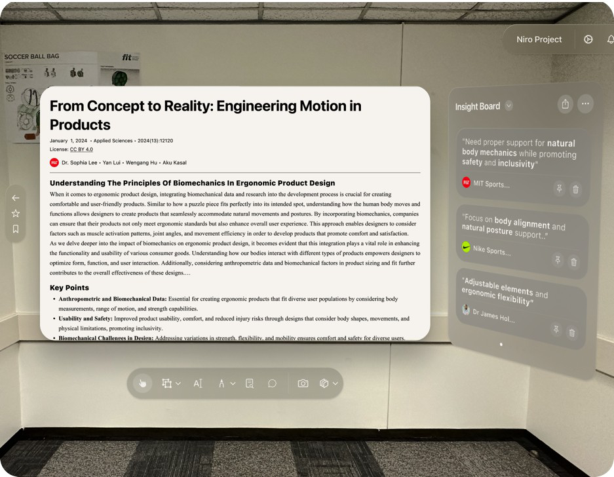
Figure 1: Screenshot of SPACIAL App prototype for Apple Vision Pro. 2024. Own work.
INSPIRATION SEEKING: REFERENTIAL RESEARCH The referential research feature leverages advanced metadata extraction technology, eye-tracking, and gesture recognition to support research and ideation. This allows the users to interact with physical objects in 3D space, using them as contextual reference points for gathering relevant articles, images, and videos. The system enhances research by:
150 Narcisse and Kang
Recognizing physical objects to generate related digital resources.
Extracting materials, textures, and colors for further exploration.
Connecting users directly to research insights through interactive data.
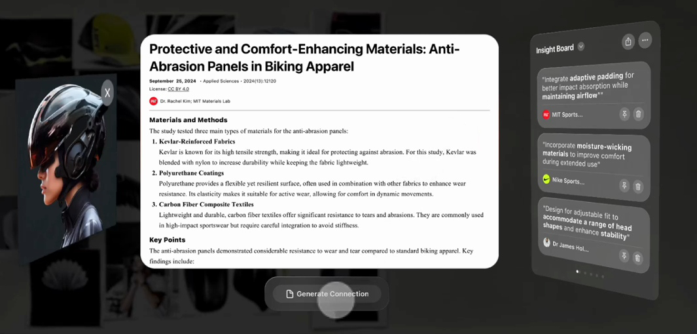
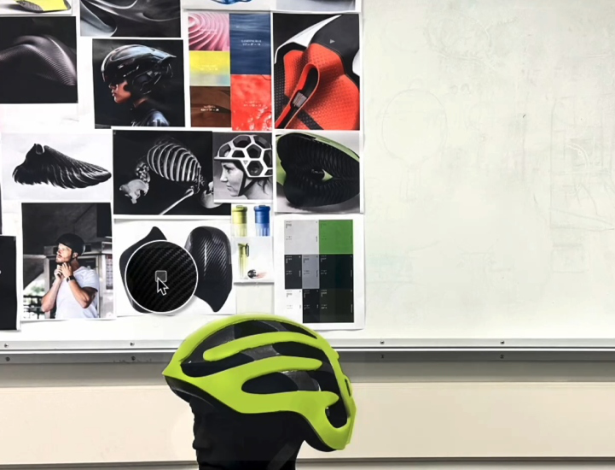
RELATED ARTICLES In this scenario, a user might be working with a physical artifact, such as a helmet, as a reference point for their Research. Using the referential research feature, the user can interact with the artifact through spatial mapping and metadata technology to help identify specific design elements on the helmet. They can use this to search for related articles, studies, or resources that provide deeper insights into the artifact’s components, form, manufacturing processes, and more. The user can then extract relevant insights from the Research and organize them on an insight board within their workspace. This enables them to connect the artifact and the research, tying specific insights to the reference point (Hossain et al., 2020).
Figure 2: Screenshot of related articles research feature in the SPACIAL App prototype. 2024. Own work.
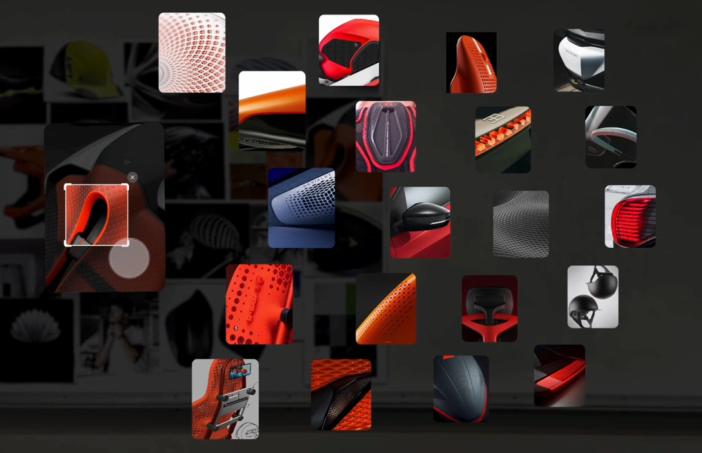
RELATED IMAGES The Image search mode addresses the challenges of inspiration gathering by leveraging APIs and advanced image recognition technology (Hossain et al., 2020). This feature allows users to highlight specific elements within an image, such as textures, colors, or forms, to generate related visuals and explore more profound, relevant content. Unlike traditional methods of endless browsing, this technology enables users to focus on inspiration that matters, maintaining connections between ideas as they zoom in and out to refine their creative direction. Users can seamlessly drag and drop images into digital mood boards and pin them dynamically within the workspace. This functionality enhances individual workflows and fosters collaboration, as teams can build on each other’s inspirations.
Reshaping Creative Workspaces: Leveraging the Transformative Power 151
Figure 3: Screenshot of related images research feature in the SPACIAL App prototype 2024. Own work.
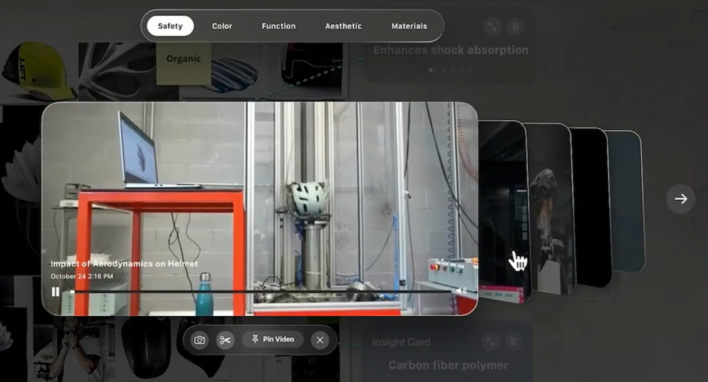
RELATED VIDEOS From categories like CMF (Color, Material, Finish) to manufacturing processes, users can search for relevant content, snapshot key moments, and dynamically pin them in 3D space. These videos serve as visual aids for presenting complex ideas, such as assembly processes or manufacturing techniques, making them valuable tools for supporting projects and enhancing understanding across teams.
Figure 4: Screenshot of related videos feature in the SPACIAL App prototype 2024. Own work.
152 Narcisse and Kang
APPLYING INSPIRATION IN REAL-TIME This feature lets users immediately apply what inspires them and instantly preview materials in context, bridging the gap between ideation and execution. Traditional practices often require 3D modeling, rendering, or creating physical prototypes to test ideas and materials in real-time, which can be time-intensive. Using spatial mapping technology, materials, colors, and textures can be digitally manipulated and projected onto surfaces or objects, constrained to dimensions for accurate visualization. This could provide users a more interactive and tangible way to explore and view concepts in real time. This functionality ensures that users never lose that spark of inspiration, allowing them to capture and apply ideas in the moment.
Communicating ideas and gathering feedback can often be challenging. However, the sketching-over-objects feature provides a solution by enabling users to provide real-time annotations and visual communication. This feature could be extremely helpful in ensuring that everyone is aligned with precise, real-time visual feedback directly on the object. While current hardware, such as the Apple Vision Pro, does not yet fully support this feature, due to the state of current gestural technology, advancements in XR technology and hardware like Meta Quest controllers demonstrate the potential to bring this functionality to life.
Figure 5: Screenshot of applying inspiration in real time feature in the SPACIAL App prototype 2024. Own work.
CONCLUSION
This research has demonstrated the transformative potential of spatial computing in redefining the creative workspace. By seamlessly integrating digital and physical interactions, spatial computing enhances inspiration
Reshaping Creative Workspaces: Leveraging the Transformative Power 153
gathering, ideation, and collaboration, addressing the inefficiencies of traditional work environments. This new paradigm can empower users to explore ideas in innovative ways. The next development phase will refine the application to align with specific vertical use cases to maximize its impact.
The study’s development of a spatial computing-based workspace highlights the immediate benefits of this technology: expanding creative possibilities, improving workflow efficiency, and fostering seamless collaboration among design professionals. Through real-time interaction with digital and physical objects, users can more naturally iterate and refine ideas, making spatial computing a valuable tool for modern design workflows.
While this research focuses on spatial computing’s present capabilities, future developments may further enhance its impact. AI-driven features could support adaptive workflows, provide intelligent recommendations, and optimize ideation processes. However, spatial computing’s core value lies in its ability to break down traditional barriers and enable dynamic, flexible workspaces that align with the evolving needs of creative professionals.
As spatial computing continues to evolve, its integration into creative industries will be essential for redefining the way designers conceptualize, collaborate, and innovate. These innovations highlight the importance of combining technology and design to push the boundaries of what creative workspaces can achieve, paving the way for a new era of digital-physical collaboration.
REFERENCES
Augmented and Virtual Reality Market Size, Share, Industry Trends and Growth Analysis 2032. (2024, October 11). MarketsandMarkets. https:// www.marketsandmarkets.com/Market-Reports/augmented-reality-virtual- reality-market-1185.html Donald M. Rattner, A. (2017, June 30). How to use the psychology of space to boost your creativity. Medium. https://medium.com/s/ how-to-design-creative-workspaces/how-to-use-the-psychology-of-space-to- boost-your-creativity-4fe6482ef687 Hossain, N. Z., Jenia, T. N., Rahman, M. S., Anonta, S. H., & Hasan, K. T. (2020).
A Context-Based Searching Technique by Extraction and Fusion of Metadata of Digital Photos. Metadata for Image Search and Discovery/. https://doi.org/ 10.1145/3377049.3377061 Kharkar, S., Sabde, P., & Kharkar, S. & Sabde, P. (2023). Exploring the role of sensory input in creative thinking. The International Journal of Indian Psychology, 11(2). https://doi.org/10.25215/1102.087 Mapping the future of spatial computing. (2024, May 3) Esri. www.esri.com/about/
newsroom/blog/mapping-spatial-computing/ Oppezzo, M., & Schwartz, D. L. (2014). Give your ideas some legs: The positive effect of walking on creative thinking. Journal of Experimental Psychology Learning Memory and Cognition, 40(4), 1142–1152. https://doi.org/10.1037/ a0036577 Slepian, M. L., & Ambady, N. (2012). Fluid movement and creativity. Journal
of Experimental Psychology General, 141(4), 625–629. https://doi.org/10.1037/ a0027395
154 Narcisse and Kang
Torrendell, H. (2024, March 29). Spatial Computing: A Complete guide. Treeview Studio Blog. https://treeview.studio/blog/spatial-computing-complete-guide/ Virtual Reality & Flow: Exploring VR’s impact on Flow states. (n.d.). https://www.novobeing.com/blog/virtual-reality-and-flow-exploring-virtual- realitys-impact-on-peak-performance
LISTED IN THE AHFE DIGITAL BOOKSTORE CATALOGUE
Explore the complete digital volume
Interdisciplinary Practice in Industrial Design
Read this individual research paper free through the original publisher, or explore the full digital proceedings book.
ISBN 978-1-964867-59-5
Explore this ISBN in the AHFE Bookstore ↗Listed in the July 2026 bookstore catalogue; search by ISBN to confirm current availability · Digital book purchase optional