Min Kang, Suochun Fang (2024). An EV Charging UX Design Exploration for Broader Distribution of Level 2 Charging System with Improved User Experience. In: Interdisciplinary Practice in Industrial Design. AHFE Open Access, vol. 144, pp. 112–121. https://doi.org/10.54941/ahfe1005123
The growth of the Electric Vehicle (EV) market has led to the development of an efficient and user-friendly charging infrastructure. This paper evaluates the current public EV charging infrastructure growth landscape. It identifies a gap in accessibility and convenience due to their limited number and geographical concentration, mainly with Level 3 DC fast chargers. As an alternative, the paper proposes a strategy focusing on the widespread distribution of Level 2 charging systems, incorporating User Experience (UX) design principles to enhance accessibility and ease of use. The strategy suggests equipping all EVs with portable Level 2 chargers and increasing the availability of low-cost charging ports in diverse parking locations, thus integrating charging into daily routines. The innovative unibody design of the portable Level 2 charger, combined with the deployment of more AC power outlets and the introduction of digital technology for real-time charging status and control, aims to improve convenience and charging efficiency. Furthermore, the paper advocates a dual-track approach, maintaining Level 3 DC fast chargers for long journeys while promoting Level 2 solutions for everyday use. This integrated approach seeks to address current infrastructural limitations and foster a more sustainable, user-friendly, and widely accessible EV charging network, thereby accelerating the adoption of EVs and contributing to environmental sustainability.
The EV market is rapidly growing as technology has advanced, and con- sideration of the environment has increased. Efficient and user-friendly EV charging infrastructure is vital for growth (Borlaug et al., 2023; Pardo-Bosch et al., 2021). Multiple charging options are available based on the environ- ment and needs, including residential areas, workplaces, and public spaces. The user experience of EV charging plays a significant role in the widespread adoption of EVs (Mastoi et al., 2022). The existing trajectory focuses on Level 3 DC fast chargers that provide rapid charging. However, they are often
An EV Charging UX Design Exploration for Broader Distribution 113
limited in number and geographically concentrated. They also require signif- icant power and infrastructure investments, often making them less feasible for expansive deployment covering all geographical areas, especially in res- idential or urban settings (LaMonaca & Ryan, 2022). This has created a gap in accessibility and convenience for many potential EV users. This study proposes a design concept of a Level 2 charging system that helps the charg- ing activities streamline users’ daily routines with enhanced user experience. Implementing this strategy could accelerate EV adoption by addressing the current limitations of charging infrastructure on daily uses and a dual-track approach with a Level 3 DC fast charger specific for long-trip use cases.
EV CHARGER TYPES: LEVEL 2 AND LEVEL 3 CHARGERS Two types of EV chargers are mainly used based on the different user require- ments and needs: AC Level 2 chargers and Level 3 DC fast chargers. Level 2 chargers are primarily used in residential and some commercial places. They operate on a 240-volt AC supply and typically provide 12 to 80 miles of range per hour of charging. They balance charging speed and energy effi- ciency, making them a practical solution for overnight charging or top-ups during work hours. Level 2 chargers are valued for their convenience and cost-effectiveness, as they leverage existing electrical infrastructure and offer a moderate charging pace that suits daily commuting patterns. Level 3 DC fast chargers deliver a direct 480-volt DC supply to the battery, which signif- icantly reduces charging times. They can provide up to 100 miles of range in 10 minutes, making them perfect for quick on-the-go charging during long trips. However, the high installation and maintenance costs and demanding power requirements are the obstacles to widespread. Regardless of whether it offers Level 2 or Level 3 chargers, the current public charging system has some unfulfilled needs. Users face the challenge of finding charging sta- tions that are too far apart from each other, which results in extra time and effort spent looking for them. Additionally, these chargers need more frequent maintenance. This results in users having to wait longer for their vehicles to charge, which hinders their ability to make the most of their parking time.
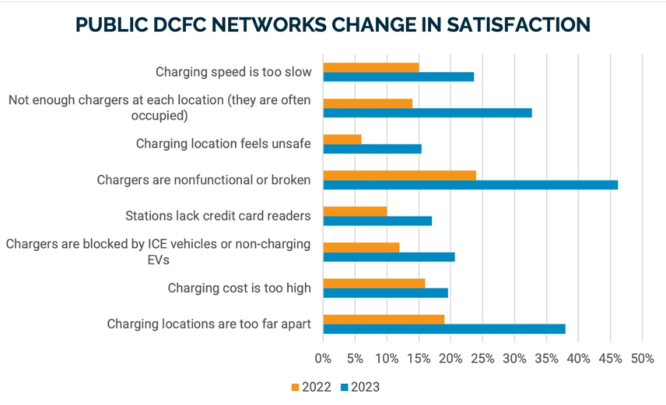
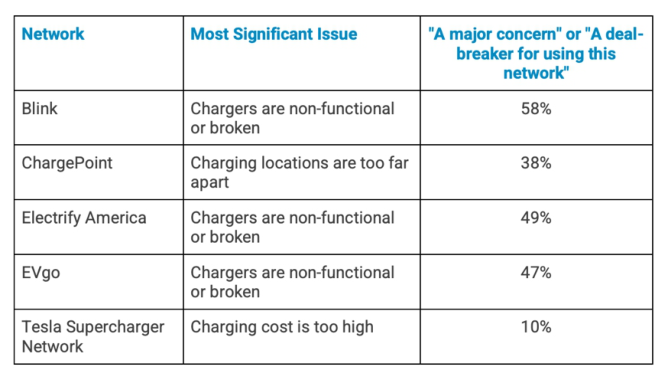
EV Owner Survey: Pain Points and References Plug In America conducted a survey, 2023 EV DRIVER SURVEY (O’Connor et al., 2023), among 3,300 EV owners, compared with responses collected in 2022. Under the comparison, it is shown that the satisfaction of level 3 charg- ing is dropping, and the major problems, including over-separated location, insufficient charging equipment, and broken/non-functional chargers, still need to be solved, leading to an increased number of complaints (Figure 1). Those problems are usually considered “major concerns” or “dealbreak- ers for using this network” for the major service providers except Tesla (Figure 2).
In the newest research report from Shell’s survey, EV Driver Survey Report 2023 (Shell Recharge, 2023), among EV owners, nearly half (49%) of drivers would choose where to shop and travel based on the availability of charge points, and 57% said they would visit destinations more frequently if they
114 Kang and Fang
had charge points. It is pointed out as an “untapped opportunity”that drivers are more willing to base their decision on where they will have a more enjoyable experience at those destination sites.
Figure 1: EV owners’ complaints to existing DC fast charging networks (O’Connor et al., 2023).Figure 2: The most significant issue for major networks in the united states (O’Connor et al., 2023).
A similar idea was also reflected in the report, EV Consumer Behavior, published by the Electric Vehicle Council in 2021 (Electric Vehicle Council, 2021). The majority of EV owners support having a charging station where they would spend more extended periods of time anyway: shopping malls, airports, commuter lots, and downtown parking lots with easy access to a variety of venues.
An EV Charging UX Design Exploration for Broader Distribution 115
LEVEL 2 CHARGING SYSTEM CONCEPT On the one hand, from the research, it can be concluded that the major pain point for EV owners is the lack of access to functional charging equipment, and this problem needs to be solved when service providers implement level 3 charging stations. On the other hand, it is a well-known fact that vehicles are parked about 95% of the time (Morris, 2016). This long parking time presents an excellent opportunity to integrate EV charging while parking into daily routines because it fits the user’s preference for “destination sites.” To achieve this, a proposed solution is to adopt portable level 2 chargers for all EVs and increase the number of accessible charging ports across a broad range of parking locations. This setup will improve the EV charging user experience significantly by maximizing parking time to charge.
This concept aims to provide a seamless experience with a system for users by utilizing the time when their vehicle is parked. A system design concept has been proposed that includes numerous accessible electricity outlets in parking places and portable chargers in every EV. The system is implemented in such a way that the facilities only provide the outlets while the users bring their own chargers. This approach helps to reduce the cost of implementation and maintenance and speeds up the disposition of the system. Users can use portable chargers to charge their devices wherever they park their vehicles, such as in their home garage, workplace, or public parking lots.
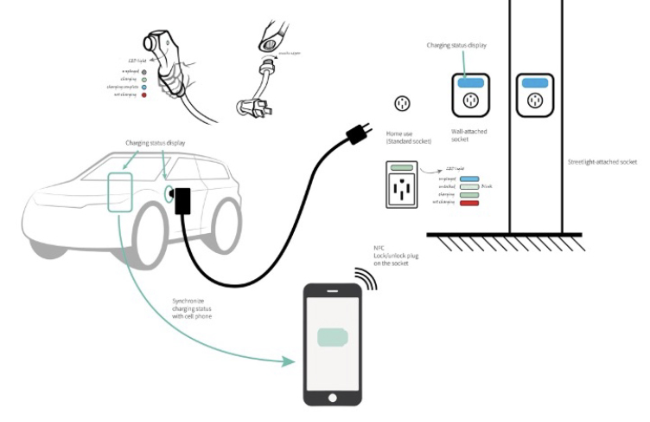
The user-centric aspect of this concept encompasses several key compo- nents: A mobile application offering users control over the charging process and access to comprehensive information and a portable level 2 charger with a single-unit body design to enhance usability and security. Various charging port designs are also proposed to accommodate different parking environments (Figure 3).
Figure 3: Level 2 charging system with portable level 2 charger, outlets, and mobile app.
116 Kang and Fang
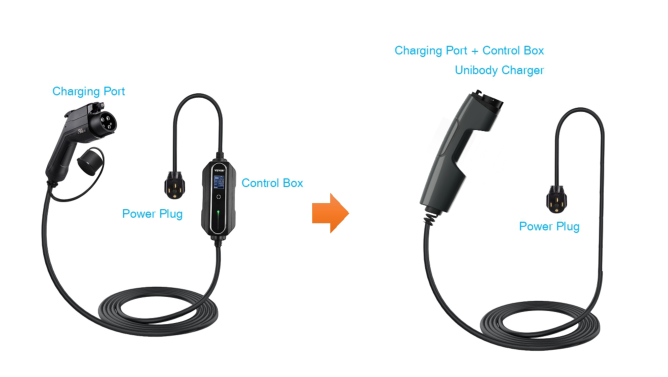
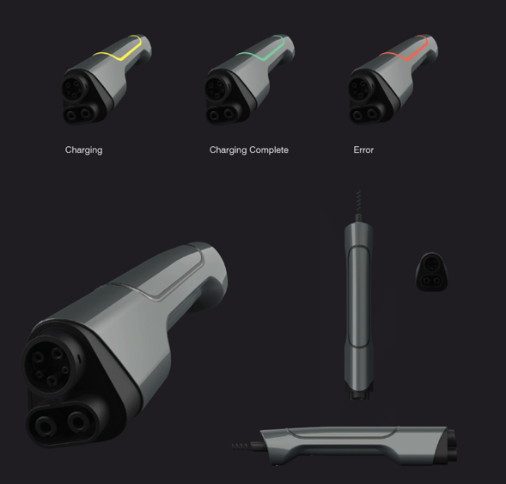
Unibody Level 2 Portable Charger Design To successfully perform the charging, a portable level 2 charger is a necessity in every EV. This will allow users to charge at public places, including garages, street parking, and shopping malls. The current level 2 portable charger com- prises a charging port, control box, and power plug. The new design suggests a unibody charger that combines a control box and a charging port (Figure 4).
Figure 4: Current portable level 2 charger and proposed concept.
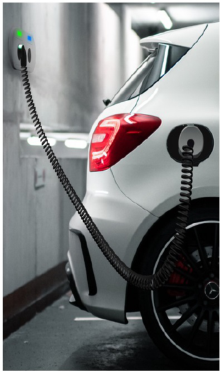
A spiral cable with a power plug has been incorporated in the second ver- sion of this design (as shown in Figure 5). It is placed at an elevated position above ground level to ensure the cleanliness and organization of the space. This arrangement improves tidiness and eliminates the need to roll up the cable after use, simplifying the storage process.
Figure 5: Portable level 2 charger with coiled cable: The second version.
An EV Charging UX Design Exploration for Broader Distribution 117
The unibody charger incorporates indicator lights on the housing surface to provide users with immediate visual feedback (as shown in Figure 6) upon device connection.
Figure 6: Design of the level 2 charger.
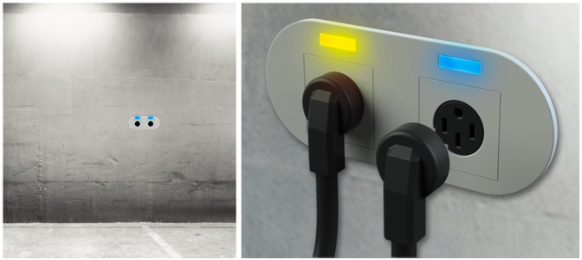
More AC Power Outlets in Parking Places The Level 2 charging system has a primary component: installing large out- lets in different parking areas, such as public parking lots, parking garages, and street parking. Indoor parking facilities require dedicated charging units between each parking bay (Figure 7). These units have two outlets and corre- sponding indicator lights that match the charger’s indicator light. This feature provides EV owners with clear visual cues about the charging status.
Figure 7: The concept of power outlets in garage parking places.
118 Kang and Fang
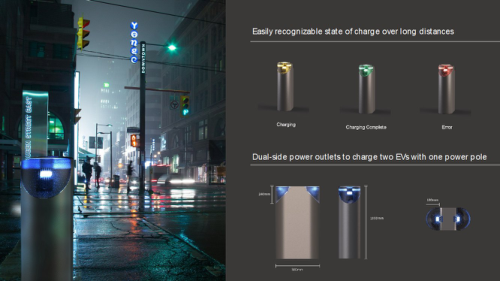
Outdoor parking areas feature a charging pole housing two charging outlets and corresponding indicator lights to convey charging status infor- mation to EV owners (Figure 8). The protective shell on both sides of the charging infrastructure is secured. It can be unlocked through a mobile appli- cation, thereby safeguarding power transmission from potential sabotage and adverse weather conditions such as rain.
Figure 8: The design concept of power outlet poles in street parking areas.
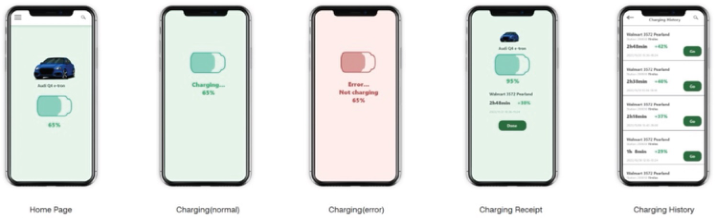
Real-Time Charging Status on Smartphone The first and foremost feature of the mobile app is to offer users easy access to their current charging status from their phones anytime and anywhere. This eliminates any concerns users may have when utilizing the time when the vehicle is parked. They can also view their charging history to understand their charging patterns better. Besides, users can search and select their pre- ferred charging location. The user has complete control over their account and can add or remove vehicle information as needed. To encourage their use, users receive positive feedback on how efficient they have become by utilizing their parking time.
Figure 9: Real-time status checking on the mobile app.
Integrating digital technology, such as app-based control, real-time avail- ability, and automated billing systems, simplifies the charging process and enables efficient energy management. This is crucial in ensuring that the
An EV Charging UX Design Exploration for Broader Distribution 119
increasing demand for electricity due to EV charging does not overload power grids. By incorporating these features, the charging process becomes more streamlined, and energy usage can be managed more effectively.
DUAL TRACK APPROACH OF LEVEL 2 CHARGER WITH LEVEL 3 DC FAST CHARGERS The dual-track approach, integrating Level 2 and Level 3 chargers, is critical for a versatile and practical EV charging infrastructure as both are needed for each use case and scenario. It caters to diverse user requirements, balancing the need for rapid charging with strategically placed Level 3 chargers dur- ing long trips and convenient, energy-efficient charging widespread, readily accessible Level 2 chargers for everyday use. Providing accessible charging options for user convenience can promote EV adoption by alleviating the anxiety of running out of charge far from a fast charging station, a signifi- cant barrier to EV adoption. The ubiquity of Level 2 chargers can integrate EV charging seamlessly into everyday life. They work, shop, or relax at home without going out of their way to find a fast charging station. This compre- hensive network can make switching to an EV more appealing to a broader range of consumers.
Promoting the use of Level 2 chargers more daily will also help vehicles’ battery health. Regular use of Level 3 DC fast chargers can reduce the lifespan of EV batteries due to the heat generated during the rapid charging process (Tomaszewska, 2019). Level 2 chargers provide slower charging and are gen- tler on the battery. The more integrated charging solutions are incorporated into daily routines, the healthier the battery will be, resulting in a more sustainable approach to increasing the product’s lifespan. This dual-track approach offers a comprehensive solution that meets a broad spectrum of needs, ensuring a flexible, user-friendly, and sustainable charging ecosystem.
Potential Issues and Challenges While innovative, the proposed strategy for expanding the EV charging infrastructure focusing on Level 2 systems and user experience design faces several challenges. Infrastructure and cost implications, technological and logistical constraints, user adoption, and behavioral changes present signifi- cant hurdles. Environmental and energy considerations must account for the increased demand for power grids and ensure sustainability. Equity and acces- sibility issues raise concerns about the even distribution of charging facilities, potentially exacerbating disparities in urban versus rural access. Furthermore, the strategy must remain adaptable to future technological advancements in EV charging to ensure long-term relevance and effectiveness. Address- ing these challenges is crucial for successfully implementing a user-centered, environmentally sustainable, and widely accessible EV charging network.
CONCLUSION
This study critically evaluates the current landscape of public EV charging infrastructure. It identifies significant gaps in accessibility and convenience,
120 Kang and Fang
particularly with the limited number and geographical concentration of Level 3 DC fast chargers. In response, it introduces a comprehensive strategy emphasizing the widespread distribution of Level 2 charging systems, inte- grating them into daily routines, and enhancing the user experience through innovative design and digital technology. The study underscores the impor- tance of a dual-track approach, strategically maintaining Level 3 DC fast chargers for long journeys while promoting Level 2 solutions for everyday use to create a flexible, user-friendly, and sustainable charging ecosystem.
The proposed strategy includes equipping all EVs with portable Level 2 chargers and enhancing the availability of low-cost charging ports in diverse parking locations. This approach is not only cost-effective but also user-centric, as it leverages the significant parking time of vehicles, thereby integrating charging seamlessly into the users’ daily lives. The concept of a unibody portable Level 2 charger, complemented by deploying more AC power outlets and integrating digital technology for real-time charging sta- tus and control, is a forward-thinking solution that addresses the need for convenience, efficiency, and a streamlined charging process.
Moreover, the paper highlights the role of a dual-track charging infrastruc- ture in promoting EV adoption. The ubiquity of Level 2 chargers caters to everyday needs, integrating charging into daily activities such as work, shop- ping, or leisure without the need for special trips to fast charging stations. This addresses range anxiety and promotes the health of EV batteries by pro- viding a gentler charging process compared to the rapid charging of Level 3 DC fast chargers. At the same time, maintaining a network of Level 3 charg- ers ensures that the needs of long-distance travelers are met, offering a quick and efficient charging solution for longer journeys.
In conclusion, this study presents a holistic approach to enhancing the EV charging infrastructure. It does not merely propose a technological advance- ment but advocates for a user-centered design and a strategic deployment that aligns with the lifestyle and needs of EV users. By addressing the current infrastructural limitations and focusing on the integration of charging into daily routines through accessible and efficient Level 2 charging solutions, the proposed strategy aims to accelerate the adoption of EVs, contribute to envi- ronmental sustainability, and foster a more sustainable, user-friendly, and widely accessible EV charging network.
REFERENCES
Borlaug, B., Yang, F., Pritchard, E., Wood, E., & Gonder, J. (2023). Public electric vehicle charging station utilization in the United States. Transportation Research Part D: Transport and Environment, 114, 103564. Electric Vehicle Council. (2021). EV Consumer Behavior, June 2021. Fuels
Institute. https://www.transportationenergy.org/Research/Reports/EV-Consume r-Behavior/ LaMonaca, S., & Ryan, L. (2022). The state of play in electric vehicle charging services – A review of infrastructure provision, players, and policies. Renewable and Sustainable Energy Reviews, 154, 111733. Mastoi, M. S., Zhuang, S., Munir, H. M., Haris, M., Hassan, M., Usman, M.,
Bukhari, S. S. H., & Ro, J. (2022). An in-depth analysis of electric vehicle charging station infrastructure, policy implications, and future trends. Energy Reports, 8, 11504–11529.
An EV Charging UX Design Exploration for Broader Distribution 121
Morris, D. Z. (2016). Today’s cars are parked 95% of the time. http://fortune.com/ 2016/03/13/cars-parked-95-percent-of-time/ O’Connor, P., Malmgren, I., Perkins, L. (2023). 2023 EV DRIVER SURVEY. Plug In
America. https://pluginamerica.org/survey/2023-ev-driver-survey/ Pardo-Bosch, F., Pujadas, P., Morton, C., & Cervera, C. (2021). Sustainable deployment of an electric vehicle public charging infrastructure network from a city business model perspective. Sustainable Cities and Society, 71, 102957. Sanguesa, J. A., Garrido, P., Martinez, F. J., & M., J. (2021). A Review on Electric
Vehicles: Technologies and Challenges. Smart Cities, 4(1), 372–404. Shell Recharge. (2023). EV Driver Survey Report 2023. https://shellrecharge.com/en -gb/solutions/knowledge-centre/reports-and-case-studies/ev-driver-survey-report Tomaszewska, A., Chu, Z., Feng, X., O’Kane, S., Liu, X., Chen, J., Ji, C., Endler,
E., Li, R., Liu, L., Li, Y., Zheng, S., Vetterlein, S., Gao, M., Du, J., Parkes, M., Ouyang, M., Marinescu, M., Offer, G.,... Wu, B. (2019). Lithium-ion battery fast charging: A review. ETransportation, 1, 100011.
LISTED IN THE AHFE DIGITAL BOOKSTORE CATALOGUE
Explore the complete digital volume
Interdisciplinary Practice in Industrial Design
Read this individual research paper free through the original publisher, or explore the full digital proceedings book.
ISBN 978-1-964867-20-5
Explore this ISBN in the AHFE Bookstore ↗Listed in the July 2026 bookstore catalogue; search by ISBN to confirm current availability · Digital book purchase optional