Xue Dong (2024). Effective Approaches of Interdisciplinary Collaboration In the Foundation Design Course. In: Interdisciplinary Practice in Industrial Design. AHFE Open Access, vol. 144, pp. 122–129. https://doi.org/10.54941/ahfe1005124
Educators across disciplines increasingly acknowledge the significance of interdisciplinary collaboration in today's educational context. In design education, this shift presents a challenge: to adapt pedagogies effectively for students to tackle evolving complexities. Consequently, there's a pressing need to enhance training in design foundation curricula. Our study focuses on the redesign of a foundation design course to bolster teamwork among different disciplines. Through diverse collaboration modes such as warm-up workshops, peer evaluations, and interdisciplinary team projects, we aim to analyze the outcomes of multidisciplinary approaches within course projects. No matter what the collaboration type is, students are likely to be more involved and inspired through interdisciplinary collaborations, especially when facing complex topics. Our research demonstrates that integrating various collaboration methods within a single project, including teamwork, cross-sectional evaluations, and interdisciplinary external reviews, enhances students' capacity for innovation and critical thinking. Moreover, team projects and collaboration with peers, faculty, and external stakeholders foster positive sharing experiences and yield favorable outcomes in design education.
The evolving landscape of design, characterized by deepening connotations and expanding extensions, has ushered in increased complexity. Designers now face dynamic systems and challenges that require more collabora- tion across different disciplines. Feil (2013) underscores the necessity for designers to possess interdisciplinary collaboration skills, given the escalating complexity of artifacts. Design education, facing unprecedented challenges and opportunities, necessitates a paradigm shift in educators’ perspectives. Encouragingly, design education organizations such as AIGA (2018) and CIDA (2018) acknowledge these shifts, emphasizing interdependent rela- tionships within larger systems. The past few decades have seen a surge in studies by Friis (2015), McDermott (2014), and Moron (2010) on diver- sity and interdisciplinary learning in design education. McDermott highlights that interdisciplinary collaboration allows students to apply their disciplines
Effective Approaches of Interdisciplinary Collaboration in the Foundation Design Course 123
while integrating disciplinary expertise (McDermott, Boradkar & Zunjar- ward, 2014). Interdisciplinary collaboration benefits students, enhancing success after graduation through effective teamwork and communication and fostering soft skill diversity, thereby increasing competition among stu- dents (Mattioli, F., & Ferraris, S. D, 2019). More recently, as emphasized by Terenzini (2020), student learning often extends beyond solitary activities to encompass engagement with peers and mentors. Terenzini suggests that challenges encountered within group settings, such as adopting or reject- ing peer group values, attitudes, and behaviors, contribute significantly to student growth. The higher the level of engagement, the greater the edu- cational benefit. However, integrating interdisciplinary collaboration into the entry-educational period, especially in design foundation course, will encounter challenges such as many varieties of cross-discipline language bar- riers, production losses, coordinating multiple team settings/stakeholders, clearly assigning tasks, and leveraging their individual respective strengths and biases.
Recognizing this evolution and challenges, the College of Architecture and Design reframed the course of “Basic Design I/II” course for first-year stu- dents with different design disciplines. The new course module emphasizes a conceptual process, enhancing teamwork between different disciplines from varies levels of engagement. Operated as a team-taught interdisciplinary cur- riculum, the course involves instructors from diverse backgrounds, such as architecture, interior design, industrial design, and graphic design. “Basic Design I” focuses on design thinking, introducing basic design principles and methods through observation and analysis. In contrast, “Basic Design II” involves making, and encouraging students to explore hands-on mate- rials through the making. Through a comparative discussion and analysis of various interdisciplinary collaboration approaches, this paper examines the efficacy of short-term workshops and peer evaluations in bolstering stu- dents’ self-awareness, decision-making abilities, and capacity for innovation and critical thinking.
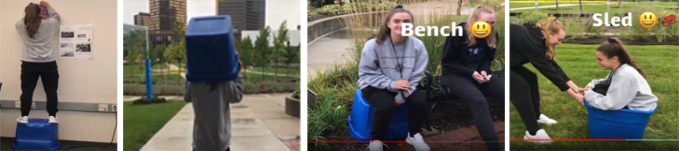
WARM-UP COLLABORATIVE WORKSHOP Warm-up workshops served as the initial step in the “Basic Design I” course, acquainting students with design thinking and making sequence to avoid over-abstract concepts and promoting participation in a large group. Ran- domly arranged collaboration teams facilitated quick interactions among students, considering both time limits and task scope. As an example, within the framework of the learning topics on reframing and abstraction, a one- hour workshop served as an introductory session for the entire class. Students were tasked with identifying common objects, such as umbrellas and keys, within the classroom. The challenge involved exploring alternative uses for these objects in different contexts. Each team showcased their innovative ideas through a 30-second video presentation to the entire class. Figure 1 illustrates a case where a team creatively repurposed a basket as a stool, raincoat, bench, and sled. In the researcher’s perspective, the brief interdis- ciplinary collaboration, constrained by simple tasks and time limitations, may not foster extensive student interaction. Nevertheless, it stands as a
124 Dong
robust approach for acknowledging diverse disciplines and aiding students in discerning their individual strengths and weaknesses.
Figure 1: Four different new use of the basket.
PEER EVALUATION/REVIEW ON INDIVIDUAL PROJECT The challenges associated with larger classes and reduced teaching ratios necessitate innovative approaches to providing feedback, especially in foun- dation design courses. Addressing this, peer evaluation offers a multifaceted feedback mechanism within the studio, as highlighted by Mandala (2016). Compared to individual evaluation, peer evaluation proves more enjoyable and yields advantages for both educators and students. Instructors gain insights into overlooked issues, fostering a more engaging class environment, while students are pushed to excel in innovation and enhance their communi- cation skills. The following examples highlight how peer evaluation enhances individual decision-making in a project by integrating diverse thinking styles to effectively address design challenges.
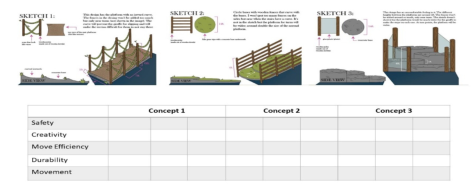
In the design studio, peer evaluation is a common practice that extends beyond project completion, encompassing concept development, ideation, mock-ups, and prototypes to ensure the design’s alignment with objec- tives. In the “Animal Stair Design” project (4 weeks), students collabo- rate on redesigning stairs based on animals’ walking and moving habits. Early ideation/sketch phases involve peer evaluation, with each student pre- senting their own three designs and receiving feedback on the criteria of safety, efficiency, durability, movement, shape/form interest, and alignment with the environment (Figure 2). This feedback guides the finalization of designs by combining strengths and addressing criticisms. Peer review discus- sions enhance learning in sketch techniques, problem-solving, and creativity, contributing to individual skill development and refining design solutions.
Figure 2: Sketch evaluation form of giraffe animal stair design.
Effective Approaches of Interdisciplinary Collaboration in the Foundation Design Course 125
The “Design for the Body” project, a two-week initiative, featured peer evaluation during its middle development phase. Students engaged in creating objects or forms for the human body, incorporating visual and multi-sensory interactions with mockups. Evaluation criteria focused on the form’s rela- tionship to the human body. Following a week of iteration, Each Student refined shapes by working on two full-scale cardboard mockups. Interdis- ciplinary peer reviews were organized, with each student utilizing a matrix to assess others mockups. Criteria encompassed form/shape interest, move- ment, safety, material, joint/connection, and quick-release, with additional considerations for specific design situations. Through this process, students addressed overlooked issues, and apply their toolbox and techniques to con- tribute to others. Examples of helmets (Figure 3) highlight interdisciplinary collaboration, demonstrating how varied skills enhance design elements across architecture, game art, and graphic design. Despite the brevity of short-term interdisciplinary collaboration, constrained by simple tasks and time limits, it remains a potent strategy for showcasing diverse disciplines and helping students recognize their individual strengths and weaknesses.
Figure 3: Helmet design of “design for body” project.
INTERDISCIPLINARY TEAM PROJECT The earlier discussion emphasizes the incorporation of peer evaluation dur- ing ideation and prototype phases in fostering interdisciplinary collaboration, particularly contributes to students’ self-awareness, influencing their final decision-making. However, this collaborative mode has, until now, been a designated part of the design process. What if we aspire to incorporate interdisciplinary collaboration seamlessly into the entire whole design? The author will delve into these considerations in the forthcoming paragraphs, presenting insightful thoughts on achieving a comprehensive integration.
As outlined by Feil (2013) in his research, the traditional design foundation projects focus on carefully crafted studies and training in visual communica- tion and execution of ideas. The typical process in “Basic Design I” projects involves divergent thinking techniques like mind maps and abstraction, fol- lowed by an iteration loop and convergent analysis to address problems. Compared with individual projects, team projects with interdisciplinary top- ics enable students to see and address the problems on an “advanced level” through comprehensive thinking and interdisciplinary collaboration (Wilson & Choi, 2013). The recent Future of Jobs Report (2018) predicts an increased demand for complex problem-solving and system skills in the next five years.
126 Dong
Consequently, there is a call for cross-case topics to solve comprehensive problems to align with this evolving landscape.
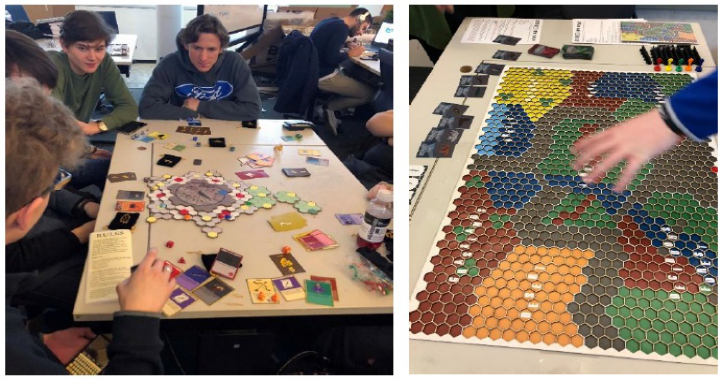
The Board Game project exemplifies the seamless integration of interdis- ciplinary collaboration and strategic assessment throughout the entire design process, encompassing graphic design, game design, product design, and spatial planning. The project emphasizes the necessity for a comprehensive approach, considering complex systems rather than isolated events or prob- lems currently imperative in professional design. In this four-week endeavor, seventy-five students were organized into interdisciplinary teams by faculty, the whole project had four primary phases, which activities were organized to support. The overarching objectives of the project were twofold: firstly, to foster a deep understanding of each other’s fields and disciplinary expertise among students, and secondly, to develop a shared language for collabora- tion and establish a set of agreements for collaborative activities. The project was divided into several phases: identifying opportunities and research, con- cept generation, prototype & play testing, and external review. Throughout all phases, both divergent and convergent thinking played pivotal roles in shaping and refining project outcomes:
Use both creative (divergent) and analytical (convergent) thinking styles to create the overall game concept or design specific gameplay elements.
Continuously refine the game by iterating, prototyping, and playtesting to gauge its effectiveness.
Following establishing game constraints, students brought forth their toolsets, fostering collaborative contributions. Progressing through the project, a fusion of diverse learning components yielded insightful observa- tions and positive results. Architecture students contributed spatial principles, 3D modeling, and 3D printing expertise. Game art students conducted thorough playtesting, iteratively refining and optimizing game rules. Simulta- neously, graphic design students enhanced visual aesthetics and meticulously designed the game’s packaging. This cross-disciplinary teamwork highlighted the efficiency gains achievable through collaboration, enriching students’ per- spectives. Throughout the project, students recognized the value of diverse disciplines in improving efficiency and broadening perspectives. Different project phases involved distinct interdisciplinary collaboration approaches, ranging from individual and paired work in the initial phases to cross-team collaborations in later stages. Cross-team anonymous reviews and external playtesting sessions enriched the final phase, promoting higher-level commu- nication skills and industry interaction. The assessment strategy employed in this project demonstrates a systematic integration with interdisciplinary collaboration. Learning activities, collaboration approaches, and assessment methods synergize seamlessly. Students undergo evaluation after each itera- tion through self-assessment within the team, faculty feedback as advisors, peer assessment as stakeholders, and professional judgment as judges. This comprehensive approach ensures a continual and authentic feedback loop, mirroring the dynamics of real-world experiences. Despite students’ high con- fidence in communication skills, persistent barriers hinder overall progress. Addressing discipline-related challenges requires timely guidance involving background information, empathetic capacity, and active learning. This
Effective Approaches of Interdisciplinary Collaboration in the Foundation Design Course 127
guidance supports effective communication across diverse disciplines and backgrounds. Class initiatives promoted open communication and question- ing within teams and with external members. Students noted that group work outside class hours facilitated sufficient communication toward achieving a shared mission.
Table 1. Activity and collaboration approaches process in board game project.
Divergent cloud ( mind map, SWOT) of board game theme, abstraction, and event
Team Discussion and Inside Team Collaboration
Phase1 Identifying Opportunities and Research
3 versions of board game design covering the following:
Elevator pitch and faculty feedback
Faculty Assessment as the advisor
Phase2 Concept Generation
Name, type, goal, principles
Target audience, Number of players
Layout, structure & rules
Visual graphics
Peer Assessment as Stakeholders
Prototype feedback and desk critics with faculty, play testing inside each section
Phase3 Prototype & Play Testing
Cross-section Collaboration Anonymous Evaluationss by Other Teams
By the professionals
Phase 4 External Review
Finished Board Game Design with rules, instructions, and package
Large Interdisciplinary Play Party College-wide Feedback
Figure 4: Board game playing testing.
128 Dong
CONCLUSION
In conclusion, this paper navigates through interdisciplinary collaboration modes in foundation design course, shedding light on their impact on stu- dent engagement and inspiration, particularly in the face of complex topics. Despite students’ communication confidence, persistent barriers underline the need for targeted guidance to overcome discipline-specific challenges.
The study showcases the effectiveness of short-term workshops and peer evaluations in enhancing students’ self-awareness and decision-making dur- ing the ideation and prototype phases. When multifaceted collaboration modes are mixed into one project (for example, working inside the team, cross-section evaluations, and interdisciplinary external reviews), students are more likely to demonstrate a higher degree of innovation and reflec- tive and critical thinking. However, they also need to address obstacles like discipline language barriers while leveraging individual creativity and skills.
Positive experiences in team projects with external collaborations highlight the advantages of comprehensive collaboration. The paper acknowledges the ongoing discourse on interdisciplinary collaboration and suggests potential extensions to collaborate with external stakeholders. Challenges in theme selection for the foundation design course prompt reflections on balancing creative freedom and establishing shared contexts for future course devel- opment. Furthermore, exploring partnerships with external stakeholders can enrich the educational experience, providing students with real-world insights and expanding the scope of collaborative endeavors in foundation design education.
REFERENCES
AIGA. (2017), AIGA Designer 2025, Why Design Education Should Pay Attention to Trends. AIGA Design Educators Community. Aug. 17, 2017. CIDA. (2018), Professional Standards 2018, Council for Interior Design Accredita-
tion Professional Standards. Jan. 2018. p. 17 Feil, M. (2013), Reinventing Classic Design Foundation Exercises to Incorporate the Exploration of Behavior and Interaction. Paper. Austin, TX: Industrial Designers Society of America Education Symposium, Aug. 18, 2014. McDermott, L. Boradkar, P. & Zunjarward, R. (2014), Interdisciplinary in Design
Education. Paper. Austin, TX: Industrial Designers Society of America Education Symposium, Aug. 18, 2014. Mandala, M. (2016), Peer Review in Design: Understanding the Impact of Collaboration on the Review Process and Student Reception. Retrieved Aug. 16th, 2016 from http://d-scholarship.pitt.edu/28637/1/m.mandala_main_final_8-16.pdf. Mattioli, F., & Ferraris, S. D. (2019). Self-evaluation and peer evaluation tool for
design and engineering teams: experiment conducted in a design studio. In DS 95: Proceedings of the 21st International Conference on Engineering and Product Design Education (E&PDE 2019), University of Strathclyde, Glasgow. 12th–13th September 2019. Moran, J. (2010). Interdisciplinarity. New York: Routledge. Terenzini, P. T. (2020). Rethinking Effective Student Learning Experiences. Inside Higher Education, 29.
Effective Approaches of Interdisciplinary Collaboration in the Foundation Design Course 129
Wilson, W& Choi, Y. M. (2013), Multi-disciplinary Design Education Improving Sponsored Studio Projects. Paper. Chicago, IL: Industrial Designers Society of America Education Symposium, Aug. 21, 2013. World Economic Forum (2018). The Future of Jobs Report 2018. Retrieved Sep. 17,
2018 from http://www3.weforum.org/docs/WEF_Future_of_Jobs_2018.pdf.
LISTED IN THE AHFE DIGITAL BOOKSTORE CATALOGUE
Explore the complete digital volume
Interdisciplinary Practice in Industrial Design
Read this individual research paper free through the original publisher, or explore the full digital proceedings book.
ISBN 978-1-964867-20-5
Explore this ISBN in the AHFE Bookstore ↗Listed in the July 2026 bookstore catalogue; search by ISBN to confirm current availability · Digital book purchase optional