Kimberly Mollo, Kyndra Adams, Andrew Berger, Eric Schneider, Tod Corlett (2022). Empowering Individuals with Limited Joint Mobility: An Embedded Interdisciplinary Program between Occupational Therapy & Industrial Design. In: Human Factors in Accessibility and Assistive Technology. AHFE Open Access, vol. 37, pp. 158–167. https://doi.org/10.54941/ahfe1001655
This paper highlights the third consecutive year of an ongoing, embedded interdisciplinary collaborative program between Occupational Therapy Doctoral (OTD) and Master of Industrial Design (design) students and faculty co-creating assistive devices that improve participation in tasks and activities for individuals living with Fibrodysplasia Ossificans Progressiva (FOP). FOP is a rare and progressive genetic disease, causing an individual's muscles, tendons, and ligaments to turn to bone, resulting in fixation and immobility. During the 9-month collaborative experience, OTD and design students co-conducted 2 sets of interviews with FOP clients identifying activities of daily living that were problematic secondary to individual disease course. OTD students administered the Canadian Occupational Performance Measure (COPM) to identify which daily routines and activities were impacted. Design students employed standardized questions to clarify how their activities were performed. Findings informed initial assistive device prototypes, which were then sent to FOP clients for user testing. After testing was completed, design students continued to prototype and conducted a second feedback interview. This program also included several interprofessional educational experiences designed by the OTD students for their design peers under occupational therapy (OT) and design faculty supervision. Content was created to reinforce FOP clients’ needs and was delivered through shared learning modules, activities, and peer-to-peer discussion. Weekly collaboration occurring in design coursework between disciplines and use of OT-related tools such as the COPM helped the design students leverage their skills by contextualizing what they observed when interacting with FOP clients, ultimately creating better products that met the needs of individuals with FOP. Findings presented include current data up to February 2022 from OTD and design interviews and FOP user feedback; data collection and prototyping will continue through May 2022. Outcomes demonstrated and reinforced the need for consistent, higher-level embedded interdisciplinary collaborative approaches that uniquely meet the needs of clients experiencing complex medical issues and help to expand the usability of assistive devices for other populations with complex issues.
Empowering Individuals with Limited Joint Mobility 159
INTRODUCTION
One out of every four individuals in the United States currently lives with a disability that affects engagement in everyday valued activities (Centers for Disease Control and Prevention, 2018). By promoting independence, assistive devices can be life-changing for individuals with disabilities. Manufactured assistive devices available on the market include dressing sticks, reachers, and built-up handled utensils that improve grip and provide an ability to bring items closer to the body, allowing for greater independence in daily activities such as dressing, grooming, and eating.
With approximately 900 individuals diagnosed worldwide, FOP is a rare genetic disease in which an individual’s muscles, tendons, and ligaments turn to bone through a process of heterotopic ossification (IFOPA 2021; Kaplan et al. 2021). Between childhood and early teen years, an individual begins to experience flare-ups in a progressive pattern starting in the neck and back, moving to the arms, hips, legs, and jaw, resulting in fixation. By middle to late adulthood, individuals with FOP become locked in awkward positions in which joint fusion occurred, limiting independence, and making daily acti- vities difficult to execute. While no device on the market will meet the needs of every unique individual, populations with more complex physical needs (such as FOP) need to add custom modifications with materials found around the home or hardware store to improve usability. Although the creativity of homemade solutions allows for engagement in valued activities, individuals with FOP deserve to have access to assistive devices that are functional and durable, as well as aesthetically appealing to meet their needs.
Collaboration between designers and occupational therapists (OTs) has demonstrated benefits for end-user experience by contextualizing client con- ditions, user-feedback, environmental influences, and performance in every- day activities (Wagenfeld et al. 2017; Young et al. 2019). OTs are licensed healthcare professionals who help individuals regardless of age or functional ability regain independence and achieve desired goals through meaningful tasks or activities that they need or want to do. OT interventions are achie- ved through a client-centered approach, empowering the individual to guide treatment with the understanding that they are experts in their lives. Thus, the OT intervention process and the user-centered iterative design process are synonymous, as both require a deep understanding of the individual and the environmental influences that impact participation in everyday lives. For this reason, OTs are well suited to assist designers in leveraging their skills, pro- viding contextualization and medical expertise for what is observed during task and activity engagement, resulting in the creation of better products that meet the end-user’s needs.
Interprofessional education experiences are a longstanding mainstay betw- een the occupational therapy and industrial departments at Thomas Jef- ferson University, an institution with strong connections to health care and design. For more than 20 years, these two departments have enga- ged in several ongoing interdisciplinary collaborative projects occurring at both the graduate and undergraduate levels, centered on creating assistive devices for assigned clients. In 2018, the university created an additional
continuous year-long, embedded interdisciplinary collaborative experience between Occupational Therapy Doctoral students (OTD) and Master of Industrial Design (design) students. Central to the current embedded inter- professional education experience is the collaborative assistive device design project for individuals with FOP. This paper explores the methodology and successes of the current FOP collaboration.
INTERDISCIPLINARY APPROACH TO PRODUCT DEVELOPMENT FOR LIMITED JOINT MOBILITY Studio Course
This year marks the fourth academic year of embedded OTD and design capstone experience and the third consecutive academic year of the FOP Col- laboration. In August 2021, 2 OTD students were embedded with 5 Master of Industrial Design students in a summer bootcamp introductory design course. From September through December 2021, OTD students presented various modules and engaged in activities with the design students and faculty during studio class time to enhance understanding of OT scope of practice and to help prepare the design students for upcoming interactions with FOP clients. Collaborative studio time also allowed the OTD students to enhance their knowledge of industrial design, the iterative design process, and understand materials, processing, and manufacturing.
Methods
The current iteration of the FOP Project resumed in November 2021. OTD students first introduced FOP and explained the disease process to the design students which led to a discussion of the disease’s impact on everyday activities. Students and faculty also virtually attended the Inter- national FOP Association (IFOPA) Family Gathering, an annual event in which members of the FOP community share information about assistive devices and learn about current developments in treating the condition. Here, students and faculty learned about homemade adaptations of “off the shelf” assistive devices, such as dressing sticks, reachers, and power wheelchair modifications. In December, OTD and design students colla- borated to contextualize the information learned at the gathering with the intent to inform future device creation. Project areas of interest were then identified by the IFOPA family services coordinator as concerns affe- cting many community members. These included everyday activities such as grooming, oral hygiene, feeding, reaching, and using personal electronic devices.
In January 2022, 2 OTD and 5 design students co-conducted interviews with members of the FOP community via the Canadian Occupational Per- formance Measure (COPM) and interview questions specifically developed by OT and design faculty. IRB approval was granted by university prior to all data collection. OTD and design students co-interviewed 11 individuals from the FOP community referred by the IFOPA community coordinator (8 individuals with FOP and 3 caregivers of individuals with FOP).
Empowering Individuals with Limited Joint Mobility 161
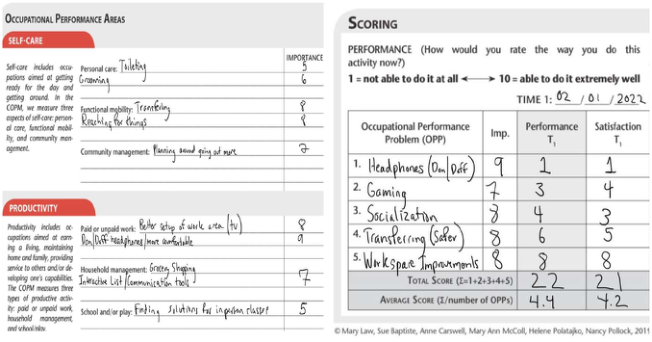
Figure 1: Example of COPM problem identification and rating form.
The COPM is a client-reported outcome measure traditionally used in occupational therapy practice to help inform intervention planning and reas- sessment following OT treatment in the areas of self-care, productivity, and leisure (Law et al. 1990) (Figure 1). For the FOP Project, design students observed the OTD student COPM interview process, which provided a point of entry to performance challenges in daily tasks and activities of the FOP cli- ents. Standardized reassessment with a tool such as the COPM can afford the opportunity to objectively evaluate the effectiveness of design prototypes, a methodology that is not traditionally used in the iterative process of product development (Schneider et al. 2019).
Following the administration of the COPM, the design students conducted a two-part interview with members of the FOP community. Part 1 focused on gaining information regarding how FOP clients currently engage in daily activities, including supports, barriers, and current device use. With informa- tion gleaned from both interviews, prototypes will be created and sent out for client testing (estimated March 2022). Design students will conduct a second interview (Part 2) to obtain user feedback as to how individuals with FOP use the device prototypes in their daily lives, and OTD students will complete a follow up COPM to determine change in performance and satisfaction in previously identified tasks and activities.
Iterations in Progress As of the end of February 2022, all students have completed the initial COPM and Part 1 of the design interviews with members of the FOP community and are preparing to send out the first round of device prototypes. Through early May 2022, students will continue to iterate assistive device designs and conduct Part 2 of the design and COPM interviews. Both sets of interviews are being analyzed via NVivo software by the OTD students to elicit themes. The remainder of this paper explores the current stage of the assistive device designs and demonstrates how collaboration with OTD students affected the iterative design process.
Figure 2: Mockup of oral hygiene tool with extended handle.
Faculty report ongoing interactions between OTD and design students are leading to creative and holistic designs for the designers, and design stu- dents are helping OTD students encounter the innovative range of possible solutions when designing assistive devices for clients via an understanding of materials and technological possibilities. Through embedded learning in studio, faculty note that students have improved interview skills regarding follow-up questions, language for disability etiquette and empathy, pre- paring them to effectively interpret information obtained from interviews and increase comfort with clients. Input from OTD students also assisted in incorporating aspects of equitable use from universal design. Disability simulation-style exercises, active listening, and minimizing personal assum- ptions are enriching the design process by helping students better understand the impact of locked positioning for FOP clients on engagement in daily activities.
Project Descriptions Oral Hygiene Device: Significant themes that emerged in the FOP interviews related to oral hygiene routines included 1) mobility restrictions in the arms, back, and neck that limit reach to the back of the mouth and 2) closed fixation of the jaw resulting in the inability to open the mouth to reach the backs of teeth. Current products are too large to adequately reach in between a fused jaw preventing clients from effectively cleaning their teeth, leading to dangerous levels of plaque buildup and related health complications. This device will fit into the jaw using a flexible head, can be contoured to the back of teeth via tongue, and will have an extended handle allowing for easy manipulation in the mouth (See Figure 2).
Personal Grooming Device: Fusion in the neck, back, shoulders, and elbows prevents reaching the top and the back of the head for individuals with FOP. The COPM indicated a desire for more independence in grooming, specifically hair brushing, while the design interviews detailed how current products are unsuitable due to limited grip and reach. The prototype handle allows for variability in arm position while affording greater control over the
Empowering Individuals with Limited Joint Mobility 163
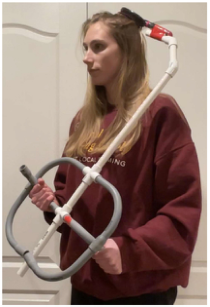
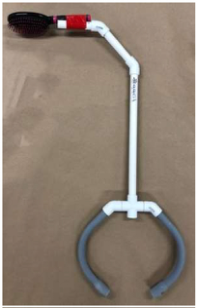
Figure 3a: Student demonstrating ability to reach back of head with reduced range of motion.Figure 3b: Prototype with updated compact handle configuration.
brush for more deliberate movements. An extendable shaft enables the brush to reach all areas of the head regardless of stature (See Figures 3a and 3b).
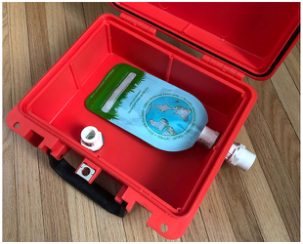
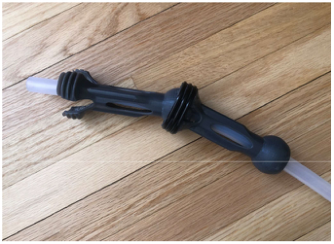
Power Straw: Fusing of the jaw and arms creates multifaceted difficulties with feeding, including getting food to the mouth effectively and types of food that can be consumed. The new device provides control over the rate and flow of food with a mechanical pump and extended straw, allowing for energy conservation when eating liquid or semi-liquid foods while being portable and discreet. Initially described as a “mechanical feeder,” current students reflected on the potentially stigmatizing language when presenting the project and worked to move to a more inclusive language of “power straw.” OTD students assisted in contextualizing and understanding information obtained from a speech and language pathologist to ensure the power straw is both a safe and effective method of food delivery (See Figures 4a and 4b).
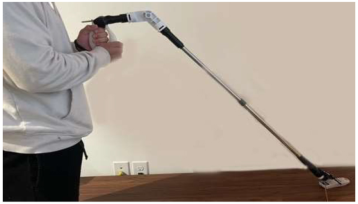
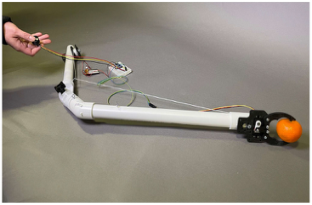
Electromechanical Reacher: Interview findings indicated difficulty in picking up fallen objects, leading to dependency on caregivers. Current mass- produced reachers and grabbers increase reach to retrieve objects but require extended grip strength to hold the handle and gross motor control to orient
Figure 4a: Pressurized storage case holding liquid-food pouch and space for electronic controls and motor.Figure 4b: Adjustable food delivery straw with see through connectors to identify blockages and ensure cleanliness.Figure 5a: Student demonstrating telescoping electromechanical reacher to grab object with joint at handle.
the device, which is difficult for FOP clients with severe mobility restricti- ons. An electromechanical reacher aims to reduce the effort needed to hold an object once it is picked up. A servo-claw at the end of the reacher will be controlled via a slider, improving the ability to grab items of various sizes. The range of fused positions in the FOP community requires reachers to be usable in varying positions, leading to introducing a joint at the handle allowing the shaft to move 180 degrees. FOP clients also emphasized the need for portability, which led to the designs incorporating a telescoping fea- ture or foldable joint of the shaft. Design students remarked that a better
Empowering Individuals with Limited Joint Mobility 165
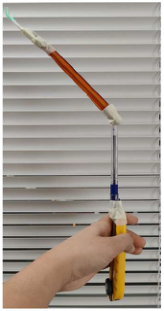
Figure 5b: Student demonstrating electromechanical reacher with foldable joint to grip orange (semi-extended position).Figure 6a: Arm mounted on wheelchair with electronics holder attachment.Figure 6b: Arm mounted on wheelchair with electronics holder attachment in alternate position.
understanding of user-centered and universal design concepts allowed them to effectively design the reacher to be useable by all members of the FOP community, regardless of fused positioning (See Figures 5a and 5b).
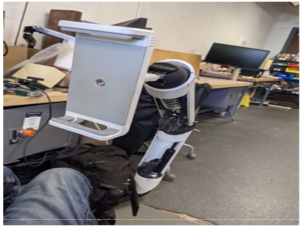
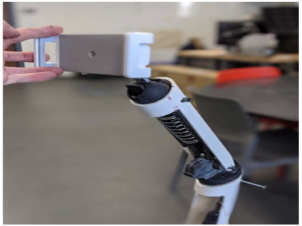
Wheelchair Electronics Mount: The wheelchair electronics mount was identified to improve the quality of interacting with electronics such as a mobile phone or tablet. Interview findings suggested that access to technology offers independence and connectedness, but restrictions in reach and upper body positioning limit usability. Available electronics holders on the market are bulky and hard to adjust and often require specific environmental positio- ning and assistance from a caregiver. An adjustable electronics mount allows for easier engagement and positioning when used or stored. Furthermore, the
wheelchair electronic mount enables individuals to use devices both in and outside of the home. Time spent collaborating allowed the design student to better understand how FOP clients desired to use their technology in their everyday lives, while the OTD students learned about how material choices impact the durability and adjustability of the device. (See Figures 6a and 6b)
CONCLUSION
The prototypes presented in this paper demonstrate improved product desi- gns resulting from collaboration between disciplines that emphasized the unique needs of individuals with FOP, the end-users of these specific products. The IRB-approved, co-conducted student standardized interviews provided structure and focus to understand the lived experience and context of indi- viduals living with FOP, and to frame the current issues in engagement with previously identified activities before jumping to a solution-oriented approach. Continual opportunities occurring during embedded coursework experiences strengthened the interdisciplinary collaboration between the stu- dents and led to rich discussions on the interview findings and contextualized information that led to different design approaches. Design students sta- ted that knowledge shared in the classroom brought greater empathy and fostered a deeper connection to the user. Design students were able to bet- ter understand the impact and value of their work and were motivated to develop highly useable products that positively impact the quality of life for the FOP community through improved activity and task engagement. OTD students, while familiar with homemade solutions for an individual client, learned and developed a deeper understanding of how the iterative design process creates effective and aesthetically pleasing devices that can be mass-produced and used by larger populations. Current designs presen- ted reflect work through February 2022; iterative processes and in-depth interview data analysis will continue until May 2022. User feedback will con- tinue to support overarching goals to provide working prototypes to the FOP community and, eventually, to build a case for manufacturing the products. To date, initial findings support and reinforce the need for continual, consi- stent, higher-level embedded interdisciplinary collaborative approaches, ones that meet the needs of clients experiencing complex medical issues which can further expand the usability of assistive devices for other populations beyond FOP.
ACKNOWLEDGEMENT
The authors would like to acknowledge the IFOPA, the FOP community, FOP Project volunteers, Karen Kirchhoff, Dr. Zvi Grunwald, Dr. Fre- derick S. Kaplan, Dr. Clive Friedman, Dr. Patricia Remshifski, Thomas Jefferson University Master of Industrial Design Students: Jennifer Hegelein, Maitri Doshi, Armando Ayala, Aaron Anderson, Justin Horst, and Monique Chabot.
Empowering Individuals with Limited Joint Mobility 167
REFERENCES
Centers for Disease Control and Prevention (2018). CDC: 1 in 4 US adults live with a disability [online]. Available from: https://www.cdc.gov/media/releases/2018/ p0816-disability.html [accessed 16 February 2022] International Fibrodysplasia Ossificans Progressiva Association (2022). What is
FOP? [online] Available from: https://www.ifopa.org/what_is_fop [accessed 16 February 2022] Kaplan FS, et al. The medical management of fibrodysplasia ossificans progressiva: current treatment considerations. Proc Intl Clin Council FOP 2: 1-128, 2021. Law, M., Baptiste, S., McColl, M., Opzoomer, A., Polatajko, H., & Pollock, N.
(1990). The Canadian Occupational Performance Measure: An Outcome Measure for Occupational Therapy. Canadian Journal of Occupational Therapy [online], 57(2), 82–87. Available from: https://doi.org/10.1177/000841749005700207. [accessed 16 February 2022]. Schneider, E., Corlett, T., Avery, M., Mollo, K., Brown, R., & Peterson, M. (2019).
Industrial design and occupational therapy: A lasting collaboration promoting meaningful design solutions. In: Industrial Designers Society of America Inter- national Design Conference, August, Chicago, IL [online], pp. 1–8. Available from: https://www.idsa.org/educationpaper/successful-immersive-educational-m odel [accessed 16 February 2022]. Wagenfeld, A., Reynolds, L., & Amiri, T. (2017). Exploring the Value of Interprofessional Collaboration between Occupational Therapy and Design: A Pilot Survey Study. The Open Journal of Occupational Therapy [online], 5(3). Available from: https://doi.org/10.15453/2168-6408.1354. [accessed 16 February 2022]. Young, D., Wagenfeld, A., & Rocker, H. V. V. (2019). Universal design and the built
environment: occupational therapy and interprofessional design teams—a scoping review. Annals of International Occupational Therapy [online], 2(4), 186–194. Available from: https://doi.org/10.3928/24761222-20190625-04. [accessed 16 February 2022].
LISTED IN THE AHFE DIGITAL BOOKSTORE CATALOGUE
Explore the complete digital volume
Human Factors in Accessibility and Assistive Technology
Read this individual research paper free through the original publisher, or explore the full digital proceedings book.
ISBN 978-1-958651-13-1
Explore this ISBN in the AHFE Bookstore ↗Listed in the July 2026 bookstore catalogue; search by ISBN to confirm current availability · Digital book purchase optional