Claudia Becchimanzi, Ester Iacono, Alessia Brischetto (2022). Acceptability of Assistive Robotics by Older Adults: Results from a Human-Centred Qualitative Study. In: Human Factors in Accessibility and Assistive Technology. AHFE Open Access, vol. 37, pp. 8–20. https://doi.org/10.54941/ahfe1001637
Laboratory of Ergonomics and Design (LED), Department of Architecture, University of Florence, 93 Sandro Pertini Street, 50041, Calenzano, Florence, Italy ↗
Assistive robotics provides a powerful solution for improving the quality of life of the elderly and frail people and will play a key role in the coming years as part of strategies for Ageing in place and Active and Healthy Ageing. If robots are going to be used by a large number of users, it is essential that they are accepted by as many people as possible. However, many of the assistive robots are designed with little consideration of the social, aesthetic, and emotional relationships that the elderly will experience when interacting with the product (Forlizzi et al., 2004). The acceptability of technology is a big issue, especially for elderly and frail people: the factors that influence it, and that also determine a positive User Experience, are many, as shown by the countless existing evaluation methods. Moreover, the acceptability of technology, in particular for elderly and frail users, is currently a delicate issue, whose evaluation criteria offer many challenges to design research. In fact, the interaction that users establish with assistive robots and all related technologies defines the very experience of aging. In this context, the Human-Centred Design and Ergonomics in Design approaches and methodologies can contribute to improve human-robot-digital technology interaction through the design of assistive robots according to people’s real needs and expectations.This paper presents the results of a survey conducted with primary and secondary users of assistive robots, with a focus on factors influencing robotic acceptability.The survey aims to collect quantitative and qualitative data about the relationship between people and robots, with a focus on beliefs, attitudes, preferences and use of such devices by users of different age and technological experience level. The survey aims to investigate users' attitudes, behaviors, beliefs and goals in relation to robots.The survey, conducted as an online questionnaire, is targeted at current and potential users of social and assistive robots. The questionnaire is addressed to a sample of users of both genders, aged between 18 and 99 years. The total sample surveyed is 272 people in Italy and 15 people in Europe. The survey includes a preliminary demographic analysis of users (age, robotic experience level, etc.) and then it investigates the beliefs, attitudes and behaviors towards assistive robots, and also the aesthetic and functional factors that may influence its acceptability.This research applies the scientific methods of Human-Centred Design and Ergonomics in Design (Stanton, 2014; Giacomin, 2014; Maguire, 2001) for qualitative investigation of older adults' preferences for assistive robots.The results provide an insight into how the acceptability factors of assistive robot tested in the literature actually relate to the preferences and attitudes of potential and current users. In addition, the results highlight the need for stronger involvement of stakeholders during the design phases of robots in order to promote a deeper understanding of those people’s needs and insights that cannot be collected by quantitative surveys. This study provides a groundwork for future researches in the Human-Robot Interaction and Human-Centred Design areas.
Assistive robotics provides a powerful solution for improving the quality of life of the elderly and frail people and will play a key role in the coming years as part of strategies for Ageing in place and Active and Healthy Ageing. If robots are going to be used by a large number of users, it is essential that they are accepted by as many people as possible. However, many of the assistive robots are designed with little consideration of social, aesthetic, and emoti- onal relationships that the elderly will experience when interacting with the product (Forlizzi et al. 2004).
The acceptability of technology is a big issue, especially for elderly and frail people: the factors that influence it, and that also determine a positive User Experience (UX), are many, as shown by the countless existing evaluation methods. Moreover, the acceptability of technology, in particular for elderly and frail users, is currently a delicate issue, whose evaluation criteria offer many challenges to design research. In fact, the interaction that users establish with assistive robots and all related technologies defines the very experience of aging. In this context, the Human-Centred Design (HCD) and Ergonomics in Design approaches and methodologies can contribute to improve human- robot-digital technology interaction through the design of assistive robots according to people’s real needs and expectations.
Acceptability of Assistive Robotics by Older Adults 9
This paper presents the results of a survey conducted with primary and secondary users of assistive robots, with a focus on factors influencing robo- tic acceptability. This study provides a groundwork for future researches in the Human-Robot Interaction (HRI) and Human-Centred Design areas.
RELATED WORKS The acceptability issue is investigated by several studies in robotics, some of them applying mixed methodologies to collect qualitative and quanti- tative data and to analyze this topic from a multidisciplinary perspective. Cesta et al. (2016) developed the ad hoc methodology “MARTA” (Multidi- mensional Assessment of telepresence RoboT for older Adults), to assess UX, attitude, behavior during interaction, acceptance, beliefs toward technology, and the long-term impact of daily use of a telepresence robot in a real-world setting. Šabanovi´c et al. (2015) investigated user preferences through use of Giraffplus 3 as an assistive robot during some participatory design worksh- ops with elders and caregivers. Coradeschi et al. (2014) developed Giraffplus according to the needs of 325 users collected through qualitative and quan- titative methods: workshops, focus groups and questionnaires. Mast et al. (2015) assessed the interaction between Care-O-Bot and 430 users (seniors and caregivers): the methodological process consisted of a first user needs analysis through focus groups and questionnaires and then of an ethnogra- phic study. The research confirms the effectiveness of the adoption of an iterative design process. Kertész et al. (2019) investigated how age, gender, cultural background, and personal characteristics affect people’s expectati- ons towards robots. Deutsch et al. (2019) conducted a qualitative study on 30 older adults to assess their attitudes and emotional responses towards dif- ferent types of robots. Lee et al. (2018) used pictures of several robots to test a new Human-Centred approach in HRI aimed at investigating how older adults perceive aging and assistive robots. The methods applied are interviews and collaborative maps. This is an excellent case study of a Human-Centered approach in robotics.
METHODOLOGY
This research applies the scientific methods of Human-Centred Design and Ergonomics in Design for qualitative investigation of older adults’ preferences for assistive robots.
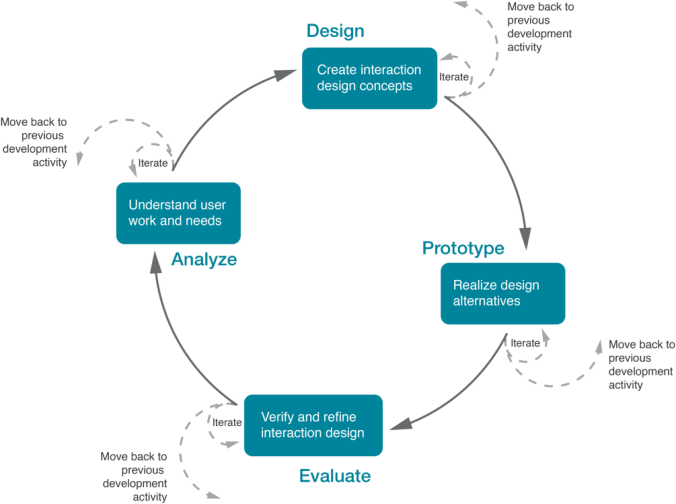
According to the HCD approach, there is difference between (1) collecting or consulting scientific data (e.g., anthropometric data, social data, statisti- cal data, etc.) to use as a guide for the project, (2) assessing the interaction (in terms of usability, pleasure of use, user experience, etc.), and (3) the glo- bal evaluation of the project. In fact, the HCD methods (Giacomin, 2014; Maguire, 2001) allow to conduct preliminary qualitative and quantitative research on users, to include them throughout the development process and the intermediate evaluation stages, and to assess factors such as usability and UX once the project is completed (see Figure 1). This difference is not so marked in the HRI area: in this field user research mainly refers to the
Figure 1: The iterative cycle of HCD and UX. Re-edited by Hartsonn & Pyla, 2012.
collection and consultation of scientific data (anthropometric, social, cultu- ral, but also related to opinions, preferences, attitudes) to be applied during the development of a robotic system, but very rarely it includes users in the design process or provides preliminary in-depth research on people’s needs and expectations. Therefore, HRI methods provide an assessment of multiple factors when the project is complete, but often bypass the iterative process that is at the core of a Human-Centred approach (Becchimanzi, 2021). This research applies the questionnaire method as it is efficient to collect data from a wide audience in a short time.
THE ROBOTICS & DESIGN QUESTIONNAIRE The survey aims to collect quantitative and qualitative data about the rela- tionship between people and robots, with a focus on beliefs, attitudes, preferences and use of such devices by users of different age and technological experience level. It also aims to investigate users’ attitudes, behaviors, beli- efs and goals in relation to robots. The research was conducted through the online survey named: Robotics & Design - The relationship between robots, design and people, targeted at actual and potential users of social and assi- stive robots. The questionnaire was addressed to a sample of users of both genders, aged between 18 and 99 years. The total sample surveyed is 272 people in Europe. The survey includes a preliminary demographic analysis of users (age, robotic experience level, etc.) and then it investigates the beliefs, attitudes and behaviors towards assistive robots, and also the aesthetic and functional factors that may influence its acceptability. Online dissemination
Acceptability of Assistive Robotics by Older Adults 11
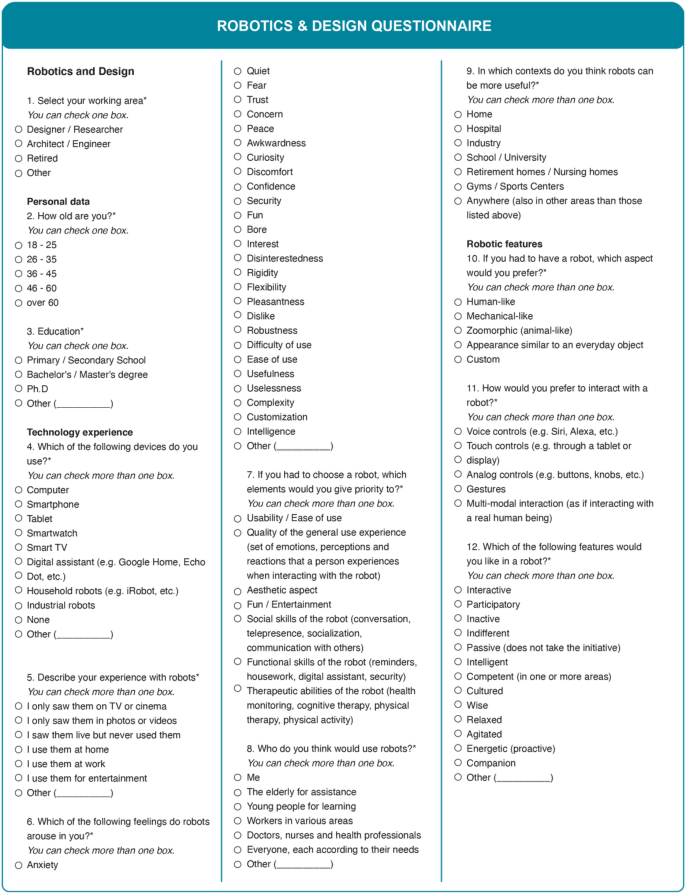
Figure 2: The framework of the questionnaire Robotics & Design.
of the questionnaire, conducted through the Google Forms platform, started in March 2020 and ended in May 2020. The survey was conducted in both Italian and English in order to collect data more effectively across Italy and Europe.
Framework and Scope The questionnaire (see Figure 2) consists of 4 sections: (1) Demographics; (2) Technology experience and experience with robots; (3) Attitudes toward Assistive Robots: users, contexts of use, and activities; (4) Key properties and preferred features of a domestic robot.
Figure 3: Results from Q.1, Q.2, Q.3.
The first section, which focuses on demographic data, aims to collect quan- titative data about the users’ demographic patterns of social and assistive robots. Factors such as age, education level, and nationality can affect the intention to use and the choice of an assistive robot (Prakash and Rogers, 2015). The second section aims to investigate the experience with technolo- gical devices and robots (domestic, social, assistive, industrial, etc.). Indeed, it is demonstrated that the relationship with technologies can affect the acceptability and the long-term use of robots (Smarr et al. 2014). Further questions focus on feelings that robots arouse in people and on users’ favorite features (formal, functional, qualitative, etc.). Many scientific studies showed that formal or functional aspects do affect the perception of the robot (For- lizzi et al. 2004; Deutsch et al. 2019) and that acceptance increases when users perceive a real benefit from robotic assistance (Frennert et al. 2013). Section 2 also addresses the issue of context of use and potential users: i.e., the needs of the primary and/or secondary users and the context of use (home, nursing home, care facility) affect both the activities that a robot might perform as well as its effectiveness and acceptability by the people it interacts with. The third section explores the values, opinions, preferences, and beliefs towards assistive robots in order to predict possible further directions of robotics. It also investigates how people describe themselves in relation to robots. Such a survey can provide interesting findings regarding the social impact of assi- stive robots (Broadbent et al. 2009) and the roles they are expected to play (Abdi et al. 2018). The fourth section focuses on activities and sophistication of the interaction: the activities were selected from the taxonomy developed by Feil-Seifer and Matari´c (2005) and they also relate to robot behaviors or perceived personality as key factors affecting acceptance. The sophistication of the interaction affects people’s perceived control and social skills of the robot, and it may also influence the perceived usefulness and ease of use (Bartneck et al. 2009).
RESULTS AND ANALYSIS Section 1 – Demographics
The first section [Q.1, Q.2, Q.3] aims to collect demographic data on partici- pants (see Figure 3). It was useful to profile people who currently use assistive robots or would be interested in using them. The participant base consisted mostly of retirees (74%), followed by architects or engineers (18%), which are identified as people with a greater analytical outlook on robotics, and a very small number of professionals in other fields (8%). The age groups of
Acceptability of Assistive Robotics by Older Adults 13
Figure 4: Results from Q.4, Q.5, Q.6.
participants are: 46–60 years old (23.9%), 18–25 years old (23.2%), over 60 (22.8%), 26–35 years old (20.6%) and 36–45 years old (9.6%). The par- ticipation of people from all age groups allows the collection of data on a wide range of users and also a comparison of their opinions, beliefs, needs and expectations about robotics. Similarly, the level of education is also quite diversified: more than half of the participants have completed secondary sch- ool and have not continued their studies (55%); 36% have graduated with a Bachelor’s or Master’s degree; only a small percentage have a First or Second Level Master degree (6%) or a PhD (4%). Identifying demographic featu- res is a key part in the design of User Personas (Cooper, 2004; Hartson and Pyla, 2012) which include all of the relevant information for the design, development, and evaluation of acceptable robotic technologies.
Section 2 - Technology Experience and Experience with Robots.
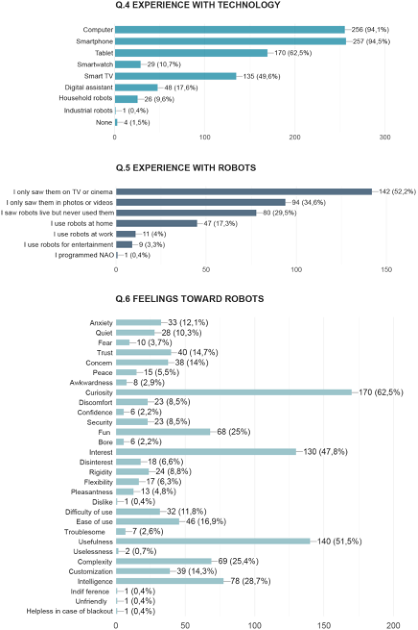
[Q.4] Which of the following devices do you use? Participants (see Figure 4) have a medium-high technological experience, mainly due to the use of computers (256 users - 94.1%) and smartphones (257 users - 94.5%). The number of tablet users is lower (170 users) but still corresponding to a high percentage (62.5%) as well as the number of people
using a smart TV (135 users - 49.6%). The percentages related to the use of less conventional digital devices are significantly lower: under half of the par- ticipants use a digital assistant (48 users - 17.6%) or a robot for household tasks (26 users - 9.6%). Only one participant uses industrial robots for work purposes (0.4%) and 4 users (1.5%) have no technological experience.
[Q.5] Describe your experience with robots Most of the participants (see Figure 4) have only watched them on TV, in the movies (142 users - 52.2%) or in photos and videos (94 users - 34.6%). 29.5% (80 users) have indirect experience of them, since they saw them in person but never used them firsthand. 17.3% use them at home (47 users) and 4% (11 users) use them at work or for entertainment (9 users - 3.3%). Only one participant has a significant level of robotics experience as he/she programmed the humanoid robot NAO (0.4%). Technological experience highly affects expectations and attitudes toward robots. In addition, a higher level of experience can help people to have more realistic expectations of robots and to more easily imagine the tasks they could be helpful for (Cavallo et al. 2018).
Section 3 - Attitudes Toward Assistive Robots: Users, Contexts of Use, and Activities [Q.6] Which of the following feelings do robots arouse in you? Most participants (see Figure 4) are curious (170 users - 62.5%), interested (130 users - 47.8%) and amused (68 users - 25%) at the idea of using a robot. The survey shows that people would be willing to use a domestic robot for functional purposes (140 users - 51.5% consider them useful) or to do domestic tasks. People expect a robot that fits individual needs, namely custo- mizable (14.3% - 39 users), flexible (17 users - 6.3%), easy to use (46 users - 16.9%), safe (23 users - 8.5%) and reliable (40 users - 14.7%). Other posi- tive emotions towards robots are tranquility (28 users - 10.3%), serenity (15 users - 5.5%), the expectation of interacting with a quite smart and skilled robot (78 users - 28.7%) and also pleasant to use (4.8% - 13 users). Despite the mostly positive emotions, few participants feel comfortable with the idea of using a robot, and only 2.2% (6 users) feel comfortable enough, 8.5% (23 users) feel uncomfortable, and 2.9% (8 users) feel ashamed. In addition, low firsthand experience can cause fear (3.7% - 10 users) and concern (14% - 38 users), due to the inability to imagine the kind of interaction or how a robot can be actually helpful at home. Many people are bound to the idea that media convey about robotics, as they imagine the robots as complex (25,4% - 69 users) or as rigid (8,8% - 24 users), therefore difficult to use. This is also confirmed by the 12,1% (33 users) who feel anxious about the idea of intera- cting or using a robot, and by the 11,8% (32 users) who consider them hard to use or troublesome (2,6% - 7 users). A single user feels helpless in case of a blackout (0.4%), namely he/she is afraid of not being able to fix a possible malfunction without the help of qualified professionals. 0.4% feel disgust (1 user), 0.7% consider robots useless (2 users) or unfriendly (0.4% - 1 user). At last, few participants are completely disinterested (6.6% - 18 users) in the
Acceptability of Assistive Robotics by Older Adults 15
idea of using a robot, 2.2% feel boredom (6 users) or indifference (0.4% - 1 user). This is probably due to low experience and inability to imagine how robots could simplify rather than over-complicate people’s lives.
[Q.7] If you had to choose a robot, which elements would you give priority to? The questionnaire investigates factors that influence the user experience with a robot both in relation to Human-Robot Interaction and to the robot’s abilities.
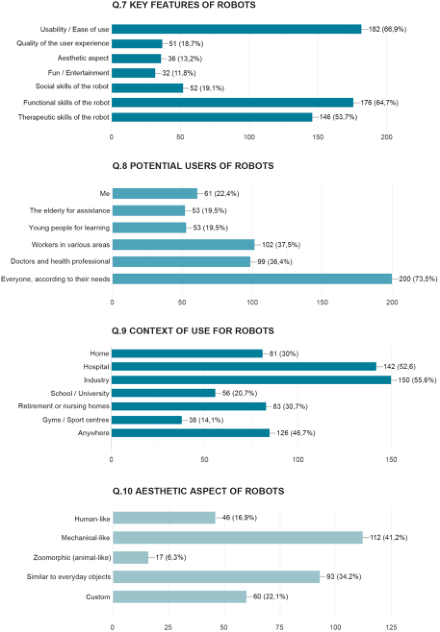
Regarding Human-Robot Interaction (see Figure 5), the elements that influence the intention to use a robot are: the ease of use/usability (66.9% - 182 users), the quality of the user experience (18.7% - 51 users), the aesthetic appearance (13.2% - 36 users) and the fun given by the interaction (11.8% - 32 users). People prefer a robot with functional skills (64.7% - 176 users) instead of therapeutic skills (53.7% - 146 users) or social skills (19.1% - 52 users). These results are consistent with questionnaires administered in other countries, such as (Smarr et al. 2014) which find that people, especially the elderly, accept to use robots to accomplish domestic tasks or to get help with excessively challenging activities but do not accept them much for social acti- vities. This is probably due to the fear that robots may in the future totally replace human care or interactions: this is why it is important to pay atten- tion both to the accurate description of the real functions and skills of robots, and to the general idea of robots that is conveyed to society.
[Q.8] Who do you think would use robots? Participants are willing to use robots in a wide range of contexts (see Figure 5), depending on specific needs (73.5% - 200 users). Many appreciate the use of robotics in healthcare (36.4% - 99 users) or in industry (37.5% - 102 users), perhaps because the advantages of using robots in these settings are more tangible. The same number of participants would accept robots as support in educational settings (19.5% - 53 users) or for elderly care (19.5% - 53 users). However, only 22.4% (61 users) identify themselves as potential users of an assistive robot: as shown by Neven (2010) the potential user is often imagined according to the stereotype of the lonely person in need of care and companionship. The rejection of this stereotype may justify such a low percentage.
[Q.9] In which contexts do you think robots can be more useful? The most popular contexts of use (see Figure 5) are industry (55.6% - 150 users), hospital (52.6% - 142 users) and care setting i.e., nursing homes (30,7% - 83 users): this also reflects the sense of reliability, precision and safety of robotic platforms. 30% (81 users) would also use robots in the home environment for household tasks, cleaning and safety. The least accepted contexts of use are school/university (20.7% - 56 users) and gyms (30.7% - 83 users), probably due to the difficulty of envisioning useful activities that robots could perform. 47.7% believe that robots could be used anywhere.
Figure 5: Results from Q.7, Q.8, Q.9, Q.10.
Section 4 – Key Properties and Preferred Features of a Domestic Robot [Q.10] If you had a robot, which aspect would you prefer? People prefer (see Figure 5) a mechanical appearance (41.2% - 112 users), which can be related to functional use, or an appearance similar to an everyday object (34.2% - 93 users). The human appearance (16.9% - 46 users) is more accepted than the zoomorphic one (6.3% - 17 users). Proba- bly this is due to the sci-fi image that the media (movies and television) have conveyed of robots: humanoids are more popular than zoomorphic robots and they are represented as provided with extraordinary abilities and out- standing intelligence. However, in case of interaction with humanoid robots in a real environment, these findings must be related to the risk of incurring the uncanny valley (Mori, 1970). A large percentage of participants would like extreme flexibility, both in terms of the tasks to be performed and in terms of aesthetics/form (22.1% - 60 users).
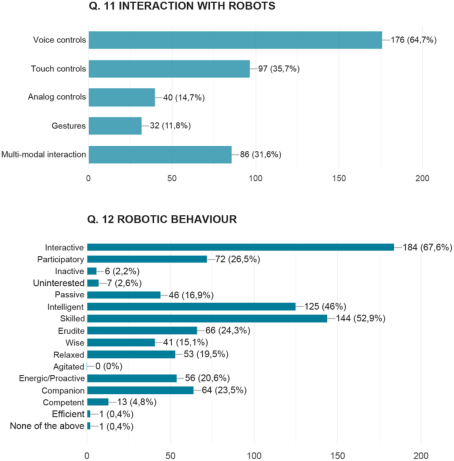
[Q.11] How would you prefer to interact with a robot? Most participants prefer interaction modalities (see Figure 6) that they alre- ady have with everyday technological devices (smartphones, tablets, etc.) and
Acceptability of Assistive Robotics by Older Adults 17
Figure 6: Results from Q.11, Q.12.
that they consider more effective: the majority would prefer voice controls (64.7% - 176 users), 35.7% (97 users) would use a robot with touch controls or with a multi-modal interaction (31.6% - 86 users). A small percentage would prefer analog controls (14.7% - 40 users) or gestures (11.8% - 32 users).
[Q.12] Which of the following features would you like in a robot? Most participants prefer (see Figure 6) an interactive robot (67.6%- 184 users) and participative one (26.5%-72 users) but also skilled (52.9%- 144 users) and smart (46%-125 users). Many would like a robot that is proactive (20.6%-56 users), a good company (23.5%–64 users), and relaxed (19.5%-53 users). Some participants would like an erudite (24.3%-66 users) and wise (15.1%-41 users) robot. Few people would like a robot that is passive (16.9%-46 users), inactive (2.2%-6 users), or uninterested (2.6%- 7 users). Only one person would like an efficient robot (0.4%) and only one person answered none of the above (0.4%), but did not specify alternative solutions.
DISCUSSION AND CONCLUSION This research provides an insight into how the acceptability factors of assi- stive robot tested in the literature actually relate to the preferences and attitudes of potential and current users.
The results show the importance of applying the HCD approach in HRI: it can provide a significant support to identify actual users’ needs and to trans- late them into design solutions (Tosi, 2020). A focus on Interaction Design
Figure 7: Digital prototyping of the Robotics & Design platform via Adobe Xd software.
(ID) and UX in HRI can contribute to the development of devices and inte- ractive systems that are actually based on people’s wishes and expectations (Preece et al. 2015; Hassenzahl, 2013).
In addition, the results highlight the need for stronger involvement of stakeholders during the design phases of robots in order to promote a deeper understanding of those people’s needs and insights that cannot be collected by quantitative surveys. Moreover, technology is a mirror of the society that produces it, which means that human values are and will alw- ays be embedded in technological devices and into robots. For this reason, it is essential to know about what people think of robots and what their expectations are.
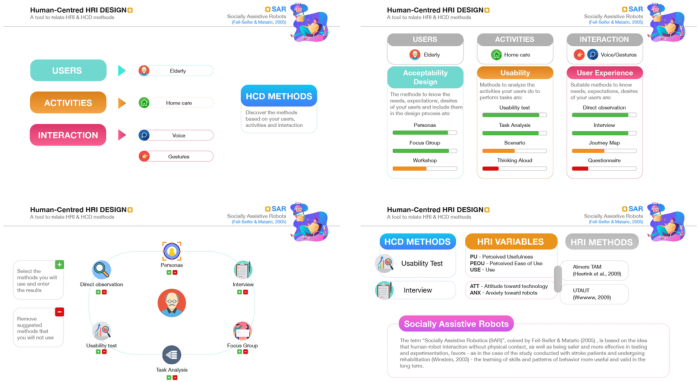
The questionnaire was also submitted in order to develop the scientific tool “Robotics & Design: the tool to design Human-Centred Assistive Robo- tics” (Becchimanzi, 2021). This tool (see Figure 7) aims to: (1) support the development of a cross-disciplinary cooperation process among all professio- nals involved in the development of robotic systems; (2) structure a scientific and methodological bridge between the HCD and HRI areas; (3) provide designers and researchers with tools for agile consultation of the main acce- ptability variables in robotics and their interrelations; (4) develop a direct connection between the scientific principles of acceptability variables and the design requirements that may affect them. This tool will be presented in forthcoming papers.
ACKNOWLEDGMENT
The authors would like to thank the participants in the survey and Professor Francesca Tosi (UNIFI) for supporting this research.
This paper is the result of the joint work of the authors, the texts were prepared in particular by: Claudia Becchimanzi: all the paragraphs; Ester Iacono: par. 1, 3, 6; Alessia Brischetto: par. 1, 3, 6.
Acceptability of Assistive Robotics by Older Adults 19
REFERENCES
Abdi, J., Al-Hindawi, A., Ng, T., & Vizcaychipi, M. P. (2018). Scoping review on the use of socially assistive robot technology in elderly care, BMJ OPEN Volume 8, No. 2. Bartneck, C., Kanda, T., Mubin, O., & Al Mahmud, A. (2009). Does the design of a
robot influence its animacy and perceived intelligence?, International Journal of Social Robotics Volume 1, No. 2, pp. 195–204. Becchimanzi, C. (2021). Design e Ergonomia per la Human-Robot Interaction: Strategie e strumenti Human-Centred Design per la collaborazione trans-disciplinare per la progettazione dell’accettabilità delle nuove tecnologie robotiche [Docto- ral dissertation, Università degli Studi di Firenze]. http://hdl.handle.net/2158/ 1238440 (2021). Broadbent, E., Stafford, R., & MacDonald, B. (2009). Acceptance of health-
care robots for the older population: review and future directions, International Journal of Social Robotics Volume 1, No. 4, pp. 319-330. Cavallo, F., Esposito, R., Limosani, R., Manzi, A., Bevilacqua, R., Felici, E., ...
& Dario, P. (2018). Robotic services acceptance in smart environments with older adults: user satisfaction and acceptability study, Journal Of Medical Internet Research Volume 20, No. 9. Cesta, A., Cortellessa, G., Orlandini, A., & Tiberio, L. (2016). Long-term evaluation of a telepresence robot for the elderly: methodology and ecological case study, International Journal Of Social Robotics Volume 8, No.3, pp. 421–441. Cooper, A. (2004). The inmates are running the asylum: why high-tech products drive
us crazy and how to restore the sanity (Vol. 2). Indianapolis: Sams, Macmillan. Coradeschi, S., Cesta, A., Cortellessa, G., Coraci, L., Galindo, C., Gonzalez, J., ...
& Ötslund, B. (2014) “GiraffPlus: a system for monitoring activities and phy- siological parameters and promoting social interaction for elderly”, in: Human- Computer Systems Interaction: Backgrounds and Applications 3, Springer, Cham, pp. 261–271. Deutsch, I., Erel, H., Paz, M., Hoffman, G., & Zuckerman, O. (2019). Home robotic devices for older adults: Opportunities and concerns, Computers In Human Behavior Volume 98, pp. 122–133. Feil-Seifer, D., & Mataric, M. J. (2005, June) “Defining socially assistive robotics”,
in: 9th International Conference on Rehabilitation Robotics, 2005. ICORR 2005, IEEE, pp. 465–468. Forlizzi, J., DiSalvo, C. and Gemperle, F. (2004). Assistive robotics and an ecology of elders living independently in their homes, Human–Computer Interaction Volume 19, No. 1-2, pp. 25–59. Frennert, S., Eftring, H., & Östlund, B. (2013, October) “What older people expect
of robots: A mixed methods approach”, in: International conference on social robotics, Springer, Cham, pp. 19–29. Giacomin, J. (2014). What is human centred design?, DES J Volume 17, No. 4, pp. 606–623. Hartson, R., Pyla, P.S. (2012). The UX Book: Process and Guidelines for Ensuring a
Quality User Experience. Elsevier. Hassenzahl, M. (2013) “User experience and experience design”, in: The encyclopedia of Human-Computer Interaction 2. Kertész, C., & Turunen, M. (2019). Exploratory analysis of Sony AIBO users, AI &
Society Volume 34, No. 3, pp. 625–638. Lee, H. R., & Riek, L. D. (2018). Reframing assistive robots to promote successful aging, ACM Transactions on Human-Robot Interaction (THRI) Volume 7, No. 1, pp. 1–23.
Maguire, M. (2001). Methods to support human-centred design, International Journal of Human-Computer Studies Volume 55, No. 4, pp. 587–634. Mast, M., Burmester, M., Graf, B., Weisshardt, F., Arbeiter, G., Španˇel, M.,
... & Kronreif, G. (2015) “Design of the human-robot interaction for a semi- autonomous service robot to assist elderly people”, in: Ambient assisted living, Springer, Cham, pp. 15–29. Mori, M. (2012). The uncanny valley: The original essay, IEEE Spectrum, Volume 12 No. 6. Neven, L. (2010). ‘But obviously not for me’: robots, laboratories and the defi-
ant identity of elder test users, Sociology of Health & Illness Volume 32, No. 2, pp. 335–347. Prakash, A., & Rogers, W. A. (2015). Why some humanoid faces are perceived more positively than others: effects of human-likeness and task, International Journal of Social Robotics Volume 7, No. 2, pp. 309-331. Preece, J., Sharp, H., Rogers, Y. (2015). Interaction Design, beyond Human-
Computer Interaction. New York: John Wiley & Sons. Šabanovi´c, S., Chang, W. L., Bennett, C. C., Piatt, J. A., & Hakken, D. (2015, August) “A robot of my own: participatory design of socially assistive robots for independently living older adults diagnosed with depression”, in: proceedings of the International conference on human aspects of it for the aged population, pp. 104–114, Springer, Cham. Smarr, C. A., Mitzner, T. L., Beer, J. M., Prakash, A., Chen, T. L., Kemp, C. C., &
Rogers, W. A. (2014). Domestic robots for older adults: attitudes, preferences, and potential, International Journal of Social Robotics Volume 6, No. 2, pp. 229–247. Tosi, F. (2020). Ergonomics & Design. Design for Ergonomics. Springer, Cham.
LISTED IN THE AHFE DIGITAL BOOKSTORE CATALOGUE
Explore the complete digital volume
Human Factors in Accessibility and Assistive Technology
Read this individual research paper free through the original publisher, or explore the full digital proceedings book.
ISBN 978-1-958651-13-1
Explore this ISBN in the AHFE Bookstore ↗Listed in the July 2026 bookstore catalogue; search by ISBN to confirm current availability · Digital book purchase optional