Ester Iacono, Claudia Becchimanzi, Alessia Brischetto (2022). Emotional design: Affective evaluation methods to assess the emotional response of 6-11 years children. In: Affective and Pleasurable Design. AHFE Open Access, vol. 41, pp. 91–103. https://doi.org/10.54941/ahfe1001785
Nowadays, the design focuses not just on the functional attributes of products but especially on emotional ones, and it investigates users' behavior from an emotional point of view.Industrial companies also discovered the economic advantages of holistically analyzing user experience and aim, beyond usability research, to improve people-product interaction. Therefore, their goal is to understand how to evaluate the emotions arising from the interaction with a product and integrate emotions into usability studies. Consequently, it is fundamental to look at Affective Evaluation Methods to enhance usability methods and make them more effective on affective responses. However, scientific literature highlights that although the understanding of emotions has progressed, measurement tools have lagged. Moreover, people generally find it difficult to report the emotions they experience. Furthermore, regarding children, evaluating the emotional impact of a product is even more complex. Therefore, applying methods and tools found in the literature (affective evaluation methods - AEM) may not be appropriate to investigate the affective response in children, according to specific variables.This research addresses the issue of children's affectivity in evaluating positive user experiences as a requirement to be considered within the design process. In addition, this research investigates theories on emotions and studies of the affective sciences and explores the contribution of design and cognitive psychology in these areas.This paper investigates strategies and evaluation tools of the Human-Centred Design (HCD), User Experience (UX), Affective Evaluation Methods (AEM) of Psychology, Affective Sciences and Cognitive Ergonomics, that allow the measurement of emotions. This study aims to:1.understanding the emotional skills of children; 2.verifying the reliability of the emotional responses expressed through the existing self-assessment tools;3.investigating effective methods to evaluate the affective response of 6-11 years children.This research describes the results of two qualitative methods for investigating emotions: (1) the survey aimed to collect data on emotions experienced by children; (2) the workshop focused on emotions conducted with children of age 6-11. The workshop included activities to analyze children’s emotional skills and their ability to recognize emotions in themselves, others, and interaction with products. Furthermore, field surveys with children and experts (direct observation, interviews, focus groups, brainstorming sessions) allowed us to evaluate the reliability of the emotional responses collected by the main tools described in the literature, e.g. tools for rational-emotional education (REBT) and Affective Evaluation Methods (AEM).The collected data revealed critical issues of current evaluation tools and identified the requirements for a new tool for children’s emotional evaluation. Specifically, it emerged that the cognitive-behavioral approaches, typical of psychology, can be powerful tools for designers to interpret and analyze the emotional responses that occurred during the interaction with a system. Together with the HCD and UX tools, these approaches can help designers improve the overall quality of the project.Furthermore, results show a lack of a theoretical framework to move from a conceptual to an empirical level to develop effective tools to measure emotions. Consequently, it is essential to introduce tools for measuring the objective and subjective aspects of the experience, as it is challenging to involve such young users in the research phases.The results of this study allowed the development and prototyping of a series of design concepts to evaluate the emotional impact and collect physiological measurements. This paper only shows the main objectives and features of the tool "Cubotto emotion kit". It is an interactive tool that provides information and allows qualitative data collection so far beyond even the measurement of emotions themselves. It could help designers understand children's preferences, such as colors and shapes that can arouse positive emotions and useful information to redesign products, services, and systems.
In recent decades, various researches in various fields (social sciences, cogni- tive psychology, etc.) have highlighted the fundamental role that emotions play in influencing our perceptions, attitudes, motivations and behaviors (Lewis et al., 2010; Ekman, 2013). The introduction of emotions within the scientific debate has led designers to pay more attention to the role of emotions in user-product interaction. It is known that the emotional state can influence human cognition on information processing and human inte- raction with products, systems or other people. Man, in fact, at a behavioral level, tends towards stimuli associated with positive emotions, avoiding those related to negative affects. Therefore, the inclusion of emotions in the design practice allows us to consider the various emotional nuances asso- ciated with the interaction with artifacts and thus represents a challenge in trying to overcome design processes that limit one’s attention to usabi- lity alone. Norman himself, introducing the concept of Emotional Design
(Norman, 2004), argued that in addition to the components of Design rela- ted to usability, aesthetics and practicality, there is also “a strong emotional component in how products are designed and used “. Also, the research on Human-Computer Interaction (HCI) has moved away from considering only the usability of products, which must respond, in a holistic way, to the needs (physical, cognitive and emotional) of users (Babbar et al., 2002). Regardless of factors related to usability, emotions can influence and convey positively or negatively the User Experience, considered “a significant artery of the Human-Centred Design approach” (Brischetto, 2018). It can contribute to defining methods and techniques to evaluate the experience and emotional dimension of the user before, during, and after using a product, system or service (ISO 9241-210, 2019). Therefore, nowadays, the Design focuses not just on the functional attributes of products but especially on emotional ones, and it investigates users’ behavior from an emotional point of view. Under- standing the user’s emotions can help the designer anticipate the product’s emotional impact and avoid unwanted feelings of disgust (Desmet and Hek- kert, 2009). Industrial companies also discovered the economic advantages of holistically analyzing user experience and aim, beyond usability research, to improve people-product interaction. Therefore, their goal is to understand how to evaluate the emotions arising from the interaction with a product and integrate emotions into usability studies. Consequently, it is fundamental to look at Affective Evaluation Methods to enhance usability methods and make them more effective on affective responses (Benker, 2011). However, scien- tific literature highlights that although the understanding of emotions has progressed, measurement tools have lagged (Norman, 2003). Today, how and with what methods is it possible to interpret and evaluate the emoti- ons arising from interaction with the products? It isn’t straightforward to evaluate them due to their complex and subjective nature; above all, little is known about the emotional response of users and the user-artifact inte- ractions that trigger emotions. Therefore, although fast and straightforward methods require only pen and paper, the results obtained are very superficial; more precise answers are received, on the other hand, through neuroscien- tific research, which is still very complex and expensive to apply (Valdivia and Fanco, 2016). Moreover, people generally find it difficult to report the emotions they experience. Furthermore, regarding children, evaluating the emotional impact of a product is even more complex. Children often have dif- ficulty indicating their moods and emotional reactions (Morris et al., 2004; Di Pietro and Bassi, 2013). For this reason, the evaluation of emotions is often based on the impressions reported by parents, teachers, etc., even if gene- rally these do not correspond to the child’s self-evaluations (Barbosa et al., 2002). This research addresses the issue of children’s affectivity in evalua- ting positive user experiences as a requirement to be considered within the design process. In addition, this research investigates theories on emotions and studies of the affective sciences and explores the contribution of design and cognitive psychology in these areas. This paper investigates strategies and evaluation tools of the Human-Centred Design (HCD), User Experience (UX), Affective Evaluation Methods (AEM) of Psychology, Affective Sciences and Cognitive Ergonomics, that allow the measurement of emotions. This
Emotional Design: Affective Evaluation Methods 93
study aims to:1) understanding the emotional skills of children; 2) verifying the reliability of the emotional responses expressed through the existing self- assessment tools; 3) investigating effective methods to evaluate the affective response of children.
STATE OF ART: AEM FOR CHILDREN Emotions are considered multi-component, i.e. are, resulting from behavi- oral, expressive, physiological reactions and subjective feelings. Therefore, current emotion measurement tools evaluate one of these components, resul- ting in various measurement approaches. As the literature (Benker, 2011) suggests, it is possible to classify AEMs into three types of instruments that differ according to the kind of measurement:
Combination of objective and subjective measurements.
This section provides an overview of the methods used to measure emo- tions in the context of design research; in particular, for this study, only the subjective self-assessment tools designed to be used with children have been analyzed. The main ones are listed below.
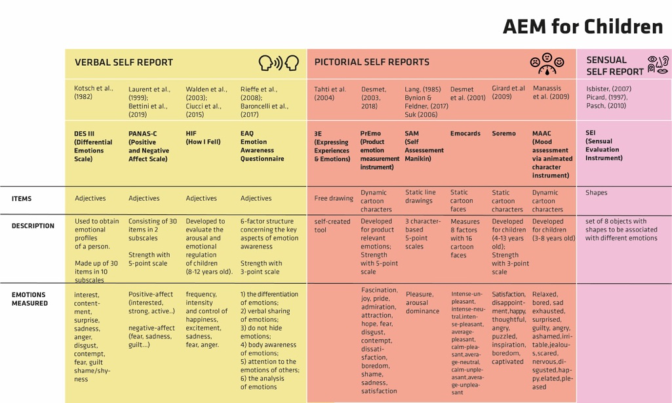
Self-Assessment Methods (Self report) Self-report methods (Fox, 2008) communicate the user’s emotional experi- ence with the product. Through scales and verbal protocols, they measure the emotions declared by the subject himself and can be structured to eva- luate any emotion, even the most complex ones. Depending on the type of tool used, there are, in fact, various types of Self-report, for example, verbal, visual, sensory (Figure 1).
Verbal self-reports, related to emotional state, aim to acquire a standardi- zed description of the emotional state referred to a specific moment, period or situation. Examples of such tools for children are: DES III (Differen- tial Emotion Scale) (Kotsch et al., 1982); PANAS-C (Positive and Negative Affect Schedule) (Laurent et al., 1999; Bettini et al., 2019); HIF (How I Fell) (Walden et al., 2003; Ciucci et al., 2015); EAQ (Emotion Awareness Questi- onnaire) (Rieffe et al., 2008; Baroncelli et al., 2018). These tools in which the child is asked to self-evaluate their abilities and characteristics are administe- red from 8 years onwards, since before the results seem less reliable (Rieffe et al., 2008; Harter, 1983) and to be understood they need the support of facilitators who can, however, influence the results. For this reason, picto- grams and images are usually used to replace words in Pictorial Self-reports; among these are: – 3E (Expressing Emotions and Experience), a self-created method that allows you to draw your own emotional experience, even if the data analysis is laborious and can lead to errors of interpretation (Tähti and Arhippainen, 2004);
Figure 1: Self-assessment methods (Verbal Self-report, Pictorial Self-report and Sen- sorial Self-report) to measure affect for children.
– SAM (Self-Assessment Manikin), a tool that proposes a manikin represen- ting the dimensions of emotions (pleasantness, excitement, dominance), is administered to evaluate an emotional response to an object or event (Lang, 1985; Bynion and Feldner, 2017). Due to its ambiguous represen- tation, it requires verbal instructions on the pictograms before use (Suk, 2006); – PrEmo, an instrument that measures 14 emotions, is represented by ani- mated characters displayed within the measurement interface. It measures the emotions aroused by static stimuli, but it is not suitable for dynamic stimuli (e.g. use of the product) (Desmet, 2018); – Emocards, a tool that features 16 cartoon faces representing eight emo- tional expressions, is not always recognizable by children (Desmet et al., 2001). Although the cards are easy to use, they only measure pleasure and perceived excitement. So, it is not possible to grasp the more subtle distinctions in the emotions aroused by the product; – Sorémo, a tool that measures children’s emotional state aged 4 to 13 when using educational software products. Specifically, the user interface pre- sents nine emotions and investigate the relationship between learning and the emotional states of the child (Girard and Johnson, 2009); – MAAC (Mood assessment via animated character instrument), a tool deve- loped for children aged 3 to 8 that measures 16 moods and emotions through animated characters to be selected based on their emotional state (Manassis et al., 2013).
In general, the main advantages derived from Pictorial Self-reports are the possibility of being used in different cultures (Desmet, 2018) and measuring different affective states. However, the user may not understand the mea- ning of the image and have difficulty recognizing and expressing the degree
Emotional Design: Affective Evaluation Methods 95
of intensity of the emotion felt. Furthermore, this assessment is intrusive in many cases, as respondents have to stop their activity to select images and express their emotional state (Desmet et al., 2016). A further category of self-evaluation tools is Sensual Self-Reports to which the SEI (Sensual Eva- luation Instrument) belongs (Isbister et al., 2007; Picard, 1997). It integrates, in the evaluation of the emotions transmitted by an object, the sense of touch. In some research (Pasch, 2010) conducted with primary school children (6- 10 years), although the SEI was perceived as a toy, it still denoted critical issues related to the elaboration of statistical results (very vague) and the difficulty for some to map the experience through touch. Therefore, appl- ying methods and tools found in the literature (affective evaluation methods - AEM) may not be appropriate to investigate the affective response in chil- dren, according to specific variables. Together with the HCD and UX tools, the cognitive-behavioral approaches, typical of psychology, could be power- ful tools for designers to interpret and analyze the emotional responses that occurred during the interaction with a system. Therefore, some tools have been analysis and application object in the field to achieve the objectives of this research.
METHODS
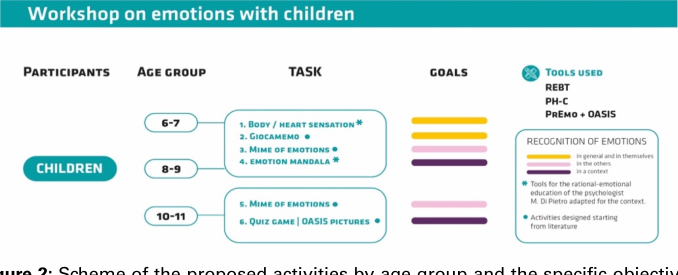
This research describes the results of two qualitative methods for investiga- ting emotions: (1) the survey aimed to collect data on emotions experienced by children; (2) the workshop focused on emotions conducted with chil- dren of age 6-11. The workshop on Emotions for Children (Iacono, 2021) included activities, supported and coordinated by the research team, to analyze children’s emotional skills and their ability to recognize emotions in themselves, others, and interaction with products. The comparison betw- een experts in different disciplinary sectors (developmental psychologists, educators, researchers and designers) allowed the definition of each activity according to specific objectives that guaranteed the translation of the data received during the analysis phase. The survey, therefore, provided for an evaluation phase of the existing tools followed by subsequent data analy- sis. Furthermore, field surveys with children and experts (direct observation, interviews, focus groups, brainstorming sessions) allowed us to evaluate the reliability of the emotional responses collected by the main tools described in the literature, e.g. tools for rational-emotional education (REBT) and Affective Evaluation Methods (AEM). For the study’s purposes, the active participation of 30 school-age children (6–11 years), 16 males and 14 fema- les, divided into three groups, according to the following age groups, was fundamental: 6–7, 8–9, 10–11. Therefore, this division into groups made it possible to adapt specific activities to children who have different emotional skills (Di Pietro and Bassi, 2013; Denham, 2001).
Workshop: Activities and Objectives The workshop activities have these general objectives: recognizing emotions in themselves, others, and about a context (Figure 2). Some games and acti- vities used are tools for rational-emotional education, typical of REBT, or
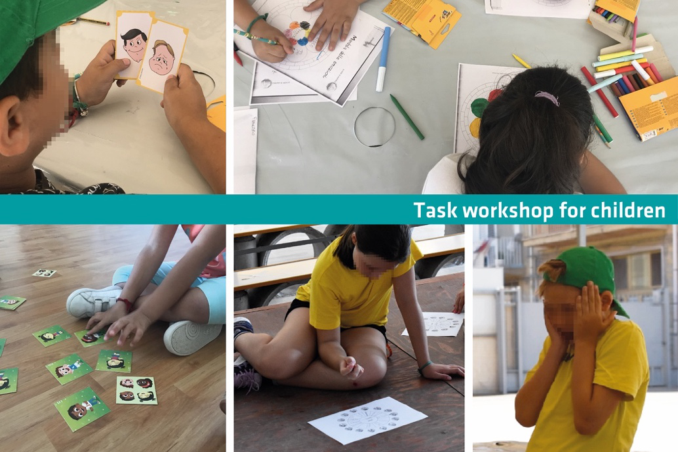
Figure 2: Scheme of the proposed activities by age group and the specific objectives associated with each of them during the workshop held in Vittoria (RG).Figure 3: The children who carry out the various activities during the workshop.
Rational-Emotional Behavioral Therapy, developed by the psychologist and psychotherapist Mario Di Pietro. Others, instead, were selected from among the AEMs to investigate the reliability of the tools in children. Some acti- vities have been adapted and redesigned for the specific context; instead, others have been designed from scratch, starting from literature and thanks to experts in the sector (Figure 3).
Task 1: Sensations of the body and heart. This activity has the objective of distinguishing the sensations experienced physically from emotional feelings (Di Pietro and Dacomo, 2007). After attaching a human shape and a heart to the same wall, the children were given post-it notes of different colors, yellow for the body’s sensations, blue for those of the heart. First, the moderator read the conditions listed in the list. Then, each child reported whether the event mentioned concerned a physical or emotional sensation, reporting the post-it either on the heart or on the outline of the human body. The list of physical
Emotional Design: Affective Evaluation Methods 97
and emotional conditions has been enriched and integrated with some of the 18 items of the PH-C (Physiological Hyperarousal Scale for Children), a tool that evaluates the bodily manifestations of arousal (Laurent et al., 2004).
Task 2: Giocamemo, a circle of emotions. The second activity involved using “Giocamemo”, a tool developed by the teacher and clinical psycholo- gist Desirèe Rossi. The specific objective of this activity is to understand the child’s emotional vocabulary and the ability to name emotions by reading the emotional expression provided by body language. After an initial expla- nation of the game, an emotion card was distributed to each child, depicting four different characters representing the same emotion. Each player had to recognize the four characters who expressed the same emotion among the 40 emotion cards (happiness, fear, anger, surprise and sadness). At the end of the game, it was possible to verify the correct association of the characters with specific emotions; the comparison with the working group and the other par- ticipants allowed a further phase of analysis on the reasons that led to that choice.
Task 3: Mime of emotions (1). The third activity assumed the recognition of emotions in others through gestures and facial expressions as a specific objective. After drawing two cards representing two distinct emotions, the children mimicked them through gestures and facial expressions. This activity allowed us to understand the emotional competence of the participants invo- lved and observe how children use non-verbal communication (gestures, facial expressions and posture) to transmit emotional messages and commu- nicate feelings, emotions, and behaviors (Schaerer, 2012). Therefore, direct observation allowed more careful analysis of the behaviors and expressions reproduced by children, reflecting on the possibility of associating certain attitudes with specific emotions.
Task 4: Mandala of emotion. The last activity, conducted with children of the two age groups 6–7/8–9, concerns the “mandala of emotions” (Di Pietro and Dacomo, 2007), revisited by the working group to understand the children’s ability to associate emotions with specific situations/contexts. Each child had to report the emotions he remembered in the smaller petals of the mandala and associate each emotion with a different color. On the other hand, in the larger petals, they were asked to indicate the events or situations that they associated with each specific emotion reported in the smaller petal. At the end of the activity, the children had to motivate their choices verbally and discuss not only with the team members but also with the other participants. The debate allowed us to analyze better and translate what the children had reported on the sheet of paper.
Task 5: Mime of emotions (2). This activity was proposed to children aged 10–11, and as in task 3, the specific objective was to recognize in others the emotion associated with a situation through facial expressions, gestu- res and posture (Schaerer, 2012). Distributed in two groups, children had to extract one of the six frames of the animated cartoons representing six distinct emotions felt by the characters in certain situations. One child per group had to mimic the same emotion/situation without looking at the par- tner. This would have made it possible to observe the ways in which the
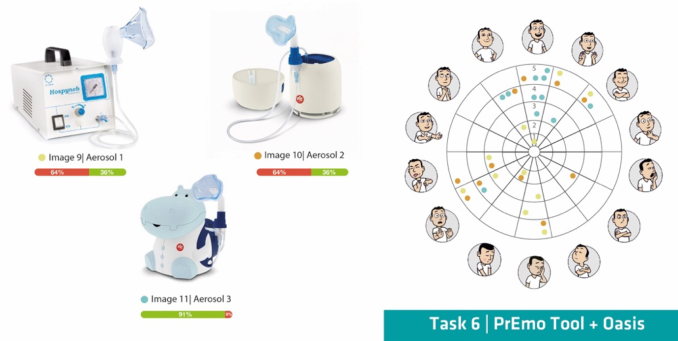
Figure 4: Some results of the PrEmo tool application for evaluating the emotional impact (positive/negative) of what is represented in the proposed images.
same emotion/situation is recognized and represented by two different subje- cts. The other members of the group had to recognize, through gestures and facial expressions, the emotion mimicked and the situation represented.
Task 6: Quiz Game (PrEmo Tool + OASIS). The last activity, as well as the most important of this study, “Quiz game”, involved the use of the PrEmo tool (Desmet, 2018) and the free access OASIS (Open Affective Standardized Image Set) images (Kurdi et al., 2017). The PrEmo tool was used in paper form, as currently, the animated version on the platform is not available. It was associated with the OASIS images, capable of arousing specific emotions in the observer. The specific objective was to recognize the emotion and emo- tional impact generated by different objects, situations and contexts, but also to verify with the children the reliability of the emotional responses obtained through the PrEmo tool. The activity involved two phases:
1. identification and recognition of the 14 emotions (characters) represen- ted in the wheel of PrEmo. Therefore, each child had to report, in the vicinity of each PrEmo character, the emotion expressed by each specific illustration; 2. evaluation of the emotional impact generated by the OASIS. 34 OASIS images related to various contexts and 20 object images integrated by the research team were selected (Figure 4).
After the projection of each image, children reported their self-assessment in the PrEmo tool, indicating the emotion felt and the degree of intensity associated with it.
RESULTS
The collected data revealed critical issues of current evaluation tools and identified the requirements for a new tool for children’s emotional evalua- tion. The construction of observation grids, where to record the behaviors,
Emotional Design: Affective Evaluation Methods 99
the execution times of the activities and the keywords related to the subjects’ emotions, favoured data collection.
The phase following the data collection allowed the analysis of all the material deriving from the Pictorial Self report (PrEmo), the direct observa- tions, the interviews with the experts, the audio/video recordings that were repeatedly viewed, analyzed and discussed with the team. The mechanical way of processing the data was complex and required a great deal of time and effort. Therefore, it would be desirable to use an automatic collection that allows less time and effort and better data sharing with all the various experts involved. In general, the results of the workshop demonstrated, rela- tive to the 30 participants involved, the ability of the children (6–11 years) to: – distinguish positive emotions from negative ones, in particular, the sensa- tions experienced on a physical level from emotional ones (task 1); – recognize basic emotions expressed and understand them through facial expressions, gestures and posture (task 2-3-5). The children showed the same emotional indicators (characters’ mouths, eyes and gestures) to identify emotions.
The collected data show how children have used this innate attitude that all men possess and implement in a specific situation. In particular, even if the emotional skills vary from child to child, from direct observations and the comparison of data, it emerged that the age group 6–7 had more significant difficulties, compared to children aged 8–9, in verbalizing one’s emotions and associating them with specific situations (task 4), but above all in motivating the distinctive features of the recognized emotion (task 3). They probably had difficulty representing emotions mentally and, therefore, recognizing them in the tools proposed to them. Concerning basic emotions, children younger than eight years were not always able to verbalize the emotions represen- ted in the cards (task 2), confirming what has already been reported in the literature (Di Pietro and Bassi, 2013) and also indicated from interviews with experts. Furthermore, children in the 10–11 age group were more able to per- form task 5 than children in the lower age group, managing to communicate emotions through more precise modes of expression and expressive indicators and highlighting a greater emotional competence. About PrEmo (task 6), the children’s affective response was considered unreliable, primarily due to the difficulty of the participants in understanding the 14 emotions represented and the intensity (from 1 to 5) of the emotion felt. In particular, the children recognized only basic emotions, and 50% also identified “boredom”. The other emotions have been confused with the basic ones; for example, admi- ration and satisfaction have been associated with joy; contempt for anger, shame for sadness, pride for pleasure and satisfaction. Emotions, however, such as desire, charm, contempt, shame, were not recognized by any of the participants. Moreover, the presence of too many figures to distinguish and two levels of response (type of emotion and intensity) in the same item was excessive and confusing. In particular, children have found many difficul- ties in indicating the emotion’s intensity felt; in many cases, they limited
themselves to mark the type of emotion or several times they kept more inten- sity at the same time. The intensity was the central element of confusion that distorted the reliability of the answer given. Overall, it emerged that each acti- vity, seen by the child as a game and not as a task to be performed, allowed the involvement of the participants and examine emotional skills, verify the reliability of emotional responses, investigate the modalities to evaluate the emotional response of children. In summary, the research highlighted that:
obtaining a verbal self-assessment by the child is not very simple, primarily due to the difficulties associated with recognizing the emotions felt;
the younger the children considered, the more important it is to give them a visual connection;
self-reports from 8 years upwards, if properly reviewed, developed and reiterated for the specific situation, can be reliable because, at that age, children know to evaluate themselves, have good emotional competence and can express emotion in words (Rieffe et al., 2008; Harter, 1983);
if self-reports are used, they must be associated with other objective eva- luation tools, as through the use of multiple tools (development of an observation grid, IAPS images, biosensors, etc.), it is possible to inve- stigate better the child’s emotional response and compare the data that emerged from the various tools. For example, the use of physiological mea- surements, through non-invasive tools, which detect emotional activation, could be integrated into the observations;
it is essential to measure the emotional impact before, during and after the specific experience lived by the child;
for the structuring of an evaluation tool, the presence of two separate items is essential, one linked to the choice of the emotion felt and the other related to intensity;
in evaluating emotions, the reference setting must be taken into account, as a variable within which the child’s emotional experience takes place;
the game could be an excellent information gathering tool for examining the child’s experience, but, of course, it all depends on the type of game, age and type of child considered.
DISCUSSION AND CONCLUSION Based on the field survey results and the comparison with experts, the resea- rch provided a set of requirements for constructing tools for evaluating emo- tions in children. This research demonstrated that the cognitive-behavioral approaches, typical of psychology, can be powerful tools for designers to interpret and analyze the emotional responses that occurred during the intera- ction with a system. Together with the HCD and UX tools, these approaches can help designers improve the overall quality of the project. Furthermore, results show a lack of a theoretical framework to move from a conceptual to an empirical level to develop effective tools to measure emotions. Consequen- tly, it is essential to introduce tools for measuring the objective and subjective aspects of the experience, as it is challenging to involve such young users in the research phases. Also, considering the subjective emotional parameter
is not measurable through self-reports, interviews, ethnographies, etc., the results of this study allowed the development and prototyping of a series of design concepts to evaluate the emotional impact and collect physiological measurements. In particular, this research has allowed the development of the “Cubotto Emotion Kit” [35], an interactive tool, still in the experimenta- tion phase, which provides information and allows qualitative data collection so far beyond even the measurement of emotions themselves. It could help designers understand children’s preferences, such as colors and shapes that can arouse positive emotions and useful information to redesign products, services, and systems. This tool will be presented in future articles.
ACKNOWLEDGMENT
The authors are grateful to the children who participated in the workshop, all the experts involved in the various phases of the research: Professor Francesca Tosi (UNIFI), Professor Enrica Ciucci (UNIFI), Professor Andrea Baroncini (UNIFI) and the psychologists Ivana Tidona and Melania Sentino.
This paper is the result of the joint work of the authors, the texts were pre- pared in particular by: Ester Iacono: all the paragraphs; Claudia Becchimanzi: par. 1, 2, 5; Alessia Brischetto: par. 1, 2, 5.
REFERENCES
Babbar, S. Behara, R. and White, E. (2002). Mapping product usability, International Journal Of Operations & Production Management Volume 22 No.10. pp. 1071– 1089. Barbosa, J. Tannock, R. and Manassis, K. (2002). Measuring anxiety: Parent⣳child
reporting differences in clinical samples, Depression And Anxiety Volume 15 No. 2. pp. 61–65. Baroncelli, A. Roti, B. and Ciucci, E. (2018). The associations between callousunemotional traits and emotional awareness in youth, Personality And Individual Differences Volume 120. pp. 247–252. Benker, J. (2011). Incremental Analysis of Affective Evaluation Methods in the
Context of Industrial Requirements. University College London. Bettini, A. Amore, E. Vagnoli, L. Maffei, F. and Martin, R. (2019). Acceptability and feasibility of a therapeutic board game for children and adolescents with cancer: the Italian version of Shop Talk, Supportive Care In Cancer Volume 27 No. 12. pp. 4479–4485 Brischetto, A. (2018) “Dallo User-Centred Design allo Human-Centred Design e alla
User Experience”, in: Ergonomia & design. Design per l’ergonomia, Tosi, F. (Ed.). pp. 70–83. Bynion, T. M. Feldner, M. T. (2017). “Self-assessment manikin”. In: Encyclopedia of personality and individual differences, pp. 1–3 Ciucci, E. Baroncelli, A. Golmaryami, F. N. and Frick, P. J. (2015). The emotional
correlates to callous–unemotional traits in children, Journal Of Child And Family Studies Volume 24 No. 8. pp. 2374–2387. Denham, S. A. (2001). Lo sviluppo emotivo nei bambini. Roma: Astrolabio. Desmet, P. M. Hekkert, P. (2009). Special issue editorial: Design & emotion, International Journal Of Design Volume 3 No. 2.
Desmet, P. Overbeeke, K. and Tax, S. (2001). Designing products with added emotional value: Development and appllcation of an approach for research through design, The Design Journal Volume 4 No.1. pp. 32–47. Desmet, P. M. Vastenburg, M. H. and Romero, N. (2016). Mood measurement with
Pick-A-Mood: review of current methods and design of a pictorial self-report scale, Journal Of Design Research Volume 14 No. 3. pp. 241–279. Desmet, P. (2018). “Measuring emotion: Development and application of an instrument to measure emotional responses to products”, in: Funology 2, Blythe, M. Monk, A. (Eds). pp. 391–404. Di Pietro, M. Bassi, E. (2013). L’intervento cognitivo-comportamentale per l’età
evolutiva: Strumenti di valutazione e tecniche per il trattamento. Trento: Erickson. Di Pietro, M. Dacomo, M. (2007). Giochi e attività sulle emozioni. Nuovi materiali per l’educazione razionale-emotiva. Con gadget. Trento: Erickson. Ekman, P. (2013). Te lo leggo in faccia: riconoscere le emozioni anche quando sono
nascoste. Torino: Amrita. Fox, E. (2008). Emotion science cognitive and neuroscientific approaches to understanding human emotions. London: Palgrave Macmillan. Girard, S. Johnson, H. (2009). Developing affective educational software products:
Sorémo, a new method for capturing emotional states, Journal Of Engineering Design, Volume 20 No. 5. pp. 493–510. Harter, S. (1983). Self-perception profile for children. University of Denver. Iacono, E. (2021). Emotional Design per il benessere psico-emotivo: strumenti di valutazione emotiva di sistemi, prodotti e servizi in ambito pediatrico. (Docto- ral dissertation, Università degli Studi di Firenze) http://hdl.handle.net/2158/ 1239048 Isbister, K. Höök, K. Laaksolahti, J. and Sharp, M. (2007). The sensual evaluation
instrument: Developing a trans-cultural self-report measure of affect, Internatio- nal Journal Of Human-Computer Studies Volume 65 No. 4. pp. 315–328. ISO 9241-210 (2019). Ergonomics of human-system interaction - Part 210: Humancentred design for interactive systems. Ginevra: International Standard Organiza- tion (ISO). Kotsch, W. E. Gerbing, D. W. and Schwartz, L. E. (1982). “10 The construct vali-
dity of the Differential Emotions Scale as adapted for children and adolescents”, in: Measuring emotions in infants and children: based on seminars sponsored by the Committee on Social and Affective Development During Childhood of the Social Science Research Council, Cambridge University Press, pp. 251–278. Kurdi, B. Lozano, S. and Banaji, M. R. (2017). Introducing the open affective standardized image set (OASIS), Behavior Research Methods, Volume 49 No. 2. pp. 457–470. Lang, P. J. (1985). The cognitive psychophysiology of emotion: Anxiety and the
anxiety disorders. Hillsdale: Lawrence Erlbaum. Laurent, J. Catanzaro, S. J. and Joiner Jr, T. E. (2004). Development and preliminary validation of the physiological hyperarousal scale for children, Psychological Assessment Volume 16 No.4., pp. 373–380. Laurent, J. Catanzaro, S. J. Joiner, T. E. Jr. Rudolph, K. D. Potter, K. I. Lambert, S.
Osborne, L. Gathright, T. (1999). A measure of positive and negative affect for children: scale development and preliminary validation, Psychological Assessment Volume 11 No. 3. pp. 326–338. Lewis, M. Haviland-Jones, J. M. and Barrett, L.F. (2010). Handbook of emotions.
Manassis, K. Mendlowitz, S. Dupuis, A. Kreindler, D. Lumsden, C. Monga, S. and Guberman, C. (2013). Mood assessment via animated characters: An instrument to access and evaluate emotions in young children, Open Journal Of Psychiatry Volume 3 No. 1. pp. 149–157. Morris, T. L. Hirshfeld-Becker, D.R. Henin, A. Storch, E. A. (2004). Developmentally
sensitive assessment of social anxiety, Cognitive And Behavioral Practice Volume 11 No.1. pp. 13–27. Norman, D. A. (2003). Designing Emotions Pieter Desmet, The Design Journal Volume 6 No.2. pp. 60–62. Norman, D. A. (2004). Emotional Design - Why we love (or hate) everyday things.
New York: Basic Civitas Books. Pasch, M. (2010). “Improving children’s self-report in user-centered evaluations”, proceedings of the 9th international conference on interaction design and children, pp. 331–334, Association for Computing Machinery, New York. Picard, R. W. (1997). Affective Computing. Cambridge: MIT Press. Rieffe, C. Oosterveld, P. Miers, A. C. Meerum Terwogt, M. Ly, V. (2008). Emotion
awareness and internalising symptoms in children and adolescents: The Emotion Awareness Questionnaire revised, Personality And Individual Differences Volume 45 No. 8. pp. 756–761. Schaerer, S. (2012). Come si sente? Riconoscere e nominare le emozioni primarie (Doctoral dissertation, Scuola universitaria professionale della Svizzera italiana – SUPSI). Suk, H. J. (2006). Color and Emotion-a study on the affective judgment across media
and in relation to visual stimuli (Doctoral dissertation, Universität Mannheim). Tähti, M. Arhippainen, L. (2004). A Proposal of collecting Emotions and Experiences. Interactive Experiences In Hci Volume 2. pp. 195–198. Valdivia, J. C. Fanco, G. A. M. (2016). Beyond emotional design: Evaluation meth-
ods and the emotional continuum, Blucher Design Proceedings Volume 8 No. 2. pp. 265–270. Walden, T. A. Harris, V. S. Catron, T. F. (2003). How I feel: a self-report measure of emotional arousal and regulation for children, Psychological Assessment Volume 15 No. 3. pp. 399–412.
LISTED IN THE AHFE DIGITAL BOOKSTORE CATALOGUE
Explore the complete digital volume
Affective and Pleasurable Design
Read this individual research paper free through the original publisher, or explore the full digital proceedings book.
ISBN 978-1-958651-17-9
Explore this ISBN in the AHFE Bookstore ↗Listed in the July 2026 bookstore catalogue; search by ISBN to confirm current availability · Digital book purchase optional