Mariya Toma, Francisco Rebelo, Elisângela Vilar (2023). Finding Tendencies of Outfits for Gym Workout Based on the User Emotions: A Study Using Kansei Method. In: Ergonomics In Design. AHFE Open Access, vol. 77, pp. 1–13. https://doi.org/10.54941/ahfe1003358
Currently, consumers already have predefined outfits coming more and more often from various sources, which rely on classification through trends in color, fabric, styling, and other parameters that limit the consumer to combinations that might not satisfy them on other emotional levels. It’s noticeable that fashion retailing doesn’t always rely on “newness” for a competitive advantage, so the clothing design process should imply subjectivity in the clothing's purpose or preference, as well as in the social behavior of the target market. Therefore, there’s a need to create outfits that highlight the construction and communication of identity over physical product properties.This project uses the Kansei Method to achieve a predictive model for women's gym wear, in order to find outfit tendencies based on the potential user's emotional reactions that will serve as both a model to support the decision-making of the designer through the new product development process, and as a model to develop a database to support online fashion advisors embedded on fashion stores’ websites. This research intends to present the creative process, product creation, and outfit trends in fashion design in order to answer the questions of what kind of gym workout outfits for women can be developed; which words better translate the emotional reactions occurring from the anticipation of the usage of those outfits; how is it possible to create a model that predicts the tendencies related to those emotional reactions; and how can the resulting model be applied for garments classification in online shopping.In this project, the Kansei Method, which can be described as a translator of the consumer’s emotions into concrete design characteristics, consists of the following stages: Span the semantic space of emotional words for gym workout outfits, with Elegant, Functional, Flashy, Confident, and Stimulated being the selected Kansei words; Span the space of the properties for gym workout outfits, where the outfits properties and their levels were decided to be: Color property with the levels Top, Bottom, Top and Bottom; Fitting property with the levels Tight, Loose; and Pattern property with the levels With pattern, Without pattern. These properties were combined with all the levels resulting in 12 different outfit possibilities, for instance, Color on top, loose and with pattern being one of them; Data Compiling and Data Collection were made in two countries, Portugal and Switzerland; which brought the inputs for the establishment of the final predictive Kansei Model.As a result of this investigation, a prototype of an online website was developed from the Kansei Model where outfits classification is made with the selected Kansei Words. Through the usability studies made in both countries to test this website, the outfit with the properties: color on bottom, tight fit and without pattern, by presenting the highest values, revealed to be the one that more strongly evokes an emotional reaction of the user, which is the emotion of feeling flashy while anticipating the usage of this outfit in a workout at the gym scenario.
The designer’s responsibility does not end the moment he delivers his idea. It continues beyond this phase, continues to the use and post-use of the product (Duarte, 2020). One particular feature of design is to produce a design image with a new concept, one that has never existed before (Taura & Nagai, 2011) and it’s pushed on to the designers to take the role in defining how to use the collected information from every source (Sinha, 2002). They are increasin- gly more aware that their ability to be derivative of market leaders and to spot trends has become a key part of their work rather than innovation itself (Sinha, 2002). In this study we use Sensory information as in our relation- ship with the world through our senses. This means that our senses give us the best information when interacting with a product, sensory stimulus, and this same information can be used in studies of several distinct research fields. Furthermore, since we currently live in a digital era that repeatedly shows us
the beneficial impact of digital images, it demonstrates how sight is one of our most salient senses that makes us image consumers (Bridger, 2017).
With the constant growth of popularity of online shopping, especially in regard to fashion products (Farid, 2015), when we talk about network stores, the customer demands more options and possibilities in relation to what he can or cannot do during the research and selection of the pieces he intends to buy (Zhao & Zhou, 2015), hence there being several solutions to help the customer in the decision of choosing the garments at a distance just as a fashion advisor of virtual intelligence (Farid, 2015).
And how do designers integrate this “emotional touch”when creating new products? The use of intuition, creativity and experience is generally the most common answer, but beyond that, designers and engineers have been using different qualitative and quantitative methods to gather data about a pro- duct’s perception and user experience, several of them being under the term of “emotional design” such as Kansei Engineering (KE) (Marco-Almargo & Llabrés, 2014).
KANSEI APPLICATION A consumer-oriented technology based on Ergonomics and Computer Scie- nce for product development (Nagamachi, 1995). Kansei can be referred to as the impression one gets of a certain artifact, environment or situation in the context of product development. This requires the use of all your senses such as: sight, hearing, touch, smell and taste, as well as her or his cognition (Ishihara et al., 2008). Like a translator, he takes sensations and translates them into features of the product to be developed, called as product pro- perties. Therefore, it is a method that uses sensory experience as a base of research (Nagamachi, 2002). This method has been used in a number of dif- ferent industries and has been rated as a very effective development method that incorporates consumer demand (Nagamachi, 1995).
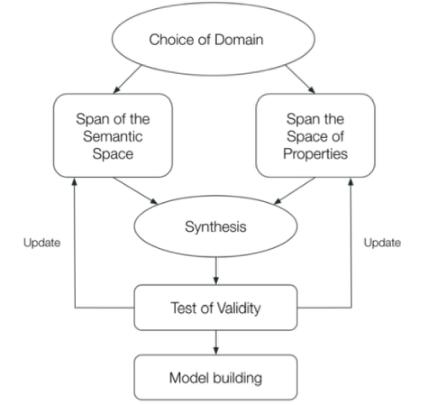
As of now, there are eight types of KE (Lokman, 2010) still evolving and changing according to new studies being developed. In this project we are applying the Type I: Category Classification. It’s a breakdown concept method that uses a tree structure to associate customer affective needs to products’ physical parameters (Schütte, 2002). This research employs the “Words”gateway to reach the Kansei and for this method we follow the steps presented in the original model of conducting Kansei studies in Figure 1.
Domain We start by defining the product’s domain, that will be the main object of study and also the target group for this same product (Marco-Almargo & Lla- brés, 2014). This Domain was defined as: Sport wear to workout at the Gym; with Women as the target group. It considers “outfits” as well as individual garments within the sportswear category, more accurately, general clothing women use at the gym that does not target any sport or specific workout.
Finding Tendencies of Outfits for Gym Workout Based on the User Emotions 3
Figure 1: The original model for conducting Kansei engineering studies (adapted from (Schütte et al., 2004)).
Span of the Semantic Space Succeeding with the Span of the Semantic Space, we collect the Kansei Words (KW) that emotionally describe the product (Marco-Almargo & Llabrés, 2014). This phase is initiated with the collection of the low-level Kansei words, as in-depth as possible, that cover the chosen domain through various sources. A total of 89 low-level KWs were collected from previous litera- ture studies, social networks such as advertisements, social media platforms, marketing of sports and gym wear, online interviews and competitors. In this phase was applied Schütte’s method of KW selection (Schütte, 2013) through three main steps: Elimination of duplicates or non-applicable words, remaining 71 KW; Affinity Diagram, remaining 20 KW; and Experts opinion, achieving a total of 5 final KW: Elegant; Can do the exercise; Flashy; Con- fident and Stimulated. The KW “Can do the exercises” is further referred to as “Functionality” for an easier reading and understanding of the following process.
These 5 KW were grouped with their respective direct opposite word and the final set of pairwise KW consists of: Elegant – Vulgar; Can do the exercise Easily - Can do the exercise With Difficulty (Functionality); Flashy – Discrete; Confident – Shy; Stimulated – Bored.
Span the Space of Properties The properties are the design attributes of the product which can be collected considering several different values although the emotional response that an attribute can inflict on a person is majorly prioritized (Marco-Almargo & Llabrés, 2014). Similar to the collection in Span the Semantic Space, diffe- rent sources were used for this section. Firstly, a few of the properties were
found through the same Literature Review and Online Search of the “Colle- ction of Low-level KW”, following with interviews with potential consumers and later discussed with experts (fashion design colleagues). The interviews were conducted in Portugal and Switzerland simultaneously with 13 num- ber participants from each country. The target group was female individuals with no age restriction. After gathering all the words, these were later sorted through elimination of the non-applicable words, attempts of initial sketches and a careful selection with experts, until the remaining properties remained: color; fitting; and pattern. In Table 1 we present each Property and their corresponding levels.
The details of the outfits were reduced to minimum, so it won’t influence the outfit choice during the data collection phase, creating unintended results. For the type of material, we opted for a seamless texture simulating the fabric often used in legging. The pattern was decided to be the same color as the base color in the non-existing pattern level.
Two color samples were tested due to some discussions with experts, the turquoise group of outfits demonstrated to be more impartial to the gender topic, however it was noticed that this color saturation changes significantly from each screen type (computer, phone or tablet screen) making it seem more green or blue depending on the device. On the other hand, the pink color was described as more flashy, drawing more attention to it than the turquoise. Therefore, in the pre-test, 60% of the participants stated that they identify more with the pink outfits as it’s a color they always see at the gym while the other 40% mentioned that the turquoise color reminds them of medical garments such as nurse or dentist uniforms, making pink the main final color for the outfits.
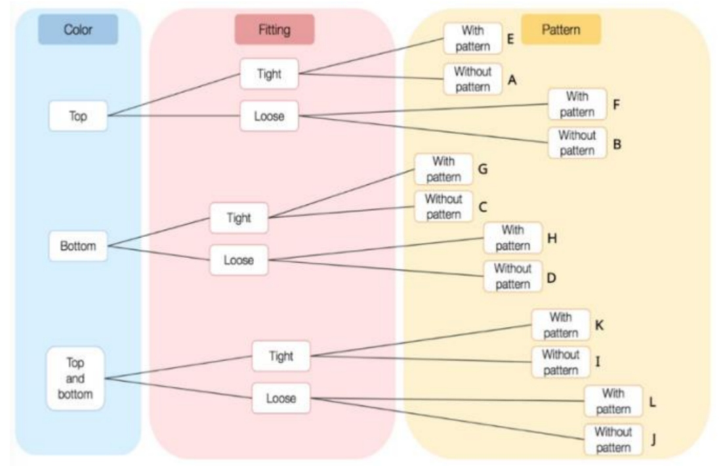
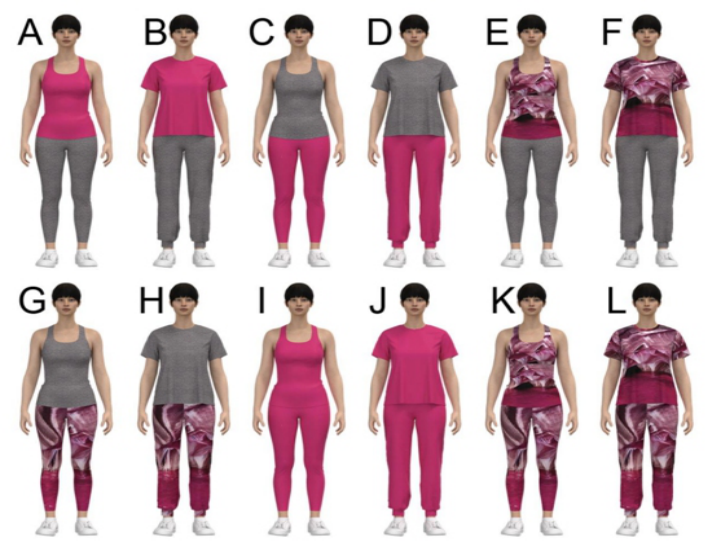
In Figure 2, the Levels of the Properties are associated among themselves creating a tree structure for the final compilation of outfit outcomes. Each branch from A to L matches with the outfits labeled the same way in Figure 3, which are the final outcome of the outfits of this research.
Synthesis Having collected all high-level KW along with the designed products accor- ding to the properties established, it is time to approach the consumer emotions, feelings and perceptions. Following the KE Type I, a method that is the most widely used since it can operate with the average data collected from all participants and aim for the KW and different Stimuli (Nagamachi, 1995), each Kansei word will connect to all the number of product properties (Schütte et al., 2004). For the possibility of the usage of physical parameters
Table 1. Final properties and levels distribution table.
Table available in the original PDF paper.
Property Property Label Level 1 Level 2 Level 3 1 Color Top Bottom Top and Bottom 2 Fitting Tight Losses - 3 Pattern With Pattern Without Pattern -
Finding Tendencies of Outfits for Gym Workout Based on the User Emotions 5
Figure 2: Tree structure of the combination between levels.Figure 3: Final pink version of the outfits.
to predict how a certain characteristic will make the user feel, the prediction model has to show us the evidently strong correlation between those product physical properties with the user’s emotions (Schütte et al., 2004). This makes
the synthesis phase the fundamental area of KE, making it a distinct methodo- logy compared to the other employed in the emotional design area (Schütte, 2005).
Collecting and Compiling Data Two questionnaires were made using Google Forms, one in Portuguese and one in french. Through Semantic Differential (SD) scales, from 1 to 7, we collected how the participant feels based on the predictions of using the outfit during gym workout. Both questionnaires were shared through online platforms like Facebook, Instagram, WhatsApp message and direct messages to the target group, in addition to field approach only in Switzerland; The Collecting Data took 1 month and 2 weeks to achieve a reasonable amount of responses. From the Portuguese questionnaire we obtained 159 responses while on the French one there were 110, which accumulated to a total of 269 participants, with a total age average of 33.19.
Results Linking the outfit properties with the KW is the main point of KE. In the synthesis phase it is necessary to understand the connection between the outfit properties and the respective main Kansei evoked on the consumer minds.
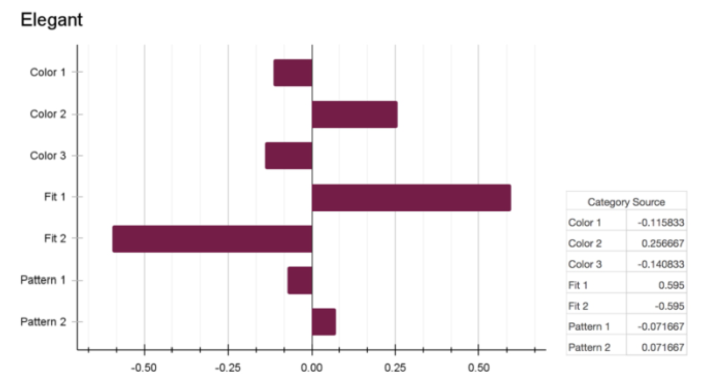
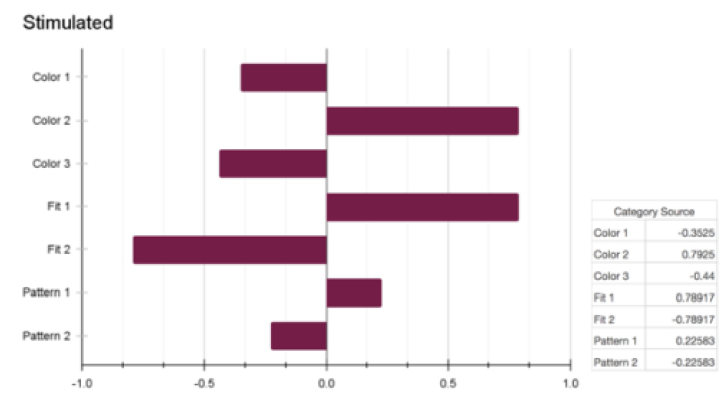
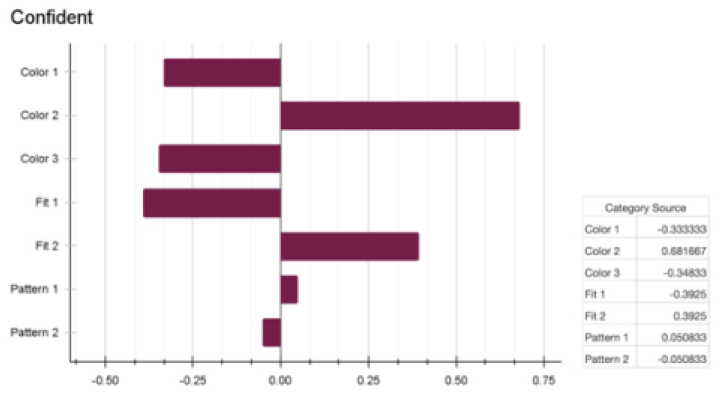
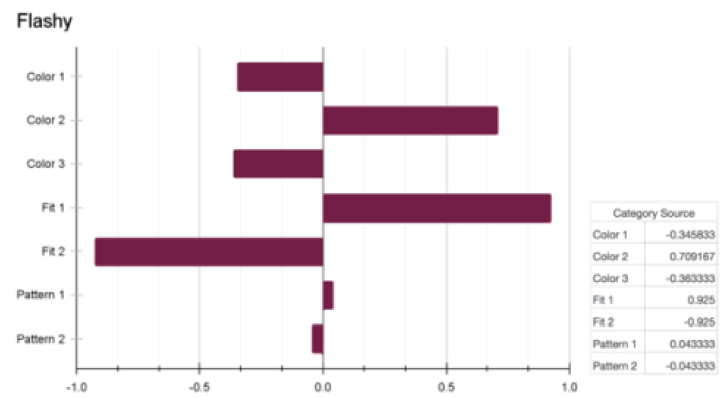
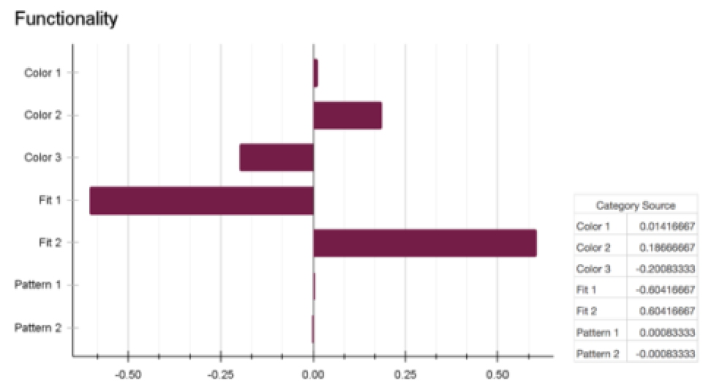
By this, the results of the Kansei were represented by graphics (Fig. 4, 5, 6, 7 and 8) for each Kansei word, from both countries’ questionnaires combined. These graphics can be interpreted as follows: Properties with posi- tive values influence positively a KW and properties with negative values influence negatively a KW. The intensity of this influence is set by the value.
It is interesting to note that some properties, assumed as known common sense, such as tight being considered elegant, match with the obtained results, while properties such as the pattern bring unexpected results, which demon- strates the richness of this work and the importance that it brings to fashion design.
Figure 4: Kansei results for KW elegant.
Finding Tendencies of Outfits for Gym Workout Based on the User Emotions 7
Figure 5: Kansei results for KW stimulated.Figure 6: Kansei results for KW confident.
Validation and Kansei Model As mentioned before in the Literature Review, it’s very much encouraged to have a Validation test since it can appraise the results acquired and test input and output data. A predictive model can now be created based on the information from the last 5 graphics with the Total of both questionnaires results. The Kansei Model in Table 2 was created through the application of the Quantification Theory Type I (QT1) - in which each KW is matched with each product property and shows it’s positive or negative emotional influence in evoking the Kansei.
Figure 7: Kansei results for KW flashy.Figure 8: Kansei results for KW functionality.
With the predictive model now we can interpret its data accordingly. Should the designer, with these outfits, focus strongly on evoking one specific Kansei, namely:
Elegant, then it should have the color on the bottom, with pattern, neutral color on the top and a tight fit (example: outfit G);
Functional, then it should have either: color on the top and neutral color on the bottom and a loose fit; or color on the bottom with neutral color on the top and a loose fit. In this KW, the pattern has almost no influence, leaving it to the designer’s decision on how to manipulate this property (example: outfits B, F, D and H);
Finding Tendencies of Outfits for Gym Workout Based on the User Emotions 9
Table 2. Kansei model – guidelines for the design of an outfit (to workout at the gym) to evoke specific Kansei (KW).
Table available in the original PDF paper.
Product Properties Color Fit Pattern
KW Top Bottom Top and Bottom Tight Losses Without pattern With pattern Elegant − + − ++ −− − + Functionality + + − −− ++ Flashy − ++ − ++ −− + − Confident − ++ − − + + − Stimulated − ++ − ++ −− + − ++ Strong postive evoke of the kansei + Moderate postive evoke of the kansei −Moderate negative evoke of the kansei −−Strong negative evoke of the kansei
Flashy, then it should have color on the bottom, without pattern, neutral color on top and a tight fit (example: outfit C);
Confident, then it should have color on the bottom, without pattern, neutral color on top and a loose fit (example: outfit D);
Stimulated, then it should have color on the bottom, without pattern, neutral color on top and a tight fit (example: outfit C).
PROTOTYPE For the purpose of validating the Kansei model we propose a usa- bility study as an application of this study’s’ results in the industry, specifically the online fashion retail. A website of low-fidelity was developed in order to reflect its possible application. Available Link: https://mariyatoma.wixsite.com/website-1.
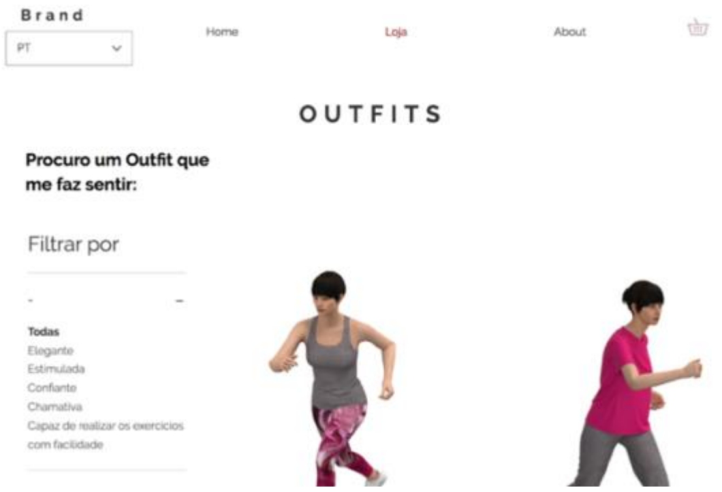
This website relies on the results of this research and the outfits present in the website are the ones used in this project, making this prototype an example of what this methodology can bring to the online fashion market. For a completely functional website of this kind, it’s needed a continuous work of database construction and maintenance that covers a large enough amount of all kinds of outfit properties with different colors, patterns, styles, fabrics, flow, etc., as well as a much vaster span of the semantic space. This prototype is a simulation of an online store that sells gym wear for women. On the “Store”page (Figure 9) we have the main application of this research: the “Filter”. This is the most common interactive function of an online store, not only from fashion design but also other fields and in this prototype the “Filter”feature does not search product properties but the Kansei words: Ele- gant, Stimulated, Confident, Flashy or Capable of doing the exercises easily (Functionality).
This is one of the ways to implement the results of this methodology, that focus on consumers’ emotions to improve the user experience and stand as a virtual fashion advisor that offers clothes combinations based on human- centered studies that bring a new value to the outfits on display by offering a necessity that consumers aren’t able to detect or express through normal situations.
Figure 9: Store page of the website prototype.
The objective of these studies is to validate the results obtained throughout this research and narrowed to the Kansei Model (Table 2). With a total of 12 participants, 6 women from Portugal and other 6 from Switzerland, with an average age of 29 years old, similar to the average from the previous phase. By creating a scenario for the participant to enter a context where he is a customer navigating an online store, the participants navigated the website and completed a few tasks until selecting a final outfit for purchase.
The usability tests proved to be very successful as more than 80% of the participants showed to be satisfied with the prototype, result of this research, and would like to see its implementation in the online market. There was a filter that showed to be a favorite among the participants, the “elegant”filter, while others were questioned why they had those specific outfits there and why not on another filter for example, the outfits in “flashy”should also be in “confident” and vice versa. Overall, it’s a matter of informing the consumer how these studies are made and how we got to the outputs we present to them. A main point often mentioned was a body type filter for the purpose of crossing the existing filters with a body type shape since some participants couldn’t identify with the outfits displayed because it doesn’t suit their body type.
RESULTS
By the means of the Kansei method we could achieve the following results: the words Flashy, Confident and Stimulated proved to have levels with higher value of evoking the Kansei (emotions) because their positive values reach a
Finding Tendencies of Outfits for Gym Workout Based on the User Emotions 11
maximum of ≈0.9; ≈0.7; and ≈0.8 respectively; while the levels of the other two KW studied, Elegant and Functionality reach only a maximum positive value of ≈0.6. This indicates that the first three words better translate the emotional reactions occurring from the anticipation of the usage of outfits to workout at the gym. However, the usability studies of the website proved that the customers give more importance to the word “elegant”, as 50% of those interviewed returned often to that filter. This could mean that even though the word elegant doesn’t classify as a better translator of emotions, it is one that customers look for the most.
CONCLUSION
This project proved to bring very interesting data for the fashion design field, both in the designers’ creative process and in the online fashion market. After applying the Kansei methodology we arrived at a predictive model that can give us the information on how we can translate product properties into emo- tions, by the use of Kansei words, from an anticipation of the use of a certain product, in this case study, outfits to workout at the gym. We could then determine what kind of outfits can be developed by a set of properties that women associate to workout clothing. From the results we can also determine that the words “flashy” and “stimulated” better translate emotions than the other KW studied.
For the creation of the predictive model we can confirm that the Kansei method was the right methodology to be used for this context and the pre- dictive model is accurate due to the long process of this method. It is also proved during this project that the results of the Kansei method can be also applied, not only as an aid to the design process but also in online shopping, and with a high expectation of a near future implementation at that. The final validation and usability tests proved to be successful since more than 80% showed to be satisfied in the interaction with the website and the out- fits available. The Kansei method has proven, through this research, that it can work not only with one isolated garment, but also with garments coordi- nation (outfits). Although there are still inconsistencies and mistakes detected throughout this project, its innovation and importance were noticed by the target group and it’s expected to be improved and actually implemented in future practices of fashion design.
Regarding the fashion design itself, we already have the success studies from Nagamachi & Lokman (2011) on the Good-up bra, that ended up star- ting a new era for the bra industry, and a recent study on creative process and product innovation that proves that this methodology can work in accorda- nce with innovation, not losing it half way (Wagner et al., 2018). Both studies bring reassurance to the fashion design field that this methodology is capable of bringing valuable information and crucial results for the industry.
ACKNOWLEDGMENT
National funds finance this work through FCT - Fundação para a Ciência e a Tecnologia, I.P., under the Strategic Project with the references
UIDB/04008/2020 and UIDP/04008/2020 and ITI -LARSyS-FCT Plurian- nual funding’s 2020- 2023 (UIDB/50009/2020).
REFERENCES
Bridger, D., 2017. Neuro Design - Neuromarketing Insights to Boost Engagement & Profitability. KoganPage. Duarte, E., 2020. Como ser Humano num Mundo Tecnológico [Vídeo Conferência].
Lisboa: ErgoUX. Farid, A. F., 2015. A study on the growing popularity and purchase of fashion product from online stores in India. IJRET: International Journal of Research in Engineering and Technology, 04(08). [Online] Available at: https://www.rese archgate.net/profile/Afrose_Farid/publication/301678962_A_STUDY_ON_THE _GROWING_POPULARITY_AND_PURCHASE_OF_FASHION_PRODUCT_ FROM_ONLINE_STORES_IN_INDIA/links/57218e9c08ae0926eb45c34b.pdf [Acessed in 2021]. Ishihara, S., Nagamachi, M., Schutte, S. & Eklund, J., 2008. Affective Meaning:
The Kansei Engineering Approach. Elsevier, 477–496. [Online] Available at: https://doi.org/10.1016/b978-008045089-6.50023-x [Acessed in 2022]. Lim, H. & Ko, H., 2011. (Fun) - FUN Fashion Design in the Emotional Consumption Era. DBpia; . [Online] Avai- lable at: https://www.dbpia.co.kr/Journal/articleDetail?nodeId=NODE06675768 [Acessed in 2022]. Lin, Y. et al., 2019. Improving Outfit Recommendation with Co-supervision of Fashion Generation (pp. 1095–1105). [Online] Available at: https://dl.acm.o rg/doi/pdf/10.1145/3308558.3313614?casa_token=Q8NOqstTEBgAAAAA: flm3ruCVeh30vZwGmUeGkUqelZErXMxXeOGykbpDQBGjO9ySxjPVq5nCX 1HRi6WhOL0CSz8-Wa5k [Acessed in 2021]. Lokman, A., 2010. Design & Emotion: The Kansei Engineering Methodology. Uni-
versiti Teknologi MARA (UiTM) Malaysia, 1(1), 1–14. [Online] Available at: https://ir.uitm.edu.my/id/eprint/11102/1/11102.pdf [Acessed in 2022]. Marco-Almargo, L. & Llabrés, X. T.-M., 2014. Application of Kansei Engineering to Design an Industrial Enclosure. Papers of the 14th Annual ENBIS Conference. Nagamachi, M., 1995. Kansei Engineering: A New Ergonomic Consumer-Oriented
Technology for Product Development. International Journal of Industrial Ergo- nomics, 15(1), 3–11. Nagamachi, M., 2002. Kansei engineering as a powerful consumer-oriented technology for product development. Applied Ergonomics, 33(3), 289–294. [Online]. Available at: https://doi.org/10.1016/s0003-6870(02)00019-4 [Acessed in 2022]. Nagamachi, M. & Lokman, A. M., 2011. Innovations of Kansei Engineering
(Industrial Innovation). In CRC Press. CRC Press, Taylor & Francis Group. Ok, M., Lee, J.-S. & Kim, Y. B., 2019. Recommendation Framework Combining User Interests with Fashion Trends in Apparel Online Shopping. MDPI, 9(2634). Schütte, S., 2002. Designing Feelings into Products: Integrating Kansei Engineering
Methodology in Product Development [Licentiate Thesis]. Schütte, S., 2005. Engineering Emotional Values in Product Design - Kansei Engineering in Development [PhD Thesis in Science and Technology]. [Online]. Schütte, S., 2013. Evaluation of the affective coherence of the exterior and interior of
chocolate snacks. Food Quality and Preference, 29(1), 16–24. [Online] Available at: https://doi.org/10.1016/j.foodqual.2013.01.008 [Acessed in 2022].
Finding Tendencies of Outfits for Gym Workout Based on the User Emotions 13
Schütte, S., Eklund, J., Axelsson, J. R. C. & Nagamachi, M., 2004. Concepts, methods and tools in kansei engineering. Theoretical Issues in Ergonomics Science, 5(3), 214–231. Sinha, P., 2002. Creativity in Fashion. Journal of Textile and Apparel, Technology
and Management. [Online] Available at: https://www.researchgate.net/profile/P ammi-Sinha/publication/237334691_Creativity_in_fashion/links/0deec5343dcb daae8c000000/Creativity-in-fashion.pdf [Acessed in 2021]. Taura, T. & Nagai, Y., 2011. Design Cratvity 2010. [Online] Available at: https://books.google.ch/books?hl=en&lr=&id=caiI3oD2ztsC&oi=fnd&pg=PP5& dq=fashion+design+creativity&ots=MxL6a9kalA&sig=-AlVD-paStuXnvTODG kYI5uIdT8&redir_esc=y#v=onepage&q=fashion%20design%20creativity &f=false [Acessed in 2021]. Wagner, M. et al., 2018. Environmentally-Friendly Perception of Fashion Products:
A Kansei Study. In Books (pp. 369–378). Springer Nature Singapore. [Online] Available at:https://books.google.ch/books?hl=en&lr=&id=IjtRDwAAQBAJ&oi =fnd&pg=PA369&dq=kansei\protect$\relax+$fashion\protect$\relax+$design& ots=biXyiiT61X&sig=M0djODqCGBH-eNV2bav0ytoIiYQ&redir_esc=y#v=o nepage&q=kansei%20fashion%20design&f=false [Acessed in 2022]. Zhao, L. & Zhou, J., 2015. Analysis on the Advantages and Disa- dvantages of Clothing Network Marketing. International Journal of Business and Social Science, 06(04). [Online] Available at: http://ijbssnet.com/journals/Vol_6_No_4_1_April_2015/17.pdf [Acessed in 2021].
LISTED IN THE AHFE DIGITAL BOOKSTORE CATALOGUE
Explore the complete digital volume
Ergonomics In Design
Read this individual research paper free through the original publisher, or explore the full digital proceedings book.
ISBN 978-1-958651-53-7
Explore this ISBN in the AHFE Bookstore ↗Listed in the July 2026 bookstore catalogue; search by ISBN to confirm current availability · Digital book purchase optional