New design concepts and paradigms enable innovations that not only apply to the technological environment, but also result in great opportunities to generate relevant social impacts. A good example is the use of creative tools for adaptability of buildings, such as Biomimicry that makes it possible to bring inspiration from nature to inspire new ideas. The circular economy is a model that combines economic development with responsible use of natural resources and minimizes environmental impact. It reinserts waste back into the production process, using it as raw material for new products and reducing the volume of waste that reaches nature. On the other hand, digital manufacturing allows the production of non-standard construction components through parametric modeling, and additive or subtractive manufacturing. This optimizes production time and allows new compositional configurations without wasting resources. In this context, Biodesign principles are a viable and effective option. Thereby, this article intends to reflect on the architecture of popular housing, making the interaction between the concepts of the biodesign with the technological resources and the new paradigms already mentioned, resulting in something that we can classify as eco-parametric architecture. For this purpose, we will analyze the social context of the residents of the city of Recife, Brazil. Thus, in order to reflect on how the design professional can contribute to solve the lack of housing that persists for decades, this article intends to propose a concept of eco-parametric architecture for low-income housing that involves such innovations.
Digital fabrication has been a great ally in the growth of popular housing, as it has made it possible to build houses without the need for bricks, cement and mortar. Through CAD computer software, 3D printing of cement and CNC milling machines, true examples of technological innovation, it is possible to create small housing spaces, which can assist in the process of social inclu- sion of homeless people (BORGES, 2016), transforming social structures and promoting dignity.
Countries in economic growth such as Brazil are places of great social challenges, where industrial advancement has not coincided with the acqui- sition of basic social rights. This is the case of Recife, capital of the state of Pernambuco located in the Brazilian Northeast, a city with about
Eco Parametric Architecture: Circular Design & Digital Fabrication 15
10,000 homeless people (IBGE, 2020), sleeping on the streets, subject to natu- ral weather, fires, and other social dramas. The lack of housing in Recife can be reduced and even solved through new technologies that can drastically reduce the costs of these facilities.
Through the circular economy it is possible to transform the largest pollu- ting and abundant source in the city of Recife, the plastic, into raw material for the construction of houses. From manual collection made by rubbish col- lectors, the discarded plastic goes from useless to a precious item of solidarity and economy.
In this scenario, parametric design can provide projects with greater ada- ptability, fitting and flexible parts, capable of building economical and efficient popular dwellings. Since it is very practical to assemble, as it does not use nails or screws, it also saves resources.
Like digital fabrication, the mini houses and the Wikihouse system are via- ble solutions for popular housing that can be even more efficient if added to social design, which proposes an environmentally responsible manufacturing.
Therefore, this paper aims to present architectural solutions for housing of people in social vulnerability in the city of Recife (Brazil) based on digital fabrication technologies having as premise the circular economy and the eco- parametric fabrication.
ANALYSIS OF THE SOCIAL CONTEXT OF THE HOMELESS POPULATION OF RECIFE Initially, the spaces of reference to meet and welcome the homeless population are based and developed, mainly by the process of welfare democratization that, despite the constitutional advances, occurred slowly and late for social rights to be really considered.
In this context, the different numbers referring to economic, social, politi- cal, psychological and urban aspects, which involve the complexity and need in several fields such as health, social assistance, housing, and education, the inequality produced by the urban scenario forces people living on the streets to appropriate places, being most often in squares, parks, gardens, overpas- ses and degraded areas such as old abandoned buildings on a temporary or provisional basis.
However, in 2020, it was estimated by the Institute of Applied Economic Research (IPEA) that the homeless population in Brazil grew about 139%, having thus, consequently, the total number of approximately 221,869 peo- ple living in precarious conditions on the streets. Moreover, according to CadÚnico (2021), a preliminary analysis of the data of this population betw- een the months of December 2021 and May 2022, it was noted the growth around 16% - desolating numbers in the midst of a pandemic and social crisis.
Currently, the Metropolitan Region of Recife is considered the area of highest concentration of homeless people in Pernambuco. According to Lucila Bezerra (2022), in an article linked on the website Brasil de Fato-Pernambuco, there was an increase from 1.4 thousand to 10 thousand more people approximately living on the streets of the city, which reports
a population of 1.6 million inhabitants (IBGE, 2020), data recorded in the period before the pandemic of COVID, in the census of 2019.
Recently, in December 2022, another count synthesis was elaborated in a publication in JC de Pernambuco by the Journalist Katarina Moraes (2022), in which more than 520 homeless families were identified in active occupations in abandoned properties in the city center. Rare events in the Metropolitan Region caused by the economic crisis aggravated by the covid-19 pandemic and the rain emergency, leaving thousands of peo- ple displaced and homeless (the increase was 24.6% of people in these conditions).
In the register based on the Survey of the Homeless Population (Pessoa em Situação de Rua – PSR, in Portuguese) of Recife in 2022, it was registered the existence of 2,022 homeless people located in the Administrative Political Regions of Recife (RPA), in Specialized Reference Centers for the Homeless People, referenced as POP Centers, spaces aimed at serving the vulnerable population that lives in the center of Recife and makes available the services of assistance, where they have professionals who welcome them.
A partnership between the Municipality of Recife and the Federal Rural University of Pernambuco (UFRPE) intends to disclose, still in 2023, the par- tial count of people who depend on the city streets to live or earn income. According to UFRPE professor Humberto Miranda (2022), the census that has been taking place since August 2022 will be concluded and presented with complete information, not only the numerical dimension of homeless population, but the general detailing of schooling, gender, income, social car- tography of the city, and information about the interviewees that will be able to provide a basis for projects aimed at them.
NEW MANUFACTURING AND POPULAR HOUSING New means of production are gradually changing the scope of civil constru- ction in the world context. Technological innovations optimize production time and enable new construction methods, generating greater autonomy for the designer, architect, or engineer. In this way, innovative solutions can be found for social problems that have been around for years and that, despite being well known, seem to be unsolvable.
Technological innovation, through digital fabrication, could change the ways of interaction between the agents of civil construction, as presup- posed by Kolarevic, but with the objective of no longer promoting an increase in productivity through the surplus value of the worker, but to develop an emancipatory practice, in the sense of building a learning that transforms social processes and structures that exclude the majo- rity of the population, creating solidary relations through development (KOLAREVIC, 2003 as cited in BORGES, 2016).
In this aspect, digital fabrication is a tool with enormous potential to transform the current reality into a new and promising scenario. In sum- mary, digital manufacturing is a means of producing objects that uses digital
Eco Parametric Architecture: Circular Design & Digital Fabrication 17
resources through Computer-Aided Design (CAD) software, which are three- dimensional modeling software and 2D vectors to be used as cutting or printing plans and sent to the CAM (Computer-Aided Manufacturing) equi- pment responsible for making the artifact, either additively or subtractively. This machinery can be a laser cutter, a CNC milling machine, or a 3D prin- ter, among others. Historically, digital manufacturing began to be used in the 1950s in the aviation and automotive industries, and every day it has evolved more and more accessible.
In Brazil, the social housing construction sector generally uses the masonry house model as the recurring standard, and the promotion of popular hou- sing construction is under the responsibility of the government, which often does not meet the necessary demand. Therefore, it is important to rethink solutions and new actors that can change the current scenario, and design through digital fabrication may be the way to go. Next, it will be demonstra- ted some trends, construction examples, and technologies that can inspire new solutions.
MICRO-HOUSING SCENARIO There is a worldwide tendency to reduce more and more housing spaces, mainly due to the high real estate prices in big cities, the obtainment of higher profits by construction companies and new trends in the way of life that reflect on housing. According to the website Psicologias do Brasil (2022), a clear example of this scenario occurs in Tokyo, Japan, where mainly young college students or young people starting their careers opt for this type of hou- sing, which is affordable and well located in a populous city like the Japanese capital.
In Brazil there are also examples of micro dwellings, often still seen as something eccentric, restricted to inns, as a tourist attraction or a unique experience. A good example are the “mini houses” located in Sorocaba in the countryside of São Paulo. According to Bruno Dias (2022), the four mini houses vary between 9 and 12m2, which are placed in a place called Bosque Encantado (Enchanted Forest) with 3,000 m2 of green area. Each house has a different theme, decoration, and construction technique, affectionately named “Brasileira”, “Holandesa”, “Amarelinha”, and “Carioca”.
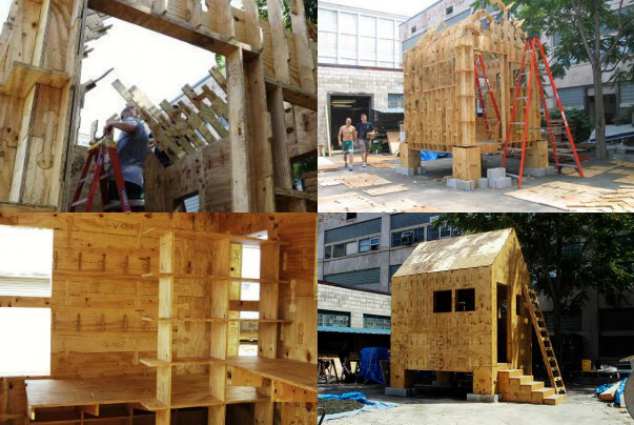
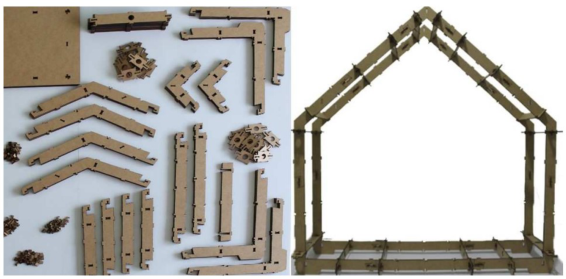
However, the experience of small housing is not restricted to tourism. A relevant case is the one developed by Eduardo Sampaio Nardelli and Vinicius Juliani Pereira (2017) both from Mackenzie Presbyterian University. The pro- ject consists in the investigation of Digital Fabrication in the construction of social housing in an innovative way. As a result, the group chose to use the subtractive method and use the open source Wikihouse system, which con- sists of house designs that can be downloaded for free on the internet. The houses are designed to be built from CNC machined parts into structures that can be assembled easily like a puzzle, by anyone with no training or background in construction or carpentry Figure 1.
The research has shown not only the possibility of executing decent hou- sing but has also opened a range of possibilities regarding manufacturing material, cutting, and ease of assembly.
Figure 1: Prototype housing structure inspired by the wikihouse. Source: Nardeli; Pereira, 2017.
3D PRINTING AND CONCRETE The 3D printing of cement is already a promising reality in the field of civil construction, and with the technology it is possible to print houses efficien- tly, quickly, and avoiding the waste of materials, besides lowering the price of production. The technique follows a principle similar to other additive manufacturing: the overlapping of layers. What differs is the scale of the equipment and the material to be printed, the cement, which requires speci- fic care in relation to the machinery and the weather conditions of the place to be used.
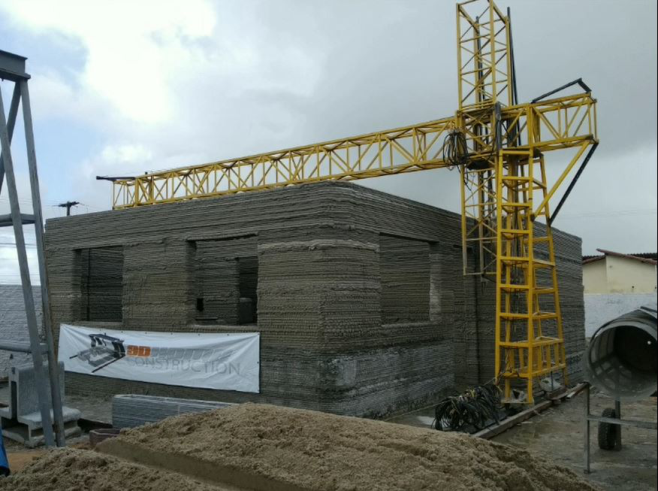
A good reference of the application of this technology is the project of the company 3DHomeConstruction, formed by a group of 3 engineers from Natal - RN (Brazil) and who are responsible for the first 3D printed house in Brazil. This technology allows large-scale production and printing of more complex building patterns of the usual standards (Cunha, 2020).
The entire mechanism and devices used in this technology are capable of being used to provide affordable housing quickly, efficiently, and economi- cally. The machinery, however, is the main challenge for a developing country Figure 2.
CNC MILLING CNC milling machines are another technology capable of promoting affor- dable housing, because they allow the grinding of the part through a rotating cutter that can move in 3 axes (X, Y, Z) or more (the higher the number of axes the more complex the model). The cutting plan is defined by computer- generated CAD drawings and the parameters, such as cutting speed, plate height, origin point, among others, are configured on the CAM platform of the machine from the generated G-Code. The use of CNC milling machines is
Eco Parametric Architecture: Circular Design & Digital Fabrication 19
Figure 2: Prototype housing structure inspired by the wikihouse. Source: Nardeli; Pereira, 2017.
quite diverse, allowing the cutting of various materials such as wood, plastic, and even non-ferrous metal plates.
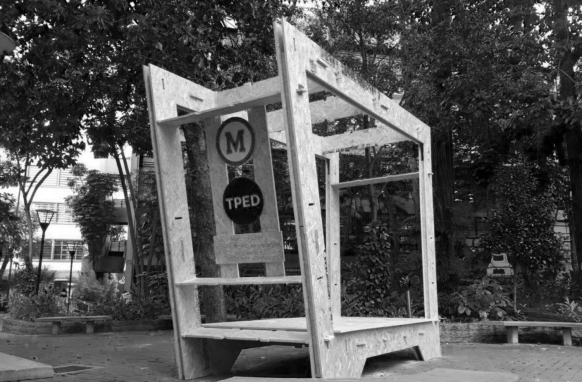
To illustrate, it is possible to see in Figure 3 a housing built from CNC milling, the “Instant House” (Campolongo, 2019). This is a building project for low-income and emergency situation people that focused on practicality of assembly, low cost, and ease of transportation. CNC machined wood parts were used that were assembled by fitting together.
Equally quick and inexpensive mechanism, capable of taking people out of social vulnerability.
PLASTIC RECYCLING Recycling plastic is a possible resource to be used in the construction of popular housing because besides the ecological benefits it also generates social impact by including various actors in the process, such as the waste picker community, designers, makers, engineers, and other people interested in collaborating with a more sustainable society.
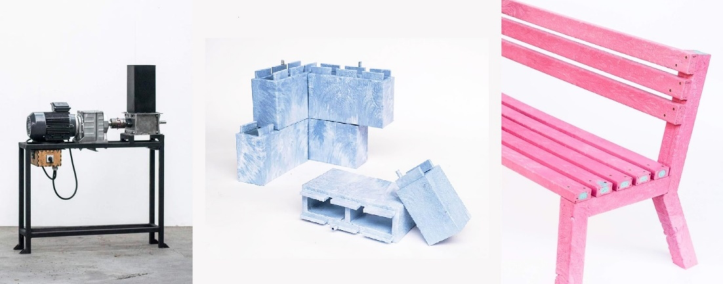
One model that is already well structured and can be applied is Precious Plastic, an open hardware plastic recycling project with several machines that shred, melt, press and inject the plastic. Precious Plastic aims to bring people together through its Internet platform in which it provides clear and strai- ghtforward instructions on how to start the recycling process in small steps Figure 4.
Figure 3: Instant house prototype. Source: Campolongo, 2019.Figure 4: Plastic crushing machine, brick (structural piece), and a bench. Source: precious plastic.
There are several possibilities of working, from simply separating the recycled waste correctly to creating the entire recycling network and deve- loping spaces with the project’s machinery.
Since plastic is one of the biggest polluters and a practically inexhaustible source in urban cities, which is also the case in the city of Recife-Brazil, its use in the production of pluggable parts for housing construction is feasible since the manual plastic collection system made by waste pickers would initiate a circular economy process. The plastic removed from rivers and streets by the collectors would serve as raw material for the construction of houses for the collectors themselves, besides involving other local and national agents in this cycle.
Eco Parametric Architecture: Circular Design & Digital Fabrication 21
PLUG-IN PARTS As previously mentioned, both the Wikihouse and the Instant House models use fittings to join structures. This possibility allows greater practicality at the time of assembly and saves resources, as it does not require extra fastening parts such as hardware, nails, or screws Figure 5.
Figure 5: pluggable parts wikihouses. source: Branco; Canuto, 2017.
PARAMETRIC DESIGN Finally, another well-known trend is parametric design, especially in this con- text of housing production that does not follow the hegemonic pattern, as the complexity of shapes obtained from generative algorithms allows creating morphological complexity in an effective way, even when design inspiration comes from nature, enabling the use of biomimicry concepts with propriety.
Biomimicry, which consists of “conscious imitation of the genius of life. (...), inaugurates an era whose foundations are based not on what we can extract from nature, but on what we can learn from it” (Benyus, 2016, p.10). It is a nature-based innovation that has changed design concepts and paradigms. In other words, inspiration is sought in forms, specificities, interrelations and behaviors of living organisms to propose innovations, for example, for environments, objects, graphic and electronic works (Arruda, 2010; Rossin, 2010). To understand the importance of this movement, it is worth remembering that the first great wave of the environmental movement began between 1960 and 1970, when ecology began to be talked about, giving rise to the model of “alternative design”, later “green design” and later until the present day of today “ecodesign”.
For some time now, the publication of the book “Design for the Real World: Human Ecology and Social Change” (1985) by Victor Papanek, has been criticizing the design profession, which encourages consumption and degrades the environment, and the paradigm of “Form follows Function”. The work was responsible for taking the designer out of his comfort zone and looking at the real world of miseries, wars and hunger.
Since then, design, “the language that molds objects and makes the mes- sages they carry” (Sudjic, 2010, p. 21) begins to look at ecological and humanitarian issues.
CONCLUSION
From the survey of existing technologies, it is clear that there is already enough technology for the construction of low-cost housing, low ecological impact, efficient and quick to be applied.
The micro dwellings mentioned in the article reinforce the idea that it is possible to have minimal units in a rational way, providing maximum comfort in an extremely small environment.
Among the techniques mentioned, printing with cement is a resource that is still inaccessible, and it centralizes actions in the engineering team (produ- ction), not being ideal for the context of the city of Recife-Brazil. The CNC cut parts make it possible to manufacture new construction patterns, opti- mize production time and enable the manufacture of pluggable parts, which can be easily implemented.
The parametric design allows projects outside the recurring standards and with greater complexity and with re-adjustable parameters, excellent for the unhealthy conditions of the studied city. And finally, plastic recycling, which can be a powerful tool for social inclusion, through the creation of a commu- nity system for collecting, shredding, melting, pressing, and injecting plastic. This raw material can generate a huge variety of structural parts, such as fit- tings, wall, or roof tiles, as well as decorative and functional objects, such as kitchen sinks, cupboards, benches, etc.
Technologies like these can provide more than 10,000 people with digni- fied housing amidst the difficulties of urban life.
REFERENCES
Arruda, Amilton. Como a biônica e biomimética se relacionam com as estruturas naturais na busca de um novo modelo de pesquisa projetual. Brasil: UFPE, 2010. p. 1–9. Retrieved from https://fido.paler-mo.edu/. Access on 27 Dec. 2022. Benyus, Janine M. Biomimética: inovação inspirada pela natureza. Editora Cultrix,
2016. Bezerra, Lucila. (February 21st 2022) Recife: faltam dados para guiar políticas sobre população de rua. Retrieved from https://www.brasildefato.com.br/2022/02/21/ recife-faltam-dados-para-guiar-politicas-sobre-populacao-de-rua.html. Borges, Marina Ferreira. Fabricação digital no Brasil e as possibilidades de muda-
nça de paradigma no setor da construção civil. In: Ambiente Construído, Porto Alegre, vol. 16, no. 4, pp. 79–91, out./dez. 2016. ISSN 1678–8621 Associ- ação Nacional de Tecnologia do Ambiente Construído. Retrieved from https: //dx.doi.org/10.1590/s1678-86212016000400106. Branco, Bruna; Canuto, Robson; Cantalice, Aristóteles. Fabricação Digital Aplicada à Habitação de Caráter Emergencial: Um estudo sobre a adaptação de WikiH- ouses ao contexto ambiental brasileiro. In: SIGraDi - Congreso de la Sociedad Ibero-americana de Gráfica Digital, XXI, 2017, Concepción, Chile. Campolongo, Eduardo Luisi Paixão Silva. MACKHAUS: Fabricação Digital Sub-
trativa Aplicada à Produção de Habitações por Meio de Encaixes em Madeira.
Eco Parametric Architecture: Circular Design & Digital Fabrication 23
Orientador: Professor Dr. Charles de Castro Vicent, 2019. p. 217. Dissertação (Master’s Thesis) - Programa de Pós-graduação em Arquitetura e Urbanismo, Universidade Presbiteriana Mackenzie, São Paulo, 2019. Cunha, Renato. 3DHomeConstruction constrói a primeira casa de impressão 3D do Brasil. Stylo Urbano, 2020. Retrieved from https://www.stylourbano.com.br/3dho meconstruction-constroi-a-primeira-casa-de-impressao-3d-do-brasil/. Access on January 30th 2023. Dias, Bruno. Mini casas de 9 m2 oferecem experiência minimalista no interior de SP.
Fatos desconhecidos, 2022. Retrieved from https://www.fatosdesconhecidos.com .br/mini-casas-de-9-m%C2%B2-oferecem-experiencia-minimalista-no-interior -de-sp/. Access on January 30th 2023. IBGE. Arranjos populacionais e concentrações urbanas do Brasil. Rio de Janeiro: IBGE, 2020. IPEA. Instituto de Pesquisa Econômica Aplicada. Atlas de vulnerabilities social dos
municípios brasileiros. Brasília: Ipea, 2020. Jovens japoneses preferem apartamentos de 9 metros quadrados: “Eu não moraria em outro lugar”. Psicologias do Brasil, 2022. Retrieved from https://www.psicologiasdobrasil.com.br/jovens-japoneses-preferem-apartam entos-de-9-metros-quadrados-eu-nao-moraria-em-outro-lugar/. Access on January 30th 2023. Moraes, Katarina. (December 15th 2022) Mais de 520 famílias sem-teto passam a ocupar prédios abandonados no Centro do Recife após chuvas e pandemia. Retrieved from https://jc.ne10.uol.com.br/pernambuco/2022/12/15140582-ma is-de-520-familias-sem-teto-passam-a-ocupar-predios-abandonados-no-centro- do-recife-apos-chuvas-e-pandemia.html. Nardelli, Eduardo Sampaio; Pereira, Vinicius Juliani. Autoconstrução, Fabricação
Digital e a Construção Autônoma. In: SIGraDi - Congreso de la Sociedad Ibero- americana de Gráfica Digital, XXI, 2017, Concepción, Chile. Precious Plastic, A Big Bang for Plastic Recycling, 2023. Retrieved from https://prec iousplastic.com/. Access on January 30th 2023. Prefeitura do Recife. (August 22nd 2022) Novo censo sobre população de rua do
Recife será divulgado neste mês. Website: https://www.cbnrecife.com/artigo/nov o-censo-sobre-populacao-de-rua-do-recife-sera-divulgado-neste.html. Rossin, Karen Jonhson. Biomimicry: nature’s design process versus the designer’s process. WIT Transactions on Ecology and the Environment, Miami, Estados Uni- dos, v. 138, p. 559-570, 2010. Retrieved from https://www.witpress.com/. Access on December 30th 2022. Sudjic, Deyan. A linguagem das coisas. Rio de Janeiro: Intrínseca, 2010.
LISTED IN THE AHFE DIGITAL BOOKSTORE CATALOGUE
Explore the complete digital volume
Ergonomics In Design
Read this individual research paper free through the original publisher, or explore the full digital proceedings book.
ISBN 978-1-958651-53-7
Explore this ISBN in the AHFE Bookstore ↗Listed in the July 2026 bookstore catalogue; search by ISBN to confirm current availability · Digital book purchase optional