Catarina Carreto, Rui Carreto (2026). Innovation in Design for Sustainability. In: Human Dynamics, Product Evaluation and Quality. AHFE Open Access, vol. 212, pp. 77–85. https://doi.org/10.54941/ahfe1007815
The intensification of ecological crises, resource scarcity, and social inequalities compels design to fundamentally redefine its role, methods, and criteria for innovation. This article argues that innovation in design can no longer be understood as the mere creation of new artifacts, but rather as the capacity to reconfigure systems of production, consumption, and disposal. Based on the widely recognized premise that the majority of the environmental impacts of products and services are determined during the design phase, the designer is repositioned as a strategic agent in the transition toward sustainable socio-economic models.Within this context, the article examines the synergistic articulation of four complementary approaches: Ecodesign, as an analytical foundation oriented toward life-cycle thinking; Circular Design, focused on redefining business models and material flows; Biodesign, which incorporates biological principles and processes; and Human-Centered Design (HCD), responsible for ensuring social, cultural, and ethical relevance. It is argued that the transdisciplinary integration of these approaches constitutes an emerging paradigm of systemic innovation in design, in which success is assessed according to interdependent environmental, social, and economic criteria, thereby demanding new professional competencies and expanded forms of collaboration.
Despite the diversity of trajectories and actors involved in the construction of Modern Design, all ultimately converged toward the same goal, charting a new direction for the discipline. Design combines art and technology through a particular articulation between artistic practice and industrial production, a process that has evolved through various stages up to the present day. As a discipline, it emerged from a new social way of thinking, grounded in problem-solving and oriented toward design and mass production, with the aim of expanding access to products and services. This massification of products was developed according to a linear economic model based on short product life cycles and the disposal of objects after use (“take, make, use, and dispose”).
In 1929, the Great Depression accelerated the process of industrialization and, in an attempt to stimulate economic growth, designers began creating
78 Carreto and Carreto new products based on the principle of planned obsolescence, a practice that remains prevalent today, particularly in electronic products. Since then, growing concerns regarding planetary sustainability—including resource depletion, waste generation, land and water contamination, and the limited recovery, recycling, and reuse of materials—have increasingly threatened human viability.
In response to these challenges, the 1980s witnessed the development of new approaches based on product life-cycle thinking, alongside the introduction of the first circular economy models, whose primary concerns were recycling and the elimination of waste and pollutants (Geissdoerfer et al., 2017). Since then, several models have been discussed and developed, integrating design at the very beginning of the circular value chain. This integration is considered one of the most important requirements for the successful implementation of a circular economy.
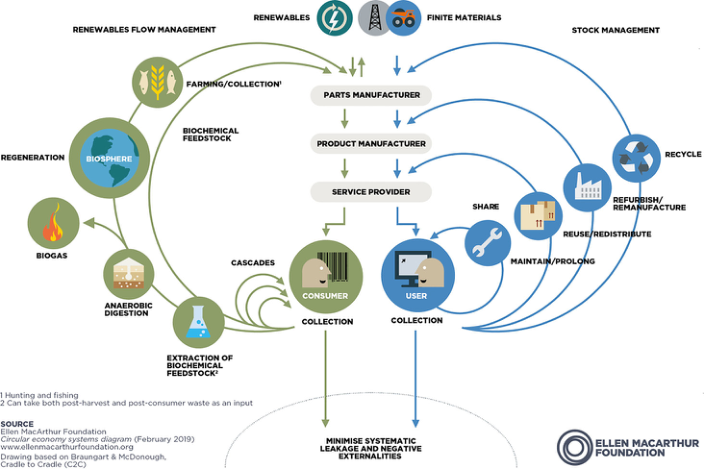
The term “circular economy” gained wider prominence following publications by the Ellen MacArthur Foundation, established after sailor Ellen MacArthur decided to dedicate her efforts to environmental causes and research in this field (Ellen MacArthur Foundation, 2013). At the core of the Foundation’s objectives are the preservation and enhancement of natural capital, the optimization of resource productivity, and the promotion of system effectiveness (Ellen MacArthur Foundation, 2013). Based on these principles, the Foundation developed the visual representation known as the “Butterfly Diagram”, which illustrates how materials should circulate within a continuous system in order to eliminate the concept of waste.
Figure 1: Butterfly diagram, Ellen MacArthur foundation, 2013. [Source: https://www. ellenmacarthurfoundation.org/circular-economy-diagram, Access: December 01, 2026].
Innovation in Design for Sustainability 79 The beginning of the 21st century is marked by complex and interconnected challenges, often described as wicked problems. Phenomena such as the climate crisis, environmental degradation, the depletion of natural resources, and the persistence of social inequalities highlight the inadequacy of dominant socio- economic models and demand profound structural transformations. In this context, Design—historically associated with the materialization of products, services, and messages—is called upon to assume a broader strategic role, acting as a mediator of systemic change processes (Manzini, 2015).
Consequently, the concept of innovation, a central element of design practice, must be reconfigured. Innovation is no longer limited to formal novelty or incremental technological improvement but is increasingly understood as a process of transforming meanings, practices, and socio- technical systems. From this perspective, innovation can emerge not only through technological advances but also through changes in how individuals and societies interpret, experience, and interact with products, services, and systems (Norman & Verganti, 2014).
This shift in perspective is reinforced by evidence indicating that more than 80% of a product’s environmental impact is determined during its design phase (European Commission, 2022), which assigns designers a unique responsibility and a significant capacity for structural intervention. In this context, sustainability-oriented innovation in Design is increasingly grounded in a set of theoretical and methodological approaches which, despite their different focuses, share the ambition of promoting systemic change. Accordingly, this article aims to critically analyse and articulate four of these approaches—Ecodesign, Circular Design, Biodesign, and Human- Centered Design (HCD)—arguing that their integration constitutes an essential condition for a design practice that is effectively transformative.
DIMENSIONS OF SYSTEMIC INNOVATION IN DESIGN As environmental consequences have become increasingly evident, academics and practitioners have begun to explore alternatives to traditional approaches in Design practice and innovation. New terms have emerged, such as Ecodesign, Sustainable Design, and Social Design, partly driven by Victor Papanek, who, since the 1970s, argued that design and ecology are closely— and yet complexly—interconnected (Papanek, 1995). Considered a pioneer of social and Ecological Design, Papanek criticized unchecked production and advocated for the designer’s ethical responsibility. He positioned design as part of the solution for a better world. “The response of design must be positive and unifying; it must be the bridge between human needs, culture, and ecology” (Papanek, 1995, p. 31).
Thackara (2015) argues that the core idea of sustainable design extends beyond the creation of products, encompassing practices and ways of living that contribute to the regeneration of ecosystems and social relations. The author emphasizes the role of design as a means of shaping not only material artifacts, but also social relationships, environments, and ecological systems.
Lavoisier’s (1743–1794) well-known principle, “Nothing is created, nothing is lost, everything is transformed,” can be used as a foundational concept for Sustainable Design and innovation. Today’s designers cannot
80 Carreto and Carreto focus solely on the aesthetic and functional characteristics of products. It is essential that they also consider, at an ecological level, the fate of products after use. By aligning sustainability with Design and product development, Circular Design emerges as a method for applying this approach, with key concerns including material selection, standardization, and the modularization of product components.
Baker-Brown and Brooker (2024) illustrate pedagogical and practical approaches to material reuse and show how adaptive design can transform educational and professional practices, demonstrating the role of Design as a strategic agent in advancing circular economies and sustainable lifestyles.
Ecodesign is a Design approach that integrates environmental considerations into all stages of product development, aiming to reduce its negative impact on the environment throughout the entire product life cycle. Unlike traditional Design, which prioritizes cost, aesthetics, and functionality, Ecodesign places sustainability on an equal level of importance alongside these criteria. Also referred as Design for Environment (DfE), it establishes the methodological foundations for the systematic incorporation of environmental criteria across the entire life cycle of products and services—from raw material extraction to end-of-life (ISO 14006:2020).
Its main contribution lies in the use of Life Cycle Assessment (LCA), a tool that enables the quantification of environmental impacts and supports design decisions related to material selection, energy efficiency, waste reduction, and disassembly strategies.
Operating under a logic of prevention and eco-efficiency, Ecodesign enables the mitigation of environmental impacts before they occur, positioning itself as an essential foundation for any innovation approach committed to environmental sustainability (Tukker et al., 2001; ISO, 2020; Pigosso et al., 2015).
Circular Design: Reconfiguration of Systems and Value Models Circular Design emerged as a critical response to the structural limitations of the linear economic model. Rather than merely proposing incremental improvements in material efficiency, this approach introduces a systemic transformation that entails the reconfiguration of value chains, business models, and organizational structures. In this context, design no longer operates exclusively in the formal and functional configuration of artefacts but instead intervenes in the conception of regenerative production systems strategically oriented toward long-term value creation. It represents an evolution of design beyond the physical object, extending its scope to the transformation of productive systems, economic models, and organizational structures. This shift reflects a paradigmatic transition from product-centered design to design as a systemic strategy.
The circular economy advocates maintaining the value of products, components, and materials for as long as possible through the creation of closed technical and biological cycles (Ellen MacArthur Foundation, 2013). However, the implementation of these principles depends on a profound transformation in value creation and value capture models. Circular Design
Innovation in Design for Sustainability 81 operates precisely at this point of intersection, proposing solutions that integrate material innovation, logistical reconfiguration, and the development of alternative economic models, such as product-service systems, leasing, planned maintenance, and remanufacturing (Stahel, 2010).
Circular Design extends the scope of Ecodesign by shifting the focus from the isolated product to systems of production, use, and value recovery. Situated within the circular economy paradigm, this approach promotes strategies such as product life extension through repair, reuse, and remanufacturing; shared access through product-service systems; and the closing of material loops through high-quality recycling (Ellen MacArthur Foundation, 2019).
In this context, innovation manifests predominantly in the sphere of business models and organizational structures, requiring designers to engage collaboratively with disciplines such as engineering, economics, and management. Circular Design therefore redefines the role of design as an orchestrator of material flows, user relationships, and long-term economic strategies (Manzini, 2015).
Authors such as Walter R. Stahel anticipated this shift by advocating a “performance economy,” in which the focus moves from ownership to access and from obsolescence to durability (Stahel, 2010). Similarly, Ezio Manzini emphasizes the systemic dimension of design, arguing that contemporary innovation occurs primarily within organizational and relational domains, requiring designers to develop competencies in strategic coordination and collaborative facilitation (Manzini, 2015).
Thus, Circular Design redefines the disciplinary field of design by extending its scope beyond the production of objects and integrating it into the construction of sustainable value ecosystems. It represents a paradigmatic reconfiguration that positions design as a structuring agent of socio-economic transitions, capable of contributing to the conception of regenerative systems and resilient business models.
Biodesign and Biomimicry: From Impact Reduction to Regeneration Biodesign and Biomimicry introduce a paradigmatic shift by proposing nature not merely as an aesthetic reference, but as a source of functional, structural, and systemic principles. Biomimicry investigates strategies developed by living organisms over millions of years of evolution to solve complex problems, inspiring solutions in materials, structures, and energy-efficient processes (Benyus, 1997). Examples include self-cleaning surfaces inspired by lotus leaves, passive ventilation systems modelled on termite mounds, and lightweight structural solutions derived from natural geometries.
Biodesign, in turn, goes beyond inspiration by integrating living organisms—such as fungi, bacteria, algae, and other biological systems—into the design process itself, enabling biodegradable, adaptive, and regenerative solutions (Myers, 2018). This approach shifts Design from a logic of impact minimization toward a perspective of ecological regeneration, aligning design activities with the planet’s biogeochemical cycles (Reed, 2007).
The emergence of biomaterials based on mycelium, bacterial cellulose, algae, and bio fabrication processes demonstrates how biological systems can contribute to replacing resource-intensive industrial materials while
82 Carreto and Carreto simultaneously reducing waste and carbon emissions (Drexler & Tibbitts, 2021). In this context, living matter is no longer regarded merely as a resource but as an active participant in design processes, capable of growth, adaptation, self-repair, and decomposition.
From a systemic perspective, Biodesign challenges the mechanistic worldview that has historically shaped industrial production. Instead, it promotes a regenerative paradigm grounded in ecological interdependence, resilience, and co-evolution between human and natural systems (Reed, 2007; Mang & Reed, 2012). As Reed (2007) argues, regenerative design seeks not only to reduce environmental damage but also to restore and enhance the ecological and social capacities of the systems in which interventions take place.
Consequently, innovation within Biodesign extends beyond the development of novel materials or products. It encompasses new forms of collaboration between designers, biologists, engineers, material scientists, and environmental researchers, fostering transdisciplinary practices capable of addressing contemporary socio-ecological challenges (Myers, 2018). In this sense, Biodesign represents one of the most radical expressions of systemic innovation, as it redefines the relationship between Design, technology, and nature, positioning human activity as an integral component of living systems rather than as an external force acting upon them.
Human-Centered Design (HCD): The Social and Cultural Dimension of Sustainability Human-Centered Design (HCD) positions people—their values, behaviours, cultural contexts, and aspirations—at the core of the innovation process (IDEO, 2015; Norman, 2013). Within the sustainability discourse, this approach plays a fundamental role, as technically efficient or environmentally optimized solutions do not, by themselves, guarantee adoption, acceptance, or meaningful impact.
By employing ethnographic methods, participatory design processes, and co-creation practices, HCD enables a deeper understanding of users’ lived experiences, revealing behavioural barriers, social dynamics, and underlying motivations that directly influence the success or failure of sustainable solutions (Brown, 2009; IDEO, 2015). This emphasis on contextual inquiry allows designers to move beyond assumptions about rational behaviour, acknowledging that everyday practices are shaped by cultural norms, infrastructures, and social inequalities (Manzini, 2015).
In this sense, HCD contributes to bridging the gap between systemic sustainability strategies and real-world implementation. It ensures that ecological transition processes are not only technically viable but also socially legitimate, culturally meaningful, and behaviourally feasible. Rather than positioning users as passive recipients of solutions, HCD frames them as active agents within complex socio-technical systems, whose participation is essential for long-term transformation (Sanders & Stappers, 2008).
From a systemic innovation perspective, HCD plays a mediating role between technological innovation (such as circular and bio-based solutions) and societal adoption. It helps translate abstract sustainability goals into
Innovation in Design for Sustainability 83 tangible practices embedded in everyday life, supporting behaviour change, engagement, and collective ownership of solutions (Norman, 2013; Manzini, 2015). Furthermore, HCD aligns with principles of social sustainability by promoting inclusivity, accessibility, and equity in design processes. This is particularly relevant in the context of environmental transition, where unequal access to resources, infrastructure, and decision-making power can reinforce existing social disparities (Raworth, 2017). As such, HCD not only improves usability and desirability but also contributes to ensuring that sustainability transitions are just and socially balanced.
Ultimately, Human-Centered Design reinforces the idea that systemic innovation in design requires the integration of environmental, technological, and socio-cultural dimensions. It positions human experience not as separate from ecological systems, but as an embedded component of them, essential for achieving resilient and enduring transformations.
Discussion: Synergies for an Integral Innovation in Design The analysis of the four approaches highlights their complementary and interdependent nature. Ecodesign provides the necessary analytical foundation for identifying and reducing measurable environmental impacts. Circular Design extends this logic to a systemic level, reconfiguring material flows and economic models. Biodesign introduces regenerative and bio- inspired principles, offering pathways for disruptive innovation aligned with the logic of natural systems. Finally, Human-Centered Design (HCD) acts as a social anchor, ensuring that technical and systemic solutions are meaningful, desirable, and effectively embedded in everyday practices.
Design innovation for sustainability therefore emerges at the intersection of these dimensions. For instance, a food delivery system may integrate a product-service model (Circular Design), life cycle assessment (Ecodesign), biodegradable or biofabricated packaging materials (Biodesign), and solutions developed through a deep understanding of users’ habits, constraints, and cultural contexts (HCD). In such configurations, innovation is no longer located within a single disciplinary domain but distributed across interconnected layers of environmental, technical, economic, and social transformation.
The main gap identified in both literature and professional practice lies in the absence of integrated methodologies capable of guiding designers in navigating these perspectives in a coherent and structured way. While each approach has developed robust theoretical and methodological frameworks independently, their articulation into a unified design process remains underexplored. This fragmentation often results in partial solutions that address either environmental efficiency, systemic restructuring, biological innovation, or user experience in isolation, rather than in a holistic manner.
Addressing this gap requires the development of transdisciplinary frameworks that enable iterative and multi-scalar decision-making, supporting designers in balancing trade-offs and synergies between ecological impact, systemic feasibility, biological integration, and human desirability.
84 Carreto and Carreto In this sense, integral innovation in design is not the result of adding multiple approaches, but of establishing meaningful relationships between them within a coherent systemic logic.
CONCLUSION
This article has argued that innovation in design for sustainability has evolved from isolated approaches focused on material efficiency toward a paradigm of systemic, transdisciplinary, and multidimensional innovation. The articulation between Ecodesign, Circular Design, Biodesign, and Human- Centered Design should not be understood as an optional methodological choice, but rather as a necessary condition for addressing the complexity of contemporary challenges.
This integration repositions the designer as an agent of synthesis and mediation, capable of articulating science, technology, economy, and society within collaborative processes of transformation. In this expanded role, design moves beyond the production of artifacts to become a strategic practice for shaping socio-technical and ecological systems.
As future developments, this study suggests: the development and validation of integrated design frameworks; the reconfiguration of design education, fostering transdisciplinary curricula that combine environmental, technological, and social competencies; and the expansion of applied research and real-world pilot projects that test and operationalize this articulation in diverse contexts.
The future relevance of design as a discipline will depend on its capacity to operate within this convergence, generating innovations that are economically viable, ecologically regenerative, socially just, and culturally desirable.
ACKNOWLEDGMENT
This scientific article was funded by national funds through the Portuguese National Funding Agency for Science, Research and Technology (FCT) under the project UID/05488/2025 https://doi.org/10.54499/UID/05488/2025.
REFERENCES
Baker-Brown, D., & Brooker, G. (Eds.) (2024). The Pedagogies of Re-Use: The International School of Re-Construction. Routledge. Benyus, J. M. (1997). Biomimicry: Innovation Inspired by Nature. HarperCollins. Brown, T. (2009). Change by Design: How Design Thinking Transforms Organizations
and Inspires Innovation. HarperBusiness. Drexler, M., & Tibbitts, D. (2021). Biodesign: Nature, Science, Creativity. Thames & Hudson. Ellen MacArthur Foundation. (2013). Towards the circular economy: Economic and
business rationale for an accelerated transition. Ellen MacArthur Foundation. European Commission. (2022). Commission Staff Working Document: Impact Assessment Report accompanying the proposal for a Regulation establishing a framework for setting ecodesign requirements for sustainable products (SWD(2022) 82 final). European Commission.
Innovation in Design for Sustainability 85 Geissdoerfer, M., Savaget, P., Bocken, N. M. P., & Hultink, E. J. (2017). The circular
economy – A new sustainability paradigm? Journal of Cleaner Production, 143, 757–768. https://doi.org/10.1016/j.jclepro.2016.12.048 IDEO. (2015). The Field Guide to Human-Centered Design. IDEO.org. International Organization for Standardization. (2020). ISO 14006:2020— Environmental management systems: Guidelines for incorporating ecodesign. ISO. Mang, P., & Reed, B. (2012). Designing from place: A regenerative framework and
methodology. Building Research & Information, 40(1), 23–38. Manzini, E. (2015). Design, When Everybody Designs: An Introduction to Design for Social Innovation. MIT Press. Myers, W. (2018). Bio Design: Nature, Science, Creativity. Thames & Hudson. Norman, D. A. (2013). The Design of Everyday Things (Revised ed.). Basic Books. Norman, D. A., & Verganti, R. (2014). Incremental and radical innovation: Design
research versus technology and meaning change. Design Issues, 30(1), 78–96. https://doi.org/10.1162/DESI_a_00250 Papanek, V. (1995). Arquitectura e Design: Ecologia e Ética. Edições 70. Pigosso, D. C. A., McAloone, T. C., & Rozenfeld, H. (2015). Characterization of eco-design maturity based on indicators for environmental performance. Journal of Cleaner Production, 86, 5–16. https://doi.org/10.1016/j.jclepro.2014.08.014 Raworth, K. (2017). Doughnut Economics: Seven Ways to Think Like a 21st-Century
Economist. Chelsea Green Publishing. Reed, B. (2007). Shifting from sustainability to regeneration. Building Research & Information, 35(6), 674–680. Sanders, E. B.-N., & Stappers, P. J. (2008). Co-creation and the new landscapes of
design. CoDesign, 4(1), 5–18. Stahel, W. R. (2010). The performance economy (2nd ed.). Palgrave Macmillan. Thackara, J. (2015). How to thrive in the next economy: Designing tomorrow’s world today. Thames & Hudson. Tukker, A., Eder, P., Charter, M., et al. (2001). EIPRO: Environmental impact of
products. European Commission, Joint Research Centre.
LISTED IN THE AHFE DIGITAL BOOKSTORE CATALOGUE
Explore the complete digital volume
Human Dynamics, Product Evaluation and Quality
Read this individual research paper free through the original publisher, or explore the full digital proceedings book.
ISBN 978-1-964867-88-5
Explore this ISBN in the AHFE Bookstore ↗Listed in the July 2026 bookstore catalogue; search by ISBN to confirm current availability · Digital book purchase optional