Yasmine Almadi, Min Kang (2025). Systems Design Approach to Waste-to-Energy Transformation: A Circular Economy in the Coffee Industry and Community. In: Interdisciplinary Practice in Industrial Design. AHFE Open Access, vol. 183, pp. 170–178. https://doi.org/10.54941/ahfe1006438
This study explores how systems design can establish circular economies by transforming organic waste into renewable energy, addressing the dual challenges of waste management and energy resilience through Bean to Green initiative, a real-world case study implemented in Houston, TX. The research demonstrates how spent coffee grounds (SCG) can be leveraged to generate renewable energy, foster community engagement, and reduce landfill dependency with a systems design approach.The system integrates three interconnected components: SCG collection kiosks strategically placed in coffee shops and public spaces, transportation facilitated by electric vehicles to minimize carbon emissions, and biofuel production facilities that process SCG into renewable energy for powering community infrastructure. A companion mobile application designed with a strong focus on user experience (UX), plays a pivotal role in enhancing public engagement by offering an intuitive interface for tracking individual contributions, rewarding participation, and providing educational content about sustainability goals. Coupled with accessible branding and communication strategies, the initiative bridges educational gaps and appeals to diverse demographics. The broader implications of this study extend beyond the coffee industry, offering a scalable and replicable framework for circular economies across various sectors in other urban settings. By leveraging systems thinking and collaborative community-driven strategies, this research highlights the transformative potential of waste-to-energy models in advancing climate action. The findings contribute to a deeper understanding of how human-centered sustainable systems design, UX design principles, and inclusive branding strategy can create scalable pathways for future renewable energy and waste management innovation and drive environmental and social changes.
This review applies a systems design approach to establish a circular economy. Focusing on the coffee industry, the goal is to utilize organic waste, such as spent coffee grounds (SCG), for bioenergy production. This research aims to propose a scalable system solution that integrates waste collection,
Systems Design Approach to Waste-to-Energy Transformation 171
transportation, and energy conversion into the management of organic waste to reduce environmental harm while addressing energy challenges.
Bean to Green, the developing concept that applies research findings to real-life situations, is a case study in Houston, TX. It demonstrates the potential of managing SCG produced by local coffee shops as a renewable energy source.
The system is made up of four key components: SCG Collection Kiosks: Offering convenient and communal disposal at partnered coffee shops’ locations and related businesses.
Electric Vehicle Transport: Transporting collected SCG using low-emission EVs to processing facilities.
Biofuel Processing Facilities: Converting SCG into renewable energy. Community Energy Infrastructure: Supplying biofuel energy to public amenities like streetlights and water fountains while emphasizing individual contributions.
To ensure individual participation, a companion mobile app engages users as they donate SCG and offers rewards incentives to continue. Furthermore, individual contributors remain informed regarding the sustainability initiatives their donations support. By integrating community engagement with circular economy principles, Bean to Green highlights the potential for scalable, localized energy solutions.
The key components producing a circular economy in this review are as follows: Sustainable Waste Management: Examines strategies for reducing landfill dependency and reducing methane emissions from organic waste.
Renewable Energy Production: Explores bioenergy conversion methods and their potential impact on local energy infrastructure.
Community Engagement: Investigates strategies for incentivizing public participation in sustainability initiatives.
Circular Economy Models: Analyzes case studies of waste-to-energy systems and their scalability.
METHODOLOGY
At its heart, Bean to Green is a system solution driven by circular economy principles. By repurposing organic waste into a biofuel resource, SCG collection and transformation reduce the presence of organic waste in landfills, which in turn minimizes environmental impact. Two key case studies that achieved a circular economy for SCG are Kaffeeform and Vermont Coffee Company.
A circular economy creates a closed-loop life cycle for an object. Instead of following a product’s traditional life cycle analysis, which includes a beginning and an end, circular economy integration aims to maximize a product’s life past its designed function to reduce environmental impact. In the context of this study, the goal of a circular economy is to repurpose SCG from decomposing in a landfill, which can result in a loss of energy potential and contribute to harmful methane emissions in the atmosphere. Key
172 Almadi and Kang
strategies include waste-to-energy conversion, innovation in biodegradable materials, and closed-loop recycling models.
Every year, 18 million tons of SCG are produced worldwide, most ending up in landfills (May and Folkerts, 2021). In 2022, Municipal Solid Waste (MSW) landfills emitted 100.9 million tons of methane in the US alone, 17.7% of total US methane emissions. Studies identified the methane yield of SCG, in which 6 million tons of SCG emit 1.22 million tons of methane (Eyas Mohammed et al., 2022).
When organic waste mixes with chemicals in other waste in landfills, it multiplies the momentum of emissions. Due to low oxygen levels at landfills, mass decomposes anaerobically, thus producing methane. Furthermore, mixing organic waste and chemicals produces hazardous leachates, contaminated liquid that runs off landfill grounds and contaminates the groundwater supply (Christenson and Cozzarelli, 2003).
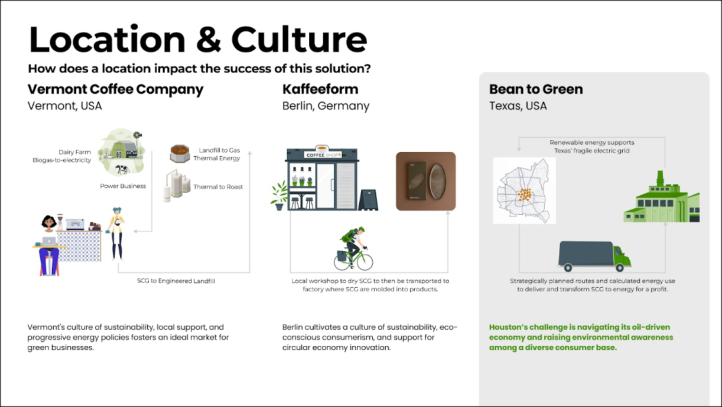
The problem begins before that, however. The culture around consumption and total neglect of waste management have expedited the hazards of biowaste. Existing circular methods to address SCG vary. At a community level, SCG are used as fertilizer by gardeners and farmers alike (Ragauskaite, Dovile, and Rasa Slinksiene, 2022). Figure 1 assesses the impact of location, methodology, and brand approach on the success of the circular model in compared to the approach with Bean to Green.
Figure 1: Assessing location, methodology, and brand approach (created 2025).
Vermont Coffee Company (Vermont, USA): In the northern region, Vermont Coffee Company transports its SCG to a nearby Quebec-based engineered landfill operated by EBI Energie Inc., thus contributing to captured methane producing biogas which is used to roast their coffee beans. Further energy needs are met by their dependence on purchasable local farmers’ Cow Power, which is a local biogas-to-electricity resource,
Systems Design Approach to Waste-to-Energy Transformation 173
thus nurturing communal interdependence and support across energy, waste, dairy, and coffee sectors.
Kaffeeform (Berlin, Germany): Kaffeeform minimizes carbon emissions during the collection, transport, and diverted waste stream of local SCG. Furthermore, SCG becomes durable bioplastic products with longer life cycles ending in biodegradation. This initiative was very successful in Berlin, a sustainability-conscious city committed to materially and socially supporting environmental initiatives.
Bean to Green (Texas, USA): In Houston, Texas, Bean to Green would collect SCG from partnered coffee shops and their customer base through local disposal kiosks while publicizing local initiatives which SCG donations would be benefiting.
These examples highlight scalable strategies for repurposing SCG, reducing methane emissions, and enhancing sustainable production cycles through community engagement.
Systems design thinking streamlines collaboration between different components, ensuring harmony in function and output. Bean to Green applies this principle to ensure seamless cooperation between coffee shops, transport networks, and biofuel facilities. Accessibility and engagement stem from human-centered design. For a replicable and scalable solution, Bean to Green must foster long-term user participation from individuals and businesses, offering a blueprint for waste-to-energy programs.
Systems thinking is the core foundation for successful circular economy models. It integrates various stakeholders, including waste producers, transporters, and end-users, in Bean to Green’s mission of waste-to-energy transformation.
User Experience (UX) and community engagement must be utilized to successfully divert waste streams from isolated consumers to productive transformation. Bean to Green connects consumers and businesses through interactive disposal kiosks, mobile app engagement, and rewards programs with partnered coffee shops. These touchpoints aim to encourage long-term participation and returning customers, keeping Bean to Green a feasible solution for this waste stream.
SCG contains a high energy potential, making it an attractive biowaste for biofuel production. Three major ways in which its potential is extracted from 1 kg of SCG are:
Anaerobic digestion: Observing SCG’s dry mass digestion, at 30–40
C for 20–30 days in mesophilic conditions, and 5–60
C for 15–20 days in thermophilic conditions, for 1–3 kWh (Kim and Lee, 2024).
Pyrolysis for bio-oil: Using high temperatures (500–600
C) at fast heating rates (10–100
C/min) for 10–30 minutes to produce bio-oil for 3.89–4.86 kWh (Kim and Lee, 2024).
Pyrolysis for Biochar: Using high temperatures (300–400
C) at slow heating rates (0.5–5
C/min) for 1.39–2.08 kWh (Kim and Lee, 2024).
In order to choose the most appropriate method of biofuel production, existing infrastructure must be able to utilize fuels or require minimal
174 Almadi and Kang
alteration to work. Furthermore, some methods are more energy-intensive than other forms of biofuel.
The following table lists start-ups relating to biofuel production, efficiency, and data analysis for supporting the feasibility of Bean to Green’s mission.
Table 1: Start-ups in relation to bean to green partnership.
Table available in the original PDF paper.
Company Country Founded Goal Overlap Name Cowboy Wyoming,
2020 Utilizes agricultural byproducts to
Methane production and CO2 reduction.
Clean Fuels
Colorado USA
feed methanogenic organisms through repurposed alternative feedstock coal seams in Wyoming’s Powder River Basin (PRB) area. The output is Renewable Natural Gas (CH4), while the CO2 permanently binds to the coal below Earth’s surface.
Reverion Germany 2022 micro power plants double the
Anaerobic digestion plants facilitated by micro power plants to maximize their efficiency.
efficiency of existing biogas production, utilize surplus renewable energy, and capture CO2. All with zero carbon emissions.
Molten Stanford
2021 Cracks methane at blazing hot
Utilizing existing waste
Industries USA
streams and methane-producing infrastructure to produce hydrogen and graphite.
temperatures into hydrogen and graphite using renewable electricity. Our methane is responsibly procured from certified low-emissions natural gas and waste streams such as dairy farms, waste-water treatment plants, and landfills. This leads to hydrogen and graphite that are carbon-neutral or carbon-negative.
Nodal Utah USA 2021 Landfill gas-to-energy datacenter
Processing and
Power
technology and systems. NCR is powering our first-of-kind projects enabling optimization of energy sales and datacenter compute loads.
facilitating methane production and biogas output through data collection measurement and analysis.
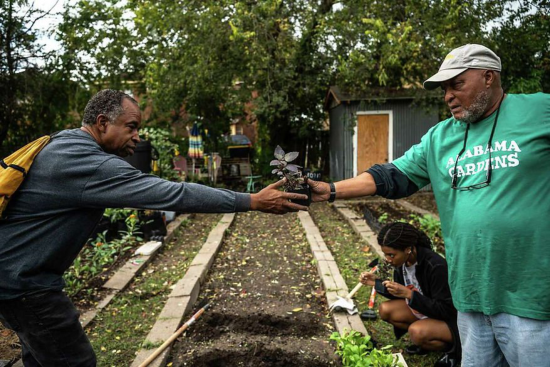
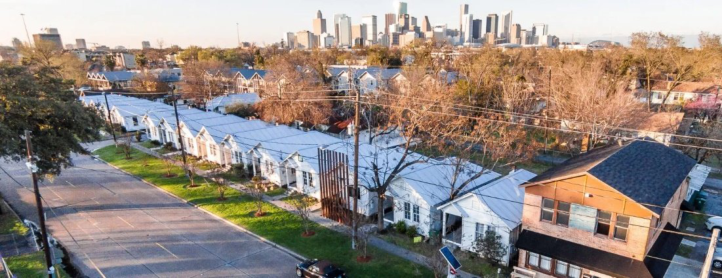
Organic waste, specifically SCG, maintains its energy potential in its waste form. That is, once consumers extract flavor by brewing coffee grounds, what’s left is a nutrient-rich mixture of coffee grounds and water, known as SCG. This mixture, when separated into wastewater and dried waste coffee grounds, offers multiple benefits. The wastewater now carries nitrogen, phosphorus, and potassium, along with organic matter that promotes microbial activity and soil fertility (Campos et al., 2021). Due to the acidity of wastewater, Bean to Green can access further partnerships with local farmers and community gardens (figure 2) that favor acidic and nutritious water for their gardens. Third Ward is also home to Project Row Houses (Figure 3); a creative project aimed at providing affordable enterprise spaces for single
Systems Design Approach to Waste-to-Energy Transformation 175
mothers. With the goal of enriching the youth of the historic neighborhood and preserving its culture and history, the entire project functions as a communal support to offer growth opportunities for local entrepreneurs, students and artists.
Figure 2: Alabama gardens in Third Ward (2023).Figure 3: Project row houses in Third Ward (2023).
Energy demands soar during extreme weather, whether as seen during winter Storm Uri for the dire need of warmth, or in the Texas summer heat during Hurricane Beryl. Bean to Green, during initial stages, can serve to alleviate the strain of select energy-dependent public amenities to make room for improvement and increased reliability on dominating sectors of energy in Houston. With the understanding that 1 kg of SCG produces approximately 3 kWh, resultant biofuel can light up one typical 250-watt bulb streetlight for 12 hours a day (Perera and Perera, 2015). A study analyzing medium- sized coffee shops in Sydney, Australia, found that one coffee shop produces 10 kg of SCG a day on average (Cameron and O’Malley, 2016). A local coffee shop located in central Houston produces approximately 50 pounds of spent
176 Almadi and Kang
coffee grounds per day and almost 100 pounds on their busiest days. At its initial stages, tackling a high-priority consumer of energy like streetlights, at a sizable impact rate, a large area like Houston, can build trust, legitimacy, and attraction towards Bean to Green as a reliable solution to resolving energy limitations.
DISCUSSION
The summer of 2024 witnessed a mass power outage in Texas, in which distribution infrastructure led to power outages for 2.3 million Texans, with over 26 reported deaths. Energy Expert Ed Hirs from the University of Houston blamed “extended neglect and underinvestment in grid infrastructure by the state and utilities.” According to CenterPoint, 21.7K remained without power for over 10 days. A major community concern was communication; customers could not get an estimate on when power would return, where to go to cool in the heat, and what neighborhoods still had power. One extreme reaction came from a Fort Bend County citizen pulling his gun at a power lineman fixing the local power lines. CenterPoint’s initial response to the anticipated hurricane failed to prepare appropriately. For instance, linemen were not staged in Houston in advance to prepare for the hurricane, leading to further delayed repairs to the grid. Once again, the summer of 2024 confirmed the need for upgraded infrastructure and alternative sources of energy to combat extreme weather conditions.
With the historical mistrust of private industry in the federal government “meddling” in their businesses, Winter Storm Uri caused a lot more damage when the power got cut off from methane processing facilities, thus reducing in-state gas availability. Beyond the need for an increased supply of critical weather-appropriate energy, the question lies in how to shape public trust and engagement with governmental support at times of crisis.
ERCOT operates independently, avoiding federal regulation. It prioritizes private market control over comprehensive infrastructure investment, which has led to energy vulnerabilities, especially during crises.
Governor Abbott released an executive order that reignited mistrust between businesses and government as he ordered methane gas providers to sell in-state to power generators, which led to resistance by Texan providers and longer hours without power. Houston’s energy infrastructure has long relied on traditional fossil fuel energy production. With a hesitancy to better prepare Texas electric infrastructure for extreme weather, despite rising climate change, introducing variety in renewable energy supply both addresses climate and grid challenges while alleviating the strain on fossil fuel energy. By integrating SCG-to-biofuel systems, businesses and individuals become a part of the effort of energy production, thus engaging awareness and motivation to ensure a positive relationship between climate and energy security.
The ongoing power struggles between state authorities, private energy firms, and federal regulators create a complex landscape for renewable energy initiatives like Bean to Green. Without policy incentives and corporate
Systems Design Approach to Waste-to-Energy Transformation 177
alignment, integrating SCG-derived biofuel into Texas’ energy mix faces significant challenges. Addressing these barriers requires: Stronger Policy Frameworks: Ensuring regulatory support for alternative energy solutions.
Corporate Incentives: Encouraging private energy firms to invest in circular economy models.
Public-Private Partnerships: Facilitating collaboration between state agencies and renewable energy innovators.
The Bean to Green model has the potential to extend beyond the coffee industry into other organic waste sectors. By leveraging circular economy principles and renewable energy innovation, similar systems can be applied to food production and agriculture. Expanding the initiative’s impact will contribute to broader sustainability efforts and climate action.
Circular economy models can be expanded beyond the coffee industry to agriculture, food production, and textile waste management. Applying similar systems thinking approaches can optimize waste recovery in various sectors.
CONCLUSION
This study highlights the potential of a systems design approach in establishing a circular economy by transforming spent coffee grounds (SCG) into renewable energy. By integrating waste collection, biofuel production, and community engagement, Bean to Green offers a replicable model for sustainable urban energy solutions. Addressing existing gaps and overcoming barriers to adoption will be crucial in scaling this initiative for broader environmental and economic impact.
This initiative fosters public participation and creates a more accessible pathway for individuals and businesses to contribute to sustainability efforts by leveraging human-centered UX design and strategic branding.
Beyond the coffee industry, the Bean to Green model presents a framework that can be adapted to other organic waste sectors, including food production and agriculture. This amplifies its impact on sustainability and climate resilience. The research underscores the importance of integrating circular economy principles into urban infrastructure, reducing landfill dependency, and mitigating methane emissions.
However, to fully realize the potential of waste-to-energy models, policy support, corporate investment, and cross-sector collaborations must be strengthened. Future research should explore optimizing biofuel conversion methods, expanding partnerships with energy providers, and evaluating long-term behavioral shifts in consumer participation. By addressing these challenges, Bean to Green can contribute to a more sustainable and resilient urban energy landscape, setting a precedent for circular economy-driven innovations worldwide.
178 Almadi and Kang
ACKNOWLEDGMENT
The authors would like to acknowledge the Summer Undergraduate Research Fellowship at the University of Houston for supporting this research study and design.
REFERENCES
Bjerg, P. L., Albrechtsen, H.-J., Kjeldsen, P., Christensen, T. H., & Cozzarelli, I. (2003). The groundwater geochemistry of waste disposal facilities. In H. D. Holland, K. K. Turekian, & B. S. Lollar (Eds.), Treatise on geochemistry: Environmental geochemistry (Vol. 9, pp. 579–612). Elsevier. Campos, Renata Cássia, Vinícius Rodrigues Arruda Pinto, Laura Fernandes Melo, Samuel José Silva Soares da Rocha, and Jane Sélia Coimbra. “New Sustainable Perspectives for ‘Coffee Wastewater’ and Other By-Products: A Critical Review.” Sustainable Chemistry and Pharmacy 21 (2021): 100480. https://doi.org/10.1016/ j.scp.2021.100480 Hirs, Ed. 2024. “Hirs: The State of Texas Vs. Texans-A Matter of Life, Death and Money.” Oil & Gas Investor 44 (9) (09): 8–9. https://search.proquest.com.ezproxy.lib.uh.edu/trade-journals/hirs-state-texas-vs- texans-matter-life-death/docview/3104586765/se-2 Kim, Jae Young, and Jae Goo Lee. “Effect of Temperature and Heating Rate on
Pyrolysis Characteristics and Product Distribution of Spent Coffee Grounds.” Korean Journal of Chemical Engineering (2024). https://doi.org/10.1007/s11814- 024-00376-y Kubota, L. “Vermont Coffee Company Converts to 100 Percent Biogas for Roasting Operations.” Daily Coffee News, (2018). https://dailycoffeenews.com/2018/05/ 30/vermont-coffee-company-converts-to-100-percent-biogas-for-roasting-oper ations/ May, G., & Folkerts, J. (2021). Breaking new grounds for coffee. Food Science and
Technology, 35(2), 28–31. https://doi.org/10.1002/fsat.3502_8.x Mahmoud, Eyas, A. E. Atabani and Irfan Anjum Badruddin. “Valorization of spent coffee grounds for biogas production: A circular bioeconomy approach for a biorefinery.” Fuel (2022): n. pag. Oak Ridge National Laboratory. (2019) Vermont Green Power Profile. U. S.
Department of Energy, n.d. https://chptap.ornl.gov/profile/89/VermontGreenPo wer-profile1.pdf Perera, K. D. D., and L. A. S. Perera. “Analysis on Energy Efficiency and Optimality of LED and Photovoltaic Based Street Lighting System.” Engineer: Journal of the Institution of Engineers, Sri Lanka 48, no. 1 (2015): 11–20. https://doi.org/10. 4038/engineer.v48i1.6844 Planet Ark. Cameron, A and O’Malley, S. (2016) Coffee Ground Recovery Program Report 2019. https://static1.squarespace.com/static/ 5385613ee4b0883f7108f96f/t/5ccbc0f0971a1850c2c59049/1556857129706/ Coffe%20Ground%20Recovery%20Program%20Report%202019_Planet%20 Ark.pdf Ragauskaite, Dovile, and Rasa Slinksiene. “Influence of Urea on Organic Bulk
Fertilizer of Spent Coffee Grounds and Green Algae Chlorella Sp. Biomass.” Sustainability 14, no. 3 (2022): 1261. https://doi.org/10.3390/su14031261. Schaper, Andrew, and Le Xie. “A Conceptual Model for Analyzing the Impact of Natural Gas on Electricity Generation Failure during the 2021 Texas Power Outage.” In 2021 North American Power Symposium (NAPS), 1–6. IEEE, 2021. https://doi.org/10.1109/NAPS52732.2021.9654761
LISTED IN THE AHFE DIGITAL BOOKSTORE CATALOGUE
Explore the complete digital volume
Interdisciplinary Practice in Industrial Design
Read this individual research paper free through the original publisher, or explore the full digital proceedings book.
ISBN 978-1-964867-59-5
Explore this ISBN in the AHFE Bookstore ↗Listed in the July 2026 bookstore catalogue; search by ISBN to confirm current availability · Digital book purchase optional