Elena Cioffi, Barbara Pizzicato (2022). Design and tools for the transformation and valorisation of agro-industrial waste for Made in Italy industries. In: Interdisciplinary Practice in Industrial Design. AHFE Open Access, vol. 48, pp. 83–90. https://doi.org/10.54941/ahfe1002019
Responding to a sustainable production is an imperative that is gaining more and more relevance in the definition of specific programs and strategies at national and international level. This urgency leads towards zero waste and circular models and processes that minimize the extraction of resources from the biosphere and do not create waste; instead, when the waste of natural or anthropogenic transformations cannot be avoided, their valorization as resources must be carried out. The development of integrated supply chains, knowledge transfer between different disciplines and the dialogue between research and industry becomes fundamental for the achievement of these objectives. Existing studies in the literature regarding the agri-food production chain in Italy show that the sector, whose environmental impacts are by no means marginal, is fragmented in many small production companies; an interesting and critical aspect at the same time since the generation of waste is not accompanied by an appropriate dissemination of data at a quantitative-qualitative level and there is no clear regulatory framework available on alternative management and valorisation methods. Design, given its natural inclination to transversality, allows to trace scenarios in which to configure, through interdisciplinary approaches, the sustainability models that are intended to be covered in this contribution. Moreover, its methods and tools allow to develop a critical thinking starting from the very early designing phase. The paper addresses the valorisation of agro-industrial waste in a circular and systemic perspective through the presentation of a review of case studies from the textile supply chain, which is one of the most relevant for Italian industry.Due to its disastrous environmental impact, the global textile industry is today the subject of extensive research aimed at the development of innovative materials and processes in order to overcome the traditional linearity of the textile supply chain. The negative impacts of the textile industry are distributed along the entire value chain and are mainly attributable to greenhouse gas emissions -for which the textile industry represents the fifth manufacturing sector- consumption and pollution of water resources and the production of textile waste. In particular, the production of synthetic fibers, which is estimated to be almost two thirds of the global fiber production, is associated with a high use of non-renewable resources and emissions, which derives from the extraction of fossil fuels. In this sense, the valorisation of agro-industrial waste as secondary raw materials and new sustainable inputs for the textile supply chain, represents an opportunity not yet fully explored, in particular as regards the development of a new generation of fibers, yarns and eco-compatible fabrics alternative to the materials currently in use. Bio-based wastes and by-products from agri-food industry could as well present enormous potential for valorisation in the textile finish due to their intrinsic properties (antimicrobial, prebiotic, antioxidant activity, among others). At present, nevertheless, textiles from agro-residues do not completely meet the requirements to make them an attractive replacement for conventional fibre sources. Future research should therefore focus on identifying new agro-residue based blends that offer both performance and sustainability, adopting a systemic design approach based on interdisciplinary and interconnections as a strategy for innovation.
CIRCULAR MODELS AND PROCESSES FROM A DESIGN PERSPECTIVE Overall consumption of materials available in nature is expected to double over the next forty years, and at the same time annual waste production will increase by 70% by 2050 (European Commission 2020), in this context, it is essential to accelerate the transition to circular and regenerative production models that focus on resource efficiency and sustainability (Organisation for Economic Co-operation and Development 2021), new alternative scenarios must be traced and design is playing an important role in defining programs and strategies at national and international level, as with the Action Plan for Design-Driven Innovation in which the EU encourages the integration of design in innovation policies in synergy with the objectives of the circu- lar economy to facilitate the transition from a linear production model to a circular one. Furthermore, taking the Circular Economy Action Plan as a refe- rence, the areas of action for this paper have been identified, i.e. production (including product design and production processes); waste management and valorisation of secondary raw materials; and sector-specific innovations regarding food waste and of biomasses (Ministry of Education, University and Research 2020).
The systematic literature review on methods, applications and criticalities related to the design of supply chains for the transition to a circular economy (MahmoumGonbadi, A. et al. 2021) was considered, the authors underline on 254 selected articles how “the current literature in the field is affected by a disconnection between supply chain design and the founding principles of Circular Economy” and there is “[…], a reductionist interpretation of the Circular Economy. […] While methodological contributions appear adequate to focus on the non-deterministic nature of Closed Loop Supply Chain design problems, there is paucity of empirically-grounded research”.
However, the approaches proposed to undertake effective circularity models starting from product design are growing, for example the EU will propose the legislative initiative aimed at sustainable products, such as the extension of the Ecodesign Directive so that the framework can apply to the widest possible range of products consistent with circularity princi- ples (Symbola 2020), is also reported that ecodesign “requires metrics and resource-efficiency standards that are missing, this would facilitate the defi- nition of related (and shared) resource-efficiency targets, which could be beneficial in relation to CE” (Morseletto 2020).
AGRO-WASTE VALORISATION FROM MADE IN ITALY AGRO-INDUSTRIAL SECTOR Agro-industrial sector has a great potential in the context of the Circular Eco- nomy through strategies such as efficient resources management, waste and by-products reutilization, defence of biodiversity, and valorization of local material and immaterial wealth.
Emphasis on quality, specialty of products and non-reproducibility in other areas (Farinella and Moiso, 2021) represent competitive characteristics of the Italian agro-industrial sector, recognized for its high perceived quality and positioned in the high end of the market that differentiate it from other European countries and make it a fertile context for the introduction of new circular and sustainable production models.
In response to the current global challenges, the pursuit of environmen- tal, social and economic sustainability became a priority. Local systems and agro-industrial supply chains received renewed attention, also through the reconfiguration of relationships between the actors of the value chain. Waste production concerns all levels of the agro-industrial supply chain, although quantifying waste is not an easy task, it is estimated that agro-industrial resi- dues produced in Europe may amount to 87 million tons, of which agriculture accounts for about 20%. In Italy, in particular, data available shows that field residues amount to over 1,4 million tons and account for 2,8% of sup- ply chain total waste production (Intesa San Paolo, 2020), which disposal is often onerous, scarcely sustainable or even harmful for the environment.
Adopting a circular and systemic approach and considering this significant amount of output produced by agro-industrial sector as a resource rather than waste, it is possible to unlock its enormous potential as input to acti- vate new systems, thus generating several benefits for the environment and the territory: the development of new local economies, the creation of new
Design and Tools for the Transformation and Valorisation of Agro-Industrial Waste 85
job opportunities, the increase of regional competitiveness (Bistagnino, 2011; Fiore et al., 2020).
DESIGN TRANSVERSAL TO DISCIPLINES, RESEARCH AND INDUSTRY: CASE HISTORY It is fundamental, for design to make a real contribution in terms of sustaina- bility, to use effective existing methods and tools to support decision-making in the design phase to promote sustainable product life cycles (PLC) (De los Rios and Charnley 2016). Aamong these, Circularity Indicators methodo- logy is a significant tool to support designers and the production sector to analyse the performance of a product or company in the context of the Circu- lar Economy, allowing to estimate the progress within the transition from a linear model to a circular one (Moraga et al., 2019). However, it was found that design for sustainability tools and guidelines are mostly about technical criteria, with little focus on the larger framework related to corporate sustai- nability strategies. Designers, by education, outlook, and experience, must be capable of developing new, interdisciplinary solutions to improve life qua- lity and sustainability (Towards designation as a UNESCO City of Design Montreal, Design of the City, City of Design 2006).
Most solutions to implement and maintain a sustainable industry are inter-sectoral and interdisciplinary, and concurrent teams are a common approach for sustainable product development and whole systems design. However, research has highlighted issues with this approach when knowledge is compartmentalised, and key information cannot be properly transmit- ted and pointed out a need to develop new transdisciplinary capabilities to avoid increasing product development time and complexity (De los Rios and Charnley 2016).
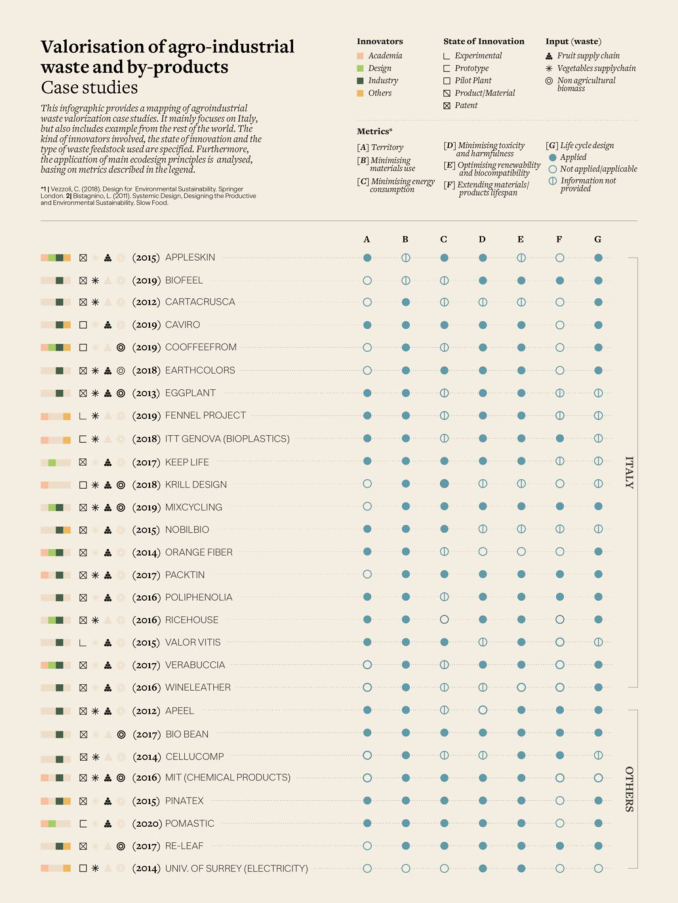
The case history presented in this paper aims to identify examples of waste valorization characterised by a high level of innovation, overcoming the tra- ditional applications of agro-industrial waste. Although this research focuses on Made in Italy production, the case studies are gathered from the inter- national context in order to provide a broader perspective on the current innovation landscape.
The infographic presented in fig. 1 is not intended as an exhaustive map- ping of research projects conducted in this field, but a critical selection of significant examples such as to outline some relevant categories that highli- ght the involvement of three key actors: academic research centres, industry, and design.
Nevertheless, it seems clear that the transition toward sustainable develo- pment models can only be achieved through a synergic cooperation between stakeholders: institutions, through effective strategies and action plans; indu- stry, through the implementation of circular business and production models; academia and research, supporting through new technologies, tools, metho- dologies, and approaches; designers, as a junction point between academia and industry, through the integration of ecodesign principles in the design process and the development of closed loop systems; communities, through the adoption of a responsible lifestyle.
86 Cioffiand Pizzicato
Figure 1: Valorisation of agro-industrial waste and by-products. (Cioffi, Pizzicato 2022).
A first group of case studies includes research projects developed from aca- demic research, demonstrating its key role in society as an agent of change, not only as it produces knowledge-based and highly technological innovati- ons, but also as it can provide new models, perspectives, and shared practices. Packtin, for instance, is a spin-off of University of Modena and Reggio Emi- lia that aims to develop a circular virtuous system from natural waste input, combining the decrease of food waste and the saving of materials and energy linked to the packaging disposal. This is possible through the recovery of agro-industrial by-products such as orange, apple and tomato peel or spent
Design and Tools for the Transformation and Valorisation of Agro-Industrial Waste 87
sugar beetroots from which they extract biopolymers for the production, among other applications, of biodegradable coatings used to improve conse- rvation and extend food shelf life (Packtin, n.d.). Another example is Fennel, a research project involving Foundation Idis, the Department of Agriculture and the Department of Pharmacy of Università Federico II in Naples, and an agricultural company, with the aim of valorising non-edible waste of fennel as a source of biomolecules with a wide potential in the nutraceutical sector (Unina, n.d.).
In other cases, the synergistic collaboration between academia and indu- stry generates an exchange of expertise and know-how that lead to relevant results in terms of sustainable innovation. This is the case of Coffeefrom, which was developed for Expo2015 following an experimentation promoted by Lavazza and Novamont in collaboration with Politecnico di Torino and a social cooperative, which consisted in the recovery of coffee grounds from Lavazza bars for the cultivation of fresh mushrooms. The project, carried out by the cooperative in collaboration with the Fondazione Politecnico di Milano and the Department of Chemistry “Giulio Natta” of Politecnico di Milano, gave birth in 2019 to a new bio-based material from industrial coffee grounds (Coffeefrom, n.d.).
A second group includes case studies from industrial research: currently, more and more companies are considering the valorisation of waste and by- products from other supply chains not only as a means to foster the transition to circular economy, but also as an opportunity in terms of development and economic growth. NobilBio, for example, collaborates with local farms by recovering by-products of wine production in order to create biomaterials to be applied in the dental sector. A further development was the creation of a consortium for the application of hazelnut production waste in the chemical, pharmaceutical and green building sectors (Nobilbio, n.d.).
As it can be seen, the emphasis on the local dimension is indeed a cen- tral topic, transversal to many case studies. The valorisation of tangible and intangible resources of the territory, local know-how, expertise, and heri- tage is crucial in the systemic approach, that proposes a re-localization of production on a local scale as a solution to limit the negative outputs of the agri-food system, reorganising food production according to the chara- cteristics of local ecosystem and population and creating more productive and effective systems (Bistagnino, 2012). In some cases, the creation of new circular supply chains can be a response to the heavy impact of cer- tain manufacturing activities, such as the textile sector which is characterised by an enormous use of non-renewable resources and production of waste. Many are the solutions developed in this area, such as new yarns and eco- friendly fabrics from agro-industrial residues (Biofeel, Pinatex, Wineleather, Appleskin, etc.) or natural dyes from agricultural and herbal industry waste (EarthColors). Other virtuous examples include the collaboration between actors “operating in different sectors of activity that engage in mutually bene- ficial transactions to reuse waste and by-products, finding innovative ways to source inputs and optimising the value of the residues of their processes” (Domenech et al., 2019), in a more advanced logic of industrial symbiosis. For example, the excess bran obtained by Barilla for the production of pasta
88 Cioffiand Pizzicato
becomes new fiber for the production of Favini Crush paper, which is in turn partly used as packaging for Barilla pasta (Favini, n.d.).
The third group of case studies analysed concerns projects, materials and products born as part of the design project. Nowadays, the boundaries of design as a discipline tend to blur more and more, with designers adopting a markedly interdisciplinary approach and operating at the intersection of other disciplines, researching and experimenting on matter firsthand in their studio. According to this logic, many materials and products have been deve- loped that use waste and basic materials of nature and which can be easily reintegrated into the natural metabolism. Krill Design, for instance, is a stu- dio that combines the design of new materials obtained from by-products of the food chain such as peels, seeds, and shells with the potential of 3D printing, adopting on-demand production to minimise the utilisation of mate- rials and energy (Krill Design, n.d.). Another example of this approach is the startup Ricehouse, that recovers non-edible waste from the rice supply chain and transforms it into low impact materials for the building sector (Ricehouse, n.d.).
FUTURE DESIGN APPROACHES Benefits in terms of sustainability deriving from new circular supply chains are evident, but it is necessary to consider some critical issues and potential obstacles. First of all, the Italian agri-food sector is characterized by nume- rous small and medium-sized enterprises, a fragmentation which, together with the infrastructural deficiencies of the territory, determines a high num- ber of flows within the supply chain (Buttol et al., 2019). This could lead to difficulties in the procurement of waste and by-products in adequate quan- tities for the activation of new value chains. Other critical issues concern the competitive uses of agro-industrial waste, which are generally classified according to the so-called “5F” - fodder, fertilizer, fiber, feedstock, and fuel (Koopmans and Koppejan, 1997). It is therefore necessary to consider the potential uses of the residues identified and evaluate the feasibility – also in terms of technologies and processes – of new processes that lead to alterna- tive uses of the waste, favoring an approach that minimizes the loss of value but rather follows an upcycling logic. Other considerations concern the pos- sible consequences on local economy and the environment such as changes in established agricultural practices, soil depletion, the use of harmful chemicals or intensive farming practices (Ribeiro et al., 2022).
In this context, design emerges as crucial in supporting new needs, para- digms and production models, therefore, designers have the role and the responsibility of contributing to the necessary transformations to build circu- lar, systemic and sustainable supply chains and this implies a change in design practices and the development of new capabilities by drawing on multiple and diversified repository of knowledge, integrating production culture and design research towards sustainable scenarios. But what kind of capabilities should be cultivated in designers and how to define and configure the role that design can play in this transition process?
Design and Tools for the Transformation and Valorisation of Agro-Industrial Waste 89
REFERENCES
Bistagnino, L. (2011). Systemic Design, Designing the Productive and Environmental Sustainability. Bra, Italy: Slow Food. Buttol, P., Cortesi, S., Colonna, N. (2019). Valorizzare le biorisorse nelle filiere
agroalimentari. ENEA, Energia Ambiente ed Innovazione, No. 3. Favini (n.d.). CartaCrusca case history. [online] Available at: https://www.favini.com /gs/carte-grafiche/crush/cartacrusca-case-history/. (Accessed 2 March 2022). Circular Economy Action Plan (2020). Available at: https://ec.europa.eu/environ
ment/pdf/circular-economy/new_circular_economy_action_plan.pdf. (Accessed 2 March, 2022). Coffefrom (n.d.). Trasformiamo i fondi di caffè in nuove visioni senza sprechi.
[online] Available at: https://www.coffeefrom.it/it/mission. Accessed 2 March 2022 De los Rios, I.C. and Charnley, F.J.S. (2017). Skills and capabilities for a sustainable and circular economy: The changing role of design. Journal of Cleaner Production, Volume 160, pp. 109–122. Domenech, T., Bleischwitz, R., Doranova, A., Panayotopoulos, D., & Roman, L.
(2019). Mapping Industrial Symbiosis Development in Europe. Typologies of networks, characteristics, performance and contribution to the Circular Eco- nomy. Resources, Conservation And Recycling Volume 141, 76-98. Farinella, D., Moiso, V. (2021). Local Agriculture, Agri-Food Chains and Sustainability: Theoretical Issues and Policy Indications. Fuori Luogo Rivista Di Sociologia Del Territorio, Turismo, Tecnologia Volume 9 No. 1. Fiore, E.; Stabellini, B.; Tamborrini, P. (2020). A Systemic Design Approach Applied
to Rice and Wine Value Chains. The Case of the InnovaEcoFood Project in Piedmont (Italy), Sustainability Volume 12 No. 21. Koopmans, A., Koppejan, J. (1997) “Agricultural and forest residues. Generation, utilization and availability”, proceedings of Regional Consultation on Modern Applications of Biomass Energy, Kuala Lumpur, MY. Krill Design (n.d.). Chi siamo [online] Available at: https://www.krilldesign.net/chi-
siamo (Accessed 2 March 2022). La Repubblica (n.d.). Nobil Bio Ricerche [online] Available at: https: //ricerca.re-pubblica.it/repubblica/archivio/repubblica/2019/06/10/nobil-bio- ricerche-dai-residui-delluva-scartati-odontoiatriciTorino13.html. (Accessed 2 March 2022). MahmoumGonbadi, A., Genovese, A. and Sgalambro, A. (2021). Closed-loop supply chain design for the transition towards a circular economy: A systematic literature review of methods, applications and current gaps. Journal of Cleaner Production, Volume 323. Moraga, G., Huysveld, S., Mathieux, F., Blengini, G.A., Alaerts, L., Van Acker, K.,
de Meester, S. and Dewulf, J. (2019). Circular economy indicators: What do they measure? Resources, Conservation and Recycling, Volume 146. Morseletto, P. (2020). Targets for a circular economy. Resources, Conservation and Recycling, 153, Volume 153. Packtin (n.d.). Il nostro modello di economia circolare. [online] Available: https:
//www.packtin.com/. (Accessed 2 March 2022). Ribeiro, T.B., Voss, G.B., Coelho, M.C. and Pintado, M.E. (2022). Chapter 33 - Food waste and by-product valorization as an integrated approach with zero waste: Future challenges. [online] ScienceDirect. Available at: https://www.sciencedirect. com/science/article/pii/B9780323910019000177.
90 Cioffiand Pizzicato
Ricehouse (n.d.). Filiera a ciclo chiuso. [online] Available at: https://www.ricehouse.
it/filiera-a-ciclo-chiuso. (Accessed 2 March 2022). Symbola. (n.d.). GreenItaly 2020. [online] Available at: https://www.symbola.net/ri cerca/greenitaly-2020/. (Accessed 2 March 2022) Towards a more resource-efficient and circular economy. The role of the G20
[online]. Available at: https://www.oecd.org/environment/waste/OECD-G20- Towards-a-more-Resource-Efficient-and-Circular-Economy.pdf. Accessed 2nd March 2022. (Accessed 2 March 2022). Towards designation as a Unesco City of Design Montreal, Design of the City, City of Design. (2006). [online] Available at: https://designmontreal.com/sites/desig nmontreal.com/files/publications/candidature_montreal_ville_unesco_design_-_ anglais.pdf. (Accessed 2 March 2022). Unina (n.d.) Sottoprodotti della filiera del finocchio [online]. Available at: https:
//www.unina.it/-/25430941-sottoprodotti-della-filiera-del-finocchio. (Accessed 2 March 2022).
LISTED IN THE AHFE DIGITAL BOOKSTORE CATALOGUE
Explore the complete digital volume
Interdisciplinary Practice in Industrial Design
Read this individual research paper free through the original publisher, or explore the full digital proceedings book.
ISBN 978-1-958651-24-7
Explore this ISBN in the AHFE Bookstore ↗Listed in the July 2026 bookstore catalogue; search by ISBN to confirm current availability · Digital book purchase optional