Young Mi Choi Ph.D., Wendell Wilson (2022). Iterative Prototyping & Testing In The Development Of A Reliable And User-Friendly Dispensing Device For Medical Consumables. In: Interdisciplinary Practice in Industrial Design. AHFE Open Access, vol. 48, pp. 1–8. https://doi.org/10.54941/ahfe1002009
This project adressed by this paper was undertaken by two teams of undergraduate students in a Junior level design studio course within the School of Industrial Design at the Georgia Institute of Technology. The problem addressed by these students was identified and presented to the class by a local medical equipment manufacturer. In a brief that was provided to the class, the sponsor described the need for a reliable dispensing system for N-95 Masks to be used in the clinical environment. It had been observed that masks are typically stocked in open cartons or in improvised arrangements of repurposed baskets/containers that may be stacked on shelves or attached directly to walls. Since the industry sponsor offers a wall mounted rail system to provide equipment management in healthcare environments, it was expected that any design concept proposed be compatible with this proprietary system. The sponsor also made it clear that the use of electrical power in the design of dispensing mechanisms should be avoided so “smart” solutions were not explored in the course of this project.After being briefed on the problem and goals of the industry sponsor, students began with background research intended to help identify and understand the needs of various users, existing solutions, the use environment, as well as specific developmental requirements. Based on this preliminary research, students developed design goals and design criteria to guide subsequent development of conceptual design solutions. Aside from making the design ergonomic and user-friendly to operate, easy to manufacture, and aesthetically acceptable, the over-arching design objective of this project was the development of a design which (1) could be easily loaded directly from mask packaging; and (2) could reliably dispense masks with minimal failures (including failure to dispense, dispensing of multiple masks at a time, incomplete dispensing of masks and miscellaneous jams of the dispensing mechanisms). To achieve this goal, it was necessary for students to undertake a process of iterative prototyping and testing of their design concepts in order to fine tune design detailing and optimize functionality. This paper details the process of how iterative prototyping and testing was utilized by students to fine-tune their design concepts into reliable and user-friendly N-95 mask dispenser solutions. This effort was unique and educationally significant in that the typical design studio project results in conceptual solutions that seldom need to undergo such testing and refinement.
Industrial Designers routinely use a variety of iterative processes over the course of problem solving. In the instance of solving a mechanical challenge, iterative prototyping & testing of proposed designs is the only effective way to develop designs that feature mechanisms that must function reliably. The goal of this paper is to present observations of iterative prototyping and testing that students employed in the design of a medical mask dispenser as part of their work in design studio class within the School of Industrial Design at Georgia Tech.
Iteration and prototyping are central activities in both the engineering and product design process. It allows trial and error in the exploration of a solu- tion space where a designer can try out creative approaches as well as to objectively test performance and functionality. A potential solution might regress in performance through the process. Even failed or unacceptable per- formance leads to learning that can ultimately contribute to a better final design approach.
Important as these activities are, students must learn to be able to use them effectively. Students will often be building their own prototyping skills while simultaneously learning to use them to critically evaluate their designs (Lemons et al. 2010) & (Adams et al. 2003) and gain a deeper understanding of technical tradeoffs (Neely et al. 2013) and open-ended problems (Viswa- natjhan & Linsey 2009). These skills become more important in healthcare settings. Prototypes are also important tools for communication, to other designers with whom they are collaborating or with stakeholders who need to understand functionality, appropriateness for a task, or a wide array of intangible attributes that can impact adoption and use.
Designers are well suited to tackling problems in healthcare by introducing new approaches and ideas with solutions. The challenge in these settings since testing a solution and engaging with end users/stakeholders in these settings is often done in the context of research, governed by formal review and moni- toring processes (Godbold et al. 2019). These processes can be very slow, making it critical that designers can effectively apply what they learn from limited time in those environments to test and gatheruser centered feedback. The focus of this paper is to highlight the use of iterative prototyping on a healthcare focused problem and its impact on student learning and design outcomes.
METHOD
This project was conducted within a junior level undergraduate studio course in the School of Industrial Design at the Georgia Institute of Technology. This studio is focused on the design of products and systems that are related to Healthcare. Several project sponsors pitched possible projects to the stu- dents at the outset of the semester, after which students formed teams of 3–4 students to address their choice of project.
Two teams of 3 students chose to tackle the design of an N95 mask dispen- ser for a local medical device manufacturer which wished to explore the market for a system that could effectively & reliably dispense masks in the
Iterative Prototyping & Testing in the Development of a Reliable 3
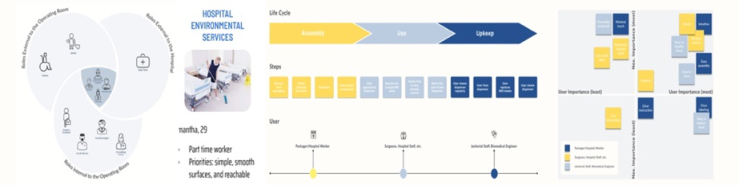
Figure 1: Research Infographics including (Left-Right): Stakeholder Map, User Persona, Journey Map of Storage & Use Process for N95 Masks in Hospital and Needs Matrix.
hospital environment. Existing solutions for storing and distributing masks in the hospital environment are mostly limited to baskets, boxes and other storage options mounted on walls or placed on shelves. Masks are typically removed from these containers at the point of use by healthcare professio- nals. Maintaining sterility of stored masks and facilitating their removal in an orderly and predictable fashion without cross contamination is proble- matic in this approach. Clearly a purpose-built device that safely store & dispense masks is needed.
Because the reliability with which this device can operate is the ultimate determinate of potential market value, unlike a typical studio project, it was necessary that all proposed design concepts be prototyped and tested in order to determine their potential. In order to fine tune the functionality of their designs it was necessary for both teams to engage in an iterative process of prototyping and testing, which is the focus of this paper. Prior to this project, none of the students on either team had undertaken projects that required iterative prototyping and testing.
Initially, students performed background research in order to better under- stand the problem, the nature of competitive & compensatory solutions and to identify appropriate design objectives and criteria for subsequent design efforts. As a part of this initial research, students identified stakeholders, the needs of users, available solutions – on the market and those represented by patents, the design and manufacture of masks, examined the process of how masks are currently “dispensed”in order to identify design opportunities and relevant design requirements. Personas were developed to represent the needs of various stakeholders.
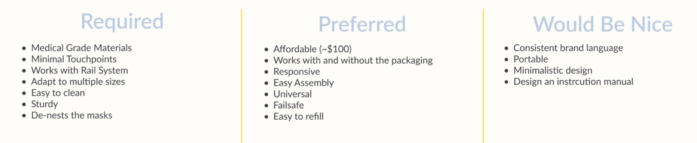
Findings during this initial research were analyzed and a set of design objectives & criteria were developed to guide subsequent design efforts. Both teams presented a summary of this preliminary research and the resul- ting design goals to the project sponsors to provide the opportunity for confirmation/correction.
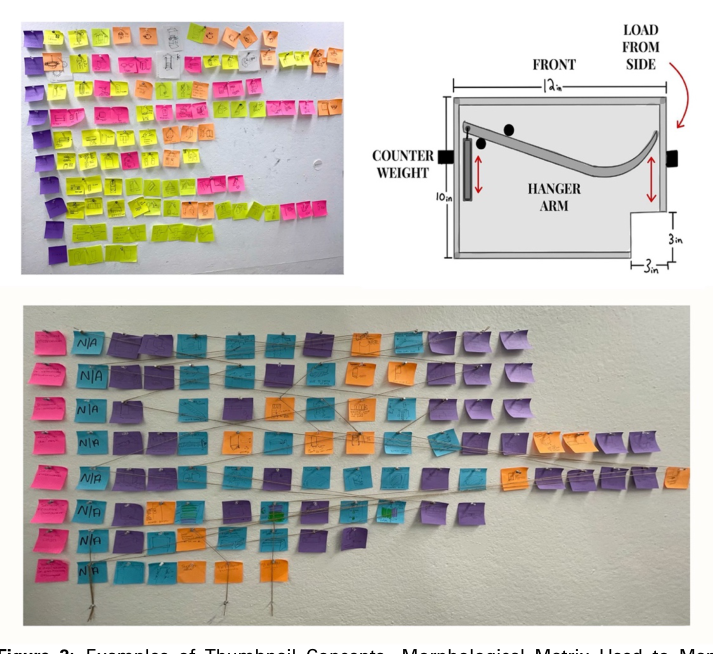
At this point both teams proceeded to generate ideas using a 2D ideation process.
Ideas were organized into concept proposals using morphological matri- ces. 2D sketches were prepared to represent possible configurations for each concept.
These preliminary concepts were refined to the point that study models could be fabricated to permit tentative assessment of their potential. Each
4 Choi and Wilson
Figure 2: Design Goals/Objectives/Criteria.Figure 3: Examples of Thumbnail Concepts, Morphological Matrix Used to Map Concepts, and Example of Initial 2D Design Concept.
team developed 3-4 different design concepts, each represented by testable study models, CAD models and supporting details. These concepts were pre- sented to the project sponsors, along with a discussion of the advantages & disadvantages of each, in order to identify the most promising approach for subsequent refinement and development. After establishing which concept that merited further refinement, each team proceeded with a process of itera- tive refinement, prototyping, testing and refinement etc.. Through testing of prototypes, students observed how successfully masks could be loaded, dene- sted and dispensed individually, while preventing possible contamination of stored masks during the dispensing process. Early prototypes were constru- cted with paper, foam core, wooden dowels and other materials that could
Iterative Prototyping & Testing in the Development of a Reliable 5
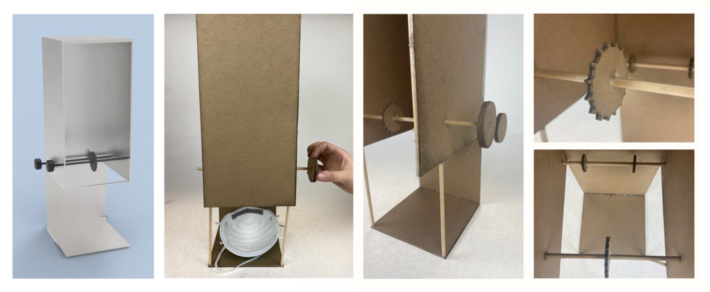
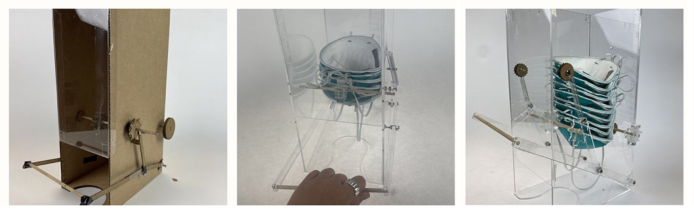
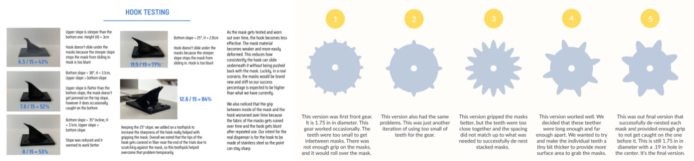
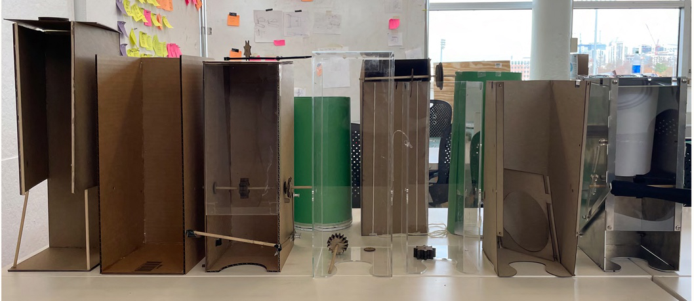
Figure 4: (Left-Right) Preliminary CAD Model & Preliminary Study Model.Figure 5: Iteratively Refined Prototypes (Arranged Left-Right in Terms of Fidelity).Figure 6: Refinement of Key Prototype Details (ie. Hooks & Gears).
easily be fabricated but unfortunately were not sturdy or precise enough to permit meaningful or repeated testing.
Students used informal testing protocols to identify features and details that seemingly led to more consistent & successful dispensing of masks. Sub- sequent prototypes were fabricated with more substantial materials such as laser cut acrylic sheet and 3D printed parts that lend themselves to more durable and accurate/detailed prototypes - better suited for repetitive testing.
As designs were refined and the fidelity of prototypes became more repre- sentative of design intent, key operational details of each design were subject to independent iteration, testing & refinement. Among these details were the cogged rollers and hooks that engaged masks during the dispensing pro- cess. These components were repeatedly refined, prototyped, tested & further revised based on observations that were made during testing.
6 Choi and Wilson
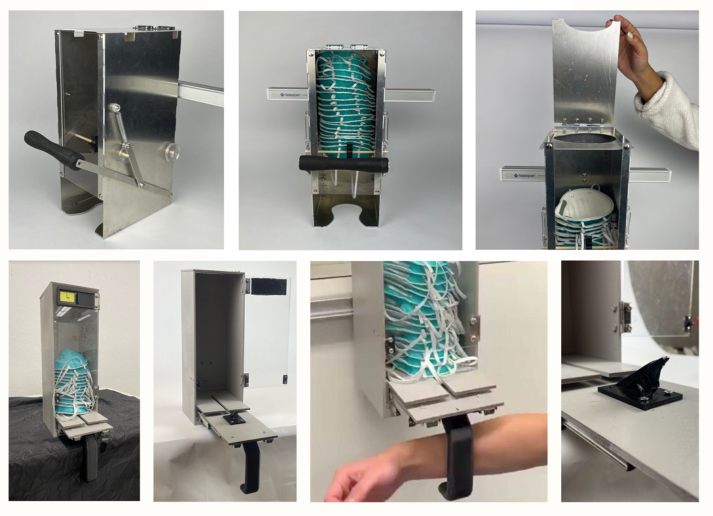
Figure 7: Final Prototypes (Two teams Top & Bottom).
As designs were finalized, students tried to utilize materials more repre- sentative of final production (i.e. plasma cut aluminum sheet to represent stainless sheet, laser cut acrylic to represent polycarbonate material, 3D printed plastic to represent injection molded components, etc..).
RESULTS AND DISCUSSION
Using a process of iterative prototyping and testing, both teams developed and refined multiple prototypes of their final designs (i.e. one team developed & tested 7 iterations while the other team went through 9 iterations of their final design direction). These designs were tested and modified repeatedly so that the final designs demonstrated a high level of reliability – measured at 75%–85% by one team and 90%–95% by the other. Both teams identified further modifications which presumably could increase their design’s reliabi- lity. Note: Testing involved the attempted dispensing of masks in quantities of 20 (the quantity contained in a typical carton of masks). The percentage of success was based on the number of masks that were successfully dispensed out of a quantity of 20 (i.e. the successful dispensing of 18 masks out of a carton of 20 resulted in a 90% success rate). Similar testing of each design ite- ration was performed to help identify refinements that resulted in improved performance.
The project sponsor generously funded applications for Provisional Patents through the USPTO in order to provide protection of the IP developed by both teams.
Iterative Prototyping & Testing in the Development of a Reliable 7
Figure 8: Iterations developed by one of the mask dispenser teams over the course of the design development process.Table 1. Reliability of iterative prototypes.
Table available in the original PDF paper.
Gen 1 Success: Gen 2 Success: Gen 3 Success: Final Gen Success: Team A: 43%* 52%* 77%* 84% Team B: 50%** 70%*** 80%**** 85–95%
* Hook Configuration Variations tested with final Prototype Housing (Figure 6: Left) ** Acrylic Prototype with initial gear profile (Figure 8: 4th from Left) *** Narrower Acrylic Housing with fewer gear teeth (Figure 8: 5th from Left) **** Final Housing with narrower rear gear with fewer teeth (Figure 7)
CONCLUSIONS AND RECOMMENDATIONS The improvements in final project deliverables clearly demonstrate the effectiveness of an iterative process of modeling, testing and subsequent refinement of proposed designs resulted in designs that were demonstrati- vely effective solutions to the problem. Such iteration is the most reliable method, available to students with Industrial Design training, to systemati- cally improve performance of mechanical designs. (It should be noted that none of the students on either project team had particular skills or experie- nce in the development of mechanisms or training in the use of computational optimization tools to refine such mechanisms.
In future efforts of this nature several suggestions can be made:
1) The measures of success in testing need to be consistent between teams working on the same problem and throughout the iterative process. Stu- dents tended to handle testing of crude study models on more of an informal basis – which led to disparities in how success was measured. 2) Testing protocols should be representative of real-world measures of success likely to be encountered by system users. Specifically, test pro- tocols should be based on quantities/dimensions typically found in use environments or commonly available packaging. (For instance, design decisions were made early in the process based on testing of dispenser mechanisms with fewer masks than found in typical package).
8 Choi and Wilson
3) Modelmaking abilities of students necessarily limited the nature design refinements that each team was able to implement. It is suggested that additional instruction be included in design curriculums or that technici- ans skilled in fabrication processes be made available to assist students. (For instance, students lacked metal fabrication skills needed to fabricate some design details).
ACKNOWLEDGMENT
The authors would like to acknowledge the generosity of Nexxspan Heal- thcare, LLC in supporting this work with Industrial Design students at the Georgia Institute of Technology.
REFERENCES
Adams, R. S., Turns, J., and Atman, C. J., 2003, “Educating Effective Engineering Designers: The Role of Reflective Practice,” Des. Stud., (3), pp. 275–294. Godbold, R., Lees, A., & Reay, S. (2019). Ethical challenges for student design proje-
cts in health care settings in New Zealand. International Journal of Art & Design Education, 38(1), 182-192. Lemons, G., Carberry, A., Swan, C., Jarvin, L., and Rogers, C., 2010, “The Benefits of model building in Teaching Engineering Design,” Des. Stud., 31(3), pp. 288–309 Neeley, L. W., Lim, K., Zhu, A., and Yang, M. C., 2013, “Building Fast to Think
Faster: Exploiting Rapid Prototyping to Accelerate Ideation During Early Stage Design,” ASME Paper No. DETC2013-12635. Viswanathan, V. K., and Linsey, J. S., 2009, “Enhancing Student Innovation: Physical Models in the Idea Generation Process,” 39th ASEE/IEEE Frontiers in Education Conference, San Antonio, TX, Oct. 8–21.
LISTED IN THE AHFE DIGITAL BOOKSTORE CATALOGUE
Explore the complete digital volume
Interdisciplinary Practice in Industrial Design
Read this individual research paper free through the original publisher, or explore the full digital proceedings book.
ISBN 978-1-958651-24-7
Explore this ISBN in the AHFE Bookstore ↗Listed in the July 2026 bookstore catalogue; search by ISBN to confirm current availability · Digital book purchase optional