Susan Sokolowski, Huiju Park, Linsey Griffin, Meredith Mcquerry, James Tuttle (2022). Visual, Volumetric and Anthropometric Measurement Comparisons Between Boot Interior and 3D Foot Scans to Improve Female Firefighter Safety. In: Interdisciplinary Practice in Industrial Design. AHFE Open Access, vol. 48, pp. 91–99. https://doi.org/10.54941/ahfe1002020
In 2016, the National Fire Protection Association (NFPA) estimated that 62,085 injuries occurred in the line of duty. Haynes and Stein (2017) further reported that a U.S. firefighter injury is reported every eight minutes. Many of these injuries can be attributed to poorly fitting and functioning turnout gear, especially boots. When boots fail to fit appropriately, the firefighter can be in danger of losing proprioception, getting burned, slipping and tripping. This pilot study developed a method using techniques from the industrial design field to capture the interior of a common fire boot, to then compare it to 3D female firefighter foot scans. Visual, volumetric, and anthropometric measures were analyzed to make recommendations on how manufacturers could improve boot fit for firefighters.
For firefighters, turnout boots are designed to protect the foot and lower leg from heat, flames, punctures, falling objects, slipping, chemicals and water - all while taking on heavy loads and intersecting with variable terrain (Soko- lowski, 2018). When boots fail to fit appropriately, the firefighter can be at risk for injury through losing proprioception, getting burned, slipping and tripping. Female firefighters experience higher rates of injury than male firefi- ghters (Liao, Arvey, Butler & Nutting, 2001; Sinden, MacDermid, Buckman, Davis, Matthews & Viola, 2013). In fact, between 2010 and 2014, the NFPA estimated that female firefighters experienced an average of 1,260 injuries on the fireground each year (Campbell, 2017). Research by Hollerbach et al. (2017) attributed female firefighter injuries to one of six causes, including ill-fitting gear – which includes fire boots.
In the realm of firefighter boots, several researchers have documented sizing and fit issues expressed by women. Related to sizing, Park et al. (2014) identified in their study that female firefighters felt their boots were over- sized, affecting mobility and comfort. Hulett et al. (2008) reported 46.8% of women studied experienced problems with boot fit. Boot fit was also studied by Boorady et al. (2013). In their study, respondents explained overall boot fit was too long/large, to the point of having lost boots during fire activities (e.g., crawling). Although several studies have reported poor fit, none have looked at why it exists between the boot interior and foot. To understand fire boot fit issues, a new research method is needed to evaluate the interface between the boot interior and female firefighter foot – which to this date has never been studied.
METHODOLOGY
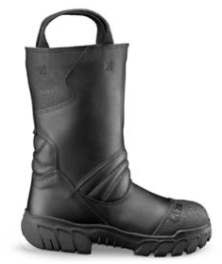
Fire Boot Studied The interior of a Men’s 8/Women’s 10 Wide 13” fire boot was analyzed for this pilot study (Figure 1). The boot is a popular, value-priced product in a top firefighting PPE manufacturer’s assortment and certified by the NFPA. It is sold with an additional set of polymer inserts that the firefighter can place under the sock liner for a snugger fit, however, for this study the inserts were not used. The boot is marketed with several features, ranging from protective materials to specialized components for fireground activity comfort and fit.
Figure 1: 13” fire boot.
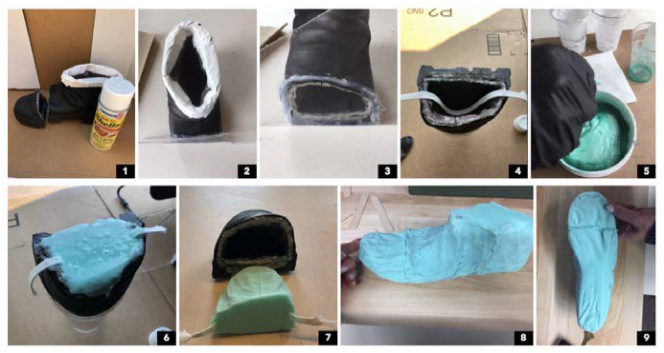
Fire Boot Interior Capture To study how the boot interfaces and compares to female firefighter feet, the interior of the boot needed to be captured. A process (Figure 2) utilizing methods from industrial design was developed to collect the data. With this process the boot becomes a mold, so the interior could be captured with silicone, thus creating a 3D part. The boot was first cut into toe, midfoot and calf sections with a power saw. As the toe and midfoot portions of the boot were the only two analyzed for the study, the calf portion was set aside. Next,
Visual, Volumetric and Anthropometric Measurement Comparisons 93
Figure 2: Process for capturing the fire boot interior.
the interiors of the toe and midfoot sections were prepped with shellac and mold release (Step 1), so the silicone would not stick to the boot liner upon demolding. The cut top edge of the midfoot section was taped-off to keep the edge sturdy and a plexiglass dam (Step 3) was also added to the front portion of the midfoot section (with hot glue) to close the edge for mold pouring and part adhesion. To help with part removal, the toe portion of the mold was prepped with nylon webbing (Step 4). Smooth-on Mold Max silicone was measured and mixed so the toe and midfoot molds could be poured and cured for 24-hours (Steps 5 and 6). Once the parts were cured, they were removed from the molds and joined together with a flexible epoxy (Steps 7 and 8). With the boot interior part completed, it could then be scanned to create a 3D file (Step 9).
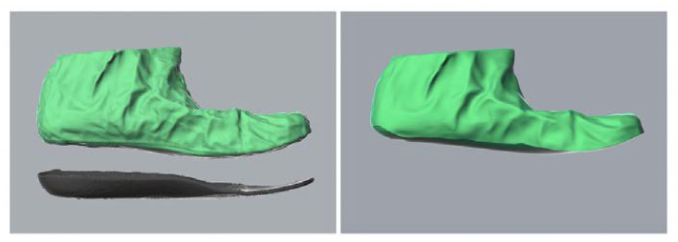
The boot interior part was scanned using an Artec Eva scanner, cleaned and saved as an .obj file. Since the scan was captured without the sock liner (to prevent migration of the sock liner during the molding process), it was scanned separately so it could be removed from the 3D interior boot file to create the actual interior that the firefighter would interface with their feet. This process was done using the Rhino QuadReMesh command which converts the 3D scan meshes into NURBS surfaces, so the sock liner could be subtracted-out with ease and volume accuracy (Figure 3).
3D Femaler Firefighter Foot Scans Through previous research, the authors captured 3D foot scans from female firefighters using a Structure scanner (Jo, Sokolowski, McQuerry, Griffin & Park, 2021). Five right foot scans were identified from that study to fit into the boot selected for this pilot study, based on foot length measures. These feet measured 1-2cm shorter in length compared to the selected boot’s interior part. This measurement range is typically used to fit footwear in the U.S. market (Shoegazing, 2021). Before the foot scans were analyzed they were cleaned, cut to the same height as the interior part and made watertight.
Figure 3: Boot interior before (left), and after sock liner removal (right).
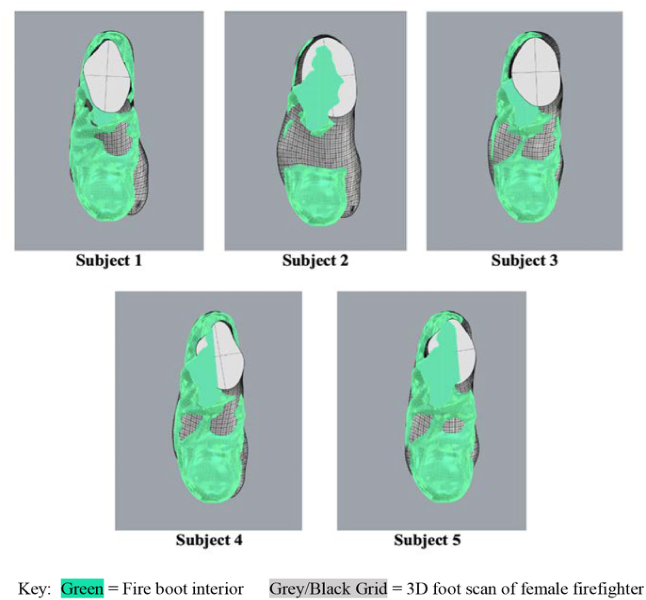
3D Boot Interior and Foot Scan Data Analysis Once prepared, the 3D boot interior and female firefighter foot scan files were ready for analysis. Three methods were used to analyze these files. The first was a qualitative visual analysis where the 3D interior and individual foot scan files were aligned at the center back heel and floor to be compared visually. This was done in Rhino which allowed the files to be colored and stacked on top of each other to visualize whether they were the same size, too big or too small.
The second analysis method measured the volume of the 3D files in cubic centimeters. Measures were collected in Rhino, reported in a table and color coded if they were larger (red) or smaller (green) in comparison to the boot interior’s volume. Since the 3D foot scans were taken without socks, a sock ease measure of 1.6% was added to each foot volume measure. The ease measure was calculated by the PI measuring a foot with and without a wool fire sock and averaging the differences.
The third method of analysis looked at comparing anthropometric foot measures to measures of the boot interior. Five measures (Table 1) were defined that could be accurately collected between the different 3D files in
Table 1. Measurements and definitions.
Table available in the original PDF paper.
Measurement Definition Foot Length (cm) Maximum length of the right foot, from the back of the heel to the longest toe. Foot Breadth (cm) Maximum horizontal breadth measure from the first metatarsophalangeal protrusion to the fifth metatarsophalangeal protrusion of the right foot. Ball of Foot to Heel Length (cm) Length measure from the foot breadth measure location to back of heel of the right foot. Heel Width (cm) Maximum horizontal breadth measure between the most medial and lateral sides of the right heel. Heel/Ankle circumference (cm) Circumference measure of the right foot from the dorsal juncture of the foot and leg (at the front of the ankle) to the base of the heel.
Visual, Volumetric and Anthropometric Measurement Comparisons 95
Rhino. Measurement definitions were adapted from the 1988 Anthropome- tric Survey of U.S. Army Personnel (Gordon, Churchill, Clauser, Bradtmiller & McConville, 1989).
The sock ease measure of 1.6% was also added to the foot measures to mimic the condition of the firefighter wearing socks on their feet while wea- ring fire boots. Like the volume measures, the boot interior and foot scan measures were acquired in Rhino, reported in a table and color coded if they were larger (red) or smaller (green) in measure.
RESULTS AND DISCUSSION
Qualitative Visual Analysis Through this study, it is clear why female firefighters comment poorly about the fit and comfort of their boots. The silicone molded part derived from the fire boot interior proved to be quite wrinkled in form, and in use, it is likely to create hot spots, rubbing and blisters around the firefighter’s foot. The wrin- kling is due to the multiple layers of non-stretch, protective materials that make-up the boot, along with its’ simple pull-over design with no fit adju- stments. To reduce wrinkles, it may be worth for manufacturers to explore laminating or stitching material layers together to establish a composite-like structure with engineered fold lines that are less likely to collapse.
Figure 4: Visual analysis of boot fit between boot volume and subject 3D foot scans.
Even though all five of the 3D foot scans analyzed were selected based on their length in comparison to the boot interior, three major fit challenges were uncovered through the visual analysis (Figure 4). The first was foot breadth – where the boot interior (green) was seen to be narrower in forefoot width than the foot scans (grey/black grid). The second issue was seen with subje- cts 1, 3-5 where the boot interior fit around the ankle and back of foot was visibly larger than the foot scans. The third was the curvature of the boot interior at the forefoot versus the foot – where the boot curved up more than the foot. These findings coincide with previous research where female firefi- ghters described boot fit and comfort issues around the forefoot, along with challenges of their boots falling off when crawling on the fireground (Park et al., 2014; Boorady et al., 2013; Hulett et al., 2008). These issues could be resolved by developing new lasts that take in account female firefighter foot measures and conducting wear tests to validate the last shape.
3D Boot Interior Versus Foot Scan Measures To further understand the fit interface between the fire boot interior and subject foot scans, quantitative measures were collected (Table 2). The first measure was a simple volume measure, and for 4/5 subjects (80%) – the volume of the foot scan was larger than the boot interior, suggesting the fire boot would fit too tight. Like the visual analysis, the foot breadth measu- res were 100% wider than the boot interior. The ball of foot to heel length measures were longer than the boot interior, suggesting that the last is not positioning the foot correctly inside of the boot. The heel width measures were found to be close to the boot interior measure (ranging from .05cm to 1.36cm), however the heel/ankle circumference measures were much smaller than the boot interior, ranging from 2.41cm to 5.85cm – which aligned to the findings in the visual analysis where the boot interior looked larger than the
Table 2. Volumetric and anthropometric measurements, by subject (without sock ease).
Heel/Ankle Circ. (cm) Key: Larger than Boot Interior: Smaller than Boot Interior:
foot scans. As mentioned, these differences could be resolved by developing a new last based on female firefighter foot anthropometric data.
A sock ease measure of 1.6% was added to the subject foot measures in Table 3 to represent how the socked foot would interface with the boot. What is important to note here is that the sock ease did not have a major effect on the results. Only one measure (subject 3’s heel width) out of the 30 subject foot measures changed from smaller than the boot interior (green box) to larger (red box). In summary, the results from this study demonstrate the current last used for the selected boot is not proportionally sized to reflect female foot shape.
CONCLUSION
This pilot study developed a method using techniques from the industrial design field to capture the interior of a common fire boot so comparisons could be made to 3D female firefighter foot scans to understand fit chal- lenges reported by female firefighters in previous research. The interior of a Men’s 8/Women’s 10 Wide 13” fire boot was captured for this study, and visual differences, volume, and anthropometric measures were analyzed to make recommendations on how manufacturers could improve boot fit for firefighters. The study was unique because it was the first time the fire boot interior was captured in 3D and directly compared to female foot scans. The method of data collection used could also be applied to the study of other footwear or equipment products that have complicated constructions with multiple layers of stiff materials that encompass the body. Practically, the fin- dings from this research are important because they could directly affect the safety of female firefighters. As noted, female firefighters experience higher rates of injury than their male counterparts (Liao et al., 2001; Sinden et al., 2013).
There were several limitations to this pilot study. The first was the small sample size. Since scans were selected from a previous study, a more targeted study could be conducted where subjects are recruited specifically for the boot size in question. Secondly, a focused study with different types/thicknesses of socks and foot sizes could be conducted to understand sock ease in relation to foot scans to statistically determine more accurate ease values. Lastly, since the 3D foot scans were taken while standing and unloaded (without wearing turnout gear), a study with loaded foot scans could provide more informa- tion of how the foot deforms in comparison to the boot interior. Research from Jo et al. (2021) found that the foot became longer, wider, and lower to the ground when subjects were loaded with turnout gear. In conclusion, this study uncovered opportunities to improve the fit of turnout boots for female firefighters. With effective manufacturing partnerships and future research, there is the potential for women to experience fewer injuries and improved performance with their PPE, establishing equity with their male counterparts.
ACKNOWLEDGMENT
The authors would like to acknowledge all female firefighters that dedicate their service to the community. This research was funded in part by the 2018 University of Oregon Faculty Grant, the Cornell University Agricultural Experiment Station federal formula funds, Project No. NYC-329851 recei- ved from the National Institute of Food and Agriculture (NIFA) United States Department of Agriculture, the Minnesota Agricultural Experiment Station, and the National Institute of Food and Agriculture, U.S. Department of Agri- culture, Hatch under MIN-53-088, and the Small Grants Program through the Council on Research and Creativity at Florida State University.
REFERENCES
Campbell, R. B. (2017). Patterns of female firefighter injuries on the fireground.
National Fire Protection Association, Data and Analytics Division. Gordon, C. C., Churchill, T., Clauser, C. E., Bradtmiller, B., & McConville, J. T.
(1989). Anthropometric survey of US army personnel: methods and summary statistics 1988. Anthropology Research Project Inc Yellow Springs OH. Haynes, H. J., Stein, G. P. (2017). US fire department profile 2015. Quincy, MA: National Fire Protection Association. Hollerbach, B. S., Heinrich, K. M., Poston, W. S., Haddock, C. K., Kehler, A. K.,
& Jahnke, S. A. (2017). Current female firefighters’ perceptions, attitudes, and experiences with injury. International fire service journal of leadership and management, 11, 41. Hulett, D. M., Bendick, M., Thomas, S. Y., & Moccio, F. (2008). A national report card on women in firefighting. Madison, WI: International Association of Women in Fire & Emergency Services. Jo, J., Sokolowski, S., McQuerry, M., Griffin, L., Park, H. (2021). Firefighters’ feet:
Differences by sex and weight-bearing. Manuscript submitted for publication. Liao, H., Arvey, R. D., Butler, R. J., Nutting, S. M. (2001). Correlates of work injury frequency and duration among firefighters. Journal of occupational health psychology, 6(3), 229.
Visual, Volumetric and Anthropometric Measurement Comparisons 99
Park, H., Park, J., Lin, S. H., & Boorady, L. M. (2014). Assessment of Firefighters’ needs for personal protective equipment. Fashion and Textiles, 1(1), 1–13. Shoegazing. (2020, July). The tip; Space in front of the toes. Shoegazing website:
https://shoegazing.com/2020/07/26/the-tip-space-in-front-of-the-toes/ Sinden, K., MacDermid, J., Buckman, S., Davis, B., Matthews, T., Viola, C. (2013). A qualitative study on the experiences of female firefighters. Work, 45(1), 97–105. Sokolowski, S. L., Cantrell, N. & Griffin, L. (2018). Firefighting turnout boots: How
a human factors approach can improve performance. Advances in Interdiscipli- nary Practice in Industrial Design, 59–67. https://doi:10.1007/978-3-319-94601- 6_8
LISTED IN THE AHFE DIGITAL BOOKSTORE CATALOGUE
Explore the complete digital volume
Interdisciplinary Practice in Industrial Design
Read this individual research paper free through the original publisher, or explore the full digital proceedings book.
ISBN 978-1-958651-24-7
Explore this ISBN in the AHFE Bookstore ↗Listed in the July 2026 bookstore catalogue; search by ISBN to confirm current availability · Digital book purchase optional