Susan Sokolowski (2026). A human factors framework for adaptive athlete–centered product design. In: Interdisciplinary Practice in Industrial Design. AHFE Open Access, vol. 222, pp. 167–176. https://doi.org/10.54941/ahfe1007756
Adaptive athletes often augment existing products or create their own solutions to participate effectively and efficiently in sport. Designing relevant products for these athletes requires a human factors approach that balances individual needs with performance considerations. This paper aims to provide background on the adaptive athlete's needs, based on sport, rules and regulations, environment, support systems, and impairment classifications established by World Para Athletics, as well as on physiological, biomechanical, and psychological performance considerations, to develop a framework for designers. The framework serves as an adaptive athlete-centered tool for ideation to organize complex requirements for product design.
An adaptive athlete is any person with a disability who participates in modified sports at recreational, competitive, or elite levels, across all ages and environments (Office of the Provost, University of Michigan, n.d.). Globally, an estimated 1.3 billion people live with disabilities, approximately 16% of the world’s population, representing a substantial potential population of adaptive athletes (World Health Organization, 2022). Despite scale, most athletes lack access to products designed for their individual and performance needs. As a result, adaptive athletes often augment existing products or create their own solutions to participate efficiently and effectively. This could lead to unsafe conditions or put the athlete at a competitive disadvantage.
This paper establishes a human factors framework to support ideation in the design of footwear, apparel, and equipment products for adaptive athletes. A systems thinking approach was employed to account for the wide range of factors that make up the adaptive athlete ecosystem which can influence how a product is designed. Sport, environment, rules and regulations, support systems, key impairment classifications set forth by World Para Athletics were reviewed, along with associated physiological, biomechanical, and psychological performance needs. Foundational knowledge was then synthesized into an adaptive athlete–centered design framework, enabling designers to systematically innovate successful products.
BACKGROUND
Core Influences on Adaptive Athlete Product Design To develop a design framework that is adaptive athlete-centric, it is important to use a systems thinking approach to understand the elements that make up the athlete’s ecosystem and how they interact. Systems thinking focuses on the interconnection of factors (Arnold & Wade, 2015), rather than in isolation, to enable holistic decision making in product design. At a high-level, the core elements that influence the design process for adaptive athlete-specific products include the sport being played, rules and regulations, environment, and athlete support system.
The sports adaptive athletes play can encompass a wide range of activities that are individual-based (e.g., track and field, swimming), and team-based (e.g., wheelchair basketball, sitting volleyball). Sport rules and regulations include ones that pertain to the specific sport played, competition-specific rules and ones related to the products worn. These rules are usually governed by international federations, national governing bodies, and specialized organizations that align with International Paralympic Committee standards (International Paralympic Committee, n.d.).
The training and competition environment includes athlete level of play (e.g., recreation, competitive, elite), location of where the sport is being played (e.g., indoors, outdoor, aquatic), along with terrain (e.g. snow, mud, ice, asphalt), temperature, humidity, and elevation. Also at the core, is the support system that enables the athlete to be successful, including the organizing bodies that champion adaptive athletic events (e.g., Special Olympics, Paralympics), coaches, family members, medical and therapeutic experts (e.g., physicians, physical therapists, athletic trainers, nutritionists, psychologists), product specialists and outfitters, along with other athletes and teammates where relevant. These core influences set the stage for the product designer to understand the multifaced context in which adaptive athletes operate.
Impairment Classifications for Adaptive Athletes Beyond the core influences, it is important to understand adaptive athlete- specific impairments, so products can be designed to seamlessly integrate with individual needs. To enable competitive equity, World Para Athletics established an impairment classification system for adaptive athletes (World Para Athletics, n.d.). The system helps to functionally define how athletes are eligible to compete, and how they are grouped together for competition to minimize the impact of impairments on overall sport performance (World Para Athletics, n.d.). To be classified, the athlete must have an eligible impairment, meet the minimum impairment criteria for the sport they want to compete in (as each sport has different criteria), and be assigned a sports class (International Paralympic Committee, n.d.). There are 10 eligible impairment types. They are presented with their definitions in Table 1.
Table 1: Impairment classification definitions (World para athletics, n.d.).
Table available in the original PDF paper.
Impairment Definition Ataxia Athletes have uncoordinated movements due to damage to the central nervous system.
Athetosis Athletes have continual slow involuntary movements. Hypertonia Athletes have an increase in muscle tension and a reduced ability of their muscles to stretch, caused by damage to the central nervous system.
Impaired Muscle Power
Athletes have a condition that either reduces or eliminates their ability to voluntarily contract muscles to move or to generate force.
Impaired Passive Range of Movement
Athletes have restriction or lack of passive movement in one or more of their joints.
Intellectual Impairment
Athletes have restriction in intellectual functioning and adaptive behavior in which affects conceptual, social and practical skills required for everyday life.
Leg Length Difference
Athletes have a difference in the length of their legs as a result of a disturbance of limb growth, or trauma. Limb Deficiency Athletes have total or partial absence of bones or joints because of trauma (e.g., amputation), illness (e.g., bone cancer) or congenital limb deficiency (e.g., dysmelia).
Short Stature Athletes have a reduced length in the bones of the upper limbs, lower limbs and/or trunk.
Vision Impairment Athletes have reduced, or lack of vision caused by damage to the eye structure, optical nerves, optical pathways, or visual cortex of the brain.
Product Performance Influences for Adaptive Athletes The products worn and used by adaptative athletes can both accommodate human impairment-related needs and enhance performance, provided they are permitted under rules established by relevant governing bodies. For this paper, the physiological, biomechanical and psychological performance factors that can be influenced by product design are examined.
Physiology is the integrated study of the body’s responses to sport that underpin athletic performance and health, including cardiorespiratory, muscular, metabolic, and neuromuscular systems (Wilmore et al., 2004). For athletes, footwear, apparel, and equipment can be designed to assist human physiology by managing their thermoregulation, recovery processes, cardiovascular strain, and metabolic demands (Di Domenico et al., 2022; Oral et al., 2021; Dupuy et al., 2018; De Sousa et al., 2014; Steele et al., 2025).
Biomechanics is the application of mechanical engineering principles to the human musculoskeletal system to study the anatomical and functional relationships between structure, position/posture, and movement of body segments during sport activities (Bartlett, 2014). For athletes products can
170 Sokolowski be designed to foster their biomechanics by providing support, stability, form and range of motion (Williams et al., 2024; Dami et al., 2024; Zamporri & Aguinaldo, 2018; Gascon et al., 2018).
Lastly, psychology is the scientific study of the factors associated with participation and performance in sport (Weinberg and Gould, 2023). For athletes, products can be designed to influence psychological performance through motivation, confidence, and team dynamics (Zunker et al., 2014; Cross, 2011; Bhowmik, 2019). By understanding adaptive athlete impairments and the ways in which products can support human performance, designers are better equipped to ideate meaningful solutions for adaptive athletes, forming the foundation of the human factors framework.
Products Worn and Utilized by Adaptive Athletes Like abled-bodied athletes, adaptive athletes wear and utilize footwear, apparel and equipment for sport training and competition (Sokolowski, 2019). Apparel products typically cover the body’s core and may cover some or all the upper and lower extremities. They are usually made of soft and flexible materials (e.g., knits, wovens, thermoplastic films) and can include items like jerseys, pants, tanks, bras, base layers, vests, jackets, tights, and shorts. Footwear products cover the foot and sometimes the ankle, calf, knee and thigh. They are made of a combination of soft and hard materials (e.g., leathers, synthetic leathers, wovens, knits, foams, composite plates, rubber) and can include items like ski boots, slides, court shoes, cleats, racing flats, and spikes. Equipment products are the tools used by athletes that are sport or user specific. These products can also be made of hard and soft materials (e.g., rubber, foams, composites, metals, knits, wovens) and include items like gloves, grips, pads, guards, sleds, wheelchairs, balls, eyewear, and prosthetics. As forementioned, each sporting event organization (e.g., Paralympics, Special Olympics) will provide rules outlining what the athlete can legally wear and use, with detailed descriptions for assistive devices. Product dimensions, body coverage, branding, and materials are often the attributes that have specific design rules to insure appropriate athlete appearance, physical prowess, competitive fairness and safety (International Paralympic Committee, 2011).
METHODOLOGY
Purpose and Process Designing products for adaptive athletes is a complex process because requirements are often multifaceted. To establish an adaptive, athlete-centric design framework, existing knowledge on sport, environment, rules and regulations, support systems, and key impairment classifications set forth by World Para Athletics, together with associated physiological, biomechanical, and psychological performance needs, was synthesized to create an ideation tool for designers. Through this exercise, the intent is to provide a process that enables designers to generate ideas that are functional and appropriate for the adaptive athlete being designed for.
A Human Factors Framework for Adaptive Athlete-Centered Product Design 171 Core Influences
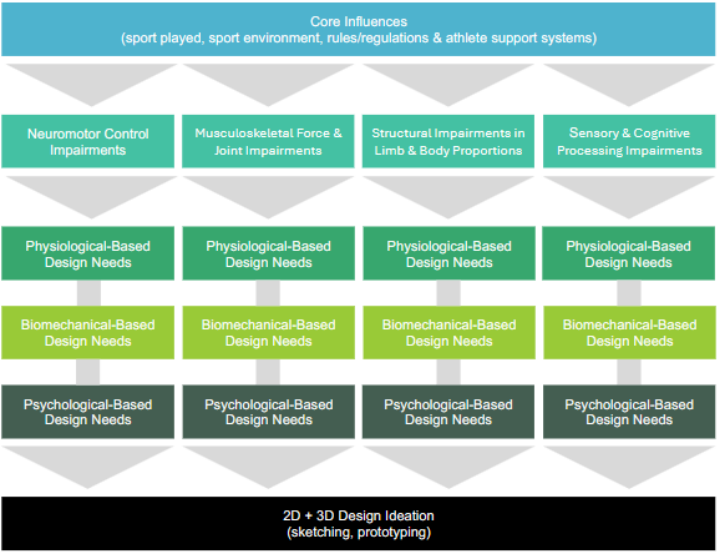
The first component of the framework involves the core influences surrounding the adaptive athlete regarding the product being designed. As outlined in the background, these include knowledge on the sport being played, sport environment, rules and regulations, and athlete support systems. They form the foundation of the design work, which designers can research from literature, along with athlete and/or expert interviews and surveys.
Impairments, Performance, and Product Design Needs Synthesized The 10 impairments outlined by World Para Athletics can be synthesized into four high-level themes aligned with human performance and functional product design needs. These themes include neuromotor control impairments, musculoskeletal force and joint impairments, structural impairments in limb and body proportions, and sensory and cognitive processing impairments. Organizing information in this way enables more specific knowledge to be sourced directly from athletes, specialists, coaches, and scientific literature to identify adaptive, athlete–centered product design needs. Because adaptive athletes have diverse individual requirements, product design must balance core ecosystem influences with personalized solutions to optimize safety and performance.
Neuromotor control impairments include ataxia, athetosis, and hypertonia. These conditions affect muscle tone and movement due to nervous system damage, resulting in uncoordinated, involuntary, weak, or stiff movements (World Para Athletics, n.d.). Physiologically, products can prevent overheating from extra exertion due to these impairments (Griggs et al., 2020) by using ventilated, stretchy, and moisture-wicking materials. Materials can also be selected for their weight characteristics to reduce overall metabolic costs. Often, athletes with neuromotor control impairments use a wheelchair, and pressure ulcer design considerations (Schofield et al., 2013) should be incorporated by creating products with soft materials, in working positions (Watkins & Dunne, 2015), and with reduced seams, trims, pockets, tags, and hard edges. Fit and the ability to adjust product interfaces are important too, given body shape variability. Biomechanically, products can be designed to provide stability, support, and range of motion control (Rum & Kons, 2025), without restricting motion; psychologically, products can be designed for accurate fit, odor management, ease of donning, doffing, and use, enabling independence and confidence (Jefferies et al., 2012).
Musculoskeletal force and joint impairments involve limited muscle power and reduced passive range of motion (World Para Athletics, n.d.), which reduce the athlete’s ability to generate force or full joint range of motion, affecting stability, propulsion, and posture. Physiologically, products can be designed to support athletes with these impairments by reducing metabolic strain, improving thermoregulation, and recovery through materials that stretch and breathe, form, compression and fit (Fletcher et al., 2021; Griggs et al., 2020). Biomechanically, products can help guide joint motion, dexterity, posture and propulsion (Miyashita et al., 2021), through form, fit, materials, trims, donning and doffing solutions, while psychologically products can
172 Sokolowski reduce fear of falling and enhance confidence due their contribution of stability, propulsion and posture, which ultimately demonstrates the impact of positive psychological capital on athletic performance (Kim, 2025).
Structural limb and body proportion impairments include limb-length differences, limb deficiencies, and short stature (World Para Athletics, n.d.). Performance-wise, these impairments can affect balance, leverage, and reach. Physiologically, as discussed previously, products need to be designed to prevent unnecessary exertion and help manage overheating. Biomechanically, they should be designed to support balance despite structural asymmetries (Vogt et al., 2020) and, where relevant, use frictionless materials internally to better interface with prosthetics and remain durable over time. Psychologically, custom-fit products or ones with adjustability to accommodate length variabilities can foster positive body image and confidence (Bragaru et al., 2011).
Sensory and cognitive processing impairments include vision and intellectual limitations (World Para Athletics, n.d.), which can affect visual input, perception, and decision-making. Through design, products can support human physiology by enabling efficiency through sensory feedback (Semjonova et al., 2022), biomechanics by enabling spatial awareness to promote a smooth range of motion and aligned posture, and psychology by motivating the athlete (Jefferies et al., 2012) through fit, color, texture, and aesthetic decisions to foster confidence.
Through this synthesis of core influences, impairments, performance and design needs, a human factors framework for adaptive athlete–centered product design can be established.
RESULTS
The human factors framework for adaptive athlete–centered product design was established to organize information for designers as they progress from 2D to 3D ideation. The framework enables information to be gathered sequentially, from relatively accessible to more complex, so cumulative learning occurs, and preparation for ideation becomes less daunting. As shown in Figure 1, the framework first guides the designer to collect information on the core influences for the athlete being designed for, including their sport, sport environment, rules and regulations, and their support systems; this information is typically available from published literature, sport governing bodies, athletes, and their support systems.
Research queries related to core influences could include:
1. What is the history of sport being designed for? 2. How is the sport is played, and is it an individual or team sport? 3. Where the sport is being played (indoor, outdoors, aquatic)? 4. What terrain is the sport being played on? 5. What are the size and characteristics of the sporting environment, including temperature and possible weather conditions? 6. What level is the athlete (e.g., recreational, competitive, elite)? 7. What are the rules and regulations related to the sport, including product and competition-specific rules that may influence product design?
8. Who is the athlete’s support system and what can they tell you about the athlete and their needs?
The second phase of the framework focuses on understanding the athlete’s specific impairment(s), which can be informed by the athlete, coaches, specialists, and scientific literature. Example research queries related to impairments could include:
1. Which of the four impairment themes applies to the athlete? 2. Does the athlete have more than one impairment theme? 3. How is the impairment(s) defined for the athlete? 4. Which body part(s) does the impairment(s) affect? 5. What is the severity of the impairment(s)? 6. How does the impairment(s) affect playing the sport in question?
The third, fourth, and fifth phases of the framework synthesize the resulting physiological, biomechanical, and psychological product needs derived from the core influences and impairments. Because athletes could have multiple impairments, this synthesis should be completed for each impairment type. These needs can be identified using information provided by athlete themself, coaches, specialists, and scientific literature. Sample research queries could include:
1. Based on the core influences and impairment(s), how is the athlete’s physiology affected?
2. Given these physiological effects, how might products (footwear, apparel, equipment) be designed to better support this athlete? 3. Based on the core influences and impairment(s), how is the athlete’s biomechanics affected? 4. From the biomechanical effects, how might products (footwear, apparel, equipment be designed better to better support this athlete? 5. Based on the core influences and impairment(s), how is the athlete’s psychology affected? 6. From the psychological effects, how might products (footwear, apparel, equipment be designed to better support this athlete?
DISCUSSION
The framework serves as a navigation tool, to help designers gather information sequentially to inform their 2D and 3D ideation work. It has been used by the author as a teaching tool in design courses, with positive outcomes. By using the framework, designers can translate their findings into a SWOT analysis, design brief, mind map or other ideation tools at their use to support 2D and 3D ideation. A key limitation is that the framework structures the knowledge- gathering process, but it does not provide quantitative decision-making guidance, as each design project will have different hierarchal requirements based on the individual athlete’s needs. Opportunities for future research include inviting other designers to apply the framework and examine their successes and challenges in the knowledge-gathering process, to further refine the tool and enable stronger 2D and 3D ideation work.
CONCLUSION
Designing for adaptive athletes can be a complex and sometimes overwhelming experience for designers. Safety, comfort, accuracy, and performance rides on the success of the product developed, placing a high level of responsibility on the designer. The adaptive athlete–centered product design framework provides a sequential method of collecting information as designers work toward 2D and 3D ideation, helping to ensure critical information is gathered and organized effectively.
REFERENCES
Arnold, R.D. and Wade, J.P. (2015). A definition of systems thinking: A systems approach. Procedia computer science, 44, pp. 669–678. Bartlett, R. (2014). Introduction to sports biomechanics: Analysing human movement
patterns. Routledge. Bhowmik, C. (2019). Science of team dynamics: A review of psychological factors influencing team performance in sports. Int. J. Physiol. Nutr. Phys. Educ, 4, pp. 625– 631. Bragaru, M., Dekker, R., Geertzen, J.H. and Dijkstra, P.U. (2011). Amputees and
sports: a systematic review. Sports medicine, 41(9), pp. 721–740. Cross, E.M. (2011). The uniform effect: Collegiate student-athletes’ experiences with competition athletic apparel and self-perception. Unpublished PhD Dissertation, Virginia Tech, Blacksburg, Virginia.
A Human Factors Framework for Adaptive Athlete-Centered Product Design 175 Dami, A., Payen, E., Farahpour, N., Robb, K., Isabelle, P.L. and Moisan, G. (2024).
Medially wedged foot orthoses generate greater biomechanical effects than thin- flexible foot orthoses during a unilateral drop jump task on level and inclined surfaces. Clinical Biomechanics, 112, p. 106193. De Sousa, J., Cheatham, C. and Wittbrodt, M. (2014). The effects of a moisturewicking fabric shirt on the physiological and perceptual responses during acute exercise in the heat. Applied ergonomics, 45(6), pp. 1447–1453. Di Domenico, I., Hoffmann, S.M. and Collins, P.K. (2022). The role of sports clothing
in thermoregulation, comfort, and performance during exercise in the heat: a narrative review. Sports Medicine-Open, 8(1), p. 58. Dupuy, O., Douzi, W., Theurot, D., Bosquet, L. and Dugué, B. (2018). An evidencebased approach for choosing post-exercise recovery techniques to reduce markers of muscle damage, soreness, fatigue, and inflammation: a systematic review with meta- analysis. Frontiers in Physiology, 9, p. 312968. Fletcher, J.R., Gallinger, T. and Prince, F. (2021). How can biomechanics improve
physical preparation and performance in paralympic athletes? A narrative review. Sports, 9(7), p. 89. Gascon, S.S., Gilmer, G.G., Hanks, M.M., Washington, J.K. and Oliver, G.D.
(2018). Biomechanical influences of a postural compression garment on scapular positioning. International Journal of Sports Physical Therapy, 13(4), p. 700. Griggs, K.E., Stephenson, B.T., Price, M.J. and Goosey-Tolfrey, V.L., 2020. Heatrelated issues and practical applications for Paralympic athletes at Tokyo 2020. Temperature, 7(1), pp. 37–57. International Paralympic Committee. (no date). Paralympic classification. Available
at: https://www.paralympic.org/classification (Accessed: 19 January 2026). International Paralympic Committee. (no date). Classification by sport. Paralympic.
org. https://www.paralympic.org/classification-by-sport International Paralympic Committee. (2011). IPC Policy on sport equipment.
Available at: https://www.paralympic.org/sites/default/files/2024–04/Sport%20 Equipment%20Policy_2011.pdf Jefferies, P., Gallagher, P. and Dunne, S., 2012. The Paralympic athlete: a systematic review of the psychosocial literature. Prosthetics and orthotics international, 36(3), pp. 278–289. Kim, K. (2025). Impact of positive psychological capital on the athletic performance
of Para athletes. Asia-pacific Journal of Convergent Research Interchange, 11(4), pp. 387– 401. Available at: http://apjcriweb.org/content/vol11no4/38.html (Accessed: 3 February 2026). Miyashita, T., Katayama, S., Yamamoto, A., Sakamoto, K., Kitano, M., Takasaki, R.
and Kudo, S. (2021). The effect of functional biomechanics garment for walking. International Journal of Environmental Research and Public Health, 18(23), p. 12415. Office of the Provost, University of Michigan. (no date). Mythbreaking: Adaptive sports. University of Michigan Office of the Provost. Available at: https://provost. umich.edu/mythbreaking-adaptive-sports/ (Accessed: 19 January 2026). Oral, O., Nomikos, G. and Nomikos, N. (2021). Evaluation of athlete physiology and
performance in different national sport clothes. Biomedical Journal of Scientific and Technical Research, 38(3), pp. 30333–30342. Rum, L. and Kons, R. (2025). Advancing performance: biomechanics in paralympic and adapted sports. Frontiers in Sports and Active Living, 7, p. 1683091. Schofield, R., Porter-Armstrong, A., and Stinson, M. (2013). Reviewing the literature
on the effectiveness of pressure relieving movements. Nursing Research and Practice, 2013(1), 124095.
Smart textile sock system for athletes’ self-correction during functional tasks: Formative usability evaluation. Sensors, 22(13), p. 4779. Sokolowski, S.L. (2019). Sports industry meets academia: The pedagogical development of an MS degree program in sports product design. Technology and Innovation, 20(3), pp. 165–177. Steele, J., VanKeersbilck, L., Ward, J.B. and Hunter, I. (2025). Advanced footwear
technology slows oxygen uptake drift and reduces neuromuscular fatigue during extended running. International Journal of Sports Physiology and Performance, 21(1), pp. 65–71. Vogt, B., Gosheger, G., Wirth, T., Horn, J. and Rödl, R. (2020). Leg length discrepancy— treatment indications and strategies. Deutsches Ärzteblatt International, 117(24), p. 405. Watkins, S.M. and Dunne, L., 2015. Functional clothing design: From sportswear to
spacesuits. Bloomsbury Publishing USA. Weinberg, R.S. and Gould, D. (2023). Foundations of sport and exercise psychology.
Human kinetics. Williams, G.K., Reeves, J., Vicinanza, D., Mills, C., Jones, B. and Wakefield-Scurr, J. (2024). Breast-torso movement coordination during running in different breast support. Scientific Reports, 14(1), p. 21365. Wilmore, J.H., Costill, D.L. and Kenney, W.L. (2004). Physiology of sport and exercise (Vol. 20). Champaign, IL: Human Kinetics. World Health Organization. (2022). Global report on health equity for persons with
disabilities. World Health Organization. Available at: https://www.who.int/teams/ noncommunicable-diseases/sensory-functions-disability-and-rehabilitation/ global-report-on-health-equity-for-persons-with-disabilities (Accessed: 19 January 2026). World Para Athletics. (no date). World Para Athletics classification. Available at: https://www.paralympic.org/athletics/classification (Accessed: 19 January 2026). Zamporri, J. and Aguinaldo, A. (2018). The effects of a compression garment on lower
body kinematics and kinetics during a drop vertical jump in female collegiate athletes. Orthopaedic Journal of Sports Medicine, 6(8), p. 2325967118789955. Zunker, C., Karr, T.M., Sherman, R.T., Thompson, R.A., Cao, L., Crosby, R.D. and Mitchell, J.E. (2014). Perceptions of running performance: The role of clothing fit. The Sport Journal.
LISTED IN THE AHFE DIGITAL BOOKSTORE CATALOGUE
Explore the complete digital volume
Interdisciplinary Practice in Industrial Design
Read this individual research paper free through the original publisher, or explore the full digital proceedings book.
ISBN 978-1-964867-98-4
Explore this ISBN in the AHFE Bookstore ↗Listed in the July 2026 bookstore catalogue; search by ISBN to confirm current availability · Digital book purchase optional