Susan Sokolowski, Andr Leiserowitz, Michael Orlow, Juliana Courogen (2023). Breast Cancer Recovery Product Design Needs Using an Athlete Benefit Model (ABM). In: Interdisciplinary Practice in Industrial Design. AHFE Open Access, vol. 100, pp. 7–15. https://doi.org/10.54941/ahfe1002966
To assist with breast cancer recovery, patients may be recommended to wear a compression bra or top by their physician or oncologic physical therapist. These products often have ineffective thermoregulation, support/compression, fit, mobility, and hand feel, along with being unattractive and expensive. What is unique about these challenges is that they could potentially be resolved through a sports product innovation lens. Sports product manufacturers innovate seasonally to develop products that reduce pain, edema, discomfort, and swelling through targeted support/compression, while addressing thermoregulation, fit, mobility, hand feel, aesthetics, and price. Therefore, the purpose of this study was to utilize a sports product design Athlete Benefit Model (ABM) to determine product needs for female and male breast cancer recovery. Through this work Strengths, Weaknesses, Opportunities and Threats (SWOT) analyses were conducted to determine design opportunities. Moving forward, the research will involve manufacturer identification, materials development, prototyping, sizing, and wear testing.
Breast Cancer Facts Breast cancer is a disease where cells grow uncontrollably, negatively affe- cting healthy cells, and disrupting organ function (American Cancer Society, 2023a; Medical News Today, 2020; National Cancer Institute, 2021). In the United States, 13% of the female population and .12% of the male popula- tion will develop breast cancer each year (American Cancer Society, 2023b; Breast Cancer Foundation, 2022). Between 2007 to 2016, breast cancer inci- dence increased by 0.3% a year, while mortality declined 40% between 1989 to 2017 (American Cancer Society, 2020). As survivorship improves, poten- tial morbidity increases, including immediate and/or chronic pain, swelling, infection, seroma, lymphatic cording, scar tissue issues, nerve injury and lym- phedema (swelling disorder). These challenges can cause significant aesthetic, tissue, and biomechanical concerns - many of which are without cure and need proper management. This paper addresses post-treatment care of female
and male breast cancer patients through the evaluation of everyday compres- sion apparel products available on the market using an athlete benefit model (ABM) within a SWOT analysis, to demonstrate how tools used in the sports product design field could inform future recovery products.
BACKGROUND
Breast Cancer Treatment Process Patients diagnosed with suspected breast cancer must undergo a series of tests to determine pathology, tumor, grading and staging, to devise a rele- vant treatment plan - which can include biopsy, genetic testing, lumpectomy, mastectomy, radiation, chemotherapy, hormone therapy, immunotherapy, and reconstruction surgery. The biopsy is typically one of the initial tests conducted, where a physician uses a needle to extract tumor, cells to deter- mine cancer type (Mayo Clinic, 2023a). Based on the biopsy results, if further surgery is needed, patients will undergo one or more tumor, excisions, called a lumpectomy (Mayo Clinic, 2023b). This type of surgery removes the tumor, plus a surrounding ring of healthy tissue (Mayo Clinic, 2023b). If the pati- ent decides against a lumpectomy or the pathology/genetic testing indicates a larger surgery is required, a mastectomy is performed to remove breast tis- sue (American Cancer Society, 2023c). Both lumpectomy and mastectomy procedures may include regional lymph node removal (American Cancer Society, 2023d). In addition, radiation, chemotherapy, hormone therapy, and/or immunotherapy are commonly included as part of the treatment plan, to help stop or slow the growth of cancer cells (Cancer.net, 2023). Some patients may opt for reconstruction surgery for aesthetic purposes. Pain, swel- ling, infection, seroma, lymphatic cording, scar tissue issues, nerve injury and lymphedema can occur/persist during or after breast cancer treatments. For example, up to 60% of breast cancer patients will experience persistent bre- ast pain, 58% will report persistent peripheral neuropathy, and 24% will develop secondary lymphedema of the arm, breast or trunk; non-Caucasian women are reported to be at higher risk (Bao et al., 2018; Ren et al., 2022). Unfortunately, many of these problems have a lifetime risk of occurrence, post treatment.
Breast Cancer Recovery Product Requirements To mitigate pain, swelling, infection, seroma, lymphatic cording, scar tissue issues, nerve injury and lymphedema, breast cancer patients are prescribed to wear off-the-shelf products by their surgeon or oncologic physical therapist. These products function by directing compression to the affected area of the body. The most recommended compression recovery products in the United States include gauze bandages, ace wraps, abdominal binders, and a variety of apparel - including, bras for females and tops for males (everyday and sport versions). To assist with fit and function, these products are often modified with shaped foam pads. Compression products can be worn for few weeks or months, while some patients require them for years. To enable functionality and safety, these products should have soft seams (if relevant), fully cover
Breast Cancer Recovery Product Design Needs 9
the affected area, fit appropriately (not too tight or too loose), provide size adjustment, have a soft hand feel through materials, and no underwires or over-complicated design features. For purposes of this research paper, the design of everyday bras for females and tops for male breast cancer recovery will be the focus.
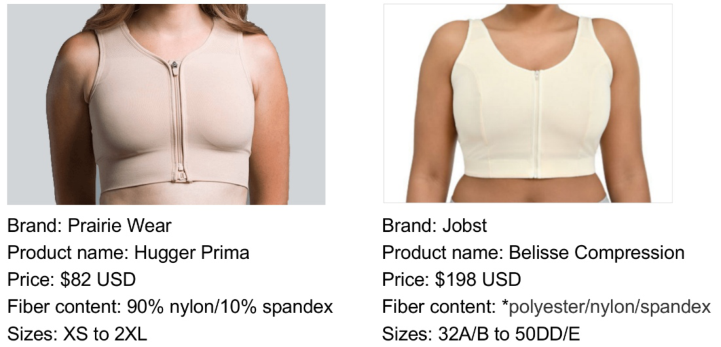
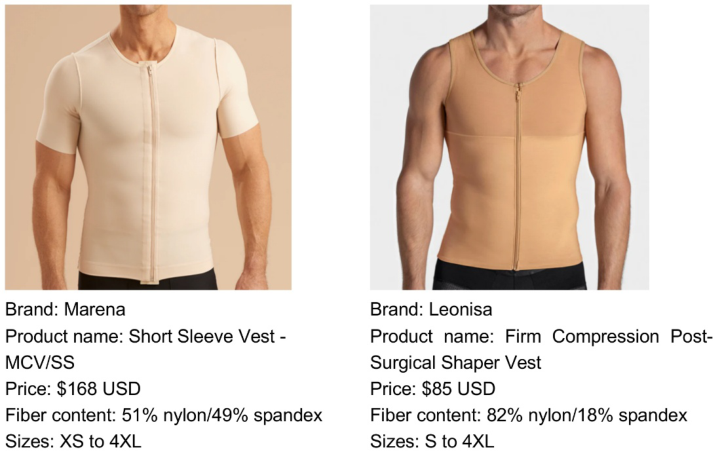
State-of-the-Art Breast Cancer Recovery Bras and Tops The recovery products selected for this research were based upon brand repu- tation and usage, as observed by the authors. Two styles were selected for each sex, for analysis. For women, the Prairie Wear Hugger Prima (Prairie Wear, n.d.) and Jobst Belisse Compression (Jobst, n.d.) bras were identified. Basic details of these products are presented in Figure 1. For men, the Marena Short Sleeve Vest (The Marena Group, n.d.) and Leonisa Firm Compres- sion Post-Surgical Shaper Vest (Leonisa United States, n.d.) products were identified. Figure 2 outlines basic details of these products.
Figure 1: Women’s breast cancer bra recovery products selected for analysis. *NOTE: Fiber percentages were not provided with marketing materials
Challenges with Breast Cancer Recovery Product Performance Despite products available to help breast cancer survivors recover from pain, swelling, infection, seroma, lymphatic cording, scar tissue issues, nerve injury and lymphedema – literature and patient feedback indicate these produ- cts are inadequate (LaBat, Ryan and Sanden-Will, 2017; Nicklaus et al., 2020; Wroblewski, MacGillivray and Cheng, 2020). Respondents from these previous studies discuss negative side effects, including poor bra wing and under band comfort, lack of adjustability, cosmetic fit, and thermoregulation (LaBat, Ryan and Sanden-Will, 2017; Nicklaus et al., 2020; Wroblewski, MacGillivray and Cheng, 2020). An opportunity lies to approach this chal- lenge through the lens of the sports product design field, where success in innovating products to maximize user comfort, safety and performance is paramount.
Figure 2: Men’s breast cancer top recovery products selected for analysis.
METHODOLOGY
Athlete Benefits Model (ABM) for Sports Apparel Design In the field of sports product design, products are invented to enhance athletic performance, while being safe and comfortable. Because sport products have a multitude of jobs to be done, designers organize their work based upon athlete benefits (Sokolowski, 2019). For sports performance apparel, athlete benefits include thermoregulation, support/compression, fit, mobility, and hand feel.
Thermoregulation is the ability of a product to provide a homeostatic expe- rience for the athlete in a wide range of activities, weather, and temperature conditions. Support/compression is the product’s ability to apply pressure to specified body zones to reduce muscle vibration, pain, tissue displacement, edema, discomfort and swelling, and/or to improve blood flow. Fit is defi- ned as how the product interfaces with the body, and other products – to understand where poor fit interferes, and good fit enables athletic functio- nality (physically and psychologically). Mobility/flexibility is how a product enables the athlete’s body to move around within the product and sporting environment. Hand feel is the property of a sports product to provide sen- sory comfort through the softness and smoothness of materials, trims, and construction details. These athlete benefits are indeed aligned to the needs to breast cancer patients in their recovery. Therefore, how can this model be used as a filter to analyze breast cancer recovery products for women and men, to develop action-orientated design plans for future products to improve user performance, safety, and comfort?
Strengths, Weaknesses, Opportunities and Threats (SWOT) Method To systematically evaluate products, designers often use a SWOT analysis. This method was created in the 1960s by Humphrey, from the Stanford
Breast Cancer Recovery Product Design Needs 11
Table 1. SWOT analysis of women’s breast cancer bra recovery products.
Support/compression: _Access to material technologies _Access to new materials development Fit: _Poor size/grading validation
Fit: _More sizes/silhouettes _More adjustability
Mobility: _Poor size/grading validation _Inability to develop new trims
Mobility: _Better armhole/chest band shape _Flexible adjustments/trims Hand feel comfort: _Sanded material backside _Chafe-free seams/trims
Hand feel comfort: _Access to material/trim technologies _Access to new materials development
Research Institute (Lucidchart, 2023). It was developed to bring accounta- bility and objectivity when strategizing around new business opportunities. It is also used widely in the performance sports product industry to analyze existing products in the market and frame-up new design opportunities.
The SWOT is organized through a 2 × 2 grid, labelled Strengths, Wea- knesses, Opportunities, and Threats. Strengths are positive attributes that are currently evident with the state-of-the-art product. Weaknesses are
existing negative attributes that prohibit the product from fully functio- ning. Opportunities are new ideas that can help the product to improve innovation-wise. Threats are external factors that could stop the opportunity from happening or present risk of moving the new ideas forward. By orga- nizing a SWOT analysis using the apparel ABM as a filter, the breast cancer recovery products identified by the researchers can be better evaluated for functionality and a clearer path for design can be devised.
RESULTS
Through using the athlete benefit model (ABM) within the SWOT analysis, the state-of-the-art female and male breast cancer recovery products were evaluated (Table 1 and Table 2).
Table 2. SWOT analysis of men’s breast cancer recovery top products.
Table available in the original PDF paper.
Strengths Weaknesses
Thermoregulation: _Materials do not ventilate/breathe _Materials are heavy/insulative
Mobility: _Poor size/grading validation _Inability to develop new trims
Hand feel comfort: _Sanded material interior _Chafe-free seams/trims
Hand feel comfort: _Access to material/trim technologies _Access to new materials development
Breast Cancer Recovery Product Design Needs 13
CONCLUSION
By organizing the SWOT analysis with the apparel ABM as a filter, the breast cancer recovery products were evaluated for their performance, and future design solutions were identified. Interestingly, both the female and male products shared similar strengths, weaknesses, opportunities, and thre- ats. Thermoregulation-wise the current products were made of materials that were hot, heavy and insulative, where knowledge from the sports apparel industry could inform better performing developments. Regarding support, the compression of the existing products could be tuned through materials innovation for zonal support, with better component options for storing/a- nchoring pads and prosthetics – especially for the women’s products. When it comes to fit, all the products evaluated did not come in a wide enough range of sizes or consider different body shapes (e.g., apple, pear, rectangle, etc.). This is a common challenge in the sports industry, one that companies are currently exploring and improving upon. There was also opportunity for the evaluated products to have improved silhouettes, so they interface with everyday apparel better – to not show-through or peek-out. Regarding mobility, the products could have adjustment features that are easier to manipulate with varying hand dexterities, and on the women’s products the chest band region could be better formed and positioned more effecti- vely so trunk rotation and bending is not encumbered. Most importantly, the products evaluated had very rough/stiff seams, edges, and trims. These can unfortunately could cause chafing and infection – therefore, constru- ction methods used in the sports industry should be referenced for base layers and body wear. Other concerns not addressed with the SWOT include aesthetics and price. The aesthetics of these products could improve, so they feel less medical and more complimentary to the products the user currently wears. Effort should also be made on the development side of the products to reduce manufacturing costs. In the sports industry produ- cts at the price points referenced in this paper have much better quality and appeal to the user. Next steps of this research are to utilize the results to design and develop physical prototypes for wear testing and validation by the user. Through this effort the researchers believe breast cancer survivors will have better choices available in the market to assist with their long-term recovery.
ACKNOWLEDGMENT
The authors would like to acknowledge the University of Oregon’s College of Design, who provided funding for this research through the 2021–2022 Board Fellowship.
REFERENCES
American Cancer Society (2020). Cancer facts & figures 2020. [online] Cancer.org.
Available at: https://www.cancer.org/research/cancer-facts-statistics/all-cancer-f acts-figures/cancer-facts-figures-2020.html American Cancer Society. (2023a). What Is breast cancer? [online] Cancer.org. Available at: https://www.cancer.org/cancer/breast-cancer/about/what-is-breast-cance r.html
American Cancer Society. (2023b). Key Statistics for breast cancer. [online] Cancer.org. Available at: https://www.cancer.org/cancer/breast-cancer/about/ho w-common-is-breast-cancer.html American Cancer Society. (2023c). Mastectomy. [online] Cancer.org. Availa-
ble at: https://www.cancer.org/cancer/breast-cancer/treatment/surgery-for-breast -cancer/mastectomy.html American Cancer Society. (2023d). Lymph Node Surgery for Breast Cancer. [online] Cancer.org. Available at: https://www.cancer.org/cancer/breast-cancer/treatment/ surgery-for-breast-cancer/lymph-node-surgery-for-breast-cancer.html Bao, T., Seidman, A., Li, Q., Seluzicki, C., Blinder, V., Meghani, S. H., Farrar, J. T. and
Mao, J. J. (2018). Living with chronic pain: perceptions of breast cancer survivors. Breast Cancer Research and Treatment, 169(1), pp. 133–140. doi: https://doi.or g/10.1007/s10549-018-4670-9. Breast Cancer Foundation (2022). What to know about male breast cancer. [online] bcrf.org. Available at: https://www.bcrf.org/blog/male-breast-cancer-statistics-re search/ Cancer.net. (2023). Breast cancer: Types of treatment. [online] cancer.net. Available
at: https://www.cancer.net/cancer-types/breast-cancer/types-treatment#hormone- therapy Jobst. (n.d.). Product detail. [online] Available at: https://www.jobst-usa.com/prod ucts/product-detail/jobst-bellisse/ [Accessed 13 Feb. 2023]. LaBat, K. L., Ryan, K. S. and Sanden-Will, S. (2016). Breast cancer survivors’
wearable product needs and wants: a challenge to designers. International Jour- nal of Fashion Design, Technology and Education, 10(3), pp. 308–319. doi: https://doi.org/10.1080/17543266.2016.1250289. Leonisa United States. (n.d.). Men’s firm compression post-surgical shaper vest.
[online] Available at: https://www.leonisa.com/products/mens-firm-compression- post-surgical-shaper-vest?variant=40513588265092 [Accessed 13 Feb. 2023]. Lucidchart (2023). What is a SWOT analysis. [online] lucidchart.com. Available at: https://www.lucidchart.com/pages/what-is-swot-analysis Mayo Clinic, (2023a). Breast biopsy: Overview. [online] mayoclinic.org. Availa-
ble at: https://www.mayoclinic.org/tests-procedures/breast-biopsy/about/pac- 20384812#:~:text=A%20breast%20biopsy%20is%20a,sample%20and%20pro vide%20a%20diagnosis Mayo Clinic. (2023b). Lumpectomy: Overview. [online] mayoclinic.org. Available at: https://www.mayoclinic.org/tests-procedures/lumpectomy/about/pac -20394650 National Cancer Institute, 2021. What is cancer? [online] cancer.gov. Available at:
https://www.cancer.gov/about-cancer/understanding/what-is-cancer Nicklaus, K. M., Bravo, K., Liu, C., Chopra, D., Reece, G. P., Hanson, S. E. and Markey, M. K. (2020). Undergarment needs after breast cancer surgery: a key survivorship consideration. Supportive Care in Cancer, 28(8), pp. 3481–3484. doi: https://doi.org/10.1007/s00520-020-05414-z. Prairie Wear. (n.d.). HuggerPRIMA. [online] Available at: https://www.prairiewear.
com/products/the-hugger [Accessed 13 Feb. 2023]. Ren, Y., Kebede, M. A., Ogunleye, A. A., Emerson, M. A., Evenson, K. R., Carey, L. A., Hayes, S. C. and Troester, M. A. (2022). Burden of lymphedema in long- term breast cancer survivors by race and age. Cancer, 128(23), pp. 4119–4128. doi: https://doi.org/10.1002/cncr.34489. Sokolowski, S. L. (2019). Sports Industry Meets Academia: The Pedagogical Deve-
lopment of an MS Degree Program in Sports Product Design. Technology & Innovation, 20(3), pp. 165–177. doi: https://doi.org/10.21300/20.3.2019.165.
Breast Cancer Recovery Product Design Needs 15
The Marena Group. (n.d.). Short Sleeve Vest - Style No. MCV/SS. [online] The Marena Group, LLC. Available at: https://marena.com/collections/mens-post-sur gical-tops-vests/products/mcvss-compression-vest [Accessed 13 Feb. 2023]. Wroblewski, S. M., MacGillivray, M. S. and Cheng, Chin-I. (2020). Bra preferences
of breast cancer survivors treated with mastectomy and prosthetic reconstru- ction. International Journal of Fashion Design, Technology and Education, 13(1), pp. 31–44. doi: https://doi.org/10.1080/17543266.2020.1718776.
LISTED IN THE AHFE DIGITAL BOOKSTORE CATALOGUE
Explore the complete digital volume
Interdisciplinary Practice in Industrial Design
Read this individual research paper free through the original publisher, or explore the full digital proceedings book.
ISBN 978-1-958651-76-6
Explore this ISBN in the AHFE Bookstore ↗Listed in the July 2026 bookstore catalogue; search by ISBN to confirm current availability · Digital book purchase optional