Jason Germany, Abhijith Shasheendra, Ketan Sunil Mhetre, Shahram Aarabi, Ashley Emery (2023). Digital to Physical Medical Modeling: Industrial Design Activities in Support of a Limb Cooling Medical Device. In: Interdisciplinary Practice in Industrial Design. AHFE Open Access, vol. 100, pp. 93–99. https://doi.org/10.54941/ahfe1002975
Industrial design has a long history of leveraging anthropometrics human factors data as a basis for good design and decision making throughout the design process. This data ranges from individual measurements supporting the bespoke design for the individual to large data sets normalized across populations that supporting a much broader user group. When it comes to the design of medical devices, traditional anthropometric data has increasingly been complemented by a range of scanning methods (3D surface, CT, MRI) as a form of input with a resulting output of CAD models as well as digitally fabricated medical models. Both the digital and physical medical models can support a number of industrial design activities as well as serving as a collaborative platform between allied disciplines during the design and development of a medical device. This paper relays the specific role medical modeling played in the industrial design process for the device design of a limb cooling product. This product was targeting the impacts of tourniquet induced limb ischemia by leveraging cooling to mitigate tissue damage. Over the course of this project, limb medical models were utilized as a platform for a number of activities including supporting several industrial design methods from early ideation to testing and concept refinement.
The use of human factors data has a long history in the field of industrial design, dating back to some of the earliest practitioners such as Henry Drey- fuss (Dreyfuss, 2003). Anthropometric data has been particularly useful in improving the fit between a product and a person, and improving overall design decision-making. Utilizing large data sets as a source of data has often complemented or augmented industrial design activities. Over the years, some of these data sets have been converted into anthropometric resources like the Measure of Man and Woman (Tilley, 2001) or the Humanscale manual (Diffrient, et al., 1974). These resources act as a platform to base design activities around and ground the work in the human form. Surface scanning
technology has created even more opportunities for designers to leverage 3D data, moving from traditional anthropometric data to volumetric data which has been embraced by groups mostly notably in apparel design (Black & Eckert, 2009). Surface data has allowed for a more direct use of scans to create representations or medical models in both digital and physical forms (Harih, et al., 2012). Large databases of scanned data like CAESER (Robi- nette, et al., 1999) are available as a platform for aligning products with the human body.
Although larger data base platforms are useful, sometimes a new device design requires the generation of a new or specialized human model to be created. Specialized anthropometric data is often collected based on the pro- duct type and specifically where the product interfaces with the human body. This is often true in medical device design projects where the either the medi- cal condition, morphology or the device itself requires a novel approach to human modeling. This novel approach provides a customize platform to build design decisions around. In many cases the medical model(s) are aimed at supporting specific clinical or engineering efforts (Haleem & Mohd, 2019) apart from industrial design activities which at times can result in separate modeling approaches development from the same sourced data. This rese- arch highlights the industrial design activities as they intersect with human modeling in the design of a limb cooling device. In particular, it examines the use of the models in both digital and physical form and how they act as a platform across a number of activities including the collaboration between interdisciplinary actors throughout the project.
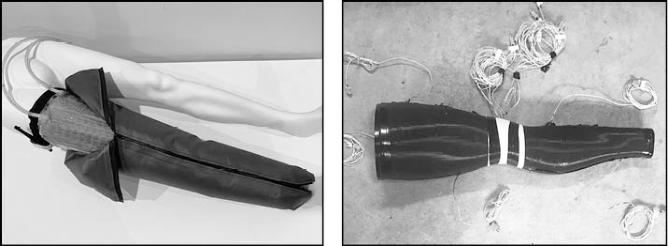
LIMB COOLING DEVICE AND MEDICAL MODEL Tourniquets have been used to prevent blood loss in severe injuries, but they can cause ischemia, or a lack of oxygen to the limb, leading to tissue damage and potentially amputation. Acute Limb Ischemia (ALI) can occur after just a few hours of tourniquet application, making it difficult to save a limb or contribute to nerve damage (Trupiano, et al., 2016). Time is one of the most significant considerations in any trauma situation and the time from tourni- quet application can play a part in determining whether a limb is amputated (Walters & Mabry, 2005). This can be the case for individuals injured in remote areas and facing transport times in excess of six hours. To address this issue, a team of researchers at the University of Washington and Univer- sity of California San Francisco have worked to develop a limb cooling device (Figure 1) so as to reduce the ischemic effects of tourniquet use. A number of studies have shown the effects of cooling on ischemia (Mowlavi, et al., 2003) and this device leverages that approach by utilizing a cooling sleeve and air splint powered by a chiller unit that maintains the lowered limb temperature while the patient is being transported.
One of the challenges in designing and ultimately testing a medical device is evaluating the products performance. To support this testing and evalu- ation, a number of medical models were created. Starting with a CT scan from an anonymized patient the research team was able to refine this 3D data into a digital medical model. This digital model was utilized to create a
Digital to Physical Medical Modeling: Industrial Design Activities 95
Figure 1: Limb cooling sleeve and limb medical model (phantom limb).
finite element model (FEM) for use in thermal simulations. To validate these simulation results and determine the actual efficiency of the device, bench testing was performed using a physical medical model or phantom limb based on data collected from the scanned human limb. Since human testing was not possible, the thermal properties of the limb were replicated using a 3D model from a CT scan. Constructed from a mixture of digital fabrication and mold making methods (Mhetre, et al., 2021), the phantom limb pro- totype (Figure 1) was designed to closely mimic the thermal conductivity and specific heat of the various tissues in the limb (Mhetre, et al., 2020). There was a lack of thermal phantoms for this specific type of bench testing, so the team had to develop the phantom from scratch using appropriate materials and prototyping methods. Both the digital and physical model were ultima- tely used to support a number of additional activities beyond the FEM work and bench testing including a several industrial design tasks throughout the project.
ACTIVITIES IN INDUSTRIAL DESIGN AND MEDICAL MODEL The industrial design activities were distributed over the course of the project and predominately supported the user touch points and device fit as well as overall usability of the system. This work was a collaborative effort and over- lapped with a number of engineering activities. A part of that shared activity included the medical modeling for both the human and animal models. These modeling efforts were aimed at benchmarking the design of a limb cooling system and central to that system was the limb cooling sleeve. The sleeve integrated two main elements, the first was a cooling radiator sleeve made from TPU welded film that made direct contact with the skin surface of the limb and the second portion of the sleeve system was an outer air splint that stabilized the limb. Based on outlined use cases, the ideal approach was to develop a one size fits all sleeve and as a result the design process required a significant amount of patterning and fit exploration to accommodate this requirement. The medical models (phantom limb) operated as a central plat- form in both digital and physical incarnations. As a platform or coalescing benchmark between designerly tasks as well as general project planning and interdisciplinary activates.
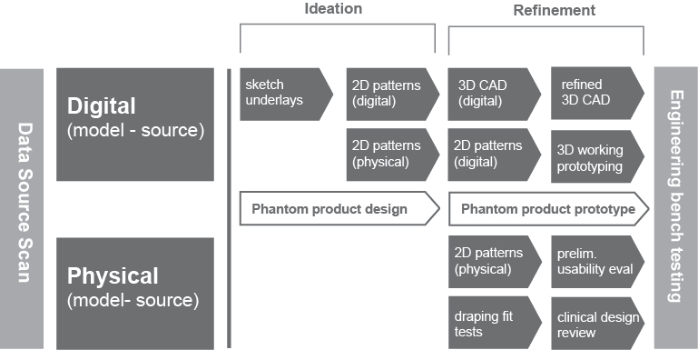
Medical Model as Design Platform The use of the human model limb was applied in various industrial design activities starting with the early ideation stages (Figure 2). For instance, the process of designing a limb cooling sleeve involved a combination of digi- tal and physical methods, including various CAD modeling and 3D surface optimization software such as MeshMixer as well as digital and manual fabrication techniques. From the ideation and early exploration phase of the project, the initial limb scans were optimized to be used in both engineering and design tasks, and ultimately, the design and build of the medical model or phantom limb. Each design phase of the sleeve system utilized the medical model platform (Figure 2), including elements of problem framing, ideation, refinement, and validation. During the ideation phase, the digital limb model was used as a sketch underlay for exploring initial sleeve pattern designs and constraints. The digital limb was also used as a digital last for creating sleeve patterns in CAD, which allowed for wrap and unwrap exploration in pattern design, leading to the creation of a number of concepts.
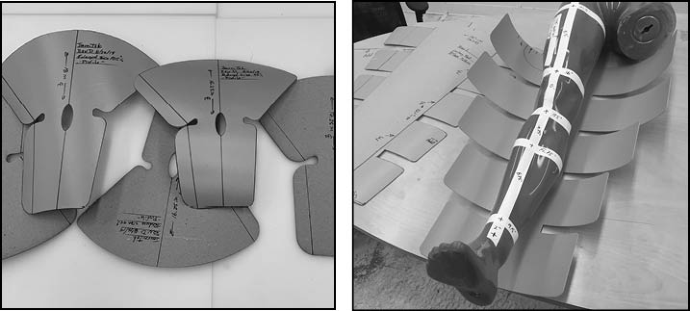
The ideation in the digital space was then complemented by early 3D pro- totyping. The CAD patterns pulled from the digital limb model were flattened and used to produce print paper patterns and laser-cut patterns. These pat- terns in both paper and sheet foam were used in draping to evaluate the coverage and conformity to a mannequin limb (Figure 3). Corrections to the patterns were augmented on the physical sheet, photographed, and brou- ght back into the CAD model. Once a basic pattern was developed, further refinement was done in the digital space, moving from initial patterning to 3D CAD. This CAD again generated 2D patterns for laser cutting and drape testing on the medical model limb (phantom limb) with rough material cuts and hand-generated sleeve prototypes. Fit tests were used to provide feedback to update the 3D CAD of the sleeve system, leading to high-fidelity working prototype sleeves being developed. These sleeves were then used for prelimi- nary usability evaluations on the phantom limb as well as in initial design reviews.
Figure 2: Industrial design activities using medical models.
Digital to Physical Medical Modeling: Industrial Design Activities 97
Figure 3: Pattern making – draping test fits.
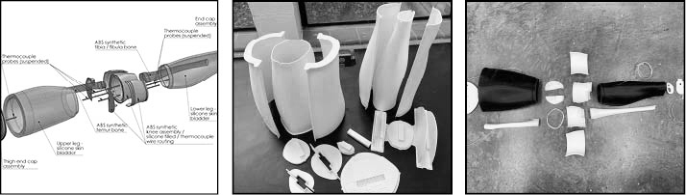
Medical Model as Product (Design and Build) Beyond the individual device design activities, a portion of the industrial design work was in support of the medical model design and build. Ele- ments of the design and fabrication efforts drew collaboration between the industrial design and mechanical engineering stakeholders on the team. The phantom limb was more than a replication of a leg scan as it had design and performance requirements comparable to a product design. The aim of the medical model as product was to replicate the morphology of a leg in three dimensions but also the thermal qualities of limb tissue all while distribu- ting 14 thermocouples to monitor temperatures across the limb. As a result, the design required a novel approach to the material composition and pro- duct architecture as well as the components. The general strategy for the final modeling followed a four step process (Bibb, et al., 2015) moving from medi- cal imaging and export of data media to working with the scanned data and generating the physical model. In much the same way that a product requi- res samples and prototype iterations (Figure 4), the final medical model was the result of a number of refinements moving from CAD modeling to digi- tal fabrication, mold making and final assembly for testing (Mhetre, et al., 2021). Having both the industrial design and mechanical engineering team members on the project working together in the design and development of
Figure 4: Phantom limb design and prototyping.
the phantom limb established a strong alignment going into the design of the limb cooling product itself.
Medical Model as Collaborative Platform One of the most catalysing elements of the medical model was its use as a platform in alignment across the interdisciplinary team working on the pro- ject. Composed of individuals in design, engineering and medicine, the device design team worked to navigate assorted objectives throughout the project. As a portion of that process and in part of the early problem framing activi- ties the medical model in both digital and ultimately physical form provided a platform for translating and representing the fundamental physical chara- cteristics that the design needed to embody. Beyond these characteristics it also contributed to establishing a conceptual boundary, translating the medi- cal condition of ischemia from abstraction to a tangible model that could be referenced throughout the project, providing validation in the performa- nce of the medical device but also a conceptual model (Krippendorff, 2006) for the non-medical team members. Grounding the teams work, it represen- ted the problem (limb ischemia) and in a way was a temporary substitution for the patient or future trauma victim.
CONCLUSION
The integration of human factors data in the design of products has been a long-standing practice in industrial design, where anthropometric data has been particularly useful in improving product-user fit and design decision- making. As an extension of this, scanned human surface data as well as CT / MRI has allowed for the development of custom medical models to sup- port a range of activities in the product development process. In the same way that platforms like Humanscale manual supported broad human factors approaches in industrial design, the contextually unique use of medical modeling allows product designers to construct a project specific anthropo- metric platform. As outlined in this paper, the three key industrial design activities supported by the limb model include the medical device (sleeve) design, the design of the medical model and as a platform for collaboration. How the platform is leveraged can be dictated by a number of factors inclu- ding the medical condition, morphology or medical device being design. As a result, the process of using the model as a platform for design activities should be consider a key starting point for any industrial design team or interdisciplinary group.
ACKNOWLEDGMENT
The authors acknowledge the U.S. Army Department of Defense for sup- porting the studies and device development through a grant name Thera- peutic Limb Cooling to Prevent Amputation in pDCR (Contract number XWH-17-1-0693).
Digital to Physical Medical Modeling: Industrial Design Activities 99
REFERENCES
Bibb, R., Eggbeer, D. & Paterson, A., 2015. Medical Modeling: The application of advanced design and rapid prototyping techniques in medicine. Boston: Elsevier. Black, S. & Eckert, C., 2009. Developing Considerate Design: Meeting Individual
Fashion and Clothing Needs Within a Framework of Sustainability. Handbook of Research in Mass Customization and Personalization. Diffrient, N., Tilley, A. R. & & Bardagjy, J. C., 1974. Humanscale: manual. s.l.: MIT press. Dreyfuss, H., 2003. Designing for People. Third ed. New York: Allworth Press. Haleem, A. & Mohd, J., 2019. 3D scanning applications in medical field: A literature-
based review. Clinical Epidemiology and Global Health, 7(2). Harih, G., Dolsak, B. & Kaljun, J., 2012. Customized product design based on medical imaging. Dubrovnik, Design Society. Krippendorff, K., 2006. The Semantic Turn: A New Foundation for Design. Boca
Raton: Taylor & Francis. Mhetre, K. et al., 2020. Design and Testing of a Thermal Phantom for Humans and Pigs for Treatment of Ischemia. New Orleans, ASTFE. Mhetre, K. S. et al., 2021. Prototyping a Thermal Limb: Methods for Building a
Thermally Representative Phantom Limb. Virtual, AHFE. Mowlavi, A. et al., 2003. Local Hypothermia during Early Reperfusion Protects Skeletal Muscle from Ischemia-Reperfusion Injury. Plastic and Reconstructive Surgery, pp. 242–250. Robinette, K., Daanen, H. & Paquet, E., 1999. The CAESAR project: a 3-D surface
anthropometry survey. Ottawa, IEEE. Tilley, A., 2001. The measure of man and woman: human factors in design. s.l.: John Wiley & Sons. Trupiano, M., Aarabi, S. & Emery, A., 2016. Using thermoelectric cooling with
tourniquets for nerve preservation. Washington, D. C., ASME. Walters, T. J. & Mabry, R., 2005. Issues Related to the Use of Tourniquets on the Battlefield,”. Military Medicine, pp. 770–775.
LISTED IN THE AHFE DIGITAL BOOKSTORE CATALOGUE
Explore the complete digital volume
Interdisciplinary Practice in Industrial Design
Read this individual research paper free through the original publisher, or explore the full digital proceedings book.
ISBN 978-1-958651-76-6
Explore this ISBN in the AHFE Bookstore ↗Listed in the July 2026 bookstore catalogue; search by ISBN to confirm current availability · Digital book purchase optional