Julia Gritzbach, Franziska Kern, Philipp Pomiersky, Wolfram Remlinger, Thomas Maier (2023). Identification of Design Elements in Vehicle Interiors for creating an Appearance associated with Sustainability. In: Interdisciplinary Practice in Industrial Design. AHFE Open Access, vol. 100, pp. 100–108. https://doi.org/10.54941/ahfe1002976
Sustainability as a current trend in many industries is not only about developing products with a lower environmental impact, but also about communicating these efforts to customers. The vehicle interior is a key opportunity to communicate sustainability, as this is where the user interacts and experiences the vehicle during the use phase. Therefore, it is necessary to know which design elements create a user experience associated with sustainability. The purpose of this study is to identify design elements in vehicle interiors linked to sustainability.SIGNIFICANCEThe need to be aware of our environment and the responsible use of resources is an important topic now and in the future. Published in The Global Risks Report 2022, 84 % of more than 800 respondents in the Global Risks Perception Survey were either concerned or worried about the outlook for the world. This shows the interest of people to see changes in the world and in products. Product design can visualize those changes. As a result, the customer perception of sustainability is essential to communicate a future sustainable mobility through vehicle interiors.METHODSA literature review and an online survey are the used methods in this study. The literature review leads to a collection of design elements that might be perceived as sustainable. This collection includes product designs in general and especially concepts of interior design in architecture. From these results, the design elements for vehicle interiors to be tested were derived. According to Seeger (2005), the technical product design can be subdivided into four subgestalts. The subgestalts are layout, shape, color/surface and graphics. The chosen design elements are relatable to these subgestalts.The online survey has three main parts: demographic data, individual attitudes towards sustainability and a pairwise comparison of different vehicle interior design elements. The questions of the second part are based on the General Ecological Behavior Scale GEB-50 (Kaiser 2020) to determine individual environmental attitudes. Furthermore, items from the General Belief in a Just World Scale GBJW (Dealbert 2002) add the opportunity to measure the willingness to engage in prosocial actions, because the social dimension of sustainability is included in the tested design elements.With pictures of vehicle interiors a pairwise comparison shows, which design elements are associated with sustainability. Every picture shown in the third part of the questionnaire only includes a manipulation of one of the subgestalts.RESULTSThe analysis of the collected data shows which variations in design elements in the subgestalts layout, shape, color/surface and graphics are associated with sustainability in the vehicle interior. It also shows how the perception of design elements correlates with various demographic characteristics and individual attitudes toward sustainability. The results obtained can be used for the user-centered development of vehicle interiors to create a user experience associated with sustainability. A following study can develop a guideline for sustainable vehicle interior design based on the generated results. To evaluate other design variations more surveys are conceivable with a similar structured questionnaire only changing the pictures in the third part.
The need to be aware of our environment and the responsible use of resources is an important issue now and in the future. Sustainability is an apparent trend in many industries as it is not only about developing products with a lower environmental impact, but also about communicating these efforts to customers. Published in The Global Risks Report 2022, 84% of more than 800 respondents in the Global Risks Perception Survey are either concerned or worried about the outlook for the world (World Economic Forum 2023). This shows the interest of people to see changes in the world and in products. Product design is able to visualize those changes. As a consequence, understanding the customer perception is essential to communicate a future sustainable mobility. The vehicle interior is a key opportunity to communicate sustainability, as this is where the user interacts and experiences the vehicle during usage. Therefore, it is necessary to know which design elements create a user experience associated with sustainability.
Identification of Design Elements in Sustainable Vehicle Interiors 101
The aim of this study is to identify design elements in vehicle interiors linked to sustainability and quantify their effects.
THEORETICAL BACKGROUND The term “sustainability” or “sustainable” has various meanings and differing concepts thereof. Some of the concepts emphasize environmental and climate protection (Schneekloth et al., 2022). Other models combine three dimensions of sustainability. These three dimensions include, in addition to environmental sustainability, economic and social sustainability. Internationally, this framework is the starting point of many sustainability strategies in different settings (e.g., the UN Sustainable Development Goals) (Hauff, 2014). In the following, the term “sustainability” is used in its multidimensional understanding:
Ecological sustainability includes the protection and preservation of the regenerative capacity of the natural basis of life.
The goal of economic sustainability is a balanced and permanently possible economic activity that cannot be pursued unilaterally or even only at the expense of future generations.
Social sustainability, in the sense of a fair distribution of benefits and burdens that can avoid social tensions and conflicts, is, however, equally important to ensure the future ecological, economic and social stability of a society.
An increasing number of people attach importance to sustainable products. The consideration of sustainability in vehicles must therefore be communicated to the users (Bobka et al., 2022). The vehicle interior design plays a central role in communicating the sustainability aspects considered in the vehicle design. There is a limited amount of research on communicating sustainability through vehicle interior design. Bobka et al. (2022) focus on sustainable design for cars, with a special focus on materials. Their survey provides initial findings with regard to the perception of various material groups. The results form a basis for decisions on the design and use of various material groups for target group-specific design concepts.
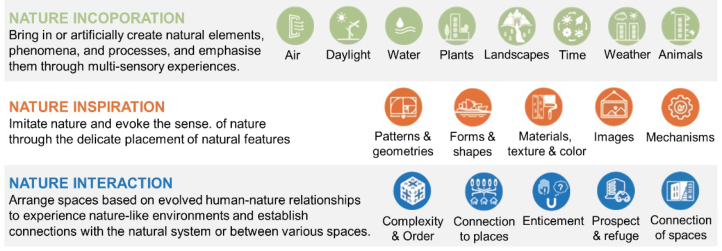
On the other hand, in architecture biophilic designs have received widespread attention, especially in response to growing environmental challenges. Zhong et al. (2022) identify and compare the key frameworks of biophilic design and its major elements. The primary elements of biophilic design categorized in three design approaches are shown in Figure 1. There are different benefits (e.g., enhance health, well-being, productivity, biodiversity, and circularity) of biophilic design in achieving sustainability (Zhong et al., 2022).
Another way to communicate sustainability is through certificates or textual information claims, which can increasingly be found on food or other consumer goods. There are various certificates, from environmental certificates to certificates that prove fair production and fair trade, e.g., the Fairtrade label.
Figure 1: Biophilic design framework with three design approaches and primary elements (adapted from Zhong et al., 2022).
In this context, an important point to note is that the degree of individual environmental awareness, for example, plays a role in the reaction to the visual appearance and verbal sustainability claims of packaging. Consumers with low environmental awareness do not react to incongruities in the appearance of sustainability claims, while consumers with high environmental awareness react more sensitively and reject them (Magnier and Schoormans, 2015).
In order to identify the sources of perceptual effects and pin them to particular design elements, the framework of product perception by Seeger (2005) is used.
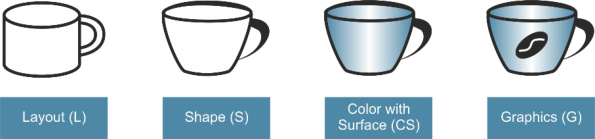
According to Seeger (2005), the product gestalt can be subdivided into four subgestalts, shown in Figure 2. Those subgestalts are layout (L), shape (S), color/surface (CS) and graphics (G). The layout (L) describes the simple composition of the product from different basic bodies. The second subgestalt shape (S) describes the surfaces and lines that form the basic bodies. Color/surface (CS), the third subgestalt, assigns a color value to the product, including the degree of reflection. Graphics (G) includes logos and letters. The influence on the perception of the product is possible through each of the subgestalts (Holder, 2016).
Figure 2: The subgestalts: layout, shape, color/surface and graphics, using the example of a coffee cup. (Holder et al., 2019).
METHODS
A literature review and an online survey are the applied methods of this study. The literature review leads to a collection of design elements that most likely be perceived as sustainable. This collection includes product designs
Identification of Design Elements in Sustainable Vehicle Interiors 103
in general and especially elements of biophilic design in architecture. From these results, the design elements for vehicle interiors to be tested are derived. The chosen design elements are relatable to the four subgestalts.
The online survey has three main parts: demographic data, individual attitudes towards sustainability and a conjoint analysis of different vehicle interior design elements.
The questions of the second part are based on the General Ecological Behavior Scale (GEB-50) (Kaiser, 2020) to determine individual environmental attitudes. The GEB-50 includes 50 items and measures individual environmental attitudes in the following areas of action: energy saving, mobility, waste avoidance, consumption, recycling and social engagement. On the first 32 items, participants indicate how frequently they engaged in various pro-environmental behaviors (e.g., “I buy meat and produce with eco-labels.”) using a 5-point Likert scale (“never” to “very often”). The remaining 18 items use a dichotomous response scale (e.g., “I am a vegetarian.”). Participants were instructed to choose the response option “not applicable” when a question “did not apply to [their] current life situation”. In line with established GEB practice, the 32 items are recoded with a frequency response format into a binary format (“very often”, “often” = 1; “never”, “sometimes”, “occasionally” = 0) before calibrating the scale.
Furthermore, the items from the General Belief in a Just World Scale (GBJW) (Dalbert et al., 2002) add the opportunity to measure the willingness to engage in prosocial actions, because the social dimension of sustainability is included in the tested design elements. The participants rate each item from 1 (“strongly disagree”) to 6 (“strongly agree”). Composite scores are computed by averaging the ratings within scales. Higher scores indicate higher GBJW.
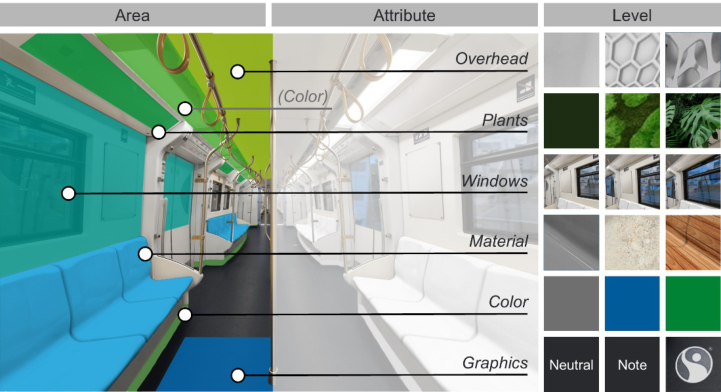
With pictures of vehicle interiors in the third part a conjoint analysis reveals, which design elements are associated with comfort and sustainability. For the conjoint analysis six attributes with three levels each are altered, covering all subgestalts. The stimulus patterns shown in the third part of the questionnaire are created by composing the different design elements based on an orthogonal main-effect plan, which shuffles meaningful levels of every design element. As the design elements and their levels are recombined in different stimulus patterns the conjoint syntax calculates the preferences in form of part-worth utilities for each level. (Baier and Brusch, 2021) The presented stimulus pattern are generated based on a picture of the interior of a common subway. As shown in Figure 3, different areas of the interior are selected for the modification of the design elements (attributes).
The changes of the layout (L) are the addition of plants and the variation of the windows. The level of these attributes are, no plants (represented by an area in the color of the plants), moss, and strikingly many plants (jungle), as well as a small, medium and large window area. The integration of the plants is based on the biophilic design approach of nature incorporation and the larger windows are inspired by the approach of nature interaction. For the subgestalt shape (S) the overhead space is changing. It is neutral (plane), honeycombed or organic, for a nature inspired design. The color/surface (CS) is changing in the attributes color and material. The shown colors are grey as
Figure 3: Systematic composition of stimulus patterns.
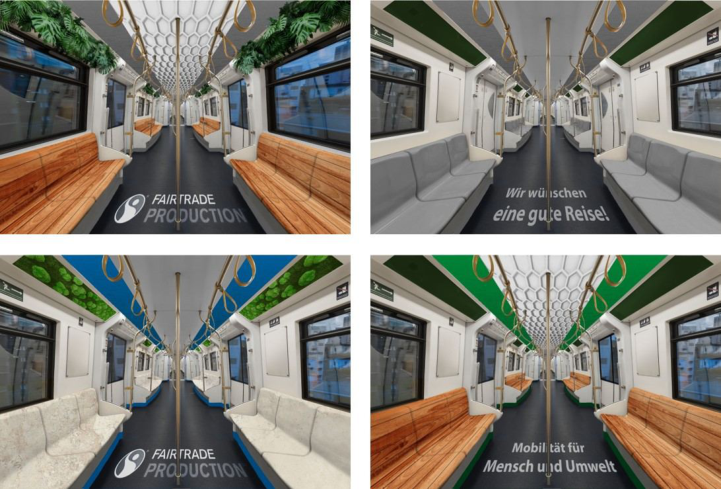
a neutral color, blue and green. In reference to Bobka et al. (2022) the chosen materials are plastics, irregular fabric and wood. The integrated graphics (G) on the wagon floor are a neutral claim, a sustainable claim and the Fairtrade label. Figure 4 displays a selection of used stimulus patterns.
Two questions are asked for each of the 18 stimulus pattern. The first question determines whether the participants think that the displayed subway
Figure 4: Exemplary stimulus pattern for conjoint analysis.
Identification of Design Elements in Sustainable Vehicle Interiors 105
is developed and produced sustainable. The question is answered on a six-point Likert scale from 1 (“not sustainable at all”) to 6 (“absolutely sustainable”). Subsequently, as a second question on the respective stimulus pattern, it was asked whether the participants assumes that they feel comfortable in the interior. The evaluation was also on a six-point Likert scale, from 1 (“I don’t like it at all”) to 6 (“I like it very much”). The survey was distributed via social media to German speakers in the DACH region. The responses are collected over a span of three weeks.
RESULTS
In the online survey, 197 data sets were collected, of which 172 contained valid data. The mean age of the participants is 36 years (SD = 14.4 years), while the ratio of men to women is 50.6 to 48.8 percent. One participant identifies as divers (0.6%). Smartphones were the most popular device (N = 119, 69.2%) to partake, followed by computers (N = 37, 21.5%) and tablets (N = 5, 2.9%).
The GEB-50 data were analyzed using a dichotomous Rasch model implemented in the eRm package (Mair et al., 2021) in R 4.2.2. The person parameters (N = 172, M = 0.48, SD = 0.83) were estimated with reasonable separation reliability (rel = 0.80). The mean GBJW score is 2.89 (SD = 0.85).
Two conjoint analysis were conducted with SPSS. The participants had rated the stimulus pattern on a scale from 1 (“not sustainable at all”) to 6 (“absolutely sustainable”) in regards to perceived sustainability and from 1 (“I don’t like it at all”) to 6 (“I like it very much”) to perceived comfort. The results are listed in form of part-worth utilities in Table 1. A single part- worth utility can be interpreted in the way that the presence of the associated level influences the participants’ judgment by this value. Accordingly, neutral graphics, for example, reduce the perceived sustainability by 0.160 points on the scale from 1 to 6, while the Fairtrade logo improves the rating by 0.154 points. The overall impression of a setting sums up the constant and all represented levels.
The wooden material has the greatest positive impact on the perceived sustainability and comfort, whereas plastic and no plants at all tend to create a strong negative effect. The relative importance of the attributes is estimated based on the part-worth utilities’ span. For the communication of sustainability the material (30.1%) is most important. On the second place are plants (20.0%), followed by graphics (15.0%) and color (13.6%). The least important design elements are the overhead area (10.7%) and the windows (10.5%). The results for comfort are in a similar range. Material leads (30.6%), followed by plants (21.5%), color (13.3%), graphics (12.2%), windows (11.2%) and the overhead area (11.1%). The Kendall-tau- b test reveals that the initial ratings for sustainability and comfort correlate (p < 0.001). This might be a hint that a sustainable interior is also perceived as a pleasant environment.
Table 1. Part-worth utilities of comfort and sustainability.
Table available in the original PDF paper.
DISCUSSION
The results show that the material plays the most important role in conveying sustainability. Wood has the greatest positive impact on perceived sustainability and comfort, while plastic tends to have a strong negative effect. These results are consistent with other research findings. For example, previous research suggests that people respond positively to wood, showing a strong preference for spaces with many wooden details (Rice et al., 2006). The negative effect of plastic is consistent with the findings of Bobka et al. (2022), which show the same effect of plastic on perceptions of sustainability.
However, compared to their study, no correlation was found between age and sustainability perception. This could be due to the sample size. Also, the age distribution is left skewed. Another limitation of the study sample is that only German speakers were surveyed. There could be cultural differences in the perception of sustainability that still need to be verified.
The second important design element is the addition of plants, with the type of plants also having an influence. Integrating plants into vehicles will be a challenge, similar to the challenges in architecture (see Zhong et al. (2022)).
Regarding the impact of graphics, it was found that the Fairtrade label is rated sustainable. Therefore, sustainable certification can be visualized through the use of sustainability labels in the vehicle interior, similar to the approach used for consumer goods. No correlation was found between individual attitudes and the evaluation of the graphics. This could also be related to the group of participants.
Identification of Design Elements in Sustainable Vehicle Interiors 107
A degree of moderation must be applied when interpreting the relative importance of the design elements. The values determined are only valid in the study setting presented, but may indicate general trends.
Overall, it should be noted that in design, perceptions of sustainability may not always match actual sustainability (Heine, 2014). Consequently, a balance should be sought between communicating sustainability through the identified design elements and implementing actual sustainability in the vehicle interior. The results presented in this study should not be used for the greenwashing of products.
CONCLUSION AND OUTLOOK In this paper, we looked for design elements that influence the perception of sustainability in the vehicle interior. Therefor a literature review and an online study were conducted including the GEB-50, the GBJW, and a conjoint analysis. The survey quantified the impact of design elements associated with sustainability in vehicle interiors with a sample size of 172 participants. The most influential design element is material, with wood being positive and plastic being negative for the communication of sustainability. The study also found a correlation between sustainability and well-being (comfort) ratings. Moreover, there is a positive influence of plants.
This study provides a basis for further research in the field of vehicle interior design and sustainability and contributes to the understanding of the relationship between design elements and a positive sustainable user experience. An important finding is that the vehicle interior should not only be designed sustainably, but also has to communicate this characteristic to the users. The study demonstrates that the perception of sustainability is measurable and thus provides a quantitative method to support future design decisions.
The study was limited to six design elements with three levels each, but more design elements could impact sustainability. So future study settings could review additional design elements and extend the application of the online survey to other vehicles (e.g. cars and airplane cabins) to identify vehicle specific differences in the influence of the design elements. Future studies could also include emerging technologies such as modular construction and smart systems into a sustainable user experience. In addition, the subjects’ evaluation of sustainability can be considered in a more differentiated manner in future studies. For example, differentiation can be made between the manufacture and use of the products as well as between social, economic and ecological factors.
Furthermore, sustainable user experience also includes design elements that appeal to other human senses. Through qualitative approaches in the form of an experiment, participants could physically perceive and experience the interior with all their senses. An experimental approach may be used to study human interactions with sustainable design.
REFERENCES
Baier, Daniel. Brusch, Michael (2021). Conjointanalyse. Berlin, Heidelberg: Springer Berlin Heidelberg.
Bobka, Karin. Kern, Mira. Kluge, Niklas. Riester, Yvonne. Stegmüller, Sebastian (2022). Material Matters. Internationale Nutzerstudie über Materialan- forderungen und die Wahrnehmung von Nachhaltigkeit im Fahrzeuginnenraum. Stuttgart: Fraunhofer-Publica. Dalbert, C. Montada, L. Schmitt, M. (2002) GWAL - Allgemeine Gerechte-Welt- Skala. In: Leibniz Institut für Psychologie (Ed.). Open Test Archive. Trier, ZPID. Hauff, Michael von (2014). Nachhaltige Entwicklung. Grundlagen und Umsetzung.
2nd ed. Berlin, München, Boston: De Gruyter Oldenbourg. Heine, Ulrike (2014). Teaching Sustainability in Design without Greenwashing.
Journal of Civil Engineering and Architecture Volume 8 No. 4. Holder, Daniel (2016). Gefallensurteil und Blickanalyse zum Fahrzeugdesign zukünftiger Aufbaugestalten anhand einer technischen Prognose. Dissertation. Stuttgart: Universität Stuttgart. Holder, Daniel. Inkermann, David. Krasteva, Petia. Vietor, Thomas. Maier, Thomas (2019). Integrated Product Gestalt Design Method for the Analysis and Definition of Interface Elements Regarding Exterior and Interior. In: Congress of the International Ergonomics Association. Springer, Cham, pp. 888–897. Kaiser, F. G. (2020) GEB-50. General Ecological Behavior Scale. In: Leibniz Institut
für Psychologie (Ed.). Open Test Archive. Trier: ZPID. Magnier, Lise. Schoormans, Jan (2015). Consumer reactions to sustainable packaging: The interplay of visual appearance, verbal claim and environmental concern. Journal of Environmental Psychology Volume 44, pp. 53–62. Mair, Patrick. Hatzinger, Reinhold. Maier, Marco Johannes (2021). eRm: Extended Rasch Modeling. 1.0–2. Website: https://cran.r-project.org/package=eRm. Rice, Jennifer. Kozak, Robert A.. Meitner, Michael J.. Cohen, David H. (2006).
Appearance wood products and psychological well-being. Wood and Fiber Science Volume 38 No. 4, pp. 644–659. Schneekloth, Ulrich. Rysina, Anna. Wolfert, Sabine. Langness, Anja. Görtz, Regina von (2022). Jugend und Nachhaltigkeit. Was die Next Generation mit Nachhaltigkeit verbindet und wie sie sich engagiert. Gütersloh: Bertelsmann Stiftung. Seeger, Hartmut (2005). Design technischer Produkte, Produktprogramme und
-systeme. Industrial design engineering. 2nd ed. Berlin, Heidelberg: Springer. World Economic Forum (February 23, 2023). Global Risks Report 2022 | World Economic Forum. Website: https://www.weforum.org/reports/global-risks-repor t-2022/data-on-global-risks-perceptions/ Zhong, Weijie. Schröder, Torsten. Bekkering, Juliette (2022). Biophilic design in
architecture and its contributions to health, well-being, and sustainability: A critical review. Frontiers of Architectural Research Volume 11 No. 1, pp. 114–141.
LISTED IN THE AHFE DIGITAL BOOKSTORE CATALOGUE
Explore the complete digital volume
Interdisciplinary Practice in Industrial Design
Read this individual research paper free through the original publisher, or explore the full digital proceedings book.
ISBN 978-1-958651-76-6
Explore this ISBN in the AHFE Bookstore ↗Listed in the July 2026 bookstore catalogue; search by ISBN to confirm current availability · Digital book purchase optional