Lutz Fischer, Daniel Holder, Benedikt Weiss, Jonathan Kiessling, Florian Reichelt, Thomas Maier (2022). Factors influencing the perception of safety in automated vehicles interiors. In: Intelligent Human Systems Integration (IHSI 2022): Integrating People and Intelligent Systems. AHFE Open Access, vol. 22. https://doi.org/10.54941/ahfe100944
Insitute for Engineering Design and Industrial Design IKTD Department of Industrial Design Engineering University of Stuttgart, 70569 Stuttgart, Germany ↗
Significance and ObjectiveTechnological progress in the automation of passenger cars leads to numerous changes in driving functions, vehicle components and promises people higher individuality and safety. The driver becomes a passenger and the relief from the driving task allows the occupants to use and enjoy their travel time for secondary activities. The subjective driving experience, feeling of safety and the resulting trust are essential for the acceptance of automation . Whether people actually feel comfortable and safe in autonomous driving scenarios and which measures are best suited to improve trust in the automated system is the subject of current research. Therefore, product development strives for a holistic optimisation of the user experience. Based on the assumption that a positive user experience is achieved through the fulfilment of various basic needs [1], it is usually realised by both recording subjective needs and requirements for relevant use cases and the iterative adaptation of product features. Literature shows that the subjective perception of safety is one of these essential needs [2] and should be taken into account for optimising the user experience. This paper focuses on the subjectively perceived safety of occupants in automated vehicles. Within this contribution we provide an overview over factors influencing the need for safety based on both a broad literature review and an additional examination. Methods and ResultsIt is clear that a positive user experience is crucial for the success of automated driving. To investigate the subjective perception of safety in the vehicle, possible influencing factors were detected and structured based findings from literature [3, 4]. The identified factors can be clustered into “control”, “comfort of posture and operation”, “interior design”, “protective effect” , “safe driving experience”, “environmental factors” and “individual factors”. Each of these factors can be further subdivided, thus 26 sub-aspects related to subjective safety could be found. With this knowledge, a self-reflective questionnaire was created to determine the participants’ personal willingness to take risks and their perception of safety in vehicles. The focus was on the factors "environment" and "protective effect". The questionnaire was answered by N=101 participants in an online survey. An overwhelming majority of the participants confirmed safety as a very important factor for personal well-being in the vehicle. The overriding factors influencing subjective safety were rated individually by the respondents and prioritised in terms of their importance. It became clear that “control”, “safe driving experience” and “protective effect” are dominant factors. “Environmental factors” (except extreme conditions) and “interior design” play a subordinate role. In particular, "Full environmental coverage", "Tangible and visual safety features", "Driving style", "Traffic situation" and "Disaster potential" are important. Conclusion and OutlookThe participants were largely able to answer the questions targeting subjective safety. In particular, questions regarding "environmental factors" could be answered precisely in the online format. The differentiability in various aspects of the “protective effect” was not conclusively possible in the online format; therefore, we are going to conduct a comparative study in the driving simulator in the next step. References1.Hassenzahl, M., Diefenbach, S., Göritz, A.: Needs, affect, and interactive products – Facets of user experience. Interacting with Computers, vol. 22, 353–362 (2010). doi: 10.1016/j.intcom.2010.04.0022.Maslow, A.: A Theory of Human Motivation. Psychological Review, vol. 50, 370–396 (1943)3.Mandel, R.: Komfortmodell und Untersuchung zum Einfluss der Innenraumgeometrie auf die Wahrnehmung und Wirkung von Fahrzeugeigenschaften. Institut für Konstruktionstechnik und Technisches Design, Stuttgart (2019)4.Schnieder, E., Schnieder, L.: Verkehrssicherheit. Maße und Modelle, Methoden und Maßnahmen für den Straßen- und Schienenverkehr. Springer Vieweg, Berlin, Heidelberg (2013)
SIGNIFICANCE AND OBJECTIVE Automated driving is one of the major enabler of future mobility. This progress not only results in changes to driving functions and components in cars, but also promises people more individuality and safety. In many cases, the driver becomes a passenger in the vision of highly automated and autonomous driving. Therein, the human is relinquishing more and more control to the vehicle. The driving experience, the perception of safety, the resulting trust and the technology acceptance will play a more important role than before. On the one hand, initial progress has been made in the field of automation in recent years, for example through pilot projects with driverless shuttles in public spaces. On the other hand, however, the first fatal accidents with automated vehicles have been reported. Customers will pay more attention to how much responsibility for their personal safety they want to release to the vehicle. So far, it is unclear what interventions will be taken to improve confidence in automated vehicles.
Since automated vehicles with a high SAE level have not yet progressed beyond prototype status or beta use, visions of future vehicle interiors are very creative and explorative. It is still unclear whether people will feel comfortable and safe in the various driving scenarios and which measures are best suited to improve trust in the automated system. What is certain is that added value through a positive user experience (UX) will be decisive for the success of automated driving (AD). This means that developers will be confronted with new or changed user requirements and will increase the technological complexity of the products. Therefore, a holistic optimisation of the UX (DIN EN ISO 9241-210:2019, 2019) is strived for in product development. The improvement of the user experience takes place through the iterative development and testing of use case-based components and possible actions. The recording of subjective needs and impressions is indispensable and thus connects the user experience directly with the basic needs of people and their feeling of comfort.
This paper focuses on the basic need for safety, in particular passengers’ subjectively perceived safety in automated vehicles. In this context, the related terms system trust and subjective traffic safety are also discussed. It will be examined in detail which factors have an influence on the need for safety in the vehicle and which influencing factors have already been used in studies. Finally, the results of a current survey on the perception of safety in vehicles are presented.
Intelligent Human Systems Integration (IHSI 2022): Integrating People and Intelligent Systems https://openaccess.cms-conferences.org/#/publications/book/978-1-7923-8988-7
THEORY OF PERCEIVED SAFETY The starting point for developing the survey is an extensive literature research and the extraction of factors influencing the perception of safety. As a basis, safety is discussed in the psychological theory of needs.
Maslow (1943) groups the basic human needs in a layer model: The basis is formed by the fundamental, physiological needs, on which the need for safety is built. The next and highest level consists of emotional needs for love, recognition, esteem, self-confidence and self- actualisation. Once the basic needs of one layer are fulfilled, the human being develops the needs of the next layer and strives to satisfy them.
Krist (1994) transfers this theory of physiological and emotional needs to the understanding of comfort in the vehicle interior. First, she translates the basic needs as hierarchically structured categories: environmental comfort, postural and operational comfort, and ambience and luxury. She also combines these with the comfort pyramid according to Bubb (2003) and Zhang et al.’s (1996) comfort-discomfort model. In the comfort pyramid, analogous to Maslow's layer model, all needs of one layer must be fulfilled for the user to become aware of the next higher one’s relevance to comfort. If, at the same time, no discomfort is generated by all factors, the aesthetic aspects of the top level are able to generate comfort. In the context of fundamental studies on the spatial effect, this consideration of comfort has been extended to include the needs affected by the vehicle interior (Mandel, 2019). Mandel (2019) proposes to include the basic need for safety from Maslow's model in the comfort consideration. On the one hand, he assigns the need for control to postural and operating comfort, i.e. the driver is able to fully grasp the environment and control the movements of the vehicle. On the other hand, he includes the expected protection (protective effect) based on visually perceived vehicle components as an extension of aesthetics. He justifies this with the actual protection of the vehicle, e.g. through passive safety components, not being perceivable by the occupant.
More recent sources relate the basic needs more specifically to the UX optimisation of technical products. Hassenzahl et al. (2010), for example, considers user needs in the context of interactive products, especially human-computer interaction. Averting from driver- centeredness through the automation of the driving function and the resulting freedom for the occupants transforms the automobile into a much more interactive product than before. In the contribution by Hassenzahl et al. (2010), need fulfilment is established as a main source of positive (emotional) technology experiences (= positive user experience). In this way, the connections between needs, affect and product perception are established. He refers to a list of the ten most important psychological needs according to Sheldon et al. (2001). Here, perceived safety and control represent essential human needs during the interaction with technical products.
Intelligent Human Systems Integration (IHSI 2022): Integrating People and Intelligent Systems https://openaccess.cms-conferences.org/#/publications/book/978-1-7923-8988-7
Amini et al. (2013) assume an approach based on the sense of coherence according to Antonovsky (1996): 1. understanding of one's own person and environment; 2. feeling of significance or meaningfulness; 3. manageability and coping ability. The sense of coherence was originally conceived as an assessment criterion for the development and maintenance of health and is adapted to perceived safety in the vehicle interior. Accordingly, it describes the individual ability to adapt to changing circumstances and to feel safe despite existing stress factors (Amini et al., 2013). The transfer is composed of the three impact dimensions: 1. comprehensibility of controls and components in the interior; 2. meaningfulness of functions in the interior; 3. feeling of control in the situation (Amini et al., 2013).
As can be seen from the previous sources, the fulfilment of subjective needs through product perception is an essential part of the UX. The various contributions further confirm the need for safety as a basic need and also show first aspects of interest regarding the evaluation of the perception of safety in the vehicle context.
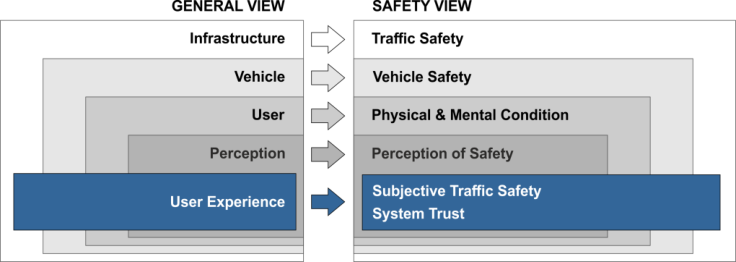
However, the literature also shows that UX approaches include the entire system of product- human interaction including surrounding aspects. Figure 1 makes it clear that the UX encompasses all aspects of driving, starting with the infrastructure, the vehicle, the user, and the user's perception. Accordingly, these levels can also be projected onto the safety view. Perceived safety can be seen as a sub-aspect of the UX. For this reason, perceived safety must be given special consideration and should be optimized in future vehicle developments.
Figure 1: The aspect of safety in relation to driving a car In the course of the literature research on the perception of safety, two central terms could be identified in the context of the vehicle interior and automated driving, which will be defined in more detail here:
System trust/Trust in automation: According to Körber (2019), system trust is the willingness of a user to surrender to the actions of an automated system based on his or her expectation that the system will perform a certain important action, regardless of the
Intelligent Human Systems Integration (IHSI 2022): Integrating People and Intelligent Systems https://openaccess.cms-conferences.org/#/publications/book/978-1-7923-8988-7 possibility of monitoring or intervening in the system. System trust is thus a latent construct between the trustworthiness of the system and the willingness/intention to trust the system. The trustworthiness can be specified via the reliability/competence, comprehensibility/ predictability and the intention of the developers. The willingness to trust depends mainly on personal experience, individual risk tolerance and environmental or cognitive constraints. In addition, the user's familiarity with the system evolves as another dimension following the subjective perception of the system properties. Thus, new expectations can change the evaluation of system trust. The concept of system trust is often used in vehicle development to optimise the human-vehicle interface and aims at improving its trustworthiness.
Subjective and objective traffic safety: Following Schnieder and Schnieder (2013), as well as Sörensen and Mosslemi (2009), traffic safety refers to the degree of perceived safety when moving objects are transported from A to B, taking into account infrastructure and traffic organisation. It can be divided into objective and subjective traffic safety. Objective traffic safety refers to the scientifically and statistically verifiable safety, e.g. from accident data or the actual number of injuries in road traffic. Subjective traffic safety, which is crucial in this paper, can be described as a mental comparison between perceived and personally acceptable risk. The perception of safety differs depending on whether vehicle occupants actively or passively intervene in traffic events. Visual, acoustic and haptic perception are dominant for traffic safety.
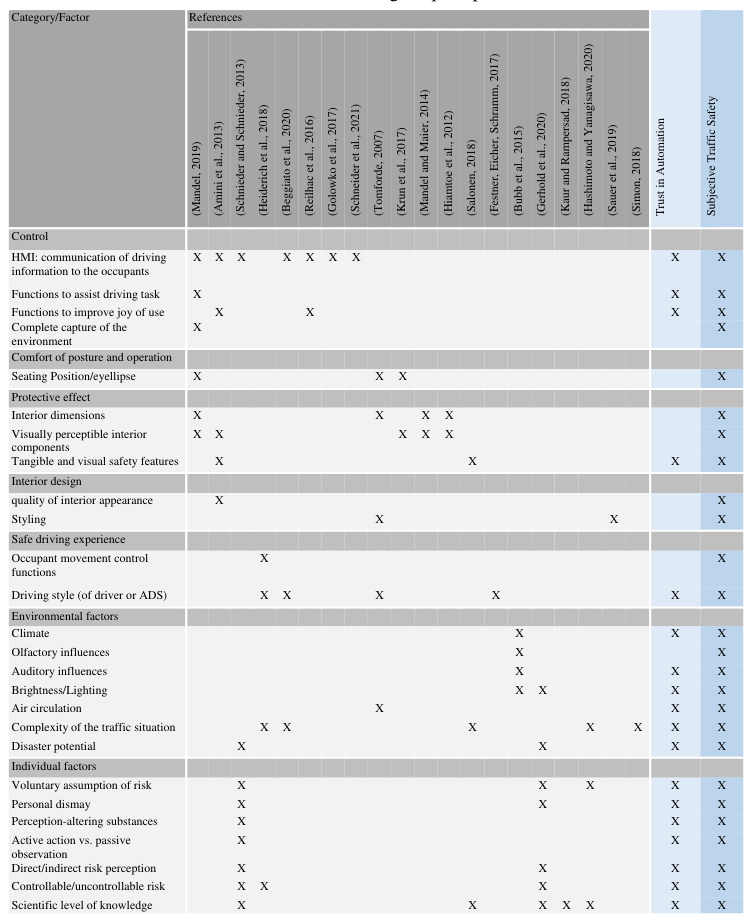
In order to enable the transfer to interior development, the literature research was specified. Influencing factors that have already been used to evaluate the user experience and safety were examined. It became clear that so far only a few studies have investigated the perception of safety and that the considerations are based on different influencing factors. Table 1 shows a holistic overview of known factors influencing the perception of safety. All factors could be clearly assigned to superordinate categories. It is not known how the factors can or must be weighted in relation to each other. According to Heiderich et al. (2018), it can be assumed that the prioritisation of the factors will differ in the context of automated driving compared to conventional passenger cars. Column 1 shows the categories and individual influencing factors, followed by the references with the allocation of the mentions. Finally, an item load was compiled for the terms trust in automation (system trust) and subjective traffic safety. Table 1 shows a large overlap of the influencing factors for both terms. This leads to the conclusion that the terms are primarily distinguished by their system reference. With regard to the basic design of the vehicle interior itself and optimisation of the design in terms of perceived safety, we will focus on the consideration of subjective traffic safety in the following.
Intelligent Human Systems Integration (IHSI 2022): Integrating People and Intelligent Systems https://openaccess.cms-conferences.org/#/publications/book/978-1-7923-8988-7
Table 1: Factors influencing the perception of safe
Intelligent Human Systems Integration (IHSI 2022): Integrating People and Intelligent Systems https://openaccess.cms-conferences.org/#/publications/book/978-1-7923-8988-7
METHOD AND RESULTS Based on the findings from literature, an explorative online survey on the perception of safety was designed and conducted. The main goal was to investigate how consciously test persons deal with their perception of safety and which particular factors determine said perception. The test persons first answered questions on their personal willingness to take risks and their perception of safety in the vehicle in a self-reflective manner. Questions regarding the influencing factors followed. With the aim to improve design-technology convergence in the vehicle interior, we first focused on the factor "protective effect", which is linked to the basic geometric design of the interior. As a second aspect, we focused on the factor "environmental factors" in order to gain more precise insights into external triggers for a need for safety. These items were rated using 5-point Likert scales. Only an excerpt of the descriptive evaluation is presented below.
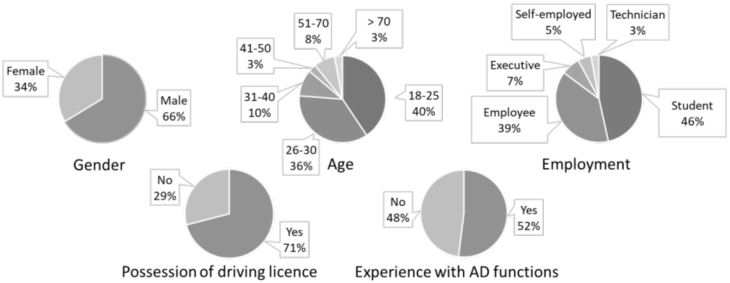
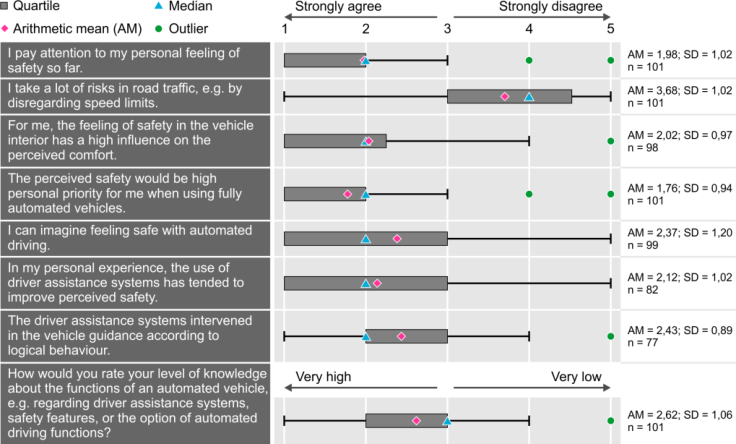
A total of N =101 participants took part in the online survey. The characteristics of the respondent collective are shown in Figure 2. Overall, the test persons consider themselves to be rather defensive drivers who take few risks. Although the test persons can imagine feeling similarly safe in automated vehicles as they do in current vehicles (cf. Figure 3), more specific questions in the context of automation showed that due to a lack of knowledge or experience with automated driving functions, the assessment is currently subject to uncertainty.
Figure 2: Characteristics of the sample collective Figure 3 shows the questions asked and the scale-based results on personal attitudes to the perception of safety. Safety was confirmed as an important factor for personal well-being in the vehicle interior. The result was underpinned by a supplementary open question on the personal importance of safety, which was answered e.g. with crash safety, crumple zone, freedom from worries or technical reliability (69 mentions). With regard to protective effect
Intelligent Human Systems Integration (IHSI 2022): Integrating People and Intelligent Systems https://openaccess.cms-conferences.org/#/publications/book/978-1-7923-8988-7
(31 mentions), tangible and visual safety features (airbags, seat belts, etc.) as well as spatial dimensions were mentioned. With regard to environmental factors (15 mentions), noise and the traffic situation in particular were named.
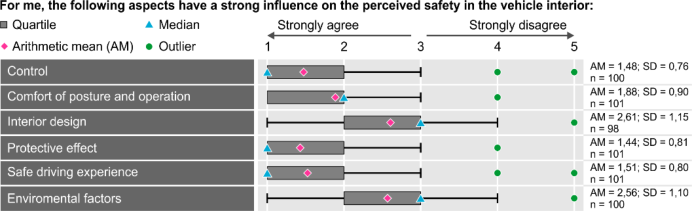
Before the influencing factors, the influence of the superordinate categories on the perceived safety was queried. Figure 4 shows the evaluation with an initial tendency. In an open control question, this evaluation was confirmed and the categories could also be sorted according to descending relevance for perceived safety: “control”, “safe driving experience” and “protective effect” dominate, followed by “comfort of posture and operation”. “Environmental factors” and “interior design” play a subordinate role.
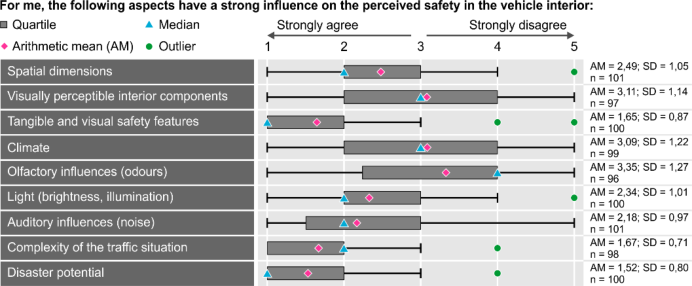
Subsequently, the various factors per category were queried. Due to the format of the survey, the individual factors listed in Table 1 were not specifically asked. The overall evaluation shows that "complete capture of the environment", "tangible and visual safety features", "driving style", "complexity of the traffic situation" and "disaster potential" are particularly important to the test persons. Less important are “quality of interior appearance”, “styling”, “visually perceptible vehicle components”, “climate” and “olfactory influences”. All further explanations are limited to the above-mentioned focal points of the paper.
Figure 3: Extract from evaluation on personal meaning of subjective safety
Intelligent Human Systems Integration (IHSI 2022): Integrating People and Intelligent Systems https://openaccess.cms-conferences.org/#/publications/book/978-1-7923-8988-7
Figure 4: Evaluation of the superordinate categories The high rating of the category “protective effect” cannot be confirmed due to the ambiguous evaluation of the assigned factors "interior dimensions", "visually perceptible vehicle components", as well as influences of different interior geometries that were also evaluated. The figure shows that “Tangible and visual safety features” are very strongly emphasised here. This is also confirmed by the open questions. Asked more specifically about the safety- relevant components of the interior, the respondents specified their answers (49 mentions): safety-relevant icons, hazard warning lights, horn and SOS button. However, the design of the components in the immediate vicinity of the driver's seat (instrument panel, doors) also heavily contributes to the perception of safety. From studies on the spatial effect (Hiamtoe et al., 2012; Mandel, 2019) we know that the geometry of the interior in particular influences various aspects of personal perception. We suspect that the online format limits the assessment of these factors.
Overall, the factors influencing the environment were rated much more precisely. As can be seen in Error! Reference source not found., traffic situations and accident potential in particular received high ratings in terms of their influence on the perception of safety.
Figure 5: Evaluation of the factors influencing the perception of safety
Intelligent Human Systems Integration (IHSI 2022): Integrating People and Intelligent Systems https://openaccess.cms-conferences.org/#/publications/book/978-1-7923-8988-7
Further questions on infrastructure, weather conditions and certain traffic situations showed clear tendencies as to which environmental influences can trigger a need for safety. Air conditioning and olfactory influences seem to have only a low influence on safety perception.
CONCLUSION
Despite the abstractness of the term perception of safety, the participants were largely able to answer the aspects of subjective safety well through targeted questions. However, it must be assumed that the assessments of the perception of safety in automated vehicles show uncertainties due to the format-related fictitious immersion. In particular, the questions on the focus "environmental factors" could be answered precisely in the online format. In the first part of the survey, the influencing factor "protective effect" still received high ratings in terms of importance for subjective safety. However, the factors assigned to the “protective effect” could not confirm this. The differentiability of the various factors influencing the “protective effect” was not conclusive in the online format, which is why we recommend and plan a comparative study in the driving simulator as the next step.
REFERENCES
Amini, P., Schmitt, R. and Falk, B. (2013) ‘Wahrnehmung von Sicherheit’, ATZ - Automobiltechnische Zeitschrift, 2013, pp. 448–454.
Antonovsky, A. (1996) ‘The salutogenic model as a theory to guide health promotion1’, Health Promotion International, vol. 11, no. 1, pp. 11–18. Beggiato, M., Hartwich, F., Roßner, P., Dettmann, A., Enhuber, S., Pech, T., Gesmann-
Nuissl, D., Mößner, K., Bullinger, A. C. and Krems, J. (2020) ‘KomfoPilot— Comfortable Automated Driving’, in Meixner, G. (ed) Smart Automotive Mobility, Cham, Springer International Publishing, pp. 71–154. Bubb, H. (2003) ‘Komfort und Diskomfort: Definition und Überblick’, Ergonomie aktuell, no. 3, pp. 5–8. Bubb, H., Bengler, K., Grünen, R. E. and Vollrath, M. (eds) (2015) Automobilergonomie,
Wiesbaden, Springer Vieweg. DIN EN ISO 9241-210:2019 (2019) 9241-210:2019: Ergonomie der Mensch-System- Interaktion – Teil 210: Menschzentrierte Gestaltung interaktiver Systeme (ISO 9241- 210:2019), Berlin: Beuth Verlag GmbH. Festner, Eicher, Schramm (ed) (2017) Beeinflussung der Komfort- und Sicherheitswahrnehmung beim hochautomatisierten Fahren durch fahrfremde Tätigkeiten und Spurwechseldynamik, Darmstadt, Uni-DAS e.V. Gerhold, L., Dorner, K., Brandes, E. and hartman, J. (2020) ‘Subjektives
Sicherheitsempfinden und subjektive Sicherheitswahrnehmung’, in Gerhold, L., Peperhove, R. and Jäckel, H. (eds) Sicherheitsempfinden, Sicherheitskommunikation
Intelligent Human Systems Integration (IHSI 2022): Integrating People and Intelligent Systems https://openaccess.cms-conferences.org/#/publications/book/978-1-7923-8988-7 und Sicherheitsmaßnahmen: Ergebnisse aus dem Forschungsverbund WiSima, Berlin, Freie Universität Berlin, pp. 9–58. Golowko, K., Mugele, P. and Zimmer, D. (2017) ‘Neue Möglichkeiten der
Innenraumgestaltung’, ATZextra, vol. 22, no. 3, pp. 42–45 [Online]. DOI: 10.1007/s35778-017-0030-3. Hashimoto, T. and Yanagisawa, H. (2020) ‘Modeling individual differences in risk feeling of autonomous driving behavior with a prediction error’, Journal of Advanced Mechanical Design, Systems, and Manufacturing, vol. 14, no. 6. Hassenzahl, M., Diefenbach, S. and Göritz, A. (2010) ‘Needs, affect, and interactive products
– Facets of user experience’, Interacting with Computers, vol. 22, no. 5, pp. 353–362. Heiderich, M., Leonhardt, S., Krantz, W., Neubeck, J. and Wiedemann, J. (2018) Method for analysing the feeling of safety at high speed using virtual test drives [Online], Springer Fachmedien Wiesbaden, pp. 875–886. Hiamtoe, P., Steinhardt, F., Köhler, U. and Bengler, K. (2012) ‘Subjective and objective
evaluation of sense of space for vehicle occupants based on anthropometric data’, Work (Reading, Mass.), 41 Suppl 1, pp. 252–257. Kaur, K. and Rampersad, G. (2018) ‘Trust in driverless cars: Investigating key factors influencing the adoption of driverless cars’, Journal of Engineering and Technology Management, vol. 48, pp. 87–96. Körber, M. (2019) ‘Theoretical Considerations and Development of a Questionnaire to
Measure Trust in Automation’, Proceedings of the 20th Congress of the International Ergonomics Association (IEA 2018). Cham, Springer International Publishing, pp. 13– 30. Krist, R. (1994) Modellierung des Sitzkomforts: eine experimentelle Studie, Dissertation, Weiden, Katholische Universität Eichstätt. Krun, D., Schmidt, G. and Rötting, M. (2017) ‘Gestaltung eines Fahrzeuginterieurs aus
ergonomischer Sicht – Gutes Raumgefühl oder verloren im Raum?’, VDI-Berichte, 21 November, pp. 165–176. Mandel, R. (2019) Komfortmodell und Untersuchung zum Einfluss der Innenraumgeometrie auf die Wahrnehmung und Wirkung von Fahrzeugeigenschaften, Stuttgart, Institut für Konstruktionstechnik und Technisches Design. Mandel, R. and Maier, T. (2014) Einfluss der Raumwirkung auf den Nutzungskomfort im
Fahrzeug, Institut für Konstruktionstechnik und Technisches Design, Universität Stuttgart. Maslow, A. (1943) ‘A Theory of Human Motivation’, Psychological Review, 1943, pp. 370–
396. Reilhac, P., Moizard, J., Kaiser, F. and Hottelart, K. (2016) ‘Cockpitkonzept für das teilautomatisierte Fahren’, ATZ - Automobiltechnische Zeitschrift, vol. 118, no. 3, pp. 44–49. Salonen, A. O. (2018) ‘Passenger's subjective traffic safety, in-vehicle security and emergency management in the driverless shuttle bus in Finland’, Transport Policy, vol. 61, pp. 106–110. Sauer, V., Mertens, A., Heitland, J. and Nitsch, V. (2019) ‘Exploring the concept of passenger well-being in the context of automated driving’, International Journal of Human Factors and Ergonomics, vol. 6, no. 3, pp. 227–248.
Intelligent Human Systems Integration (IHSI 2022): Integrating People and Intelligent Systems https://openaccess.cms-conferences.org/#/publications/book/978-1-7923-8988-7
Schneider, T., Ghellal, S., Love, S. and Gerlicher, A. R.S. (2021) ‘Increasing the User Experience in Autonomous Driving through different Feedback Modalities’, 26th International Conference on Intelligent User Interfaces. College Station TX USA, 14 04 2021 17 04 2021. New York, NY, USA, ACM, pp. 7–10. Schnieder, E. and Schnieder, L. (2013) Verkehrssicherheit: Maße und Modelle, Methoden und Maßnahmen für den Straßen- und Schienenverkehr [Online], Berlin, Heidelberg, Springer Vieweg. Available at http://gbv.eblib.com/patron/FullRecord.aspx?p=1317291. Sheldon, K. M., Elliot, A. J., Kim, Y. and Kasser, T. (2001) ‘What is satisfying about satisfying events? Testing 10 candidate psychological needs’, Journal of Personality and Social Psychology, vol. 80, no. 2, pp. 325–339. Simon, K. (2018) Erfassung des subjektiven Erlebens jüngerer und älterer Autofahrer zur Ableitung von Unterstützungsbedürfnissen im Fahralltag, Chemnitz, Fakultät für Maschinenbau der Technischen Universität Chemnitz. Sörensen, M. and Mosslemi, M. (2009) Subjective and objective safety: The Effect of Road Safety Measures in Subjective Safety among vulnerable Road Users, Oslo. Tomforde, J. (2007) ‘Entwicklung und Design von Freizeitmobilen’, in Braess, H.-H. and Seiffert, U. (eds) Automobildesign und Technik: Formgebung, Funktionalität, Technik, Wiesbaden, Vieweg, pp. 202–216. Zhang, L., Helander, M. G. and Drury, C. G. (1996) ‘Identifying Factors of Comfort and Discomfort in Sitting’, Human Factors, vol. 38, no. 3, pp. 377–389.
Intelligent Human Systems Integration (IHSI 2022): Integrating People and Intelligent Systems https://openaccess.cms-conferences.org/#/publications/book/978-1-7923-8988-7
LISTED IN THE AHFE DIGITAL BOOKSTORE CATALOGUE
Explore the complete digital volume
Intelligent Human Systems Integration (IHSI 2022): Integrating People and Intelligent Systems
Read this individual research paper free through the original publisher, or explore the full digital proceedings book.
ISBN 978-1-7923-8988-7
Explore this ISBN in the AHFE Bookstore ↗Listed in the July 2026 bookstore catalogue; search by ISBN to confirm current availability · Digital book purchase optional