Lutz Fischer, Lars Gadermann, Daniel Holder, Niklas Ihle, Julius Schlecht, Thomas Maier (2023). Investigation of the influences of sensors for automated driving on the perception of exterior design. In: Human Factors in Transportation. AHFE Open Access, vol. 95, pp. 204–215. https://doi.org/10.54941/ahfe1003806
Automated driving requires a large number of sensors. They are used to detect environmental influences and regulate vehicle guidance. Many of these sensors have to fulfil requirements regarding position and functional installation space. This creates a conflict of objectives between aesthetically appealing integration into the design and functional integration into trim parts or an aerodynamic concept. In addition, the perception of the sensors by vehicle users and other road users could favour the recognition of an automated vehicle (AV). Numerous studies showed the fundamental importance of a vehicle's exterior, especially with regard to the various semantic aspects of the resulting product effect. This is particularly apparent with regard to the communication between the driver or AV and other road users. Therefore, in this paper we consider the preconditioning of the user in relation to the degree of integration of sensor technology for automated driving. For this purpose, sensor configurations differing in shape and colour are applied to a concept car and examined in an eye-tracking study with regard to their influence on the perception of passengers and other road users. This will provide designers and engineers with insights into the design of sensor clusters in the exterior design of future vehicles.METHODSIn a first step, existing studies were systematically examined to determine the influence of the exterior design on the perception of the vehicle. In addition to the basic idea of appeal, the preconditioning by the design was examined in particular. It has been shown that the exterior design has an influence on the user's driving style, the spatial perception and the brand affiliation recognition. In more recent studies, the influence of so-called external HMIs (eHMI) on the perception of an automated vehicle has been increasingly investigated. Studies on the influence of more or less exposed sensors for automated driving on the perception of users or pedestrians are not known.In a second step, an eye-tracking study was therefore designed. In the study, the test persons were sequentially shown renderings in ¾ front and ¾ rear perspective of a concept car with different sensor configurations on the screen. The relevant sensor configurations are based on a previous study in which we conducted a position analysis and derived integration strategies for sensors. The stimulus patterns differ specifically in the sub-forms of structure (position), shape and colour. The test persons evaluated each of the stimulus patterns by means of a questionnaire with regard to their subjective impression in the use cases "crossing the street as a pedestrian" and "getting into the vehicle and being driven home". System trust, the perception of safety, recognisability and the judgement of appeal were assessed. Absolute dwell time, relative dwell time and fixation were recorded via eye tracking.RESULTSThe statistical evaluation of the results has shown that the sensors already have an influence on system trust and the perception of safety of the users and other road users in both use cases considered. In particular, for the configuration without visible sensors and additively integrated sensors, significant differences emerged as expected. As expected, there was a high degree of dispersion in the opinion towards liking the design of the users. Areas of interest were derived from the eye-tracking data via heat maps. The more accurate understanding of the perception of the degree of integration of sensors into the exterior design can support the work of designers by giving them the freedom to realise significantly more innovative designs in their design proposals compared to previous vehicles.OUTLOOKExtending the investigations to much larger vehicles, especially trucks or robotic vehicles according to SAE Level 5 without passengers could show whether the perception of sensors can already be used as a salient feature in exterior design. Furthermore, it should be investigated whether there are interactions with eHMI on AVs. In addition, system trust and safety perception could be investigated in an extended virtual reality test design with a variety of other relevant use cases such as: "oncoming AV at right-before-left intersection" to show influences of immersion. Also, the influence of time and the associated habituation factor certainly plays a role. For this reason, the effects of road users getting used to the sight with sensors should also be considered.ACKNOWLEDGMENTSThis research was supported by Federal Ministry for Economic Affairs and Climate Action in the national research project RUMBA.
OBJECTIVE AND SIGNIFICANCE The introduction of vehicles with automated driving functions requires a comprehensive sensing of the environment by the vehicle and the interpre- tation of its influences on the driving task. Therefore actuators, sensors and control software play an important role in the realisation of safety and auto- mation functions. In this paper, the focus is on sensors. They “replace” the senses of humans in highly automated vehicles. Many of these sensors have to fulfil requirements regarding position and functional installation space. This creates a conflict of objectives between aesthetically appealing integration into the design and functional integration into trim parts or an aerodyna- mic concept. Vehicle manufacturers and suppliers are increasingly showing concept vehicles for this purpose. The design-technology convergence funda- mentally follows two strategies for the aesthetic integration of sensors into the exterior design. Fischer et al. (2021) derive an additive and an integrative strategy from known concepts and prototypes via a position analysis of the
Investigation of the Influence of Sensors for Automated Driving 205
sensors. So far, it is unclear which strategy is favoured by the industry and designers. The investigation of effects on the perception of the population in traffic through the perception of sensors could support the selection of the strategy.
In real traffic, small, non-verbal nuances such as gestures, facial expressi- ons or eye contact often determine the following behaviour and perception of the participants (Carmona et al., 2021). From SAE level 4 (SAE International, 01-2014) onwards, the person in the driver’s seat no longer necessarily makes the decision about driving behaviour, so that this communication channel to the outside is no longer given. Numerous studies showed the fundamen- tal importance of a vehicle’s exterior, especially with regard to the various semantic aspects on human emotions and behaviour. In particular, distincti- veness and differentiation from other products, expression of function and features, fashion and trends, and branding influence the visual appearance of a product (Ranscombe et al., 2012). According to Mandel et al. (2015), the user of a vehicle absorbs various information about the vehicle through the visual perception of the exterior design before interacting with it. For example, the shape of the basic body and individual exterior elements convey specific information to the viewer, for example about seating or cargo volume. By comparing knowledge and experience with other vehicles, the first impres- sion is formed and thus also an initial comfort assessment (Mandel et al., 2015). Knowledge of the exterior also supports the driver in performing the driving task, e.g., in estimating distances around the vehicle or all-round visibility (Mandel, 2019). Furthermore, it could be shown that the exterior design has an influence on the driving style of the user (cf. Reichelt et al., 2020) and the brand affiliation recognition (Fischer et al., 2020). Contours and surfaces influence the brand affiliation of vehicles. Thus, vehicle faces also have an influence on the emotions of the viewer (Fischer et al., 2020). The size of the vehicle can also influence the decision to cross a road when the car arrives (Dey et al., 2017). The influence of exterior design on users’ emotions before using a vehicle is therefore described as visual preconditio- ning. Recent studies have examined the influence of so-called external HMIs (eHMI) on the perception of an AV. Although the studies usually focus on the communication itself, it could be shown that the presence of an eHMI alre- ady has a positive influence on the acceptance of the users (cf. Bazilinskyy et al., 2019; Burns et al., 2019; Joisten et al., 2021). Preconditioning can the- refore also be observed here. Studies on the influence of more or less exposed sensors for automated driving on the perception of users or pedestrians are unknown.
Therefore, in this paper the preconditioning of the user in relation to sensor configurations for automated driving is considered. For this purpose, confi- gurations differing in the degree of integration and colour are applied to a concept car and examined in an eye-tracking study with regard to their influ- ence on the perception of passengers and other road users. The three main research questions considered were: 1. Do sensors on AVs have an influe- nce on system trust, the perception of safety or the judgement of appeal? 2. Does the subgestalt (Seeger, 2005) of colour have an influence on system trust, the perception of safety and the judgement of appeal? 3. Does the
degree of integration shown in the positioning of sensors on the AV have an influence on system trust, the perception of safety and the judgement of appeal? Answering those questions will provide designers and engineers with insights into the design of sensor clusters in the exterior design of future vehicles.
METHODS
For the assessment of the sensor concepts, an eye-tracking study with two separate parts was designed. This article presents the research on the perce- ption of sensor technology, another article will go into more detail on connections with eHMI. In the study, the test persons were sequentially shown renderings in 3/4 front and 3/4 rear perspective of a concept car with different sensor configurations on the screen.
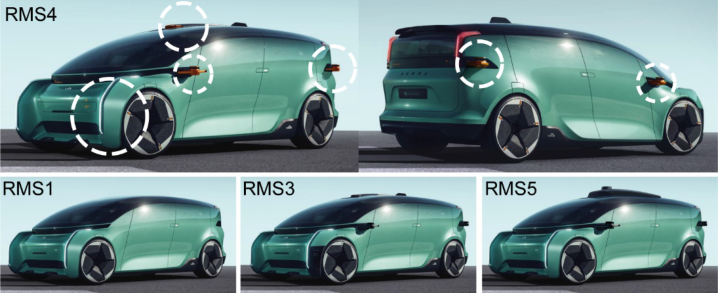
The vehicle exterior was developed in the RUMBA research project and corresponds to the expected body for a highly automated vehicle. Due to the high space requirements of the comfortably seated to reclining occupants, the result is a large wheelbase, a high vehicle roof and a van-like IC body with an integrated, rising front and a cubically terminated rear (Holder, 2016). The relevant sensor configurations are based on the previously mentioned study in which Fischer et al. (2021) derived integration strategies for sensors. The stimulus patterns differ specifically in the subgestalt of shape (position and degree of integration), shape and colour. The stimulus patterns are (c.f. Figure 1):
1. RMS1 (sensors invisible): Concept 1 deliberately shows no sensors to create a similarity to known vehicles. This maximally integrative design also serves as a baseline. 2. RMS2 (sensors visible, kept in car colour): Standard sensor configu- ration where the immediately adjacent vehicle colour is applied to the brackets and sensor trim to create a more harmonious image. 3. RMS3 (sensors visible in black areas): Sensors behind black glass or plastic trim. This, the most common type of design used in previous concepts, corresponds to the current state of development of the concept vehicle. 4. RMS4 (sensors visible, trim parts in a contrasting colour): Further vari- ation of the partial design colour with the same sensor configuration. 5. RMS5 (sensors visible and deliberately shown exposed): The stimulus pattern follows the additive strategy (Fischer et al., 2021) of sensor inte- gration and thus follows concepts such as the Waymo Jaguar (Waymo LLC, 2018) or Mercedes-Benz ESF 2019 (Mercedes Benz Group Media, 2019).
Inside a within-subject-design the test persons evaluated each of the sti- mulus patterns by means of a questionnaire with regard to their subjective impression in predefined use cases “crossing the street as a pedestrian” and “getting into the vehicle and being driven home”. The use cases provide a fictitious context that the participants were asked to imagine for the evalua- tion. The questionnaire in this part of the study has a total of 12 items that
Investigation of the Influence of Sensors for Automated Driving 207
are rated after each stimulus pattern on a six-point Likert scale (agree stron- gly = 6 to disagree strongly = 1). To evaluate trust in automation adjusted items from the TiA questionnaire according to Körber (2018) and items from Ekman (2020) are used. The selection was made according to whether the items are meaningful when looking at an external product design. The perce- ption of safety was evaluated with items following Arndt (2010), Salonen (2018) and Bazilinskyy et al. (2019). The judgement of appeal was assessed according to Holder (2016) and additional self-developed items. The stimu- lus patterns were shown randomly to each test person to minimise sequence effects. The time for looking at the vehicle was limited to 20 seconds to take viewing times in real traffic into account. With a Tobii-eye-tracking system absolute dwell time, relative dwell time and fixation were recorded. Fixation was evaluated.
Figure 1: Stimulus patterns of future vehicle presented to test persons.
RESULTS
This section presents the results of the study on the perception of sensors on AVs. First, the participants collective is presented. This is followed by the interpretation of the eye-tracking data and statistical evaluation of the questionnaire.
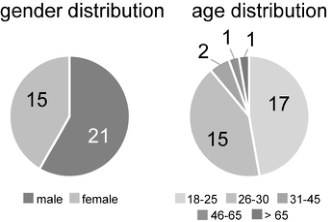
Participants Overall 36 participants – 15 female and 21 male – completed the study (cf. Figure 2). The participants’ age spans from 18 to 65 years representing a young technically orientated sample around the University of Stuttgart.
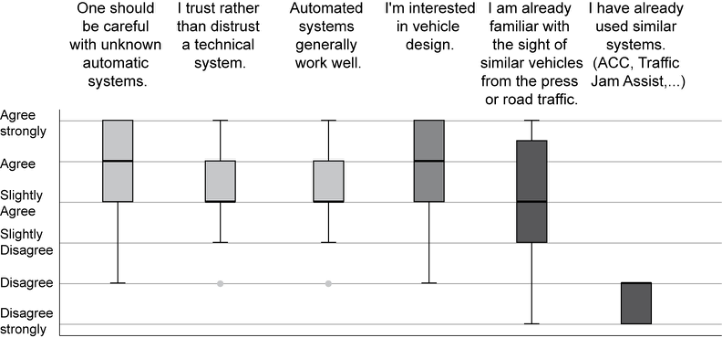
After the main study the participants were asked about some psychogra- phic characteristics (cf. Figure 3). Three questions aimed at the general trust of the participants towards automated systems. Most test persons are rather cautious about the subject. Moreover most participants are interested in veh- icle design. When asked about their experience with automated vehicles, the participants answered that they had seen such vehicles before, but that they had very little experience with automated systems themselves.
In two final open questions, the test persons were asked about positive and negative conspicuous features of the vehicles. In the context of the sensors, the
Figure 2: Age and gender distribution of participants sample.Figure 3: Survey results towards psychographic characteristics of the participants.
orange colour in particular was mentioned positively as an additional safety feature (14 mentions). In addition, the sensors instead of the outside mirrors were mentioned positively. Other positive mentions related to the shape of the headlights. The protruding components in particular were described as negative (10 mentions) and especially the roof rack (6 mentions). The tran- sition between the door and the side window as well as the orange colour scheme were also criticised (5 mentions each).
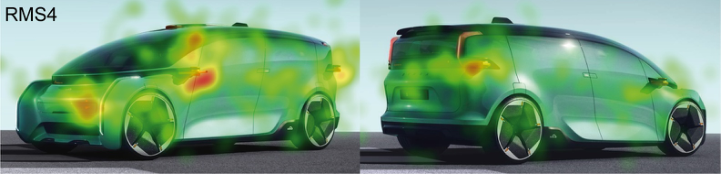
EVALUATION The evaluation of the eye-tracking data had a high error rate. Of the 36 test persons, only 19 data sets could be used to create the heat maps (c.f. Figure 4).
The evaluation of the heat maps shows typical gaze clusters at headli- ghts, rims, window line and the known position of the driver’s seat across all images, but especially at RMS1. This is fundamentally consistent with an eye-tracking study of the vehicle body, which shows gaze concentrations in the front oblique view in the area of the windows, mirrors and headlights, and in the rear oblique view in the area of the tail lights and side windows (c.f. (Holder, 2016)). Despite this, the gaze concentrations of the front sensors are clear and especially the gaze concentrations in the oblique front view in
Investigation of the Influence of Sensors for Automated Driving 209
Figure 4: Example for areas of interest from the eye-tracking data presented via heat maps.
the area of the rear sensors deviates from comparable results (Holder, 2016) and shows that the unusual and exposed shape of the sensors was perceived by the subjects. The figures for RMS2 - 5 clearly show that the test persons also noticed the sensors. In particular, the sensors on the ‘corners’ of the veh- icles were fixed. The roof rack (RMS5) also attracted attention. In general, it is noticeable that the front perspective was looked at much more intensively than the rear representations of the vehicles.
The following boxplots show the statistical evaluation of the questionnaire with regard to the subjective perception of the different vehicles and the resul- ting evaluation of trust, perception of safety in the assumed situations and appeal of the vehicle.
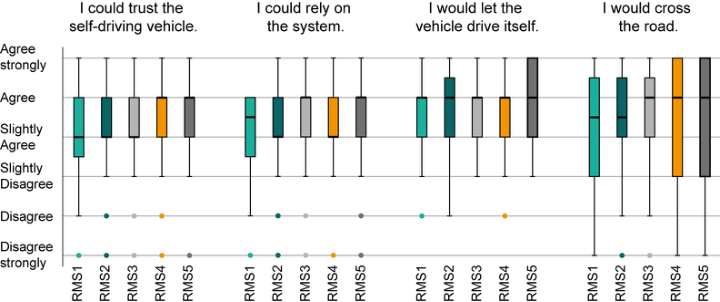
Figure 5 shows that there is a certain level of trust in the vehicles. The ratings are positive, but a repeated measures ANOVA and Huynh Field cor- rection (HF) shows no significant differences between the stimulus patterns (Question 1: F(3.644, 8.756) = 2.616, p = 0.045, partial η2 = 0.070) and (Question 2: F(2.411, 43.989) = 1.918, p = 0.111, partial η2 = 0.052)). How- ever, the comparison in pairs shows a slight tendency between RMS1 and RMS5. The vehicle with the roof rack seems to be a little more trusting.
Figure 5: Survey results towards trust in automation as box plots.
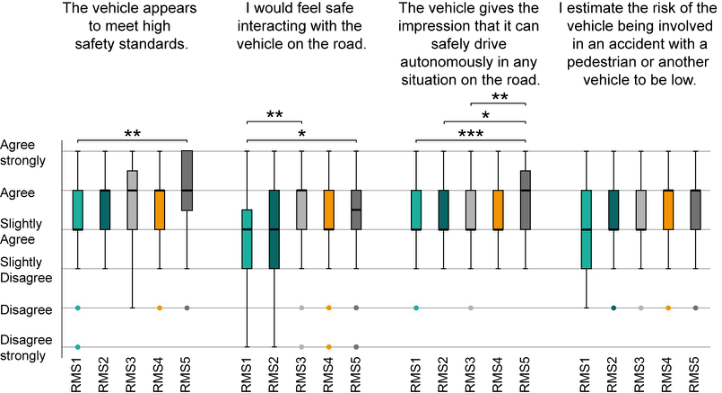
Figure 6 shows the results of the assessments of the perception of safety. An analysis of variance with repeated measures and HF correction (sphericity assumed: Mauchly-W(2) = 0.591, p = 0.041, HF = 0.905) shows a signifi- cant difference between the vehicles regarding the perceived safety standards
(F(8.967, 70.233) = 4.468, p = 0.003, partial η2 = 0.113). A Bonferroni- corrected comparison in pairs show that RMS1 without sensory equipment was rated significantly lower than RMS5 with a roof rack (MDiff = −0.694, p = 0.009, 95% CI[−1.265, −0.124]). No difference can be seen with regard to the other stimulus patterns. The effect size f according to Cohen (2013) is f = 0.379 and corresponds to a medium effect.
The ANOVA with repeated measures and HF correction (sphericity assu- med: Mauchly-W(2) = 0.510, p = 0.008, HF = 0.846) also shows that a difference in ratings exists between stimulus patterns when interacting with vehicles (F(7.856, 66.944) = 4.107, p = 0.006, partial η2 = 0.105). Bonferroni-corrected comparison in pairs show that RMS3 and RMS5 were rated significantly safer compared to the vehicle without sensors (RMS1_3: MDiff = 0.583, p = 0.002, 95%-CI[.163, 1.003] and RMS1_5: MDiff = 0.528, p = 0.040, 95%-CI[0.015, 1.041]). Between RMS1 and RMS4 a slight tendency can be observed. The effect size f according to Cohen (2013) is f = 0.362 and corresponds to a medium effect.
The evaluation of question three with an analysis of variance with repea- ted measures and HF correction (sphericity assumed: Mauchly-W(2) = 0.699, p = 0.219) shows differences in ratings regarding the management of critical traffic situations between vehicles (F(10.311, 55.289) = 6.527, p < 0.001, partial η2 = 0.157). Bonferroni-corrected comparison in pairs show that RMS5 makes a significantly better impression regarding the management of traffic situations than RMS1, RMS2 and RMS3 (RMS1_5: MDiff = 0.722, p = 0.001, 95%-CI[0.251, 1.194] and RMS2_5: MDiff = 0.389, p = 0.044, 95%-CI[0.006, 0.772] and RMS3_5: MDiff = 0.500, p = 0.003, 95%- CI[0.132, 0.868]). The effect size f according to Cohen (2013) is f = 0.379 and corresponds to a large effect. The evaluation of the risk of being involved in an accident with the vehicle was generally assessed as low.
Figure 6: Survey results towards perception of safety as box plots with significances.
Investigation of the Influence of Sensors for Automated Driving 211
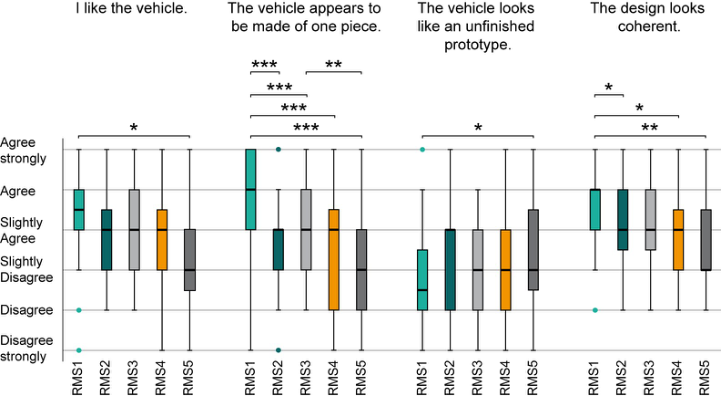
As expected, the subjects’ evaluation of appeal varied greatly (c. f. Figure 7). An repeated measures ANOVA with HF correction (sphericity assumed: Mauchly-W(2) = 0.644, p = 0.100) shows that subjects tend to like a vehicle without sensors better (F(16.756, 145.644) = 4.027, p = 0.004, partial η2 = 0.103). Bonferroni-corrected comparison in pairs show that RMS1 is rated significantly better than RMS5 (M = 3.333, SD = 1.171) (MDiff = 0.944, p = 0.012, 95% CI[0.144, 1.745]). A slight tendency can also be observed between RMS2 and RMS5. The effect size f according to Cohen (2013) is f = 0.360 and corresponds to a medium effect.
The vehicle without sensors is also evaluated as being more coherent (ANOVA with repeated measures and HF correction: (sphericity assumed: Mauchly-W(2) = 0.573, p = 0.029, HF = 888) F(24.189, 130.211) = 6.502, p < 0.001, partial η2 = 0.157). Bonferroni-corrected comparison in pairs show that RMS1 scored significantly better than RMS2, RMS4 and RMS5 (RMS1_2: MDiff = 0.472, p = 0.048, 95%-CI[0.002, 0.942] and RMS1_4: MDiff = 0.833, p = 0.014, 95%-CI[0.112, 1.554] and RMS1_5: MDiff = 1.083, p = 0.003, 95%-CI[0.270, 1.896]). The effect size f according to Cohen (2013) is f = 0.470 and corresponds to a large effect.
Questions two and three are aimed at the perception of the degree of integration of the sensor system in the vehicle. As expected, ANOVA with repeated measures and HF correction for both questions clearly shows that there are differences between the stimulus patterns related to the sensor design.
(ANOVA question 2 (sphericity assumed: Mauchly-W(2) = 0.737, p = 0.335): F(70.689, 139.711) = 17.709, p < 0.001, partial η2 = 0.336 and ANOVA question 3: F(13.089, 160.911) = 2.847, p = 0.026, partial η2 = 0.075). Bonferroni-corrected comparison in pairs for question two show strongly significant (p < 0.001) differences in the ratings of the vehicles with sensors RMS2 to 5 compared to the vehicle without sensors displayed as RMS1 appearing to be made of one piece.
Figure 7: Survey results towards appeal as box plots with significances.
In addition, RMS3 and RMS5 show a significant difference. It can be concluded from this that the more highlighted the sensor configuration, the less pleasing the vehicle appears. The effect size f according to Cohen (2013) is f = .379 and corresponds to a large effect. Question three focuses on how close to series production the vehicle appears and shows that the degree of integration can, however, be assessed as rather high overall. On average, none of the vehicles was rated as an unfinished prototype. A Bonferroni-corrected comparison in pairs shows that RMS1 is considered less of a prototype than RMS5 (MDiff = −0.667, p = 0.011, 95%-CI[0.−1.227, −0.107]. The effect size f according to Cohen (2013) is f = 0.296 and corresponds to a medium effect.
Finally, a Chi2 test was conducted to answer the research questions of whether the degree of integration or the colour of the sensors correlate with the evaluation of trust, safety perception and appeal.
The degree of sensor integration is represented by the three stimulus pat- terns RMS1, RMS3 and RMS5. It has no significant influence on the ratings of the questions regarding trust in the vehicle (question 1: χ2(10) = 7.728, p = 0.655 and question 2: χ2(10) = 5.683, p = 0.841). No correlation with the degree of sensor integration could be determined for the evalua- tion of the feeling of safety either (question 1: χ2(10) = 9.432, p = 0.492; question 2: χ2(10) = 5.877, p = 0.825; question 3: χ2(8) = 12.614, p = 0.841; question 4: χ2(8) = 4.048, p = 0.853). The significances of the stimulus patterns among each other could therefore not be confir- med. It is not possible to draw conclusions from the evaluation of the feeling of safety alone to the degree integration of the sensors with this study.
As already shown in the evaluation of the questions about appeal, a signi- ficant correlation between the degree of integration of the sensors and the appeal could be found (question 1: χ2(10) = 19.180, p = 0.038; question 2: χ2(10) = 43.291, p < 0.001; question 3: χ2(10) = 12.429, p = 0.257; que- stion 4: χ2(8) = 19.744, p = 0.011). A general correlation between appeal and the degree of integration of the sensors could thus be demonstrated. The more extensive and conspicuous the sensors, the less the subjects liked the vehicle.
The influence of colour on the subjects’ ratings was examined with the stimulus patterns RMS2, RMS3 and RMS4. These only differ in the colour design of the sensors, but not in the degree of sensor integra- tion. Here, too, it was shown that the colour had no significant influe- nce on the trust shown towards the vehicle (question 1: χ2(10) = 2.389, p = 0.992 and question 2: χ2(10) = 5.439, p = 0.860). Furthermore, no correlation could be found between colour and perceived safety ratings (question 1: χ2(8) = 5.489, p = 0.704; question 2: χ2(10) = 2.849, p = 0.985; question 3: χ2(8) = 3.590, p = 0.892; question 4: χ2(8) = 3.840, p = 0.871). The Chi2 test also showed no significant correlation between the ratings of appeal and colour design (question 1: χ2(10) = 5.900, p = 0.824; question 4: χ2(8) = 3.768, p = 0.877). For the orange colour, which is often highlighted as positive in the open questions, no correlation to trust, perception of safety or appeal could be proven here.
Investigation of the Influence of Sensors for Automated Driving 213
DISCUSSION
Overall, the statistical evaluation of the questionnaire shows differences in the ratings for safety perception and appeal between the stimulus patterns, but no firm conclusions can be drawn about the degree of integration of the sensors or the colour design. Only the expected, more negative evalua- tion of appeal of vehicles with additive sensor technology could be clearly shown. The visible sensory system does not seem to be a salient feature for the stimulus patterns shown. High ratings (Agree strongly = 6) are rarely achieved.
With regard to the significance of the results, however, the low immersion underlying the study setting should be viewed critically. Despite a very high level of detail, the vehicles show some characteristics of a concept car, e.g., very large rims. This polarisation of the design might have led to an inconclu- siveness in the evaluations. The vehicle should therefore be designed more realistically. The chosen observation time tends to be too long in the context of real traffic. However, a short preliminary test with shorter and longer vie- wing times showed that below 20 seconds it is hardly possible to make an assessment about the unfamiliar design. In order to improve immersion, a dynamic presentation of the stimulus patterns, ideally with real vehicles or virtual reality at a real crossing, would be helpful. In addition, the sample, which is rather young here, should be enlarged and adjusted to a higher age average. For the interpretation of the gaze concentrations, it must be taken into account that areas of the vehicle can be perceived and evaluated through the peripheral vision of humans without these being demonstrably focused (cf. Reid et al., 2013; Holder, 2016). The interpretation of the heat maps is therefore difficult.
CONCLUSION AND OUTLOOK This paper presents an eye-tracking study to investigate the influence of visi- ble sensors on trust in AVs, safety perception and appeal of AVs. Five stimulus patterns differ specifically in the subgestalt of shape (position and degree of integration), shape and colour. Areas of interest were derived from the eye- tracking data via heat maps. They confirmed that the test persons notice the sensors even with a short viewing time. The statistical evaluation of the results has shown that the sensors have a minor influence on trust in the vehicle but have an influence on the perception of safety of the users. In par- ticular, for the configuration without visible sensors and additively integrated sensors, significant differences emerged. As expected, there was a high degree of dispersion in the opinion towards appeal of the design on the users. It has been shown that a low level of integration of the sensors in the vehicle body has a significant negative influence on the vehicle’s appeal. Therefore rese- arch question one can be largely confirmed. An influence of the colour of the sensory system could not be statistically proven and therefore cannot be answered positively. The influence of the degree of integration of sensors was possible for the appeal of the automated vehicles. It can be deduced that a high degree of integration of sensors is to be preferred. The more accurate understanding of the perception of the degree of integration of sensors into
the exterior design can support the work of designers by giving them the fre- edom to realise more innovative designs in their design proposals compared to previous vehicles.
It remains to be clarified, whether visible sensors can increase the trust and safety in dynamic traffic. Particularly interesting could be the view out of one’s own vehicle and thereby possibly compensate for a negative appeal. System trust and safety perception therefore could be investigated in an exten- ded virtual reality test design with a variety of other relevant use cases such as: “oncoming AV at right-before-left intersection”. Also the influence of time and the associated habituation factor must be considered. Furthermore, it should be investigated whether there are interactions with eHMI and sensors on AVs. Extending the investigations to much larger vehicles, especially tru- cks or robotic vehicles according to SAE Level 5 (SAE International, 01-2014) without passengers could also show interesting results.
ACKNOWLEDGMENT
This research was supported by Federal Ministry for Economic Affairs and Climate Action in the national research project RUMBA.
REFERENCES
Arndt, S. (2010) Evaluierung der Akzeptanz von Fahrerassistenzsystemen. Modell zum Kaufverhalten von Endkunden. Dissertation, Technische Universität Dresden, Dresden. Bazilinskyy, P., Dodou, D. and Winter, J. de (2019) ‘Survey on eHMI concepts: The
effect of text, color, and perspective’, Transportation Research Part F: Traffic Psychology and Behaviour, Elsevier Ltd., Vol.67, pp. 175–194. Burns, C. G., Oliveira, L., Thomas, P., Iyer, S. and Birrell, S. (2019) ‘Pedestrian Decision-Making Responses to External Human-Machine Interface Designs for Autonomous Vehicles’ in: 2019 IEEE Intelligent Vehicles Symposium (IV), IEEE, pp. 70–75. Carmona, J., Guindel, C., Garcia, F. and La Escalera, A. de (2021) ‘eHMI: Review
and Guidelines for Deployment on Autonomous Vehicles’, Sensors, MDPI,Vol.21, No. 9. Cohen, J. (2013) Statistical Power Analysis for the Behavioral Sciences, 2nd ed., Taylor & Francis Ltd., New York, USA. Dey, D., Martens, M., Eggen, B. and Terken, J. (2017) ‘The Impact of Vehicle Appea-
rance and Vehicle Behavior on Pedestrian Interaction with Autonomous Vehicles’, Association for Computing Machinery, New York, USA, pp. 158–162. Ekman, F. (2020) Designing for Appropriate Trust in Automated Vehicles - A tentative model of trust information exchange and gestalt. Dissertation, Chalmers University of Technology, Gothenburg. Fischer, L., Holder, D., Krogmann, S. and Maier, T. (2021) ‘Integration von Sen-
soren in das Exterieur-Design automatisierter/autonomer Fahrzeuge’, in: Binz, H. et al. (Eds.), Stuttgarter Symposium für Produktentwicklung SSP2021, Conference Proceedings, Stuttgart, pp. 523–534. Fischer, M. S., Holder, D. and Maier, T. (2020) ‘Brand Affiliation Through Curved and Angular Surfaces Using the Example of the Vehicle Front’ in: ASME 2020 International Design Engineering Technical Conferences and Computers
Investigation of the Influence of Sensors for Automated Driving 215
and Information in Engineering Conference, American Society of Mechanical Engineers, Curran Associates Inc., New York, USA. Holder, D. (2016) Gefallensurteil und Blickanalyse zum Fahrzeugdesign zukünftiger Aufbaugestalten anhand einer technischen Prognose. Dissertation, University of Stuttgart, Stuttgart. Joisten, P., Liu, Z., Theobald, N., Webler, A. and Abendroth, B. (2021) ‘Communi-
cation of Automated Vehicles and Pedestrian Groups: An Intercultural Study on Pedestrians’ Street Crossing Decisions’ in: MuC ‘21: Mensch und Computer 2021, Association for Computing Machinery, New York, USA, pp. 49–53. Körber, M. (2018) ‘Theoretical Considerations and Development of a Questionnaire to Measure Trust in Automation’, in: Bagnara, S. (Ed.), Proceedings of the 20th Congress of the International Ergonomics Association (IEA 2018), Volume VI: Transport Ergonomics and Human Factors (TEHF), Aerospace Human Factors and Ergonomics, Springer International Publishing AG, Cham, pp. 13–30. Mandel, R. (2019) Komfortmodell und Untersuchung zum Einfluss der Innen-
raumgeometrie auf die Wahrnehmung und Wirkung von Fahrzeugeigenschaften. Dissertation, University of Stuttgart, Stuttgart. Mandel, R., Klarzyk, J. and Maier, T. (2015) ‘Impact of visual preconditioning on the comfort rating of the vehicle interior’, in: Bargende, M. et al. (Eds.), 15. Internatio- nales Stuttgarter Symposium, Automobil- und Motorentechnik, Springer Vieweg, Wiesbaden, pp. 725–736. Mercedes Benz Group Media (2019) ‘Neue Sicherheitsideen für eine neue Mobilität
- ESF 2019.’ online: https://group.mercedes-benz.com/innovation/esf-2019.html (Accessed 11-02-2023). Ranscombe, C., Hicks, B., Mullineux, G. and Singh, B. (2012) ‘Visually decomposing vehicle images: Exploring the influence of different aesthetic features on consumer perception of brand’, Design Studies, Vol. 33, No. 4, pp. 319–341. Reichelt, F., Holder, D. and Maier, T. (2020) ‘Influence of the vehicle exterior design
on the individual driving style’, in: Ahram, T. (Ed.), Human Systems Engineering and Design II, Proceedings of the 2nd International Conference on Human Systems Engineering and Design (IHSED2019): Future Trends and Applications, Springer International Publishing AG, Cham, pp. 223–228. Reid, T. N., MacDonald, E. F. and Du, P. (2013) ‘Impact of Product Design Representation on Customer Judgment’, Journal of Mechanical Design, Vol. 135, No. 9. SAE International (01-2014) J3016 Taxonomy and Definitions for Terms Related to
Driving Automation Systems for On-Road Motor Vehicles. Salonen, A. O. (2018) ‘Passenger’s subjective traffic safety, in-vehicle security and emergency management in the driverless shuttle bus in Finland’, Transport Policy, Elsevier Ltd., Vol. 61, pp. 106–110. Seeger, H. (2005) Design technischer Produkte, Produktprogramme und -systeme.
Read this individual research paper free through the original publisher, or explore the full digital proceedings book.
ISBN 978-1-958651-71-1
Explore this ISBN in the AHFE Bookstore ↗Listed in the July 2026 bookstore catalogue; search by ISBN to confirm current availability · Digital book purchase optional