Ferdinand Langer, Thomas Maier (2023). Influence of the shape of a forearm support on the range of pronation and supination in the context of a surgical arm assistance system. In: Physical Ergonomics and Human Factors. AHFE Open Access, vol. 103, pp. 91–99. https://doi.org/10.54941/ahfe1003039
Surgery often results in static, uncomfortable arm and upper body postures, which lead to high stress on the surgeons' upper extremities [Szeto 2012]. To counteract this, an interaction-based arm assistance system has been developed to physically unload the surgeon's upper extremities during laparoscopic procedures. This is achieved by actively supporting the forearms. Thereby, a supporting force acts on the forearms, which follows the natural forearm movements without restrictions [Karlovic 2015]. The assistance system is controlled exclusively by a form fit and frictional connection of the forearms with the arm support. Investigations show an influence of the anthropomorphic shape of the form on objective and subjective operability and an advantage of the anthropomorphic shape over no support and a flat form [Langer 2022]. In this study (funded by the German Research Foundation), the range of pronation und supination within anthropomorphic forms is investigated to design the human-machine interface of the arm assistance system for precise surgical tasks with forearm rotation. Within the scope of this research project, the interface parameter shape of the forearm support is therefore investigated on the basis of five shape variants (gender-specific negative shapes of 05-, 25-, 50-, 75- and 95-percentile adults). To investigate the range of motion of pronation and supination, the 32 subjects grasp a round handle, which is oriented orthogonally to the ground (start position). The forearm is bent 90° to the upper arm (flexion). On instruction, the subjects rotate their forearm maximally in the pronation direction and then in the supination direction. The maximum angles achieved in each case are measured starting from the start position. The subjects then rate the comfort and further properties of the shape on a 7-point Likert scale. This is repeated with all shape percentiles. The study shows that the percentile of the anthropomorphic form has an influence on the range of motion in pronation and supination of the forearm. Compared to no support of the forearm (Ø-pronation = 76.4°, Ø-supination = 114.3°), the average range of motion for support with the 05-percentile form (smallest shape) decreases by 8.4% (70.6°) for pronation and by 22.5% (93.3°) for supination. In contrast, the average range of motion for support with the 95-percentile form decreases by 5.3% for pronation and 18.1% for supination. For pronation and supination, the trend shows that the smaller the shape of the forearm support, the smaller the average range of motion. The average range of rotation that can be achieved without support and without form is not achieved with any form. The subjective survey shows that comfort is lowest for the smallest form. Furthermore, the correlation of the range of motion of the different forms is evaluated depending on the forearm percentile of the subjects. Design recommendations for the shape of the forearm support are derived from the results. It is deduced that a forearm support with rotational degrees of freedom for pronation and supination could offer an advantage for the preservation of the range of motion and consequently for the performance of tasks.
Laparoscopic surgery often results in static, uncomfortable arm and upper body postures, which leads to high stress on the surgeons’ upper extremi- ties (Galleano et al., 2006; Szeto et al., 2012; Choi, 2012). This can lead to fatigue and reduction in effectiveness with increased error rates during precision tasks (Erbse, 2002; Galleano et al., 2006). To counteract this, an interaction-based surgical arm assistance system (CAS) was developed as part
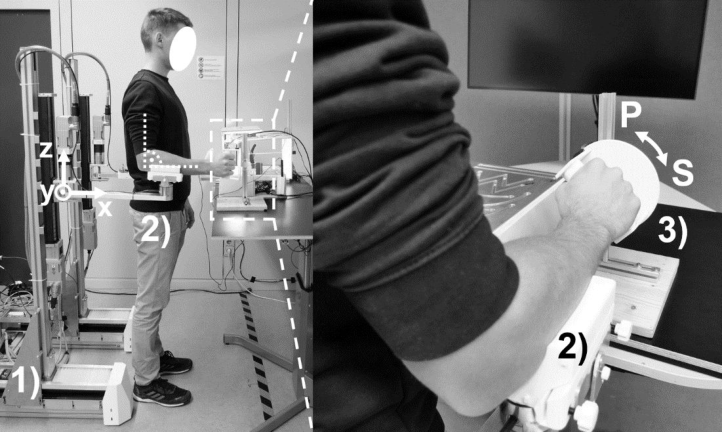
of an interdisciplinary research project (IoC 103) to physically unload the surgeons’ upper extremities during laparoscopic procedures (see Figure 1). This is achieved by actively supporting the forearms. It involves a support force acting on the forearms that can be individually adapted to the body weight (Heidingsfeld et al., 2014; Karlovic, 2019). The human-machine interface represents the forearm support, which follows the natural forearm movements without restrictions. According to Karlovic (2019), the design recommendations for the length of the forearm support are 40% of the fore- arm length and for the center of the support position 30% of the forearm length distal to the olecranon. The use of the surgical arm assistance system CAS has a positive influence on error reduction during dynamic task execu- tion compared to no support, without negatively influencing the execution time (Langer, 2022a).
It must be possible to detach the forearm from the surgical arm assistance system at any time in safety-critical situations. This is achieved by a rapid vertical upward movement of the arms (Heidingsfeld et al., 2014; Karlovic et al., 2015). Consequently, the forearms cannot be firmly connected to the forearm support, for example by a Velcro strap. The arm support is control- led solely by a form fit and frictional connection of the forearms with the forearm support of the CAS. Investigations show an influence of the anthro- pomorphic shape of the form on objective and subjective operability of the arm assistance system and an advantage of the anthropomorphic shape of the form over no support and a flat form (Langer, 2022a). It follows that the interface parameters form and material of the forearm support are criteria for effective and efficient interaction with the CAS.
Figure 1: Experimental setup with right-handed subject: interaction-based arm assi- stance system CAS (1), human-machine interface forearm rest (2), experimental task (3) and direction of pronation (P) and supination (S).
Influence of the Shape of a Forearm Support 93
These interface parameters are being investigated as part of the research project (DFG 430136438). There is evidence of an advantage of a percentile- adapted anthropomorphic shape over a flat forearm support and over no support for support at the proximal forearm (Langer et al., 2022b).
This study aims to investigate the objective and subjective usability of the forearm support form using five size percentile- and gender-adapted, anthro- pomorphic, open U-shape form variants. According to Shaaban (2008), the degree of active supination of the dominant arm without support, which is angled 90
degrees to the upper arm (flexion) is 104.2
. For pronation, this is 81.7
(Shaaban, 2008). The aim of this sub-study is to gain knowledge about the objective and subjective usability of the form of the forearm support in the context of range of motion of pronation and supination with the arm assistance system.
METHODOLOGY
In order to investigate the form of the forearm support, a trial scenario, based on different tasks, is set up and a subject study is performed. The selection of subjects is based on the characteristics age between 18 and 67. 32 subjects (age: Ø = 24.6 years, SD = 5.3 years, Range = 18-42 years; 37.5% female (f), 62.5% male (m)). The subjects were 93.7% right-handed and 6.3% left- handed. At the beginning, the body measurements of the subjects are recorded according to DIN EN ISO 7250-1:2017 (Height: Ø = 178.9 cm, SD = 7.7 cm, Range = 162.2-194.5 cm; Elbow Wrist Length: Ø = 28.9 cm, SD = 1.7 cm; Range = 25.5-32.0-cm). The average forearm circumference of the test sub- jects was measured in three different arm postures (according to DIN EN ISO 7250-1:2017, the anthropometric database iSize (Avalution, 2009) and the most common usage posture of the arm assistance system during the study: 90
flexion between forearm and upper arm). The average was calculated (Forearm circumference: Ø = 27.0 cm, SD = 2.6 cm, Range = 23.1-34.7 cm). The forearm circumference can be assigned closest to the iSize classification of the 5th-percentile for 5 subjects (f = 21.8 cm, m = 25.4 cm), to the 25th- percentile for 11 (f = 23.4 cm, m = 27.1 cm) and to the 50th-percentile for 10 subjects (f = 24.6 cm, m = 28.4 cm). The same applies to the 75th-percentile for 3 subjects (f = 26.0 cm, m = 29.8 cm) and to the 95th-percentile for 3 subjects (f = 28.6 cm, m = 32.2 cm) (Avalution, 2009). 18.7% of the subjects have prior experience interacting with arm assistance systems. One subject (25th-percentil) is excluded from performing rotational movements in the experiment because of an injury in the arm of the dominant hand.
To investigate the range of motion of pronation and supination, the 31 subjects grasp a round handle (see Figure 1), which is oriented orthogo- nally to the ground (start position). The forearm is bent 90
to the upper arm (flexion, see Figure 1). On instruction, the subjects rotate their forearm maximally in the pronation direction and then in the supination direction. The maximum angles achieved in each case are measured starting from the start position. A digital remote angle measuring device is used for the mea- surement. The subject informs the experimenter in the maximum rotation posture and the corresponding value is documented. The subjects then rate
94 Langer and Maier
the comfort and further properties of the shape on a 7-point bipolar Likert scale. This is repeated with all form percentiles.
In each task five anthropomorphic shapes of the forearm support form (05P, 25P, 50P, 75P, 95P) are examined. The length of the forearm rest is adjustable in 5 mm steps due to a modular design. The length of the fore- arm rest corresponds to 40% of the forearm length of the individual subject. The support position is centred at 30% of the forearm length distal to the olecranon. (Karlovic, 2019).
The anthropomorphic negative shapes of the forearm support forms corre- spond gender-specifically to the 5th-, 25th-, 50th-, 75th- and 95th-percentile adults from RAMSIS NextGenAutomotive 1.5. The forearm rest is mounted with lateral and medial as well as flexion and extension degrees of freedom.
The tasks are performed as a reference first without support and then with a flat form to familiarize the subject with the arm assistance system. Then the tasks are performed with the anthropomorphic forms. To avoid habitu- ation effects, the order of the form percentiles is randomized. The support force provided by the arm assistance system CAS is set according to the bod- yweight (support force: Ø = 24.2 N, SD = 4.2 N, Range = 16.2-37 N) (Karlovic, 2019). The task and the objective parameter rotation angle are selected because they record the result of task performance and a physiolo- gical metric of the subject. The posture of the upper arm and the respective flexion of the forearm to the upper arm are controlled with line lasers in all tasks throughout the study.
In addition to the objective parameters, a subjective evaluation is carried out on the comfort of the respective form as well as the support of task per- formance by the form. This is done with a bipolar 7-point Likert scale that is verbalized at anchor points (-3 = strongly disagree; 0 = neutral; 3 = strongly agree) after each form.
RESULTS
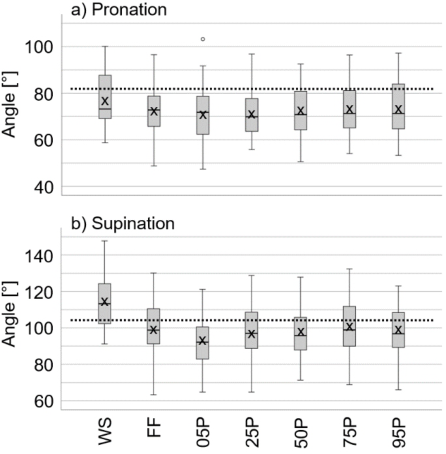
The results of the range of motion of pronation (see Fig. 2 a) and supina- tion (see Fig. 2 b) for all subjets percentiles depending on the form percentile (05P-95P), the flat form (FF) or without support (WS) are shown in Figure 2 and Table 1 (05-95SP). The maximum pronation angle without support (WS) is on average 77.1
(Median = 73.2
, SD = 12.2
, Range = 58.7-101.1
) and for supination 114.6
(Median = 113.3
, SD = 14.6
, Range = 91.2-147.8
). The average range of motion corresponds to -6.0% less for pronation (77.1
in this study vs. 81.7
in literature) and +9.1% more for supination (114.6
in this study vs. 104.2
in literature) compared to the literature according to Shaaban (2008).
For the flat form (FF) the average range of motion is 72.7
with prona- tion (median = 72.8
, SD = 10.6
, range = 48.8-96.5
), which is on average -6.1% less than without support. For the flat form (FF) and supination the average range of motion is 99.9
(median = 98.8
, SD = 14.2
, range = 63.3- 130.2
), which is on average -14.8% less than without support. The average range of motion for support with the 5-percentile form (05P, smallest shape)
Influence of the Shape of a Forearm Support 95
Figure 2: Range of motion of all subject percentiles of pronation (a) and supination (b) for the task, broken down by without support (WS), flat form (FF) and the five form percentiles (P; 05P = 5-percentile form etc.); literature values for pronation and supination according to Shaaban (2008) as dashed line.
decreases by -8.6% (Ø = 71.0
, Median = 71.8
, SD = 12.0
, Range = 47.4- 103.2
) for pronation and by -23.1% (Ø = 93.1
, Median = 92.2
, SD = 14.2
, Range = 64.8-121.2
) for supination. In contrast, the average range of motion for support with the 95-percentile form (95P) decreases by -5.9% (Ø = 72.8
, Median = 71.3
, SD = 11.8
, Range = 53.3-97.2
) for pronation and by -17.9% (Ø = 97.2
, Median = 96.8
, SD = 13.5
, Range = 66.1-123.0
) for supination.
The individual subject-specific range of motion is included by calculating the relative change in the angle of rotation with forearm support compared to no support. The average subject-specific change in maximum prona- tion / supination angle is -5.1% / -12.2% for flat from, -7.2% / -18.1% for 5-percentile form, -6.2% / -15.1% for 25-percentile form, -5.0% / -14.4% for 50-percentile form, -3.9% / -12.1% for 75-percentile form and -4.9% / -14.4% for 95-percentile form.
In the following, the range of the angles are examined broken down to the percentile of the subjects’ forearms (see Tab. 1). The assignment to the sub- jects percentiles (SP) and their dimensions are described in the Methodology section. In 5th-percentile subjects (05SP), the average maximum pronation is 74.2
and supination is 114.9
without support (see Tab. 1, 05SP). In con- trast, the max. pronation for the flat form is 68.1
, for the 05P form 68.9
and for the 95P form 69.0
. The max. supination of 5th-percentile subjects is 102.4
for the flat form, 108.0
for the 05P form and 108.6
for the 95P form.
96 Langer and Maier
Table 1. Average range of motion broken down by the form percentiles (P) and the subjects’ forearm percentiles (SP; 05-95SP = all subjects, 05SP = 5th-percentile subjects etc.).
Table available in the original PDF paper.
Pronation
Supination
Subjects’ forearm percentiles
range of Motion [
]
range of Motion [
]
Without Support (WS), flat form (FF), form percentile (P)
In 95th-percentile subjects (95SP), the average maximum pronation is 85.5
and supination is 106.9
without support (see Tab. 1, 95SP). In con- trast, the max. pronation for the flat form is 80.1
, for the 05P form 63.8
and for the 95P form 76.5
. The max. supination of 95th-percentile sub- jects is 96.2
for the flat form, 80.2
for the 05P form and 88.8
for the 95P form. The results in Table 1 show that the flat shape and any anthropomor- phic U-shape (05P-95P) result in a reduction of the maximum pronation and supination angle compared to no support at all subject percentiles.
Below are excerpts of the results from the subjective surveys after task execution for all subject percentiles. The statement “Without support, task performance is comfortable” yields an average of 1.4 for pronation and supination on a 7-point Likert scale (-3 = strongly disagree; 0 = neutral; 3 = strongly agree). For the flat form the adapted statement “The form is comfortable” averages in 0.2, for the 05P form it averages in 0.7, for the 25P form 1.4, for the 50P form 1.6, for the 75P form 1.2 and for the 95P form 1.4. The statement “No support promotes task completion” averages 0.5 on the 7-point Likert scale for no support. The adjusted statement “Shape pro- motes task completion” averages -0.3 for flat shape, 0.4 for 05P, 0.6 for 25P, 1.2 for 50P, 0.8 for 75P, and 0.9 for 95P. The statement “The form is comfortable.” is answered by the 5th- percentile subjects with an average of 0.4 for the flat form, an average of 2.4 for the 05P form, and 1 for the 95P form. In contrast, the 95th-percentile subjects answer the statement with an average of -0.3 for the flat form, -2.3 for the 05P form, and 3 for the 95P form.
DISCUSSION
The results of the objective parameter maximum angle of movement in pro- nation and supination of the forearm show that the angle achieved in both movements with support is averagely and in median lower than without sup- port (see Fig. 2). For pronation, the average range of motion of all subject percentiles decreases between a minimum of -5.7% (75P form) and a maxi- mum of -8.6% (05P form) compared to the angular range without support. For supination, it decreases between a minimum of -14.0% (75P form) and a maximum of -23.1% (05P form). This results in the trend that for pronation and supination, the maximum angle of rotation is smaller for smaller sha- pes than for larger shapes. This is also evident when looking at the average subject-specific relative change in range of rotation without support versus support with the different forms.
The average range of rotation that can be achieved without support and without form is not achieved with any form. Specifically, when looking at rotation angles broken down to subject percentiles (see Tab. 1), it appears that for subjects with larger forearm circumference (95th-percentile subje- cts), the range of motion for the 95P form at pronation is 76.5
compared to 63.8
for the 05P form, a reduction of -16.6%. For supination, the reduction is -9.6% from 88.8
for the 95P form to 80.2
for the 05P form. Statisti- cally significant differences in the maximum angle of rotation in pronation
98 Langer and Maier
and supination of the forearm between different form percentiles cannot be identified. In the subjective evaluation, the trend shows that the larger forms are rated better in terms of the comfort of the form and the promo- tion of the task by the form. In particular, for the 95th-percentile subjects, the 05P form is rated as -2.5 in comfort, which can be interpreted as “very uncomfortable”.
A weakness of the study is the limited selection of tasks as well as arm postures and the short task execution time or interaction time per subject and form. This should be considered in following studies. In contrast, the strength of the study is that five gender-specific form percentiles (05P to 95P), a flat form and without support are examined regardless of a subject’s forearm percentile. Thus, conclusions can be drawn about the parameter anthropo- morphic shape of the form of a forearm support. With rotational degrees of freedom within the form for forearm rotation (pronation and supina- tion), the maximum range of motion achieved without support could also be achieved with forearm support through the surgical arm assist system. In further studies it would be interesting to investigate the influence of a shape with rotational degrees of freedom for forearm rotation. In particular, the influence of such a shape on the interaction with arm assistance systems and the objective and subjective task performance of precision and rotation tasks.
CONCLUSION
The study shows that the percentile of the anthropomorphic form has an influence on the range of motion in pronation and supination of the forearm. For pronation and supination, the trend shows that the smaller the shape of the forearm support, the smaller the average range of motion. The average range of rotation that can be achieved without support and without form is not achieved with any form. The subjective survey shows that comfort is lowest for the smallest form.
It can be deduced that a forearm support with rotational degrees of freedom for pronation and supination could offer an advantage for the pre- servation of the range of motion and consequently for the performance of tasks. Further investigation is necessary to find the optimum of controllabi- lity of the arm assistance system for precision tasks with the most suitable shape and freedom of movement in the shape for tasks involving forearm rotation.
ACKNOWLEDGMENT
This research work was funded by the German Research Foundation (DFG) as part of the research project “Usability-Optimierung der Interfacepara- meter Form und Material bei einem interaktionsbasierten Armassistenzsy- stem” (eng.: “Usability optimization of the interface parameters form and material in an interaction-based arm assistance system”) (project number 430136438).
Influence of the Shape of a Forearm Support 99
REFERENCES
Avalution GmbH (2009) Reihenmessung der deutschen Bevölkerung. https://portal.i -size.net/. Choi S. (2012) A review of the ergonomic issues in the laparoscopic operating room.
Journal of Healthcare Eingineering, Vol 3, No. 4, 587–603. DIN EN ISO 7250–1 (2017) Wesentliche Maße des menschlichen Körpers für die technische Gestaltung – Teil 1: Körpermaßdefinitionen und -messpunkte, 9–45. Erbse, S. (2002) Entwicklung eines chirurgischen Assistenzsystems auf der Basis
piezolelektrisch arretierbarer Gelenkmechanismen. Helmholtz-Institut für Bio- medizinische Technik, RWTH Aachen, Dissertation, Aachen, Shaker-Verlag, 123–126. Galleano, R., Carter, F., Brown, S., Frank T., & Cuschieri, A. (2006) Can Armrests Improve Comfort and Task Performance in Laparoscopic Surgery?. Annals of Surgery, Volume 243, No. 3, 329–333. Heidingsfeld, M., Feuer, R., Karlovic, K., Maier, T., & Sawodny, O. (2014) A force-
controlled human-assistive robot for laparoscopic surgery. IEEE International Conference on Systems, Man, and Cybernetics, San Diego, USA, 3435–3439. Karlovic, K., Pfeffer, S., Maier, T., Heidingsfeld, M., Ederer, M., & Sawodny, O.
(2015) Effects on performance when using a Posture Assistance Device – results of a usability evaluation in laboratory setting. 6th International Conference on Applied Human Factors and Ergonomics and the Affiliated Conferences, Las Vegas, USA, 3323–3330. Karlovic, K. (2019) Untersuchung der Gebrauchstauglichkeit der Mensch-Maschine- Schnittstelle interaktionsbasierter, adaptiv physischer Assistenzsysteme. IKTD, University of Stuttgart, Dissertation, 138–147. Langer, F., Cay, E., & Maier, T. (2022a) Experimentelle Untersuchung der Form einer
Unterarmauflage eines interaktionsbasierten Armassistenzsystems in der lapa- roskopischen Chirurgie. 68. Kongress der Gesellschaft für Arbeitswissenschaft, Magdeburg, Germany, B.9.4. Langer F, Matschuck T, Dreshaj N, Maier T (2022b) Experimental investigation of anthropomorphic forms of a forearm support of a surgical arm assistance system in precision tasks. In: Triennial conference on Healthcare Systems Ergonomics and Patient Safety. Delft, Netherlands, 2022. Shaaban, H., Pereira, C., Williams, R., Lees, V. C. (2008) The effect of elbow position
on the range of supination and pronation of the forearm. In: The Journal of hand surgery, European volume, Vol 33, No. 1, 3–8. Szeto, G. P. Y., Cheng, S. W. K., Poon, J. T. C., Ting, A. C. W., Tsang, R. C. C., & Ho, P (2012) Surgeons’ Static Posture and Movement Repetitions in open and Laparoscopic Surgery. Journal of Surgical Research 172, e19-e31.
LISTED IN THE AHFE DIGITAL BOOKSTORE CATALOGUE
Explore the complete digital volume
Physical Ergonomics and Human Factors
Read this individual research paper free through the original publisher, or explore the full digital proceedings book.
ISBN 978-1-958651-79-7
Explore this ISBN in the AHFE Bookstore ↗Listed in the July 2026 bookstore catalogue; search by ISBN to confirm current availability · Digital book purchase optional