Kévin Bouillet, Sophie Lemonnier, Fabien Clanche, Gérome Gauchard (2023). What is the repercussions of the introduction of a cobot on productivity and biomechanical constraints on operators in a collaborative task?. In: Physical Ergonomics and Human Factors. AHFE Open Access, vol. 103, pp. 115–124. https://doi.org/10.54941/ahfe1003042
Collaborative robots, or cobots, are robots designed to closely collaborate with a human in a shared workplace. Introducing a cobot in a collaborative work situation aims to preserve productivity without impair the operator’s health, even improve them. Musculoskeletal disorders (MSDs), main occupation diseases in Industry, are pathologies of multifactorial origin, as biomechanical solicitations are one of them (e.g., posture, repetitiveness).This paper evaluates the repercussions of the introduction of a cobot in a collaborative task with two studies: first to compare a task in collaboration with a cobot or a human co-worker and second to analyze the impact of pace (i.e., rhythm and leader); both on productivity, quality of interactions, operator’s posture and attentional demand.Thirty-four participants in Study 1 and twenty in Study 2 performed a collaborative task inspired by assembly lines in factories, in collaboration with a co-worker. In Study 1, this co-worker was either a human or a YuMi cobot, participants were always the leader; in Study 2, the co-worker was always the YuMi cobot; the leader was either the participants or the cobot, and in this last case, different paces were imposed. Productivity was measured with the number of products manufactured, quality interactions with the rate of idleness and activity of participant and co-worker and interactions rate between them, participant’s posture with joints angles and RULA evaluation and attentional demand with performance at a second task.In Study 1, productivity was less important with the cobot than with a human, with less interactions and with higher attentional demand. However, posture was less risky with the cobot for operator health in terms of MSDs. In Study 2, productivity and attentional demand increased with the pace until a threshold at the mean-imposed pace. Posture was riskier for operator health in terms of MSDs only for the fastest imposed pace.In Study 1, deterioration of productivity and quality of the interactions with the cobot co-worker was mainly due to the limited capabilities of the cobot. Results about posture were also linked with pace, but differences were also observed during operator’s activity with less biomechanical solicitations working with the cobot than with the human for the same actions. Leading or following the pace seemed to not influence these variables in Study 2. Thus, the results of Study 2 seemed to indicate that the differences between human-human and human-cobot interactions observed in Study 1 were mainly due to the slower pace due to the cobot, except for the better posture which could be linked with the introduction of the cobot.Even though the experiment took place in a laboratory, the task was strongly inspired by the field and the results are consistent with those in the literature. These results therefore allow us to establish solid hypotheses that can be generalized to real situations in a factory, especially concerning the improvement of the posture when the operator is facing a cobot.
Collaborative robots, or cobots, are a key technology if Industry 4.0. These cobots allow new human-robot interactions (HRI) as they can interact in a shared workplace with a human (Shravani and Rao, 2018). These HRI could be described in three levels of interactions: coexistence, cooperation and collaboration (Hentout et al., 2019). In coexistence, human and cobot are in the same workplace but without common aim, while in cooperation
and collaboration, both work in the same workplace with a common aim. At the highest level of HRI (i.e., collaboration), the synchronization between the human and the co-worker is more efficient with more fluent interactions (Hoffman, 2019). However, these new HRI could lead to the emergence or move of musculoskeletal disorders (MSDs) for operators (Tsarouchi, Makris and Chryssolouris, 2016).
MSDs are the main occupational diseases, representing nearly 90% of them in France, and mainly affect operators’ upper limbs and back (L’Assurance Maladie, 2021). Biomechanical constraints represent the main factor: repetitive tasks in awkward posture and high frequency of operators’ movements associated with an high pace (Mathiassen and Winkel, 1996).
To avoid MSDs, it’s important to evaluate the tasks with high constraints. RULA evaluation (Rapid Upper Limb Assessment) is a tool widely used both in the industrial domain and in scientific researches (Misslin et al., 2021). RULA evaluates the risk of developing MSDs during a repetitive task, mea- suring joint angles of back, neck and upper limb joints (McAtamney and Corlett, 1993).
Recently, some studies demonstrated that the introduction of a cobot in an individual task (so human alone versus human-cobot), did not degraded productivity, even increased it, while RULA scores decreased (Gualtieri et al., 2020; Colim et al., 2021). However, to our knowledge, no study interested to compare human-human and human-cobot interactions accomplishing the same collaborative task on productivity and operators’ health.
Two studies were conducted to evaluate a human-cobot collaborative situ- ation: the first one aimed at comparing a human-human system with a human-cobot system, the second one at analysing the impact of two pace cha- racteristics (leader and imposed-speed). The task performed was always the same, and the variables measured were productivity, quality of interactions, biomechanical constraints (posture) and attentional demand.
MATERIAL AND METHODS Participants
Thirty-four and twenty volunteers participated to the Study 1 (S1) and the Study 2 (S2) respectively (22.1±2.0 and 21.1±2.0 years old), all students. They had no impairment affecting motor control or attentional behaviour, and had vision that not required corrections. All gave their written consent before their participation.
Materials
In both studies, the participant manufactured products with a co-worker. In S1, participants always led the pace with the aim to manufacture the most products in four minutes. The co-worker was either a cobot (COB condition) or another human (HUM condition). In S2, the co-worker was always the cobot. Either the participants led the pace in one modality (DM condition) or the cobot led it (AUTO condition) for three minutes. In AUTO modality there were three imposed-pace conditions: AUTO-SLOW (three products), AUTO-MEAN (four products) and AUTO-FAST (five products).
Which Repercussions of the Introduction of a Cobot 117
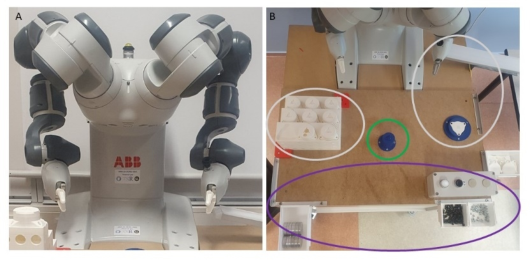
Figure 1: A/ YuMi cobot. B/ working plan: white circles for cobot areas, purple circle for participant area and green circle for collaboration area.
The YuMi cobot used had two arms, each with seven points of articulation; at the end of each arms was a gripper and a vacuum only at its left wrist (see Figure 1A). The product to manufacture was composed of a fairing, an aluminium product, a cover, three nuts and three screws. The production process was on a collaborative working plan which is decomposed in three areas: co-worker, participant and collaborative ones (see Figure 1B).
Each trial was filmed and coded to quantify the actions of the partici- pant and the co-worker according the dichotomy “Idle” and “Activity” from (Hoffman, 2019). Participant’s activity was also decomposed according to the location of the motor action: “Direct activity” (inside the collabora- tive area) and “Indirect activity” (outside the collaborative area). From this coding, we coded the interactions between both workers with the taxo- nomy of (Hentout et al., 2019): “Time out” (both in Idle); “Cooperation” (one in Idle while the other in Activity); “Collaboration” (both in Acti- vity); “Direct collaboration” (both in Activity with the participant in Direct activity).
In both studies, the participant was equipped with seventeen wireless iner- tial sensors MVN BIOMECH Awinda, fitted on the head, the trunk and upper and lower limbs (Schepers, Giuberti and Bellusci, 2018). RULA evaluation (McAtamney and Corlett, 1993) was made with these data for each frame of a trial, for right and left sides, with a MATLAB program.
Simultaneously with the motor task, the participant performed an auditory task to measure attentional resources. This task was inspired by the one in Richer & Lajoie (2019). The participant listened a recording with a sequence of phonetically related letters (B, D, P and T) with a two seconds interstimulus interval.
Process For each condition in both studies, participants completed three trials (four minutes for S1 and three minutes for S2) in a counterbalanced order. Parti- cipants beneficiated from several learning phases: motor task (in COB for S1 and DM for S2); auditory task; dual task (in COB for S1 and DM then AUTO-MEAN for S2).
At the end of each collaborative work, the number of products fully manu- factured and steps correctly performed were counted and the participant indicated the number of occurrences of one of the letters announced before the work.
Statistical Analyses The different variables measured in both studies are described in Table 1. For all variables (except for the success rate at auditory task), a value was calculated for each condition by means of the values of the three trials.
For both studies, the success rate at auditory task was compared with χ2 test to evaluate if conditions were independent. For the other variables, paired samples Wilcoxon tests were performed to compare HUM and COB condi- tions in S1. In S2, a non-parametric Friedman’s repeated measures ANOVA was performed to compare the three conditions of AUTO modality. If the test was significant, three paired samples Wilcoxon tests were performed between the three conditions of AUTO modality. Then, three paired samples Wilco- xon tests were performed to compare DM modality with the three conditions of AUTO modality.
The various statistical tests were performed with STATISTICA v.10 softw- are. The level of significance α was set at 0.05.
Table 1. Variables measured in both studies.
Table available in the original PDF paper.
Variables measured
Motor task
Number of products manufactured; Co-worker’s actions
Percentage of Activity time on a trial time;
Mean (S1) and median (S2) times of an Idle (in seconds). Participant’s actions
Percentage of Activity time on a trial time;
Mean (S1) and median (S2) times of an Idle and a Direct activity. Interactions
Percentage of interactions’ time on a trial time. RULA evaluations
Mean RULA scores for both sides (left and right) during a trial;
Mean RULA scores for both sides during partici- pants’ direct activity. Auditory task
Success rate (percentage of trials with a correct answer);
Absolute error (absolute difference between the par- ticipant’s answer and the right one).
RESULTS
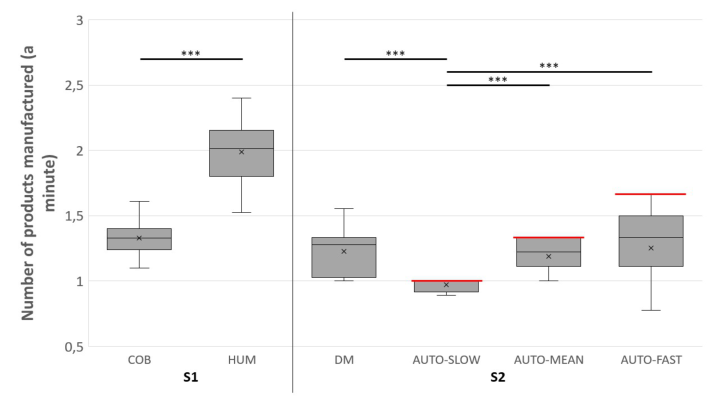
The number of products manufactured for both studies (calculated for a minute) is shown in Figure 2.
So, productivity was higher with the human co-worker than with the cobot co-worker (S1), and was also more important with a higher imposed pace
Which Repercussions of the Introduction of a Cobot 119
Figure 2: Number of products manufactured (calculated for a minute). *** p<0.001.
until a threshold with the cobot (S2). Leading the pace did not influence the productivity compared to the mean-imposed pace (S2). The conditions facing a human seems to be the best performance of all conditions.
The co-worker’s actions, the participant’s actions and the interactions rates are described in Table 2. The activity rate was more important for the cobot co-worker than the human (S1), and more important for the cobot with a higher imposed-pace (S2). For same productivity (i.e., DM and AUTO- MEAN), the cobot activity rate was less important when the participant led the pace (S2). The participant activity rate was more important with a human co-worker (S1) and with a higher imposed-pace and when the participant led the pace (S2, further analysis showed the highest activity rate in DM). Moreover, in these three same conditions, each idle were shorter (S1, S2). Col- laboration rate was less important for the cobot co-worker than the human (S1, but no significant difference for Direct collaboration). Collaboration and direct collaboration rates were more important for the cobot with a higher imposed-pace (S2). For same productivity (i.e., DM and AUTO-MEAN), the three types of interactions rates were similar in both conditions (S2). So, both studies showed that the interactions in an HHI (Human-Human Interaction) were more fluent than in an HRI, but also with higher pace.
RULA scores are calculated for both sides during all a trial and during par- ticipant’s direct activity (see Table 3). Higher the score is (from 1 to 7), higher the biomechanical constraints are and risk of developing MSDs is important. RULA scores indicated that biomechanical constraints were higher with the human than the cobot co-worker during all a trial but also during parti- cipants’ direct activity (S1). Higher imposed-pace increased the constraints on RULA scores but no difference was observed during participants’ direct activity (S2). Thus, work with the cobot-co-worker seemed to decrease the biomechanical constraints on participants’ joints and it could not be linked
S1 S2
COB HUM DM AUTO-SLOW AUTO-MEAN AUTO-FAST
Table 2. Co-worker and participant’s actions and interactions between co-worker and participant. Results are presented in median (IQ). *difference
Table available in the original PDF paper.
with HUM. adifference with AUTO-SLOW, bdifference with AUTO-MEAN, cdifference with AUTO-FAST.
Which Repercussions of the Introduction of a Cobot 121
Table 3. RULA scores for both sides during all a trial and during participant’s direct activity. Results are presented in median (IQ). *difference with HUM. bdifference with AUTO-MEAN, cdifference with AUTO-FAST.
Table available in the original PDF paper.
S1 S2 COB HUM DM AUTO-SLOW AUTO-MEAN AUTO-FAST G L 3.64* (0.46) 3.97 (0.37) 3.90 (1.11) 3.84 (0.80) 3.90 c (0.71) 4.07 b (0.58) R 3.43* (0.36) 3.66 (0.46) 3.87 (1.07) 3.64 (0.72) 3.77 c (0.90) 3.85 b (0.72) DA L 3.86* (0.69) 4.03 (0.46) 4.06 (1.35) 4.10 (0.98) 4.08 (0.96) 4.24 (0.88) R 3.45* (0.54) 3.64 (0.55) 3.92 (1.43) 3.73 (1.11) 3.83 c (1.17) 4.02 b (0.91)
Table 4. Performance at the auditory task. Results are presented in median (IQ). *difference with HUM. adifference with AUTO-SLOW, bdifference with AUTO-MEAN, cdifference with AUTO-FAST.
only with the decrease in pace with the cobot, but also by the presence of the cobot in the collaborative environment.
Attentional demand of the motor task was measured by the performance at a second task (see Table 4). Attentional demand at the motor task was more important with the cobot than the human co-worker. In addition, more pace means more attentional demand at a threshold. However, leading the pace seems not really affect attentional demand at the same followed pace.
DISCUSSION AND CONCLUSION Two experiments were described in this article: first to compare the same col- laborative work with a cobot co-worker or a human co-worker (S1), second only with a cobot co-worker to analyse the repercussions of speed and leader of pace (S2).
The results showed that productivity was reduced by 50% with the YuMi cobot co-worker than with the human co-worker. Previously, some authors showed that the introduction of a cobot in a work situation did not influence production (Gualtieri et al., 2020; Colim et al., 2021). However, their work situations had moved from an individual to a collaborative situation, with an ergonomic redesign of the workstation. In S1, the decrease in production was mainly due to the cobot, because of its limits: its speed of execution was slo- wer while its “reaction time” was longer. With the cobot, the co-worker and participant’s idle times were more important than with the human co-worker, so these idle times indicated a bad use of both worker in this HRI (Hentout et al., 2019). Moreover, the quality of the interactions was degraded: more time out and less collaboration. Thus, the HRI was less synchronized with
a bad tasks repartition between the operator and the cobot (Hentout et al., 2019). Despite a degradation of productivity with the cobot co-worker, biome- chanical constraints on operator was reduced working with the cobot (i.e., RULA scores). The reduction of biomechanical constraints was also obse- rved in the two previous studies (Gualtieri et al., 2020; Colim et al., 2021), but in S1 it could be due to the reduction of pace with the cobot co-worker than with the human co-worker. Results in S2 showed more biomechanical constraints on an operator with a too fast pace, as in Bosch and collabora- tors study (Bosch et al., 2011). At too high pace, working in these awkward postures could create MSDs for operators. Moreover, working at too high pace could not be efficient for productivity. As a matter of fact, with more products to manufacture, participants managed to manufactured as much product at the highest pace as at the mean pace in our second study. They made more mistakes with faster pace, as in previous studies (Escorpizo and Moore, 2007; Bosch et al., 2011). In contrast, interactions between the ope- rator and the cobot were of higher quality with the higher pace, with less time out and more collaboration.
Attentional demand of the collaborative task was more important with the cobot-co-worker than with the human co-worker, and with a high pace com- pared to a slow pace, as performances at the second task decreased. These results indicated that the collaborative task was more difficult with the cobot co-worker and when the pace is more important (Lomond and Côté, 2010). Despite the slower pace with the cobot co-worker, attentional demand was still more important. This result seems to indicate that working with a cobot could increase the attention of the operators, which could lead to a faster fati- gue if the operators are working for many hours, and could led to collisions or MSDs.
Leading the pace for operators, or not leading it, seemed to not influe- nce the different collaboration features when the imposed pace was adapted to them. Productivity was not different between DM modality and AUTO- MEAN conditions in contrast to those of Dempsey and collaborators (Demp- sey et al., 2010), despite a slight waste when the cobot was leading the pace (11.2±4.2% of wasted products). In the study of Dempsey and collaborators, participants worked faster reducing their idle times (as in our second study), because of the limits of the cobots. Moreover, AUTO-MEAN pace was ada- pted from productivity of COB in the first study (which is the same condition as DM in the second study). As participants manufactured an average of 1.33 products a minute with the cobot co-worker, the cobot was programmed to work at a pace of eighty products an hour in AUTO-MEAN. Thus, the cobot programming and its limits could explain why there is no difference in the measures of the quality of interactions, participant’s posture or attentional demand.
COB in S1 and DM in S2 were similar conditions (except the duration of a trial). Results seem to be similar for the different measures in both studies (no statistical test made). Thus, despite the non-ecological conditions of these studies made in laboratory conditions (not a real work, not real operators and
Which Repercussions of the Introduction of a Cobot 123
short-time work), the repeatability of the results in COB and DM conditions increased the confidence in the results for more ecological conditions.
Working with a cobot co-worker rather than with a human co-worker decreased productivity, quality of the interactions with the co-worker and increased attentional demand. However, despite these negative impacts of the cobot, participant’s posture was less risky with the cobot co-worker than with the human. Leading or following the pace seemed to not influence all these features here at the same production. The reduction of biomechanical constraints which led to the better posture could be explained by two factors: the reduction of the working pace with the introduction of the cobot and the introduction of the cobot in this collaborative work situation itself.
ACKNOWLEDGMENT
This study was conducted with the framework of the C-SHIFT project fina- nced by Impact-LUE. We are grateful to the AIP Lorrain, in particular to its director Muriel Lombard for having welcomed us in its premises. We thank Hugo Portejoie for the technical support in S1 and Amélie Dumont for recor- ding the letters of the auditory task. We also thank all participants for their involvement in both studies.
REFERENCES
Bosch, T. et al. (2011) ‘The effect of work pace on workload, motor variability and fatigue during simulated light assembly work’, Ergonomics, 54(2), pp. 154–168. Colim, A. et al. (2021) ‘Physical Ergonomic Improvement and Safe Design of an
Assembly Workstation through Collaborative Robotics’, Safety, 7(1), p. 14. Colombini, D. (1998) ‘An observational method for classifying exposure to repetitive movements of the upper limbs’, Ergonomics, 41(9), pp. 1261–1289. Dempsey, P. G. et al. (2010) ‘Influence of three principles of pacing on the temporal
organisation of work during cyclic assembly and disassembly tasks’, Ergonomics, 53(11), pp. 1347–1358. Escorpizo, R. and Moore, A. (2007) ‘The effects of cycle time on the physical demands of a repetitive pick-and-place task’, Applied Ergonomics, 38(5), pp. 609–615. Gualtieri, L. et al. (2020) ‘Design of Human-centered collaborative assembly work-
stations for the improvement of operators’ physical ergonomics and production efficiency: A case study’, Sustainability, 12(9), pp. 3606–3628. Hentout, A. et al. (2019) ‘Human–robot interaction in industrial collaborative robotics: a literature review of the decade 2008–2017’, Advanced Robotics, 33(15–16), pp. 764–799. Hoffman, G. (2019) ‘Evaluating fluency in human–robot collaboration’, IEEE
Transactions on Human-Machine Systems, 49(3), pp. 209–218. Karhu, O. et al. (1981) ‘Observing working postures in industry: Examples of OWAS application’, Applied Ergonomics, 12(1), pp. 13–17. L’Assurance Maladie (2021) Rapport annuel 2020 - L’Assurance Maladie - Risques
professionnels. L’Assurance Maladie, pp. 1–170. Lomond, K. V. and Côté, J. N. (2010) ‘Movement timing and reach to reach variability during a repetitive reaching task in persons with chronic neck/shoulder pain and healthy subjects’, Experimental Brain Research, 206(3), pp. 271–282.
Mathiassen, S. E. and Winkel, J. (1996) ‘Physiological comparison of three interventions in light assembly work: reduced work pace, increased break allowa- nce and shortened working days’, International Archives of Occupational and Environmental Health, 68(2), pp. 94–108. McAtamney, L. and Corlett, E. N. (1993) ‘RULA: a survey method for the inve-
stigation of work-related upper limb disorders’, Applied Ergonomics, 24(2), pp. 91–99. Misslin, Q. et al. (2021) ‘Ergonom.io ou l’ergonomie pour l’usine du futur’, in. CON- FERE 2021 27ème Colloque des Sciences de la Conception et de l’Innovation, Saint-Malo, France, p. 22. Richer, N. and Lajoie, Y. (2019) ‘Cognitive task modality influences postural control
during quiet standing in healthy older adults’, Aging Clinical and Experimental Research, 31(9), pp. 1265–1270. Schepers, M., Giuberti, M. and Bellusci, G. (2018) Xsens MVN: Consistent tracking of human motion using inertial sensing. Xsens Technologies, pp. 1–8. Shravani, N. K. and Rao, S. (2018) ‘Introducing robots without creating fear of
unemployment and high cost in industries’, International journal of engineering technology science and research, 5(1), pp. 1128–1135. Tsarouchi, P., Makris, S. and Chryssolouris, G. (2016) ‘Human-robot interaction review and challenges on task planning and programming’, International Journal of Computer Integrated Manufacturing, 29(8), pp. 916–931. Uguen, C., Sablon, S. and Carballeda, G. (2018) ‘Intégration de la préparation phy-
sique dans l’approche ergonomique : quel dispositif pour quel (s) objectif (s)?’, Activites, 15(2), pp. 1–34.
LISTED IN THE AHFE DIGITAL BOOKSTORE CATALOGUE
Explore the complete digital volume
Physical Ergonomics and Human Factors
Read this individual research paper free through the original publisher, or explore the full digital proceedings book.
ISBN 978-1-958651-79-7
Explore this ISBN in the AHFE Bookstore ↗Listed in the July 2026 bookstore catalogue; search by ISBN to confirm current availability · Digital book purchase optional