Alessio Silvetti, Marta Petyx, Adriano Papale (2026). Manual handling of Passengers with Reduced Mobility inside airplanes: workers’ biomechanical overload risk mitigation. In: Social and Occupational Ergonomics. AHFE Open Access, vol. 228, pp. 15–23. https://doi.org/10.54941/ahfe1007931
This study assesses the biomechanical risk for workers who support Passengers with Reduced Mobility (PRM) in handling totally uncollaborative passengers (Charlie) on aircraft. We looked at the workers' position, the PRM spot, the presence of armrests, the space behind the seats, and the use of ergonomic lifting belts. We used surface electromyography to record synchronized data on two pairs of experienced workers, then calculated the percentage of Maximum Voluntary Contraction (%MVC). The results show that the risk of biomechanical overload for PRM attendant staff can be reduced through 1) specific training, 2) team organization, 3) use of assistive devices, 4) proper selection of seating for PRM passengers, and 5) suitable aircraft design.
Several studies have examined patient manual handling (Johnson, 2023), including evaluations of the validity and effectiveness of risk-reduction strategies for workers (Krishnanmoorthy, 2025; Fray, 2024; Khairallah, 2024). In contrast to the healthcare sector, there has been no research conducted on the manual handling of passengers within aircraft. Passengers with reduced mobility (PRM), especially those identified as wheelchair cabin or “Charlie” under IATA’s classification, have functional limitations comparable to a totally non-cooperative patient and need full assistance when being transferred to their seat on the aircraft. Aircraft have limited space, so standard lifting aids used in healthcare aren’t feasible. Handling PRM requires a minimum of two workers. Research indicates that team lifting involves greater complexity compared to individual lifting. Typically, when workers lift objects together as a team, the total weight they can manage is less than the sum of what each worker could lift on their own. (Karwowski 1986; Karwowski 1988; Dennis 2003). The absence of a stable center of mass presents an additional challenge in lifting people. Literature shows that factors like anthropometry, gender, and team chemistry are important in lowering biomechanical overload risks during team lifts (Sharp, 1995; Dennis, 2003; Lee, 2016). Grouping workers with similar anthropometric data into the same team plays a key role in Received February 4, 2026; Revised April 13, 2026; Accepted May 2, 2026; Available online July 20, 2026
minimizing the risk of biomechanical load during team lifting tasks. This prevents weaker workers from exceeding their limits (Lee, 2016).
Team lifting often occurs under asymmetrical conditions, which results in shear forces being a concern (Marras, 1999). This makes such lifts more hazardous than orthogonal lifting activities (Gallagher, 2012).
Due to limited space on aircraft, standard manual patient handling risk assessments described in TR/ISO 12296 are not applicable.
The study aims to assess the risk of biomechanical overload for workers lifting Charlie category PRMs inside aircraft through surface electromyography (sEMG) (Ranavolo, 2018). In addition, our goal is to offer useful advice on minimizing risks.
AIM OF THE STUDY Our aim is to evaluate the impact on workers’ muscle activity during the transfer of a “Charlie” type PRM from a wheelchair in the aircraft corridor to an aircraft seat, focusing on the following:
1) worker position: the aim is to evaluate which position of the workers (front worker holding the PRM’s legs or rear worker holding the PRM’s trunk) is less straining for worker body. 2) aircraft seat: the aim is to determine whether handling a PRM is easier in an aisle seat or a window seat. 3) presence/absence of the armrest in the seat. The aim is to assess whether an armrest increases biomechanical overload risk during PRM transfers. 4) presence/absence of space behind seats. The aim is to verify if not having a seating row behind the PRM’s seat raises worker effort. 5) presence/absence of minor transfer aids. The aim is to evaluate whether a belt reduces biomechanical overload risk for workers handling PRM.
METHODS
Anthropometric Data And Task Description We conducted two sessions with two pairs of experienced workers (see Table 1 for anthropometric data) involved in PRM assistance at the ITA-Airways simulation center, Rome-Fiumicino airport. The simulator is frequently used for the training of workers in correct PRM handling procedures. A 95 kg subject simulated a “Charlie” type PRM.
Table 1: Workers’ data.
Table available in the original PDF paper.
Morning Session Afternoon Session Worker 1 Worker 2 Worker 1 Worker 2 Gender M M F M
Age [years] 39 35 35 31 Weight [kg] 74 87 52 71
Height [cm] 173 170 167 175 Years of experience [years] 13 13 10 11
Manual Handling of Passengers With Reduced Mobility Inside Airplanes 17 Equipment and Signal Processing
We recorded workers’ muscle activity using a Wi-Fi surface electromyograph (FreeEMG 1000, BTS SpA, Milan, Italy) with a sampling rate of 1 kHz. We acquired electromyographic signals (sEMG) from muscles through disposable Ag/AgCl pre-gelled electrodes. (H124SG, Kendall ARBO, Donau, Germany). We placed the electrodes as per the Atlas of Innervation Zones (Barbero, 2012). We processed the sEMG signals using Analyze software (BTS SpA, Ita). We filtered the acquired signals in the frequency band of interest [20–450 Hz] using a digital filter and Butterworth 9th-order passband to reduce motion artifacts (electrode-to-skin) and additional high-frequency noise elements. To obtain the linear envelope and to extract the muscular activity profile, we rectified and filtered the signals using a Butterworth 3rd-order low-pass filter with a cut-off frequency of 10 Hz. We normalized the sEMG signals to maximum voluntary contraction (MVC).
We computed mean muscle activities, reported as %MVC, for eight muscles for each worker at the same time (16 total probes).
We acquired bilaterally the following muscles: Erector Spinae (ESsx, ESdx), Upper Trapezius (TRAPsx, TRAPdx), Anterior Deltoid (DAsx, DAdx) and Biceps Brachii (BICsx, BICdx).
RESULTS
The principal findings from both sessions are presented below.
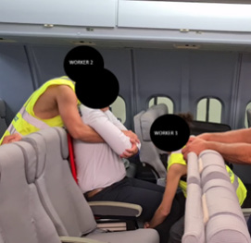
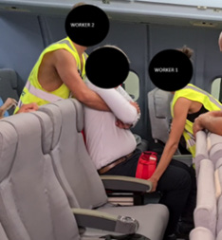
Task A - Handling of the PRM From the Wheelchair to the Seat, in the Presence of the Armrest, and Space Behind the Seat Tables 2 and 3 present sEMG (%MVC) data from Task A, comparing values without and with the belt in the first and second columns, respectively. Worker 1 (female) lifts the PRM by the legs; worker 2 (male) lifts it by the arms. The values of %MVC indicate a modest muscle activation level for this task. With belt use, worker 1 shows reduced upper limb muscle activity bilaterally. Trunk muscle activity increases slightly for ESsx, while ESdx remains unchanged. When worker 1 uses the belt, worker 2 shows reduced activity in all measured muscles, especially ESsx, TRAPsx, DAsx, and BICdx.
Figure 1: The two workers during Task A without a belt.Figure 2: The two workers during Task A with the belt.Table 2: %MVC values (±SD) during PRM handling performed by worker 1 (female) in task A.
Table available in the original PDF paper.
Worker 1 (Woman) Without Belt With Belt ESdx 19.0 ± 12.5 21.8 ± 15.7 ESsx 12.7 ± 10.2 20.9 ± 16.1
Task B - PRM Handling From the Seat to the Wheelchair, Without Armrests and With Space Behind the Seat Tables 4 and 5 present %MVC values for PRM handling during Task B, based on the afternoon mixed-gender team session. The first column shows data for the worker behind the PRM, and the second for the worker in front.
Manual Handling of Passengers With Reduced Mobility Inside Airplanes 19 Lifting behind the PRM is more overloading than lifting in front of it. Worker 1’s ESsx and TRAPsx muscles are less active during frontal holds than behind holds. As for the right side, the overall activation values are similar, despite the muscles being involved differently. When moving the PRM, worker 2 increases the muscular effort of all muscles except the BICdx from front to rear lifting.
On the right side, overall activation values remain similar even though muscle recruitment varies. Worker 2 increases effort in all muscles except the BICdx when handling the PRM from frontal to behind lifting.
Table 4: %MVC values (±SD) during PRM handling performed by worker 1 (female) in task B.
Task C - PRM Handling From the Wheelchair to the First Seat With Armrest and Sliding to the Central Seat Without Space Behind the Seat The %MVC values for Task C, which entails lifting and sliding the PRM, are shown in Tables 6 and 7. The first column lists %MVC without the belt; the second shows values with the belt. Worker 2 lifts from the front, while Worker 1 lifts from behind the PRM. Results are from the morning session and apply to the male team.
When using a belt, Worker 1 shows increased bilateral activation in the BIC, TRAP, and ES muscles. Similar increases in TRAP, BIC, and DA are seen in Worker 2. The activation of the trunk muscles remains unchanged.
Table 6: %MVC values (±SD) during PRM handling performed by worker 1 in task C.
Table available in the original PDF paper.
Worker 1 (PRM Back) Without Belt With Belt ESdx 43.1 ± 27.2 50.6 ± 48.1 ESsx 34.9 ± 27.1 49.8 ± 45.1
The study assessed how several factors affect biomechanical overload risk for workers lifting “Charlie” PRMs in an aircraft simulator: 1) worker position (in front or behind of PRM), 2) transfer location (aisle or window seat), 3) presence or absence of armrest during aisle seat transfers, 4) presence of space behind seats, and 5) use of an ergonomic belt with handles.
These are the main findings of our sEMG analysis for each of the five points:
1) Lifting the PRM from behind by the arms requires more physical effort than lifting it from the front by the legs. 2) Lifting the PRM from the wheelchair to the aisle seat is easier, while moving to the center or window seats requires more effort due to additional lifting and sliding. Additionally, workers are unable to use proper lifting postures due to the limited space behind the seat rows.
3) Lifting the PRM over the armrest does not appear to require more effort than sliding it without an armrest. Assistive devices can reduce the muscular effort needed for these tasks (see point 5). 4) When there is no space behind the seats, lifting the PRM is more strenuous for both those working behind and in front, since the person in front must also help position the PRM. 5) Using an ergonomic belt can reduce trunk muscle activity during lifting by improving grip and reducing the strain on the upper limbs. Still, when the worker in front of the PRM grips farther from the body and has little room to bend its legs, spinal extensor muscle activity increases slightly. The belt helps distribute weight more evenly between workers, offering advantages to the worker positioned behind the PRM. On the other hand, sliding the PRM laterally across the seat raises muscle activity because of friction between the belt and the seat; with no space behind the seat, the rear worker must move sideways, causing more asymmetrical handling. During seat sliding, the belt might cause the PRM to become unbalanced, so the front worker must support them to prevent a fall. In contrast, without the belt, both workers must actively coordinate when moving the PRM.
STUDY LIMITATIONS The data represents a small sample of employees selected to reflect the workforce’s range of experience. Due to operational constraints and the need to maintain uninterrupted 24/7 airport service, it was not feasible to obtain a larger statistical sample. This document includes only data from some tasks, excluding minor results. Our electromyographic data apply only to the studied conditions and may not capture daily variability. In workplace settings, biomechanical overload could significantly change depending on PRM (weight, disability, and available help from personal caregivers), workforce characteristics (experience, anthropometry, health and team spirit), aircraft layout, lift assistance device, and work pace.
Another limitation is the reproducibility of task simulations. Although we aimed to standardize data collection, the nature of the tasks sometimes made full compliance difficult.
CONCLUSION
Our study identifies important considerations for managing Persons with Reduced Mobility (PRMs) on aircraft. Biomechanical overload poses a significant risk to workers, but health and safety services can manage it effectively. Critical factors include: 1) comprehensive staff training, 2) strategic workforce organization, 3) use of assistive devices, 4) appropriate seat selection during check-in for PRM passengers, and 5) aircraft design modifications. For each of these five points, we may draw the following conclusions:
1) comprehensive staff training: a) training in the proper handling and use of assistive devices should be provided to workers in both classroom and workplace settings, followed by an assessment of learning; b) it is important to check if workers consistently apply the guidelines
provided in the training courses during work c) regular meetings help keep employees updated on potential risks and give everyone the chance to discuss work-related concerns as they come up. 2) strategic workforce organization: a) having workers with similar anthropometry on the same team can
improve teamwork and foster better collaboration; b) the strongest worker should lift the PRMs from behind, by their arms; c) if the PRM is seated away from the aisle, the stronger worker should
manage the final placement. 3) use of assistive devices: a) workers should use an ergonomic belt with handles placed under the PRM’s legs when performing vertical dislocations, such as with a fixed armrest; b) if there is no space behind the seat, it is not recommended to use the
ergonomic belt; c) it is suggested to use both a slide sheet and an ergonomic belt when sliding the PRM between seats. 4) appropriate seat selection during check-in for PRM passengers: a) avoid assigning PRM passengers to window seats to reduce lifting
and sliding; b) PRMs should not be assigned seats without space behind; if unavoidable, only assign aisle seats. 5) aircraft design modifications: a) all armrests should be removable; b) aircraft seat rows should have enough clearance to allow workers to
move easily.
Along with our PRM lifting suggestions, individual factors like pathology and social or religious barriers should also be considered. PRM pathology can reduce lifting efficiency by limiting access to ideal lifting points. Cultural or religious beliefs also play a role, as PRMs may be uncomfortable with physical contact on body parts they consider intimate (e.g., a crossed hold on the chest from behind, as in Figures 1 and 2).
The bibliography shows that all team lifting studies were conducted in labs with inexperienced workers lifting static items such as boxes. Heidari Moghaddam (2022) emphasizes the importance of further research on team lifting, including using tools like surface electromyography and studying new tasks in actual work scenarios on experienced workers. Wherever feasible, the recommendations presented in this review have been considered in our study.
Our training and work organization suggestions are relevant to airports beyond the one studied.
ACKNOWLEDGMENTS
This study is the result of a collaboration between Italian Workers’ Compensation Authority (INAIL), Aeroporti di Roma, and AdR Assistance.
REFERENCES
Barbero, M., et al. Atlas of Muscle Innervation Zones: Understanding Surface Electromyography and Its Applications. Springer, (2012). Dennis, G.J., et al. (2003). Spinal loads during two-person team lifting: effect of
watched versus unmatched standing height. INT. J. IND. ERGON. 32:1, 25–38. Fray, M., et al. (2024). Effectiveness of Safe Patient Handling Equipment and Techniques: A Review of Biomechanical Studies. HUM FACTORS. Oct;66(10):2283–2322. Gallagher, S., et al. (2012). Tolerance of the lumbar spine to shear: a review and
recommended exposure limits. CLIN BIOMECH. Dec;27(10):973–8. Heidari Moghaddam, R., et al. (2022). Team manual handling: a systematic review for identifying research gaps. INT. J. OCCUP. SAF. ERGON. 28:3, 1461–1472. Johnson, K., et al. (2023). Manual patient handling in the healthcare setting: a
scoping review. PHYSIOTHERAPY. Sep;120:60–77. Karwowski, W. et al. (1986). Isometric and isokinetic testing of lifting strength of males in teamwork. ERGONOMICS. 29; 869–878. Karwowski, W., et al. (1988). Testing of isometric and isokinetic lifting strengths of
untrained females in teamwork. ERGONOMICS. 31; 291–301. Khairallah, G.M., et al. (2024). Barriers and Facilitators for the Use of Patient Lifts by Healthcare Workers: A Scoping Review. INT J ENVIRON RES PUBLIC HEALTH. Dec 12;21(12):1659. Krishnanmoorthy, G., et al. (2025). Effectiveness of Participatory Ergonomic
Interventions on Work-Related Musculoskeletal Disorders, Sick Absenteeism, and Work Performance Among Nurses: Systematic Review. JMIR HUM FACTORS. 18;12:e68522. Lee, T.H. (2016). Lifting Strength in Two-person Teamwork. INT. J. OCCUP. SAF.
ERGON. 22(2):179–85. Marras, W. S., et al. (1999). Spine loading and trunk kinematics during team lifting, ERGONOMICS, 42:10, 1258–1273. Ranavolo A, et al. (2018). Wearable Monitoring Devices for Biomechanical Risk
Assessment at Work: Current Status and Future Challenges—A Systematic Review. INT J ENVIRON RES PUBLIC HEALTH. 15(9):2001.
LISTED IN THE AHFE DIGITAL BOOKSTORE CATALOGUE
Explore the complete digital volume
Social and Occupational Ergonomics
Read this individual research paper free through the original publisher, or explore the full digital proceedings book.
ISBN 979-8-950676-04-8
Explore this ISBN in the AHFE Bookstore ↗Listed in the July 2026 bookstore catalogue; search by ISBN to confirm current availability · Digital book purchase optional