Alessio Silvetti, Elio Munafò, Adriano Papale, Alberto Ranavolo, Giorgia Chini, Tiwana Varrecchia, Ari Fiorelli, Francesco Draicchio (2024). Ergonomic risk assessment of sea fishermen part V: muscle fatigue in Sardinian pot fishing. In: Physical Ergonomics and Human Factors. AHFE Open Access, vol. 147, pp. 29–34. https://doi.org/10.54941/ahfe1005174
We spent two full days aboard a ship to study muscle fatigue in Sardinian lobster fishermen. We investigated three tasks: 1) to drive the wheel, 2) to drop the pots, and 3) to sail the pots. For each task, we performed several surface electromyography (sEMG) acquisitions. After a 45 – 500 Hz band filter processing, we analyzed the signals at the beginning and at the end of the task. We recorded sEMG signals from the most involved muscles for each activity according to crew information. We analyzed the Median Power Frequency (MPF) values. Literature strictly correlated an 8% MPF reduction with muscle fatigue. In the first task, MPF of Right Deltoideus Lateralis after one hour of working time decreased from 79.7Hz to 73Hz. In the second task, there was a reduction of MPF after two hours of activity in three muscles. MPF of Left Deltoideus Anterior decreased from 66.7Hz to 59Hz, MPF of Left Deltoideus Anterior from 71.4Hz to 49.8Hz, and MPF of Left Trapezius Superior from 63.8Hz to 44.8Hz. Finally, in the third task, after three hours, we observed an MPF reduction in Right Deltoideus Lateralis (78.9Hz to 60.5Hz) and Right Trapezius Superior (from 56.2Hz to 38.9). Our results showed that in all the tasks, muscle fatigue occurs after less than half a working day. Muscle fatigue leads to an increased risk of developing musculoskeletal disorders in lobster fishermen.
An overview of the existing research literature, mentioned in our earlier work [Silvetti, 2017a; 2017b; 2020; 2021], reports that biomechanical overload risk in fishermen is relevant.
In our past experiences on Italian ships in Sicily and Veneto and the Tunisian one [Silvetti, 2017a; 2017b; 2020; 2021], we highlighted that fishermen’s work presents a high biomechanical overload.
equipment used in pot fishing, compared to blue fish, all play a relevant role in the incidence of musculoskeletal disorders.
Previous papers investigated pot fishing in lobster trapping with pots bigger and heavier than those observed in our experience.
The pots we saw usually served for trapping octopus, but they could also trap lobsters.
Montreuil (2015) did comprehensive research on lobster pot fishing in Quebec. The author, however, focused on the fall-out risk that often leads to fatalities. Fall-out risk, not cited by the authors, could also be an extreme consequence because of the high biomechanical load, most notably when dropping and setting the heavy pots that usually occur without mechanical aids.
Fulmer (2017) used a modified form of the Nordic Musculoskeletal Ques- tionnaire to study the prevalence of musculoskeletal disorders in 395 lobster fishermen in North America. He found that 82% of interviewees claimed pain in at least one area of the body. He also noted that the captain and crew members suffered specific musculoskeletal disorders related to their different activities. Fulmer ends that, from their own experience, workers suggested testing improvement interventions for biomechanical risk reduction.
Mirka (2005) assessed biomechanical load in pot fishing by the CABS approach. He found a low load for the captain throughout the working day, while the other two crew members reported a high biomechanical load in the pot lifting task (20–40 kg weight) and awkward static postures during crab sorting and packing activities. These last results agree with ours. In our previous experiences, we identified the sorting tasks among the most overloading.
Furthermore, in another study (Kucera, 2009) on 89 workers, authors highlight a strong correlation between pot fishing activities (loading and unloading traps in the sea) and Low Back Pain occurrence. All these tasks showed static and awkward postures lasting for a long time, orthogonal com- pression values at L4/L5 joint exceeding 3400N and lifting indexes above 3 with the NIOSH protocol.
Lastly, in a more recent paper (Duguid, 2019), authors conducted a pos- tural assessment with OWAS, RULA, and REBA of the six most common tasks. OWAS, RULA, and REBA assessments showed high levels of biome- chanical risk for all the investigated tasks. The paper claims that in unstable floor conditions, none of the methods is applicable, which, on the other hand, was found in the study and mentioned as a relevant concern by the workers. Duguid highlights that instability in big ships and mooring sea conditions is not an issue. Boats used in lobster fishing are usually small. Instability in this scenario is relevant and can increase the biomechanical overload risk.
Our new onboard experience is like those described before. We had a small boat and a crew of three.
Our aim in this paper is to investigate muscle fatigue in crabs fishing workers through surface electromyography (sEMG)
MATERIAL AND METHODS On the two days on board, we analyzed the work cycle to investigate the tasks that, according also to the worker interviews, may present biomechanical overload risks.
Ergonomic Risk Assessment of Sea Fishermen Part V 31
The three selected tasks were: 1) to drive the wheel, 2) to drop the pots, and 3) to sail the pots. We did various separate sEMG recordings for each task with a 1kHz bipolar surface electromyograph (FreeEMG BTS, Milan, Italy). We placed the probes according to the Atlas of Muscle Innervation Zones (Barbero, 2012). We processed the sEMG signals with a 45–500 Hz band-pass filter. We analyzed the time-varying median frequency (MF) of the acquired sEMG signals.
The driving task varied widely in terms of time depending on the working day. The captain reported that it lasted no more than an hour consecutively. We did the second acquisition after one hour of work.
The drop task is more standardized in duration due to the number of han- dled pots, which is always equal; we did the second acquisition of this task about two hours later, reflecting its normal duty cycle. Also, the sail task was standardized; we did the second acquisition of this task about three hours after it started.
Literature suggests that a reduction of 8% in MF may be associated with muscle fatigue [Oberg, 1990]. Depending on the task we investigated, we varied the muscles to acquire:
1. to drive the wheel: right Deltoideus Lateralis, Biceps Brachii, Trapezius Superior, and Deltoideus Anterior. 2. to drop the pots: Deltoideus Lateralis, Deltoideus Anterior, and Trapezius Superior bilaterally. 3. to sail the pots: Deltoideus Lateralis, Deltoideus Anterior, and Trapezius Superior bilaterally.
RESULTS
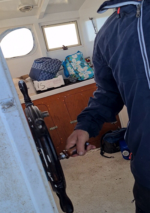
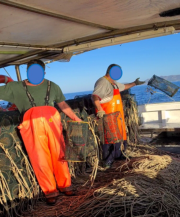
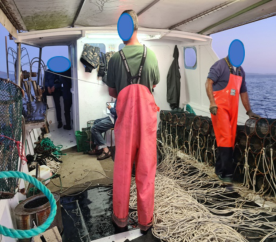
Figures 1a, 2a, and 3a show workers on the three investigated tasks.
Figures 1b, 2b, and 3b show sEMG Power Spectrum Density (PSD) from the three tasks analyzed at the beginning (in red) and at the end (in green) of the work activity along with the MF.
On task 1, the worker did a constant abdo-adduction movement, of the right shoulder on the frontal plane. Following one hour of activity, MF in the right lateral Deltoid (Fig. 1b) decreased by more than 8% from 79.7 to 73 Hz) (Fig. 1b).
Figure 1: a) (Left): image shows the worker driving the wheel. b) (Right): image shows the PSD of the sEMG signals acquired from the right Deltoideus lateralis at the begin- ning (in red) and at the end (in green) of the driving wheel task. The vertical red and green lines represent their MF.
During task 2, the worker took the pots from another crew member using his right hand, handed them to his left hand, and threw them in the sea. The worker performed a movement of abdo-adduction of his left shoulder on the frontal plane. In this second task, all three muscles investigated on the left side showed an MF reduction of over 8% after two hours of activity: Deltoideus lateralis (MF from 66.7 to 59 Hz), Deltoideus lateralis (MF from 71.4 to 49.8 Hz) and Trapezius superior (MF from 63.8 to 44.8 Hz Fig. 2b).
Figure 2: a) (Left): image shows workers dropping the pots. We acquired the worker throwing the pot with his left limb onto the sea. b) (Right): image shows the PSD of the sEMG signals acquired when dropping the pot from the left Trapezius superior at the beginning (in red) and at the end (in green). The vertical red and green lines represent their MF.
In task 3, we acquired the worker pulling a rope holding all the pots tied together. The worker used to do this task with a manual winch. The pots are simultaneously placed in a standardized sequence by another worker over the boat. The worker operating the winch performed a repetitive flexion- extension movement of both shoulders in the sagittal plane. Muscles that showed an MF reduction of more than 8% after three working hours were on the right side. Deltoideus lateralis (from 78.9 to 60.5 Hz) and Trapezius superior (from 56.2 to 38.9 Hz Fig. 3b).
Figure 3: a) (Above): image shows workers sailing the pots. We acquired the worker pulling the rope with both upper limbs. b) (Below): image shows the PSD of the sEMG signals acquired when sailing the pot from the right Trapezius superior at the begin- ning (in red) and at the end (in green). The vertical red and green lines represent their MF.
Ergonomic Risk Assessment of Sea Fishermen Part V 33
DISCUSSION
Our findings show that in all investigated tasks, the limb most used is the one that showed muscle fatigue.
When driving the wheel (Fig. 1a), the worker executes a round outward motion with the right limb, resulting in abduction and lifting of the shoul- der. Of all the muscles we acquired, the one suffering fatigue is the right Deltoideus lateralis.
When dropping the pots (Fig. 2a), the worker used his left limb to throw them into the sea, doing an abdo/adduction and elevation of the left shoulder. As a result of this repetitive motion, all the muscles we investigated on the left limb (Deltoideus lateralis, Deltoideus anterior, Trapezius superior) showed an MF reduction of over 8%, suggesting fatigue; in the right limb, which supports and passes the pots to the left limb, we did not observe MF reduction over 8%.
In pots sails, a worker used his right limb to pull the rope that ties the pots. He uses the left limb mainly as support. The worker performed a complex movement in all three planes of space. The right shoulder did abd/adduction, flex/extension, and elevation movements. The movements lead to muscle fatigue in the Deltoideus lateralis and Trapezius superior muscles.
Pot fishing, as explained in the introduction, has been widely investigated. All the studies highlighted the high biomechanical load for the workers.
For the first time we applied sEMG aboard a fishing boat in an actual scenario to assess fishermen’s muscle fatigue.
Following our previous findings [Silvetti, 2016a; 2016b; 2019; 2021], we can again conclude, in this new case, with a fishing mode dissimilar to the ones we previously studied, that fishing can lead to high risks of biomechanical overload, notably, here, for the upper limbs.
Moreover, our study shows that an instrumental technique such as sEMG is easy to use also in real work situations, including extreme work environ- ments, with no interferences for the workers. Thanks to the sEMG, we found to be true that some muscles suffer more muscle fatigue than others. Mus- cle fatigue assessment can be helpful in the early detection of bio-mechanical overload-related risks before they lead to pain and chronic musculoskeletal disorders.
A relevant topic like muscle fatigue is not even considered in ISO tech- nical standards (11228-1, 11228-2, 11228-3, 11226) despite being a well- known parameter for more than 60 years (Kogi, 1962). Nowadays, we can detect muscle fatigue with modern and non-invasive instrumental tech- niques. From a standards viewpoint, the CWA 17938 standard [CEN, 2023] provides indications for biomechanical overload risk assessment and can contribute to widening instrumental technology use in nearly any work environment.
ACKNOWLEDGMENTS
We would like to thank UILA Pesca for promoting this study and Silvetti, 2017a; 2017b; 2020; 2021.
REFERENCES
Barbero, M., Merletti, R., Rainoldi, A.: Atlas of Muscle Innervation Zones: Understanding Surface Electromyography and Its Applications. Springer, (2012). https: //doi.org/10.1007/978-88-470-2463-2 CEN Workshop Agreement (CWA 17938:2023) - Guideline for introducing
and implementing real-time instrumental-based tools for biomechanical risk assessment. Duguid A. et al. (2019) An Ergonomic Assessment of Small Boat Lobster Fishing.
Contemporary Ergonomics and Human Factors 2019. Eds. Rebecca Charles and David Golightly. CIEHF. Fulmer S. et al. (2017) Musculoskeletal Disorders in Northeast Lobstermen. Safety and Health at Work 8 282–289. ISO 11228–1. Ergonomics—Manual Handling—Part 1: Lifting and Carrying; ISO:
Geneva, Switzerland, 2021. ISO 11228–2. Ergonomics—Manual Handling—Part 2: Pushing and Pulling; ISO: Geneva, Switzerland, 2007. [Google Scholar]. ISO 11228–3. Ergonomics—Manual Handling—Part 3: Handling of Low Loads at
High Frequency; ISO: Geneva, Switzerland, 2007. [Google Scholar]. ISO 11226. Ergonomics—Evaluation of Static Working Postures; ISO: Geneva, Switzerland, 2000. Kogi, G., Hakamada, T. Frequency analysis of the surface electromyogram in muscle
fatigue. Rodo Kagaku. 1962 Sep:38:519–28. Kucera K et al. (2009). Ergonomic risk factors for low back pain in North Carolina crab pot and gill net commercial fishermen. Am J Ind Med. 2009 April; 52(4): 311–321. doi: 10.1002/ajim.20676. Mirka G et al. (2005) Use of the CABS methodology to assess biomechanical stress
in commercial crab fishermen. Applied Ergonomics 36 (1), 61–70. Montreuil S et al. (2015) Overboard Falls of Crew Members on Québec Lobster Boats Risk Analysis and Prevention Solutions. IRSST Report R-869. Oberg, T., et al., 1990. Electromyogram Mean Power Frequency in Non-Fatigued
Trapezius Muscle. European Journal of Applied Physiology and Occupational Physiology 61 (5–6): 362–369. Silvetti A et al. (2017a) Ergonomic Risk Assessment of Sea Fishermen Part I: Manual Material Handling. In: Goossens R. (eds) Advances in Social & Occupational Ergonomics. Springer, Cham doi.org/10.1007/978-3-319-41688-5_29. Silvetti A et al. (2017b) Ergonomic Risk Assessment of Sea Fishermen Part II: Upper
Limb Repetitive Movements. In: Goossens R. (eds) Advances in Social & Occu- pational Ergonomics. Springer, Cham doi.org/10.1007/978-3-319-41688-5_30. Silvetti A et al. (2020) Ergonomic Risk Assessment of Sea Fisherman Part III: Manual Handling and Static Posture. In: Goossens R., Murata A. (eds) Advances in Social and Occupational Ergonomics. Springer, Cham doi.org/10.1007/978- 3-030-20145-6_38. Silvetti, A. et al. (2021). Ergonomic Risk Assessment of Sea Fisherman Part IV:
Tunisian Chapter. In: Goonetilleke, R. S., Xiong, S., Kalkis, H., Roja, Z., Karwowski, W., Murata, A. (eds) Advances in Physical, Social & Occupational Ergonomics. AHFE 2021. Lecture Notes in Networks and Systems, vol 273. Springer, Cham. https://doi.org/10.1007/978-3-030-80713-9_20.
LISTED IN THE AHFE DIGITAL BOOKSTORE CATALOGUE
Explore the complete digital volume
Physical Ergonomics and Human Factors
Read this individual research paper free through the original publisher, or explore the full digital proceedings book.
ISBN 978-1-964867-23-6
Explore this ISBN in the AHFE Bookstore ↗Listed in the July 2026 bookstore catalogue; search by ISBN to confirm current availability · Digital book purchase optional