Alessio Silvetti, Ari Fiorelli, Antonella Tatarelli, Lorenzo Fiori, Giorgia Chini, Tiwana Varrecchia, Adriano Papale, Alberto Ranavolo, Francesco Draicchio (2024). Application of wearable technologies for the assessment of an ergonomic intervention in hairdressers: preliminary results. In: Human Factors and Wearable Technologies. AHFE Open Access, vol. 141, pp. 10–19. https://doi.org/10.54941/ahfe1005050
Several authors conducted ergonomic risk assessments through standardized protocols, like REBA, founding high-risk levels of hairdressing jobs. Others measured shoulder and wrist movement with IMU or inclinometer and found a high biomechanical risk. One study used electromyography (sEMG) to investigate flexors and extensors of upper limb to compare the activity of male and female hairdressers founding those women had considerably higher sEMG activity. In our previous study, we investigated the kinematic of the neck, trunk, and upper limb and sEMG bilaterally from Latissimuss Dorsi, Erector Spinae, Trapezius Superior, Deltoideus Anterior, Extensor Carpi Ulnaris, Flexor Carpi Ulnaris in hair drying in two different ways (horizontally – HOR and upwardly - UP). We found a high standard deviation for RoMs, indicating a high heterogeneity in performing the same task. Our sEMG results showed that, in both investigated tasks, the left side of the body was generally more involved than the right one. The right side, the one holding the phone, showed less %MVC mean values than the right side, the one holding the comb. Our sEMG results suggest that handling a 1 kg phone in a static position is less demanding for upper limbs and shoulders than using a light comb in continuous motion. In another paper, we investigated, through REBA and 3DSSPP, the static posture of workers after a corrective action consisting of a hairdryer holder. We found that the holder contributes to changing the posture in either positively and negatively. The positive effects seemed more than the negative ones. In this new paper, we investigated the effect of the hair dryer holder in dynamic situations founding that there are no significative improvements in the biomechanics of the workers. Moreover, the holder seemed to increase several investigated RoMs. The workers also complained of decreased flexibility of the wrist. Our results suggest that the holder system seems to have more negative than positive effects. To reduce the biomechanical overload in hairdryer, we suggest to improve several aspects, the training, the equipment (lighter hairdryer and adjustable seats), and increasing the breaks.
Application of Wearable Technologies for the Assessment 11
INTRODUCTION
Evidence of biomechanical overload risk and musculoskeletal disorders (MSDs) in hairdresser activity is widespread all over the world: Nigeria (Aweto, 2015), France (Deschamps, 2014), Ethiopia (Mekonnen, 2019), Norway (Hanvold, 2013), Egypt (Hassan, 2015), India (Kaushik, 2014), Iran (Reza, 2008; Mahdavi, 2014), Sweden (Wahlstrom, 2010).
MSDs in hairdressers are so relevant that even EU-OSHA (Kozak, 2019) determined to focus on this job.
In our previous study (Silvetti, 2023), we investigated the kinematic of the neck, trunk, and upper limb and sEMG bilaterally from Latissimuss Dorsi (LAT), Erector Spinae (ES), Trapezius Superior (TRAP), Deltoideus Anterior (DA), Extensor Carpi Ulnaris (EXT), Flexor Carpi Ulnaris (FLEX) in hair drying in two different ways (horizontally – HOR and upwardly - UP).
The shoulders (TRAP and DA) showed relevant mean %MVC values, particularly in the UP task.
Moreover, in both investigated tasks, the left side of the body was, overall, most involved than the right one, particularly for LAT, TRAP, DA, and FLEX muscles.
The right side, the one holding the phone, showed less %MVC mean values than the right side, the one holding the comb.
Our sEMG results suggest that handling an 850 gr phone in a static posi- tion is less demanding for upper limbs and shoulders than using a light comb in continuous motion.
Kinematic data seems to support this. The shoulder abd-adduction and elevation on the UP task and shoulder horizontal abd-adduction, elbow flex-extension, and wrist prono-supination showed the highest RoM values on the left side than on the right on both tasks.
The shoulder flex-extension showed similar overall high RoM values. This last movement of the shoulders was the most relevant as it showed the highest RoM values.
Our results also showed high SD for the RoM, thus revealing high vari- ability in the execution of the tasks in hairdressers despite our extreme standardization.
In another paper (Silvetti, 2022), we used REBA (Hignett, 2000) and 3DSSPP software (Chaffin, 2006) to assess the posture of the worker in the hair drying task before and after an ergonomic intervention consisting of a holder for the hair dryer.
Our static biomechanical data showed that the holder system seemed to reduce risk levels.
With 3DSSPP, we observed posture improvements in the left wrist flex- ion/extension and ulnar deviation, left shoulder axial rotation of the humeral head, and left elbow flexion/extension.
Also, REBA analysis showed a risk reduction. When using the holder, the score decreases from 9 to 2 for the left upper limb and from 5 to 2 for the right upper limb than non-using the holder system.
All our previous analysis showed that the holder system seems to reduce risk levels.
This new study aims to verify our previous data in a dynamic working situation through a multifactorial movement analysis based on kinematic and surface electromyography data.
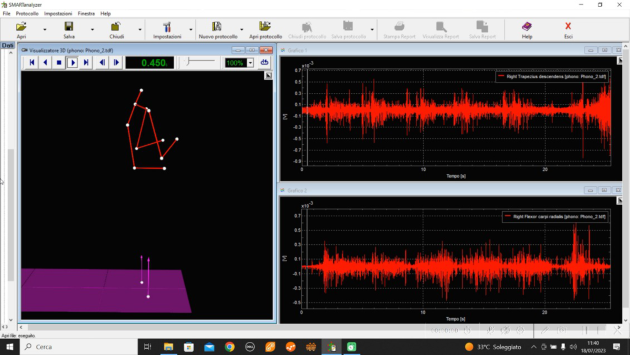
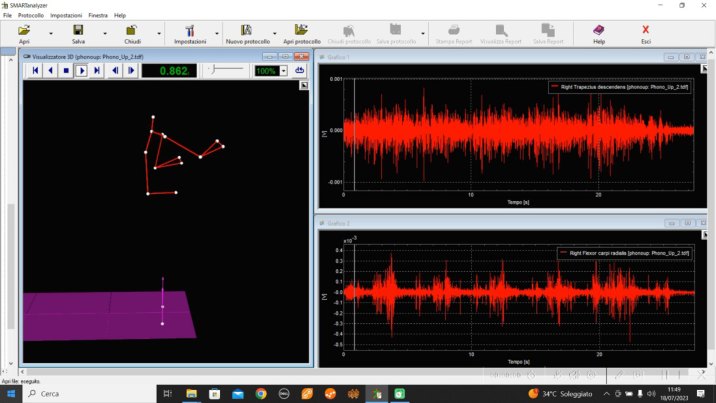
MATERIAL AND METHODS We acquired four experienced health workers, two women, and two men, with more than ten years of experience (height 168.7±9.1 cm; weight 64±8.6 kg). They performed the task of blow-drying in two different ways. The first was drying the hair horizontally (HOR), and the second was dry- ing the hair up (UP). Figures 1 and 2 show the kinematic reconstruction of the two investigated tasks and raw signals from two of the twelve investigated muscles.
We acquired the two investigated tasks pre and after a corrective action consisting of a homemade hair dryer holder that, according to manufacturer, should reduce the shoulder elevation and abduction and the trunk and neck lateral bending.
We registered three acquisitions for the two tasks in both conditions. For each, we acquired five cycles of drying. We did not consider the first and the last cycles in the analysis. The phone used was a professional one, and its weight was 850gr. For the statistical analysis we used SPSS Statistics 17.0 software (SPSS Inc., Chicago, IL, USA).
We calculated mean and standard deviation (SD) for each electromyo- graphic and kinematic parameter.
We considered statistically significant P-values below 0.05.
Figure 1: The image shows the 3D reconstruction of the task HOR and the raw signals from right Trapezius Superior and right Flexor Carpi Ulnaris. It is also possible to see reaction ground forces (purple arrows) from platform not investigated in this paper.
Application of Wearable Technologies for the Assessment 13
Figure 2: The image shows the 3D reconstruction of the task UP and the raw signals from right Trapezius Superior and right Flexor Carpi Ulnaris. It is also possible to see reaction ground forces (purple arrows) from platform not investigated in this paper.
Kinematic We used an optoelectronic motion analysis system (SMART-DX System, BTS, Milan, Italy) consisting of eight infrared ray cameras operating at 120 Hz.
We placed spherical reflecting markers on the following bony landmarks: C1, C7, T10, Sacrum, right and left acromion, right and left olecranon, right and left ulnar styloid process, radial styloid process, and ASIS.
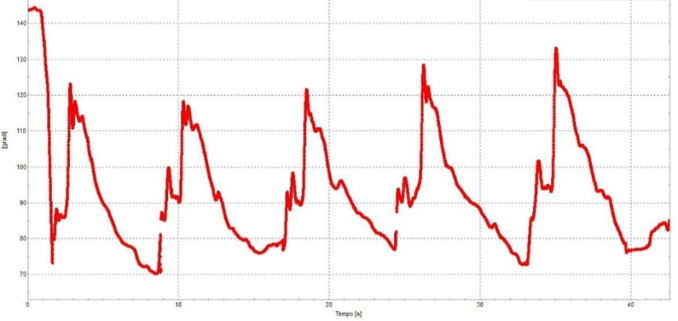
We filtered the kinematic signals with a 5Hz low bass band filter. The marker of the right elbow was used as a reference to determine the cycles (Fig.3).
Figure 3: Image shows an example of the track from right elbow to determine the cycles.
We calculated the mean Range of Motion (RoM) of the following joint angles: neck (flex-extension, lateral bending), upper back (flex-extension, lateral bending), shoulders (abd-adduction, flex-extension, horizontal abd- adduction, elevation), elbows (flex-extension), wrists (prono-supination).
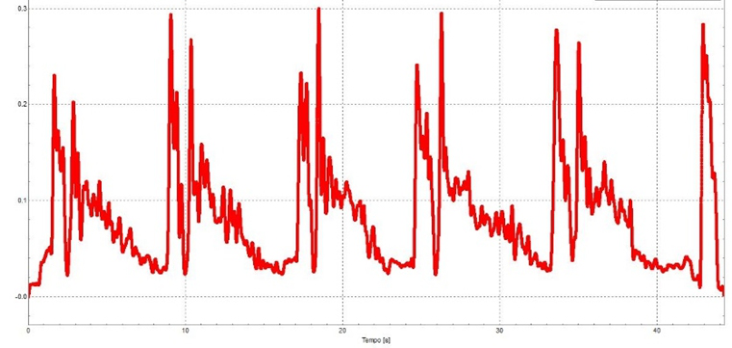
Electromyography Electromyography was acquired bilaterally from the following muscles: Latissimuss Dorsi (LAT), Erector Spinae (ES), Trapezius Superior (TRAP), Deltoideus Anterior (DA), Extensor Carpi Ulnaris (EXT), Flexor Carpi Ulnaris (FLEX). We recorded the sEMG signals using a surface electromyo- graphy system (FreeEMG, BTS S.p.A.) equipped with 12 wireless probes at a sampling frequency of 1 kHz. We placed the probes using disposable pre-gelled electrodes Ag/AgCl (H124SG, Kendall Arabic, Donau, Germany) following the recommendations of the Atlas of Muscle Innervation Zones (Barbero, 2012). The electromyography signals were processed using Ana- lyze software (BTS SpA, Ita). We filtered the acquired signals in the frequency band of interest [20–450 Hz] using a digital filter and Butterworth 9th- order passband to reduce motion artifacts (electrode-to-skin) and additional high-frequency noise elements. To obtain the linear envelope and extract the muscular activity profile, we rectified and filtered the signals using a But- terworth 3rd-order low-pass filter with a cut-off frequency of 10 Hz. We normalized the sEMG signals to maximum voluntary contraction (MVC). We performed MVC acquisitions according to SENIAM instructions (Hermens, 2000). Figure 4 shows an example of the processed signal of the Deltoideus anterior where, as Figure 4, it’s also possible to clearly identify the five cycles of each acquisition.
We computed the mean values as percentage of Maximum Voluntary Contraction (%MVC).
Figure 4: Image shows an example of the processed signals from Deltoideus anterior. It is possible to clearly see the five cycles of the acquisition.
Application of Wearable Technologies for the Assessment 15
RESULTS
Kinematic
Table 1 shows mean (±SD) RoMs of the investigated movements with (mod) and without the holder of the horizontal task (HOR). The last column shows the p-value.
Both neck movements showed increased RoMs when the worker had the phone holder; the flex-extension from 11.8 to 18.0
and the lateral flexion from 6.7
to 13.2
.
The back showed increased RoM values when using the holder in upper back flex-extension (6.7
Vs. 4.5
), lower back flex-extension (6.5
Vs. 3.5), and lateral flexion (4.0
Vs. 2.5).
The right shoulder showed increased RoM values when using the holder in horizontal abd-adduction (16.9 Vs. 10.5) and in the elevation (6.2
Vs. 4.8
). The left shoulder showed increased RoM values when using the holder in horizontal abd-adduction (20.1
Vs. 14.0
), flex-extension (40.5
Vs. 31.1
), and elevation (8.8
Vs. 6.0).
Both elbow flex extension and wrist prono-supination did not show statistical differences.
Table 1. Mean RoM values (±SD), in degree, and the p-value for both the investigated movements for the horizontal task without and with the holder.
Table 3 shows the mean (±SD) %MVC of the investigated muscles with (mod) and without the holder of the horizontal task (HOR). The last col- umn shows the p-value. HOR task showed statistical significance only on the left side, the side holding the comb, for EXT and FLEX. The EXT showed an increased sEMG value when using the phone holder from 17.9 to 24.1%. The FLEX showed a reduction of sEMG values from 14.0 to 9.7%. The sEMG values from LAT, ES, TRAP, DA, EXT dx, and FLEX dx were unaffected.
Application of Wearable Technologies for the Assessment 17
Table 3. Mean activity values (±SD) expressed as %MVC, and the p-value for the investigated muscle for the horizontal task without and with the holder.
Table 4 shows the mean (±SD) %MVC of the investigated muscles with (mod) and without the holder of the UP task. The last column shows the p-value. The UP task showed statistical significance only for FLEX muscles. The right one increases the activity with the holder from 6.3 to 8.3%; the left one, which holds the comb, decreases muscle activity from 18.3 to 10.4%.
Also UP task, sEMG values of all the other muscles (LAT, ES, TRAP, DA, and EXT) were the same with and without the holder.
Table 4. Mean activity values (±SD) expressed as %MVC, and the p-value for the investigated muscle for the up task without and with the holder.
Literature shows that hairdressing is a highly demanding job for muscu- loskeletal systems.
Hairdressers are particularly vulnerable to repetitive movements of the upper limbs, awkward and static posture. There are several tasks worthy of attention that it’s hard to standardize because they depend on the type of hair that differs for every customer. The two most relevant tasks are haircut and
hair-drying. We simulated this last one in our lab and acquired electromyog- raphy and kinematic signals from four experienced workers with and without an improvement proposal consisting of a homemade hairdryer holder.
Our preliminary sEMG data shows that in both investigated tasks (HOR and UP), the muscle activity of the left FLEX is lower when using the dry holder. However, the left side is those holding the comb, not the hairdryer. The right side showed increased sEMG values of the FLEX in the UP task if using the hairdryer holder.
Kinematic data shows that all the statistical significance found was against using the hairdryer holder. We found increased ROM values when using the holder in both investigated tasks for all the neck and trunk parameters but upper back lateral flexion in the HOR task.
We found significative increased ROM values of the right shoulder hor- izontal abd-adduction and elevation in HOR and abd-adduction in the UP task.
We also found increased ROM values when using the holder in both elbow flex-extension in the UP task.
We did no found statistical differences for wrist prono-supination in both tasks.
In conclusion, the holder seems to have more negative than positive effects on the kinematic and muscle activity of the workers. These results contrast the results of our previous paper obtained in a static analysis with com- monly standardized assessment tools such as REBA. Moreover, the workers complained that the holder limited the wrist movements that should be free according to their working experience.
Limitation of the study regards the limited number of participants but as reported in EU-OSHA document (Kozak, 2019), hairdresser activity is char- acterized by micro enterprises. In our study it was hard to make the workers quit their work for about half a day and be acquired in our lab because workers/owners wouldn’t “waste time”. We plan to recruit additional work- ers again soon to make the statistics more meaningful. Another limitation is about the chair used that, even it was adjustable, it was not a professional one. This could affect the real movement, we tried to mitigate this bias by setting the height of the chair to the height at which the worker felt fittest.
For reducing biomechanical risk in the hairdryer task, it could be help- ful to use lighter dryers like the newer ones that allows to hold them in a correct posture and avoid homemade solutions like the holder texted in this paper. Training is also a key particularly in the early phases of education in hairdressing to prevent workers learning wrong postural behaviors. Another point for reducing biomechanical load in hairdresser is to increase the breaks. However, this is not often possible because it leads to smaller earnings and it depends by the customer affluence that fluctuates day to day. Receiving cus- tomers for appointments could result in a better organization of the activity avoiding busy days and, thus, decrease the workload.
Finally, we recommend applying instrumental-based tools (CEN, 2023) for a more reliable biomechanical risk assessment in hairdryers because common standardized protocols, used in previous papers, are not able to describe the hairdresser activity that, according to our data, is not as simple as it seems.
Application of Wearable Technologies for the Assessment 19
REFERENCES
ACGIH. TLVs and BEIs. 2015. 202–204 ISBN 978-1-607260-77-6. Aweto, Happiness Anulika et al. (2015) “Prevalence of work-related musculoskeletal disorders among hairdresser”International Journal of Occupational Medicine and Environmental Health Volume, 28 No. 3. Barbero, M., Merletti, R., Rainoldi, A.: Atlas of Muscle Innervation Zones: Under-
standing Surface Electromyography and Its Applications. Springer, (2012). https: //doi.org/10.1007/978-88-470-2463-2 CEN Workshop Agreement (CWA 17938:2023) - Guideline for introducing and implementing real-time instrumental-based tools for biomechanical risk assess- ment. Chaffin DB, Andersson GBJ, Martin BJ. Occupational Biomechanics, Chap. 6, 4th
eds. Wiley (2006). Deschamps F, Langrand J, Lesage FX. Health Assessment of Self-employed Hairdressers in France. J Occup Health; 56: 157–163. France (2014). Hanvold TN, Wærsted M, Mengshoel AM, Bjertness E, Stigum H, Twisk J, Veiersted
KB. The effect of work-related sustained trapezius muscle activity on the devel- opment of neck and shoulder pain among young adults. Scand J Work Environ Health 2013;39(4): 390–400. Hassan, Omayma et al. (2015) “Occupational respiratory and musculoskeletal symptoms among egyptian female hairdressers” Journal of Community Health Volume 40, No. 4. Hignett S, McAtamney L. Applied ergonomics 2000;31(2): 201–205. Rapid Entire
Body Assessment (REBA). Kaushik, Abhishek et al. (2014) “Upper extremity and neck disability in male hairdressers with concurrent changes in pinch strength: An observational study” Healthline Volume 5, No. 2. Kozak A, Wohlert C, Wirth T, Kleinmuller O, Verhamme M, Rohr R, Nienhaus A.
Ergo hair Musculoskeletal Health of Hairdressers – Protection of Occupational Health and Safety at Workplace Medical Reference Document. (2019). Mahdavi, Sakineh et al. (2013) “Evaluation of the risk of musculoskeletal disorders using Rapid Entire Body Assessment among hairdressers in Khorramabad, Iran, in 2014”. Journal of Occupational Health and Epidemiology Volume 2, No. 3. Mekonnen TH, Abere G, Olkeba SW. Risk Factors Associated with Upper Extremity
Musculoskeletal Disorders among Barbers in Gondar Town, Northwest Ethiopia, 2018: A Cross-Sectional Study. Volume 2019, Article ID 6984719, 9 pages. Potvin J. Predicting maximum acceptable efforts for repetitive tasks. An Equation- Based on Duty Cycle. Human factors. 2012; 54(2):175–188. Ranavolo, Alberto et al. (2018) “Wearable Monitoring Devices for Biomechanical
Risk Assessment at Work: Current Status and Future Challenges-A Systematic Review” INT J ENVIRON RES PUBLIC HEALTH Volume 15, No. 9. http://doi. org/10.54941/ahfe1003623 Reza, Miri Mohammad et al. (2008) “Evaluation of ergonomic postures of hairdressers by REBA in Birjand” OFOGH-E-DANESH Volume 14, No. 2. Silvetti A, et al. (2023). Application of wearable technologies for the assessment of
biomechanical risk in hairdressers. In: Jesslyn Alekseyev and Christianne Falcão (eds) Human Factors and Wearable Technologies. AHFE (2023) International Conference. AHFE Open Access, vol. 85. AHFE International, USA. Wahlstrom, Jens et al. (2010) “Upper arm postures and movements in female hairdressers across four full working days” Volume 54, No. 5.
LISTED IN THE AHFE DIGITAL BOOKSTORE CATALOGUE
Explore the complete digital volume
Human Factors and Wearable Technologies
Read this individual research paper free through the original publisher, or explore the full digital proceedings book.
ISBN 978-1-964867-17-5
Explore this ISBN in the AHFE Bookstore ↗Listed in the July 2026 bookstore catalogue; search by ISBN to confirm current availability · Digital book purchase optional