Shuyi Liu, Rong Rong, Hanling Zhang (2024). Evaluation of Stress Intervention Performance and Usability of Smartwatch Guided Breathing Practice. In: Human Factors and Wearable Technologies. AHFE Open Access, vol. 141, pp. 130–140. https://doi.org/10.54941/ahfe1005062
Breathing practice is an effective method for alleviating mental stress. With the advancements in science and technology and the increasing demand for self-stress management, many mobile device based breathing practice applications have been developed. Based on the advantage of enabling multimodal breathing guidance, most commercial smartwatches are configured with breathing practice. However, current studies lack evaluation of stress intervention performance and usability for smartwatch guided breathing practice. In this study, we aim to explore which breathing guidance patterns and guided breathing frequencies for smartwatch-based breathing practice can effectively intervene with stress while ensuring a positive usability, and to make design recommendations for smartwatch-based breathing practice.Methods:Based on the investigation of the commonalities and characteristics of the breathing practice function settings of commercial smartwatches, we categorized the settings into one visual guidance pattern, two haptic guidance patterns, and three commonly used breath-guided frequencies. According to these guidance patterns, visual animation and haptic guidance prototypes were developed based on After Effects and Arduino. We used the Wizard of Oz method to implement visual and haptic guidance based on Apple Watch and Arduino, which can run independently or in concert.In the specific experimental phase, each participants completed a total of eight sets of experiments, including five guidance patterns and three breathing guidance frequencies. In each set of experiments, participants were required to complete a 1-minute mental arithmetic task as a stress input, a 1-minute breathing practice as a stress intervention, and to complete the Spielberger State-Trait Anxiety Inventory (STAI) and USE questionnaire to report subjective stress levels before and after the stress intervention and the subjective experience of using the stress intervention. Throughout the experiment, participants' heart rate variability (HRV) and respiratory rate (RR) were recorded using BIOPAC.Results: There was a significant difference between the stress state after the calculation task and the breathing practice. Regarding the breathing guidance patterns, the two haptic-only breathing guidance showed significantly lower usability, suggesting that haptics are more suitable for a supporting role in synergizing other patterns to guide the breathing practice. The breathing guidance that operates synergistically by visual and breath-like haptic guidance received the highest overall rating, possibly because this haptic feedback reduces cognitive workload by creating a natural mapping to the target action. In addition, acoustic feedback is considered as a developable smartwatch-based breathing guidance pattern. In terms of breathing guidance frequencies, the three commonly used deep breathing frequencies did not differ significantly in stress intervention performance and usability assessments, and individuals had different preferences for deep breathing frequencies. Therefore, personalizable and dynamic guidance frequencies might be a better solution.Conclusions:This paper analyzes the stress intervention performance and usability of smartwatch-guided breathing practice based on self-reported and objective physiological data, and proposes corresponding design recommendations for the breath-guided pattern and the guided breathing frequency. The findings of this paper could provide a reference for the design of the breathing practice function of smartwatches.
Stress refers to the escalation of psychological and physiological states, pre- senting physical and mental tension, as individuals cope with challenging events or demanding conditions. In the face of acute stress, slow, deep breath- ing can be effective in reducing stress (Brown and Gerbarg, 2005). Breathing practice refers to following a guidance to have slow, deep breathing for 1 to 5 minutes, which is an effective means of stress intervention. With the advancements in science and technology and the increasing demand for self-stress management, many mobile device based breathing practice applications have been developed to provide users with slow-paced breathing guidance for stress intervention at any time. Smartwatches, as emerging popular wearable devices, have a huge advantage in realizing multi-channel interactions. Based on such advantages, most commercial smartwatches are configured with a breathing practice function to provide breathing guidance to users from both visual and haptic channels.
Evaluation of Stress Intervention Performance and Usability 131
Different brands of smartwatches offer different breathing guidance pat- tern designs, and different default settings for breathing guidance frequency, which may result in different stress intervention performance and usability, and thus different user experiences. Some studies have developed prototypes of breathing guidance based on visual (Yu et al., 2018), haptic (Miri et al., 2020), and sound (Lee et al., 2021) channels with validation of their stress intervention performance and usability.
We investigated the stress intervention performance and usability of the breathing practice function of smartwatches. Specifically, we explored two questions: (1) How effective is the smartwatch guided breathing practice in relieving stress? (2) How do the specific breathing guidance pattern design and breathing guidance frequency settings of the breathing practice function affect its stress intervention performance and usability? First, we developed a breathing guidance experimental device. Then, we conducted a within- group experiment with 10 participants. We found that smartwatch guided breathing practice can effectively relieve stress. In addition, visual-haptic syn- ergistic breathing guidance patterns resulted in the best stress intervention performance and usability, and the 6 breaths/min breathing guidance fre- quency resulted in better objective stress intervention performance. Finally, we discussed innovative directions that can be considered in the design of smartwatch breathing practice functions.
METHOD
Materials
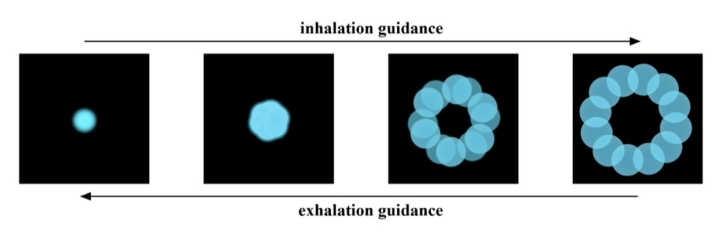
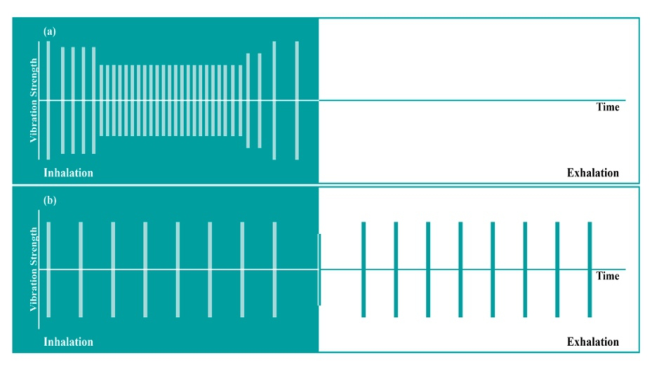
We investigated the commonalities and characteristics of existing commercial smartwatch breathing practice function settings, and categorized these inter- actions into one visual guidance pattern and two haptic guidance patterns, in which the visual and haptic interactions can independently or synergistically guide breathing. These patterns typically work with three breath guidance frequencies (5, 6, and 7 breaths/min) by default, and can be adjusted by the user according to his/her preference. Based on Adobe After Effects, we created a breath-guided visual animation, in which the image rotates and expands during inhalation guidance, and rotates in the opposite direction and shrinks during exhalation guidance, accompanied by a light effect that varies with the respiration process (see Figure 1). We developed two breath- guided haptic prototypes using the vibration module of Arduino. Prototype A mainly references the Apple watch setup: there is vibration when guiding the inhalation, and the vibration speed changes from slow to fast and then slows down again, and there is no vibration when guiding exhalation, as shown in Figure 2 (a). Prototype B mainly references to the Galaxy Watch settings: there is vibration when guiding inhalation and exhalation, and the vibration speed is uniform, and there is a light touch as a reminder when transition- ing from inhalation to exhalation, as shown in Figure 2 (b). The frequency of breathing guided by the visual animation and haptic prototypes could be adjusted to 5, 6, and 7 breaths/min.
We used the Wizard of Oz methodology to implement visual animation and haptic prototypes that operated independently or in concert to guide
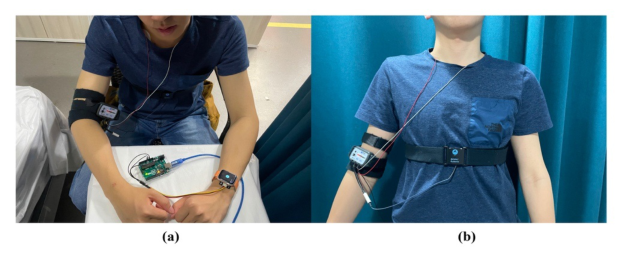
participants to practice breathing. Specifically, an Arduino vibration module and an Apple watch (watch on top) were stacked on the participant’s wrist, and the strap was adjusted to the appropriate length to ensure that the vibra- tion module fit securely on the participant’s wrist and that the participant was comfortable. The haptic prototypes were realized through the vibration module, while the visual animation was played through the Apple watch. The two types of feedback can be remotely controlled to operate independently or in tandem, depending on the needs of the experiment.
Figure 1: Visual animation for breathing guidance.Figure 2: (a) Haptic prototype A setting. (b) Haptic prototype B setting.
Evaluation Methodology Stress can be measured in a variety of ways, including objective physio- logic signals and subjective self-reports. Heart rate variability (HRV) and electrodermal activity (EDA) are commonly used objective physiologic sig- nals reflecting stress. Subjective self-reports include the Perceived Stress Scale (PSS) (Roberti et al., 2006), the Spielberger State Trait Anxiety Inventory (STAI) (Spielberger et al., 1971) and its short form (STAI-6) (Marteau and Bekker, 1992). Combined analysis of subjective and objective data allows for
Evaluation of Stress Intervention Performance and Usability 133
better assessment of stress intervention performance (Paredes et al., 2018). In addition, Lund’s USE questionnaire is commonly used for usability evalua- tion, which measures the usability of a product in terms of three dimensions: usefulness, ease of use, and satisfaction (Lund, 2001). The above methods have been shown to be effective in breath-guided stress intervention exper- iments and can be used for stress intervention performance and usability assessment.
In this experiment, we measured HRV as the objective physiological signal and used the state subscale of the Spielberger State Trait Anxiety Inventory (STAIS) as the subjective report result to comprehensively evaluate stress intervention performance. Usability was assessed using an adapted Lund’s USE questionnaire.
Physiological Signal Acquisition The ECG and RSP of the subjects were measured using BIOPAC MP160. The sampling rate of the device was set to 1000 Hz. During the experi- ment, the experimenter labelled key nodes. At the end of the experiment, the ECG and RSP data were saved and the data were processed using the NeuroKit2 software package. For ECG data, the standard deviation of the beat-to-beat intervals (SDNN) was calculated as the index of HRV. For RSP data, respiration rate (RR) was calculated.
Subjective Evaluation Subjective scales were used to assess stress intervention performance and usability of smartwatch-guided breathing practices in different settings. Par- ticipants’ subjective stress levels before and after the stress intervention were measured by STAIS questionnaire to assess stress intervention performance. Participants’ subjective experience of using the smartwatch breathing prac- tice was reported using USE questionnaire to measure the usability of the breathing practice settings.
Participants A total of 10 participants (6 females and 4 males) were recruited from the university to participate in this experiment, and their average age is 23.5 (ranging from 21 to 28 years old). All participants were in good physical condition.
Experiment Process Prior to the experiment, participants were briefly informed about the purpose and content of the experiment and then asked to read and sign a consent form. Participants then filled out a form providing their basic personal information, including gender, age, etc. The experimenter helped the participants to wear the vibration module and Apple watch on their wrists, and to put on the BIOPAC MP160 ECG&RSP data acquisition module to obtain ECG and RSP data during the experiment (see Figure 3).
In the training session, participants were familiarized with breathing practices following visual animation and haptic prototypes based on the experimental setup.
Figure 3: (a) Participants wore the vibration module and Apple watch. (b) Participants wore the BIOPAC MP160 ECG & RSP data acquisition module.
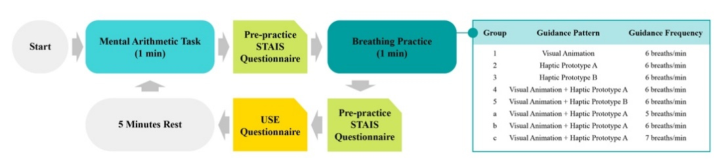
The experimental procedure is shown in Figure 4. Each participant com- pleted a total of 8 groups of experiments, including breathing practice experiments with 5 guidance patterns at the same breath guidance frequency, and breathing practice experiments with 3 breathing guidance frequencies at the same guidance pattern. Each group of experiments had a stressor task stage and a breathing practice stage. During the stressor task stage, the partic- ipant was asked to complete a 1-minute mental arithmetic task, during which his/her HRV and RSP data were recorded. Upon completion of the stressor task, participants completed the pre-practice STAIS scale to report subjec- tive stress levels prior to the stress intervention. Participants then entered the breathing practice stage, requiring them to follow the experimental setup to complete a 1-minute breathing practice, during which time HRV and RSP data were recorded. After completion of the breathing practices, participants completed the post-practice STAIS questionnaire to report subjective stress levels after the stress intervention, and the USE questionnaire to report their subjective experience of using the current breathing practice functional set- tings. At the end of the experiment the experimenter briefly interviewed the participants about their personal preferences and future scenarios regarding the functional settings of the breathing practice. To address possible learning effects and order effects, the order of the 8 groups of mental arithmetic tasks, the 5 groups of guidance pattern experiments (Group 1-5), and the 3 groups of guidance frequency experiments (Group a, b and c) were counterbalanced respectively across participants using a balanced Latin square design.
Figure 4: Experimental procedure.
Evaluation of Stress Intervention Performance and Usability 135
RESULTS
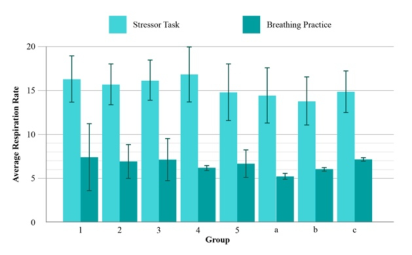
Respiration Rate (RR) Participants’ RR were analyzed. RSP data from the 1-minute stressor task and the 1-minute breathing practice were intercepted for each experimental group and RR values were calculated.
The average values of RR of the stressor task and breathing practice for each group of experiments are shown in Figure 5. Physiological data were missing from three participants due to technical problems. At the same breathing guidance frequency, the breathing practice synergistically guided by visual animation and haptic model A (Group 4) showed the closest RR to the target RR and the smallest standard deviation during the breathing practice stage (7.40 ± 3.80 vs. 6.93 ± 1.93 vs. 7.13 ± 2.41 vs. 6.21 ± 0.26 vs. 6.67 ± 1.57 bpm; Group 1 vs. Group 2 vs. Group 3 vs. Group 4 vs. Group 5). With the same breathing guidance pattern, participants’ RR guided by the three breathing guidance frequencies are relatively close to the target RR (5.22 ± 0.32 vs. 6.04 ± 0.18 vs. 7.16 ± 0.21 bpm; Group a vs. Group b vs. Group c).
Figure 5: Average values of RR of the stressor task and breathing practice for each group of experiments.
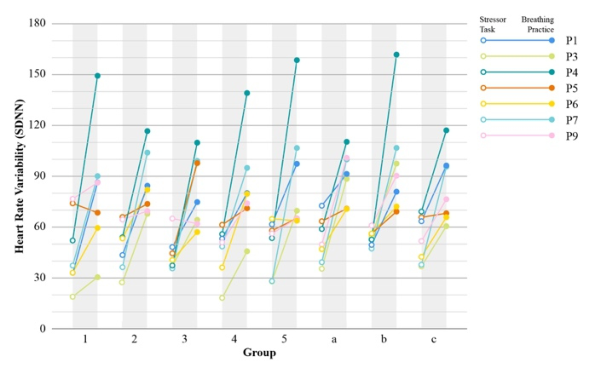
Heart Rate Variability (HRV) HRV of the participants was analyzed. ECG data from the 1-minute stres- sor task and the 1-minute breathing practice were intercepted for each experimental group, and the standard deviation of the beat-to-beat intervals (SDNN) was calculated as the index of HRV. Mean values of SDNN dur- ing the stressor task and breathing practice were calculated according to the groups of experiments. HRV metrics have large individual variance (Zhao et al., 2023), and for better within-group comparisons, we also calculated the growth rate of SDNN for each participant in each experimental group.
Participants’ HRV (SDNN) for the stressor task and breathing practice in each group of experiments is shown in Figure 6. In most cases, participants’ SDNN values showed different degrees of increase after the breathing prac- tice. The SDNN values were significantly higher in the breathing practice phase than in the stressor task phase (p<0.05).
Figure 6: Participants’ HRV (SDNN) for the stressor task and breathing practice in each group of experiments.
Regarding the influence of the choice of breathing guidance modes on stress intervention performance, SDNN values were compared among five guidance modes of breathing practices (Group 1 to 5) at the same breathing guidance frequency. The SDNN growth rate of breathing practices inde- pendently guided by tactile prototypes was the lowest, while the SDNN growth rate of breathing practices synergistically guided by visual animation and haptic prototypes was the highest, although not statistically significant (p>0.05). SDNN values were compared for breathing practices at 3 breathing guidance frequencies (Group a, b and c) to investigate the effect of the choice of breathing guidance frequency on stress intervention performance. With the same breathing guidance pattern, the breathing practice at the frequency of 6 breaths/min resulted in the highest SDNN, though its SDNN growth rate was slightly lower than that of 5 breaths /min.
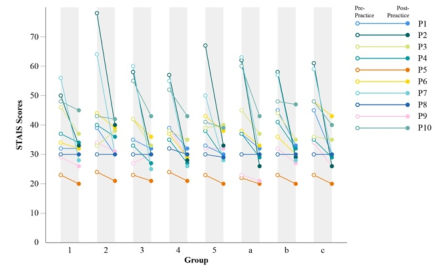
Subjective Stress Levels In each group of experiments, participants were asked to complete the STAIS questionnaire after the stressor task as well as after the breathing practice, respectively, to report current subjective stress levels. Participants’ STAIS scores were calculated after the experiments. Higher STAIS scores indicated higher subjective stress in participants.
Participants’ STAIS score changes for each group of experiments are shown in Figure 7. In general, participants’ STAIS scores were reduced to varying degrees after the breathing practice. The post-practice STAIS scores were sig- nificantly lower than the pre-practice STAIS scores (p<0.05). At the same breathing guidance frequency, Group 3 and 4 showed lower post-practice STAIS scores and higher values of decrease in STAIS scores compared to the other guidance patterns. With the same breathing guidance pattern, breathing practice guided at a frequency of 6 breaths/min led to the highest post-practice STAIS scores and the lowest values of decrease in STAIS scores.
Evaluation of Stress Intervention Performance and Usability 137
Figure 7: Participants’ STAIS scores before and after breathing practice in each group of experiments.
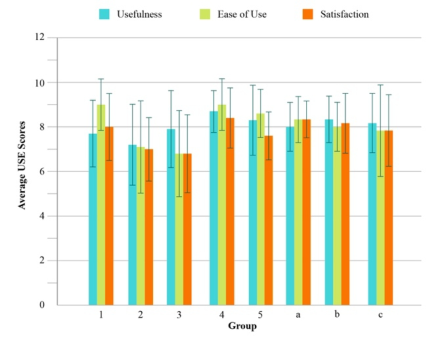
Usability Participants were asked to fill out a USE questionnaire after each breath- ing practice to report a subjective evaluation of the usability of the current smartwatch-guided breathing practice function. The USE scores were calcu- lated after the experiments to evaluate the usability of the breathing practice with different function settings.
The average USE scores of breathing practices in each group of experi- ments are shown in Figure 8. Statistical analysis showed that the choice of the breathing guidance pattern had a significant effect on the usability of the breathing practice (p<0.05). Specifically, Group 4 showed significantly higher usability than Group 2 and Group 3 (p<0.05), and the usability of purely haptic guidance patterns was significantly lower than that of purely visual and visual-haptic synergistic guidance patterns (p<0.05). For the respiratory guidance frequencies, statistical analysis showed no significant difference in usability among the three respiratory guidance frequencies (p>0.05).
Figure 8: Average USE scores of breathing practices in each group of experiments.
DISCUSSION
The results of HRV metrics and STAIS scores indicated that smartwatch- guided breathing practices were indeed effective in improving stress con- ditions. In this section, we discuss the evaluation of stress intervention performance and usability for the breathing guidance patterns and breathing guidance frequencies.
Breathing Guidance Patterns Although the breathing practice guided by visual animation and haptic pro- totype A synergistically (Group 4) did not show the best stress intervention performance from the objective data, the subjective data showed that it received the highest stress intervention performance and usability evaluation. This might be because the change in vibrational speed of this haptic feedback resembled the chest expansion action during inhalation. The cognitive work- load was reduced and the participants’ experience enhanced by creating a natural mapping to the target action. Participants’ feedback at the end of the experiment also validated this assumption. In addition, the RR results illustrated that Group 4 guided participants to breathe at the target respira- tion rate better than the other groups. The two haptic-only prototype guided breathing practices demonstrated significantly lower usability and their stress intervention performance was also relatively low, suggesting that vibration is more suited to a supporting role, working in concert with the other channels to guide the breathing practice.
Among the current commercial smartwatch breathing practice functions, the breathing guidance pattern combining visual animation and vibration is a more applicable choice for users, balancing good stress intervention per- formance and excellent usability. However, visual animation is not available in some life scenarios, such as driving and sleep aid scenarios. Given the low overall ratings received for vibration-only guided breathing practices, new multichannel-based breathing guidance patterns are worth exploring. Sound-based guidance was considered as a developable smartwatch-based breathing guidance pattern according to participants’ feedback. The design of smartwatch-based breathing practice guidance patterns should take advan- tage of the technology of smartwatches to develop more multi-channel guidance patterns for more life scenarios. Meanwhile, in the specific design of guidance patterns, it might be a good idea to enhance the user’s experience by creating a natural mapping with the breathing action, as in the case of the haptic prototype A.
Breathing Guidance Frequencies Objective data showed that the best performance of the stress intervention resulted from the 6 breaths/min breath-guided frequency, which validated existing study (Lehrer and Gevirtz, 2014). However, the results of the STAIS scores indicated that participants had higher subjective stress levels at the 6 breaths/min breath-guided frequency. Several participants reported that the 6 breaths/min respiratory rate did not allow for more thorough deep
Evaluation of Stress Intervention Performance and Usability 139
breathing like the 5 breaths/min, nor was it closer to the normal respira- tory rate like the 7 breaths/min, resulting in a certain level of subjective stress, which could explain the difference between the subjective and objec- tive results of the 6 breaths/min breathing guidance frequency. There was no significant difference in usability among the three respiratory guidance fre- quencies. Individual preferences for deep breathing frequency were diverse, which may be due to the different breathing habits and lung capacity of individuals.
For the current commercial smartwatch breathing practice function, due to better objective stress intervention performance results and existing stud- ies, the 6 breaths/min breath guidance frequency is an appropriate default setting, and the user can subsequently adjust the breathing guidance fre- quency according to personal preference. In order to achieve better stress intervention performance and usability for individuals, the breathing guid- ance frequency setting should be more flexible. Based on the development of smart wearable respiratory monitoring technology, a better solution could be a personalized and dynamically adjustable respiratory guidance rate based on individual breathing habits.
CONCLUSION
This study aims to evaluate the stress intervention performance and usability of smartwatch-guided breathing practice. Objective physiological data and subjective scale results suggest that smartwatch-guided breathing practice can effectively improve stress conditions. Although haptic technology for smart- watches shows great promise, based on the current design, the haptic-only breathing guidance patterns show the worst results in terms of stress inter- vention performance and usability. On the contrary, visual-haptic synergistic breathing guidance patterns achieve the best stress intervention performance and usability, suggesting that haptics can participate as a good supporting role in multi-channel breathing guidance. The guided breathing frequency of 6 breaths/min is more suitable as the default setting for breathing guid- ance than other frequencies to achieve better objective stress intervention performance. However, individuals have different breathing habits and lung capacity, leading to different preferences for the guided frequency of deep breathing practice for each individual.
Based on the above analysis and the good prospect of wearable technol- ogy, the future breathing practice function of smartwatch can be innovated in the following two aspects: in order to allow the breathing practice function of smartwatch to provide users with stress intervention in more scenarios, the design of new multi-channel-based breathing guidance patterns is worth exploring; for better fitting individual breathing habits, personalized and dynamically adjusted breathing guidance frequency may be a better frequency setting scheme, but the stress intervention performance and usability of this scheme need to be further validated.
ACKNOWLEDGMENT
This work was supported in part by National Key R&D Program of China(2021YFF0900602).
REFERENCES
Brown, R. P. and Gerbarg, P. L. (2005). Sudarshan Kriya yogic breathing in the treatment of stress, anxiety, and depression: part I—neurophysiologic model. Journal of Alternative & Complementary Medicine, 11(1), pp. 189–201. Lee, J., Elhaouij, N., and Picard, R. (2021). AmbientBreath: Unobtrusive just-in-
time breathing intervention using multi-sensory stimulation and its evaluation in a car simulator. Proceedings of the ACM on Interactive, Mobile, Wearable and Ubiquitous Technologies, 5(2), pp. 1–30. Lehrer, P. M. and Gevirtz, R. (2014). Heart rate variability biofeedback: how and why does it work?. Frontiers in psychology, 756. Lund, A. M. (2001). Measuring usability with the use questionnaire12. Usability
interface, 8(2), pp. 3–6. Marteau, T. M. and Bekker, H. (1992). The development of a six-item short-form of the state scale of the Spielberger State—Trait Anxiety Inventory (STAI). British journal of clinical Psychology, 31(3), pp. 301–306. Miri, P. et al. (2020). PIV: Placement, pattern, and personalization of an incon-
spicuous vibrotactile breathing pacer. ACM Transactions on Computer-Human Interaction (TOCHI), 27(1), pp. 1–44. Paredes, P. E. et al. (2018). Just breathe: In-car interventions for guided slow breathing. Proceedings of the ACM on Interactive, Mobile, Wearable and Ubiquitous Technologies, 2(1), pp. 1–23. Roberti, J. W., Harrington, L. N. and Storch, E. A. (2006). Further psychometric
support for the 10-item version of the perceived stress scale. Journal of College Counseling, 9(2), pp. 135–147. Spielberger, C. D. et al. (1971). The state-trait anxiety inventory. Revista Interamericana de Psicologia/Interamerican journal of psychology, 5(3 & 4). Yu, B. et al. (2018). DeLight: biofeedback through ambient light for stress inter-
vention and relaxation assistance. Personal and Ubiquitous Computing, 22, pp. 787–805. Zhao, Y. et al. (2023). Affective Touch as Immediate and Passive Wearable Intervention. Proceedings of the ACM on Interactive, Mobile, Wearable and Ubiquitous Technologies, 6(4), pp. 1–23.
LISTED IN THE AHFE DIGITAL BOOKSTORE CATALOGUE
Explore the complete digital volume
Human Factors and Wearable Technologies
Read this individual research paper free through the original publisher, or explore the full digital proceedings book.
ISBN 978-1-964867-17-5
Explore this ISBN in the AHFE Bookstore ↗Listed in the July 2026 bookstore catalogue; search by ISBN to confirm current availability · Digital book purchase optional