Alessio Silvetti, Giorgia Chini, Paola Giuntoli, Ari Fiorelli, Alessandro Montefusco, Adriano Papale, Marta Petyx, Alberto Ranavolo, Daniele Scialanga, Deborah D'angelo, Tiwana Varrecchia, Orietta Angelosanto (2026). Risk assessment through heart rate of a team of airport workers loading Unit Load Devices. In: Physical Ergonomics and Human Factors. AHFE Open Access, vol. 223, pp. 39–49. https://doi.org/10.54941/ahfe1007794
Literature shows that musculoskeletal disorders (MSDs) are common among airport baggage handlers, but Unit load Device (ULD) loading/unloading has not been examined before. In this paper we recorded heart rates of six workers handling 12 ULDs each up to 1,000 kg. The workplace precludes the use of ISO 11228-2 standard because the tasks of loading/unloading are performed by a team of workers with no wheeled equipment on a slope surface. Besides, no single method in literature contemplates the assessment of braking tasks in the unloading stage. Both loading and unloading tasks showed low physical effort despite the heavy handled loads. Improvements could include ergonomic handles and better Aircraft Cargo Loader operation to minimize manual handling. Though limited by sample size and reliance on heart rate, the results suggest that heart rate could be a valuable parameter for assessing workers’ effort in non-standardized work environments where other risk assessments tools are non appliable. These findings can help enhance workplace safety and reduce MSD risks in air cargo operations. The adoption of these measures may also decrease aircraft loading times. The improvements could result in greater slot availability at the airport and subsequently enhance overall airport profitability.
Literature reports a high level of musculoskeletal disorders in workers performing manual baggage handling at airports (Andersson, 1984; Stalhammar, 1986). It estimates, over the period from 1992 to 1994, that back injuries to baggage handlers costs an average of 21 million US$ per annum only in the USA and an average cost per back injury of around 10,000 US$ (Dell, 1997). No cost updates have been released since 1994, and the increase in air passenger traffic suggests that current estimates are likely understated.
Recently literature confirmed the previous data and highlights that in several years nothing has changed to improve the health and safety of airport Received January 16, 2026; Revised April 3, 2026; Accepted April 19, 2026; Available online July 20, 2026
workers. The epidemiological data are substantially unchanged (Kemp, 2010; Tafazzol, 2016; Thygesen, 2016; Mikkelsen, 2016; Wang, 2018; Asadi, 2019, Mikkelsen, 2019; Brauer, 2020, Trivedi, 2022).
The main factors associated with an increased risk of back disorder are heavy physical work, lifting and handling of loads and awkward postures (Dell, 1998; Bern, 2013; Wahlstrom, 2016; Wang, 2018), seniority (Bern, 2013; Møller, 2018), psychosocial factors (Bergsten, 2017) and job satisfaction (Bulduk, 2017).
Some possible solutions to reduce biomechanical overload in workers during baggage handling inside narrow body aircraft could be ramp snakes, power stows or sliding carpets (Gomez, 2009).
A paper (Lenior, 2012) argued that fully automated baggage handling systems are not yet practical for all airports because of factors such as cost, limited space, and the need for operational flexibility.
Since 2012, robotics has advanced to make automated systems smaller, more affordable, and a viable option for reducing workers’ biomechanical strain in airports (https://www.schiphol.nl/en/blog/cobot-at-schiphol/).
Recent studies (NIOSH, 2015; Lu, 2018; Brauer, 2020) also show that technical lifting equipment reduces musculoskeletal disorders.
Applying common standardized biomechanical risk assessment tools to baggage handling tasks in airports could be not always possible. This is true because such tasks are frequently carried out in restricted and awkward posture.
Few papers in literature reported a biomechanical risk assessment of manual handling in airport scenario.
A common standardized ergonomic risk assessment tool such as REBA has been applied (Asadi, 2019) in airport. Authors found that the REBA scores for aircraft loading workers were 3.5 to 4.8 points higher than cargo workers, customer service workers, gate workers and VIP club workers.
Only three papers reported an instrumental based tool risk assessment of baggage handling through surface electromyography (sEMG). The first one was a lab simulation on male college students (Korkmaz, 2006). Authors found high levels of muscle activity.
Another investigation, in lab scenario (Lu, 2018), provided evidence of reduction of anterior-posterior shear forces when using a mechanical lift system.
The last paper investigated sEMG and L4/L5 compression forces in real work environments (Koblauch, 2016). The author found L4/L5 compression forces exceeding the recommended thresholds for compression force during lifting.
In our case report, we didn’t analyze the typical baggage handling, outside the aircraft, inside the narrow body aircraft baggage compartments, or in the baggage room.
Our aim is to investigate the loading and unloading of Unit Load Devices (ULDs) on an aircraft cargo. The UDL is a container used to group and secure baggage/goods for efficient air transport on wide-body aircraft and specific narrow-body aircraft.
Risk Assessment Through Heart Rate of a Team 41 In literature, this task has not yet been investigated. Only a paper reported that the workers involved in pushing and pulling containers inside wide body aircraft performed an overloading task but only when the aircraft’s built-in equipment is out of service (Dell, 1997). However, the paper also indicated that this task did not result in worker injuries when the equipment was operational.
Our paper aims to assess the tasks of loading and unloading ULDs through the analysis of the Heart Rate (HR) of a team of workers in a real work environment during daily real work. We also propose suggestions for risk mitigation.
TASK DESCRIPTION A team of four, including one “Aircraft Cargo Loader” (ACL) driver and three workers pushing ULDs, completes the tasks in around 30 minutes.
The workers must store 12 ULDs in the air cargo weighing over 1,000 kg each. We acquired two sessions of loading and two sessions of unloading during real loading/unloading acitvity. Table 1 shows the weight handled for each of the four sessions in our case scenario.
Table 1: Table shows the weight in Kg of each of the ULDs handled by the workers in the four acquisitions (two loadings and two unloadings). ULD 11 and 12 of Loading 2 were empty, the weight is referred to those of ULDs.
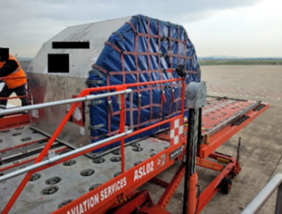
The driver uses the ACL to mechanically lift the ULDs (Fig. 1). The ACL rises the ULDs from the runway up to the level of the aircraft fuselage.
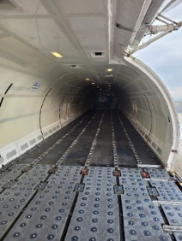
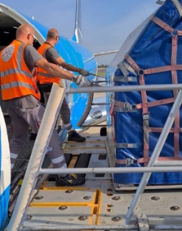
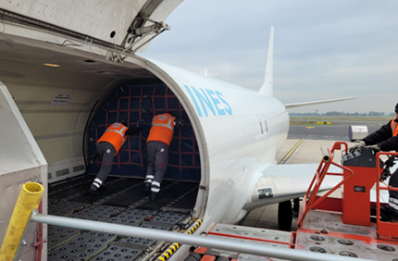
Following, a team of workers manually push on a roller floor (Fig. 2) the ULDs inside the Air Cargo (Fig. 3 and 4).
Workers move ULDs inside the aircraft according to ULD weight, ensuring proper balance and stability of the aircraft. Unloading is backward.
Figure 1: The driver of the ACL and the ULD.Figure 2: The roller floor inside the aircraft.Figure 3: Two of the acquired workers involved in the loading of the ULD from the ACL inside the airplane.Figure 4: Two of the acquired workers involved in the task of pushing the ULD on the roller floor inside the airplane.
METHODS
Risk assessment limitations with common ergonomic risk assessment tools Common push and pull risk assessment tools (Snook, 1991; ISO, 2007) cannot be used because:
1) the task is performed by a team of workers, the push and pull thresholds established by Snook and ISO are intended for tasks performed by a single worker; 2) this task is done on a roller floor, not with wheeled equipment; Snook and ISO thresholds apply only to tasks using wheeled equipment (trolleys, pallet trucks, wheelbarrows etc.); 3) is not possible to use because the front surface of UDL is soft (Fig.1 and 4). The dynamometers require a rigid and stable surface for accurate readings (Annex D of ISO 11228-2). 4) the airplane is on a sloped surface. The pushing and pulling thresholds recommended by Snook and ISO standard are intended for flat surfaces. Additionally, when unloading, workers have to “brake” the UDLs as they slide downward, and no ergonomic tools available in the literature assess the “braking tasks”; 5) surface electromyography has been applied to measure muscle effort in actual airport settings (Koblauch, 2016). However, it is not suitable for our scenario because the tasks lack standardization and because sEMG cannot be used to monitor all four workers throughout the entire task.
Heart Rate Heart rate (HR) has often been applied to evaluate cardiac workload within occupational medicine (LeBlanc 1956; Maxfield 1961; Davis 1969; ACGIH 1971; Meyer 1996). Previously, equipment was expensive and cumbersome, but wearable technology now allows easy and reliable HR monitoring (Papoutsakis, 2022; Moon, 2024; Lee, 2024; Sammito, 2024).
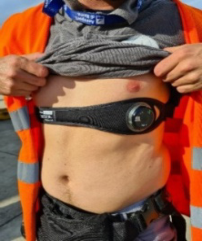
All the workers of our study wore a chest strap (Fig. 5) equipped with the Zephyr Bioharness 3.0, a sensor that records heart rate and trunk flexion (Johnstone 2012a; 2012b). The Zephyr Bioharness 3.0 is commonly used to assess workers’ kinematics and physiology in actual work scenarios where ISO standards are not appliable (Lee, 2017; Masci, 2022). In previous figures (3 and 4) the workers are wearing the equipment.
Figure 5: A worker wearing the Zephyr Bioharness chest strap.
Baseline recordings Before the data collection began, we recorded each participant’s resting heart rate for 15 minutes while they were seated in a quiet and climatized room.
The software OmniSenseTM 5.1 (Medtronic, Minneapolis, MN, USA) was used to eliminate HR artifacts.
To have a trunk posture baseline for all workers, we recorded the resting erect trunk posture at the start of the acquisitions. The workers stood in an anatomical position with their heads, upper backs, buttocks, and heels touching a vertical wall for ten seconds. In that position, the trunk was at 0 degrees inclination.
Subjects Six skilled employees were recruited over the course of two loading and unloading cycles. All participants had no history of musculoskeletal, neurological, or heart disease and were non-smokers.
Table 2 shows the anthropometric data of the workers, and the task (loading or unloading). Two subjects (3 and 4) performed both tasks.
Table 2: Anthropometric data of each worker and mean and SD of the sample. The table also shows the task that each worker executed in the recordings.
Table available in the original PDF paper.
Task
Subject Height (cm)
Weight (Kg)
BMI BMI Class Age Experience (Years) 1 185 105 30,7 Obesity 1° 30 7 Loading
We used the Frimat criterion (Frimat, 1988; Frimat, 1989) to analyze HR because it is preferred for short-duration tasks (Narvaez, 2019). The five Frimat criteria are as follows: 1) mean heart rate (HRmean), 2) maximum heart rate in the recording (HRpeak), 3) Absolute Cardiac Cost (ACC) (1), 4) Relative Cardiac Cost (RCC) (2), and 5) cardiac acceleration (ΔHR) (3). Each parameter receives a score from 1 to 6 (Table 3). The five scores are summed to determine a final ranking (Table 4).
Multiple formulas are available in literature for determining HRmax. In this paper, we applied the method proposed by Fox (1971) (220-age).
Equation reproduced from the original PDF.Table 3: The scoring criteria for each of the five parameters in Frimat’s score.
Table 4: Ranking of an activity according to its Frimat’s score.
Table available in the original PDF paper.
Frimat’s Score Values Ranking
25 Extremely hard
24 Very hard
22 Hard
20 Distressing
18 Bearable
14 Light
12 Very light
≤10 Minimum workload
RESULTS
Table 5 shows the mean (±SD) values for each parameter measured by the Frimat’ score during both loading and unloading tasks. It also shows the mean (±SD) of the final Frimat’ score.
The loading task showed higher mean values for the following parameters: ACC (34.8 vs 28.8), RCC (31.3 vs 26.7), HRpeak (127.3 vs 125.5), and HRmean (104.3 vs 95.8). By contrast, the unloading task showed a higher mean value only for ΔHR (29.8 vs 23.0). The final Frimat’ score was greater in the loading task (16.0 vs 14.8). Nevertheless, as indicated in Table 4, both loading and unloading tasks were ranked as Bearable.
Table 5: Mean (±SD), minimum, and maximum for each of the five Frimat’s score parameters and the total score for both tasks.
Table available in the original PDF paper.
Loading Unloading Mean ± SD Min Max Mean ± SD Min Max ACC 34.8 ± 4.2 28.0 40.0 28.8 ± 1.4 23.0 34.0
Table 6 presents the Frimat’ score and corresponding ranking for each acquisition. The loading task yielded scores ranging from 10, indicating minimum workload, to 19, reflecting a distressing level of workload. Scores for the unloading task ranged from 12, classified as very light, to 18, considered bearable.
Table 6: Frimat’ score and ranking per acquisition.
Table available in the original PDF paper.
Subject Task Frimat’ Score Ranking
1 Loading 17 Light
2 Loading 19 Distressing
3 Unloading 18 Bearable
3 Loading 18 Bearable
4 Unloading 12 Very light
4 Loading 10 Minimum workload
5 Unloading 16 Light
6 Unloading 13 Very light
DISCUSSION AND CONCLUSION A review by Sammito (2024) suggests analyzing HR data, given the growing use of wearable technologies, to assess workers’ occupational efforts. Moon (2024) also confirms that HR monitors can be easily integrated into workplaces to collect workers’ physiological data.
Based on these reviews, we examined two non-standardized pushing and braking tasks in an actual scenario where standard ergonomic risk assessment tools are not applicable.
We measured HR and trunk flexion using the Zephyr Bioharness 3.0, a gold-standard HR monitor (Cosoli, 2022).
Kinematic data of trunk flexion were not reported here due to the lack of standardized postures adopted by the workers when pushing or braking ULDs. Workers could execute the task by keeping the back straight and relying on leg strength rather than pushing or braking the ULD with their arms. Workers sometimes also had to manually lock the ULDs to prevent sliding, which could cause trunk flexion over 90°, unrelated to pushing or braking tasks.
HR results indicate that four of the five Frimat’s score parameters (ACC, RCC, HRpeak, HRmean) were higher during the uphill loading task compared to the downhill unloading task. This outcome also yields an increased mean overall Frimat’s score (16.0 versus 14.8). Nevertheless, the rankings for both mean values of the Frimat’s score were assessed as “bearable”. For single recordings, Frimat’s scores for the loading task ranged from 10 (minimum workload) to 19 (distressing), while the unloading task ranged from 12 (very light) to 18 (bearable). Our findings, like Dell (1997), indicate that UDL is not considered an overloading task when the aircraft’s built-in equipment functions properly.
Although we found low levels of Frimat’s scores in both loading and unloading, is it possible to improve the task. In informal feedback, workers recommended modifying ULD handles for better coupling during loading and
Risk Assessment Through Heart Rate of a Team 47 unloading. Figure 3 illustrates the inadequate coupling of the ULD handles observed in this scenario. Additionally, the loading and unloading processes within the aircraft may be mechanized. These operations are not managed by airport facilities, as they are contingent upon the specific aircraft model.
Minimizing manual handling mainly depends on the ACL drivers’ skill. Proper placement of ULDs during transfer from ACL to air cargo can significantly reduce manual activity.
There are limitations to the study. We only analyze HR, which can be affected by various factors such as BMI, mental state, fitness level, smoking, and drug use. Nevertheless, HR confirms to be a valuable physiological measure that offers relevant feedback in workplaces where ergonomic risk assessments tools or ISO standards cannot be applied.
A further issue is the small size of the sample. We were unable to include more workers because airports have unique logistical challenges and permitting requirements. The last issue is about the Fox formula that could affect the RCC. This could be true if RCC was the only parameter but, Frimat criterion consider also other four parameters. Based on our experience Frimat method is not affected by how theoretical maximum HR is computed.
Although these limitations, we assessed workers’ efforts in an actual scenario, that had not previously been analysed, where no observational ergonomic risk assessment tools can be applied.
HR can now be measured quickly, affordably, and accurately using wearable devices that provide real-time data on workers’ physiological status (Papoutsakis, 2022; Moon, 2024; Lee, 2024; Sammito, 2024).
Our findings may help airport health and safety services to reduce musculoskeletal disorders among workers. This leads to a reduction in costs due to the workers losing working days and to the reduction of workers’ compensation costs.
REFERENCES
ACGIH (1971). Ergonomics Guide to the assessment of metabolic and cardiac costs of physical work. Am Ind Hyg Assoc J. Aug;32(8):560–4. Andersson, G. et al. (1984). Nordiska frägeformulär för kartläggning av
yrkesrelaterade muskuloskeletala besvär. Nordisk Medicine. 99, 54–55. Asadi, H. et al. (2019). Risk Factors for Musculoskeletal Injuries among Airport Customer Service Employees. Proceedings of the Human Factors and Ergonomics Society Annual Meeting, Volume 63 (1): 5 – Nov 1. Bergsten, EL. et al. (2017). Daily Shoulder Pain Among Flight Baggage Handlers and
its Association With Work Tasks and Upper Arm Postures on the Same Day. Ann Work Expo Health. Nov 10;61(9):1145–1153. Bern, SH. et al. (2013). Baggage handler seniority and musculoskeletal symptoms: is heavy lifting in awkward positions associated with the risk of pain? BMJ OPEN. ;3:e004055. Brauer, C. et al. (2020). Occupational lifting predicts hospital admission due to
low back pain in a cohort of airport baggage handlers. Int Arch Occup. Environ Health. Jan;93(1):111–122. Bulduk, S. et al. (2017). Job satisfaction among aircraft baggage handlers and their exposure to risk factors for work-related musculoskeletal disorders: A case study. Work. 56(2):301–308.
Cosoli, G. et al. (2023). Wearable Electrocardiography for Physical Activity Monitoring: Definition of Validation Protocol and Automatic Classification. BIOSENSORS. (Basel). Jan 18;13(2):154. Davis, H.L. et al. (1969). Work physiology. Hum Factors. Apr;11(2):157–65. Dell, G. (1997). The causes and prevention of baggage handler back injuries: a survey
of airline safety professionals. Safety Science Monitor. 1(3). Dell, G. et al. (1998). Airline baggage handler back injuries: a survey of baggage handler opinion on causes and prevention. Fox, S. et al. (1971). Physical activity and the prevention of coronary heart disease.
Ann Clin Res. 3: 404–432. Frimat, P. et al. (1988). Utilisation d’une grille d’évaluation de l’astreinte cardiaque.
Revue De Medecine Du Travail. 15 (4) 159–160. Frimat, P. et al. (1989). Heart rate and work. What use? What criteria? Inrs Arch.
Mal. Prof. 50: 357–360. Gomez, F. et al. (2009). Improvements to ground handling operations and their benefits to direct operating costs Deutscher Luft- und Raumfahrtkongress Document ID: 12119 https://www.fzt.haw-hamburg.de/pers/Scholz/ALOHA/ ALOHA_PUB_DLRK_09-09-08.pdf ISO 11228-2. (2007). Ergonomics—Manual Handling—Part 2: Pushing and Pulling;
ISO: Geneva, Switzerland. Johnstone, J.A. et al. (2012a). Bioharness(™) multivariable monitoring device: part.
I: validity. J Sports Sci Med. Sep 1;11(3):400–8. Johnstone, J.A. et al. (2012b). Bioharness(™) multivariable monitoring device: part.
II: reliability. J SPORTS SCI MED. Sep 1;11(3):409–17. Kemp, P.A. et al. (2010). Injuries to air force personnel associated with lifting, handling, and carrying objects. Am J Prev Med. Jan. 38(1 Suppl):S148–55. Koblauch, H. (2016). Low back load in airport baggage handlers. Dan Med J.
Apr;63(4):B5233. LeBlanc, J.A. (1957). Use of heart rate as an index of work output. J Appl Physiol.
Mar;10(2):275–80. Lee, W. et al. (2017). Wearable sensors for monitoring on-duty and off-duty worker physiological status and activities in construction. Automation In Construction. 83, 341–353. Lee, G. et al. (2024). Wearable heart rate sensing and critical power-based whole-
body fatigue monitoring in the field. Appl Ergon. Nov;121:104358. Lenior, O.N. (2012). Airport baggage handling--where do human factors fit in the challenges that airports put on a baggage system? Work. 41 Suppl 1:5899–904. Lu, M.L., et al. (2018). Effectiveness of a vacuum lifting system in reducing spinal
load during airline baggage handling. Appl Ergon. 70, 247–252. Manjarres, J. et al. (2019). Physical Workload Tracking Using Human Activity Recognition with Wearable Devices. Sensors. Dec 19;20(1):39. Masci, F. et al. (2022). Assessing the Impact of Work Activities on the Physiological
Load in a Sample of Loggers in Sicily (Italy). Int. J. Environ. Res. Public Health. 19(13):7695. Maxfield, M.E. et al. (1963). Validity of heart rate as an indicator of cardiac strain.
J Appl Physiol. Nov;18:1099–104. Meyer, J.P. (1996). La frequence cardiaque, un indice d’astreinte physique ancien servi par une methodologie moderne. Ergonomie TL 20. DOC MED TRAV. 68; 315–22. Moon, J. et al. (2024). Wearable Sensors for Healthcare of Industrial Workers: A
Scoping Review. Electronics. 13, 3849. Mikkelsen, S. et al. (2016). A Cohort Study on Meniscal Lesions among Airport Baggage Handlers. Plos One. Jun 14;11(6):e0157336.
Risk Assessment Through Heart Rate of a Team 49 Mikkelsen, S. et al. (2019). Knee osteoarthritis among airport baggage handlers: A
prospective cohort study. Am J Ind Med. Nov;62(11):951–960. Møller, S.P. et al. (2017). Risk of subacromial shoulder disorder in airport baggage handlers: combining duration and intensity of musculoskeletal shoulder loads. Ergonomics. 61(4), 576–587. Moon, J. et al. (2024). Wearable Sensors for Healthcare of Industrial Workers: A
Scoping Review. Electronics. 13, 3849. Narváez, P. et al. (2019). Assessing the Level of Physical Activity in the Workplace: A Case Study With Wearable Technology. Ijitn 11:(1); 44–56. NIOSH (2015). Reducing musculoskeletal disorders among airport baggage screeners
and handlers. By Lu M, et al. Cincinnati, OH: U.S. Department of Health and Human Services, Centers for Disease Control and Prevention, National Institute for Occupational Safety and Health. DHHS (NIOSH) Publication No. 2015–201. Papoutsakis, K. et al. (2022). Detection of Physical Strain and Fatigue in Industrial Environments Using Visual and Non-Visual Low-Cost Sensors. TECHNOLOGIES. 10, 42. Korkmaz, S.V. et al. (2006). Baggage handling in an airplane cargo hold: An
ergonomic intervention study. INT. J. IND. ERGON. 36 (4),301–312. Sammito, S. et al. (2024). Guideline for the application of heart rate and heart rate variability in occupational medicine and occupational health science. J Occup Med Toxicol. May 13;19(1):15. Snook, S.H. et al. (1991). The design of manual handling tasks: revised tables of
maximum acceptable weights and forces. Ergonomics. Sep;34(9):1197–213 Stålhammar, H.R. et al. (1986). Postural, epidemiological and biomechanical analysis of luggage handling in an aircraft luggage compartment. Appl Ergon. 17.3, 177–183. Tafazzol, A, et al. (2016). Epidemiological and biomechanical evaluation of airline
baggage handling. Int J Occup Saf Ergon. 22(2):218–27. Thygesen, L.C. et al. (2016). Subacromial shoulder disorders among baggage handlers: an observational cohort study. Int Arch Occup Environ Health. Jul;89(5):867–76. Trivedi, A. et al. (2022). Prevalence of Musculoskeletal Disorders and Knowledge of
its Causes and Prevention among Airport Baggage Handlers. Safety And Health At Work. Volume 13, Supplement, Page S147. Wahlström, J. et al. (2016). Full-Shift Trunk and Upper Arm Postures and Movements Among Aircraft Baggage Handlers. Ann Occup Hyg. Oct;60(8):977–90. Wang, J. et al. (2018). Work-Related Musculoskeletal Disorders and Risk Factors: A
Cross-Sectional Study Among Chinese Flight Baggage Handlers. In Proceedings of the 20th Congress of the International Ergonomics Association https://doi. org/10.1007/978-3-319-96083-8_28
LISTED IN THE AHFE DIGITAL BOOKSTORE CATALOGUE
Explore the complete digital volume
Physical Ergonomics and Human Factors
Read this individual research paper free through the original publisher, or explore the full digital proceedings book.
ISBN 978-1-964867-99-1
Explore this ISBN in the AHFE Bookstore ↗Listed in the July 2026 bookstore catalogue; search by ISBN to confirm current availability · Digital book purchase optional