Maria Do Carmo Baracho Alencar, Irenilza Alencar Naas, Nilson Rogerio Da Silva, Florentino Serranheira (2026). Musculoskeletal pain in teleworkers in Brazil: prevalence and workplace environment risk factors. In: Physical Ergonomics and Human Factors. AHFE Open Access, vol. 223, pp. 1–7. https://doi.org/10.54941/ahfe1007790
Inadequate workstation design, prolonged sitting, and environmental discomfort are emerging as critical contributors to pain and reduced work performance in home-based settings. Objective: To identify the prevalence of musculoskeletal pain among Brazilian teleworkers and identify workstation and environmental factors associated with an increased risk of the presence of pain in the last 12 months (chronic pain). Methods: A cross-sectional survey was conducted between June and September 2025, involving 184 teleworkers from various professional sectors. Data were collected through an online questionnaire addressing sociodemographic and work characteristics, including ergonomic conditions, and the Nordic Musculoskeletal Questionnaire (NMQ). Statistical analyses included Pearson’s Chi-square test, logistic regression, and Random Forest modeling to rank predictor importance. Odds ratios (ORs) were calculated to evaluate pain persistence (7-day and 30-day recall versus 12-month chronic pain). Results: the sample comprised 184 teleworkers, of whom 59.8% were women and 38.6% were men. Most respondents were between 30 and 50 years of age (47.8 %), reflecting the demographic composition of the contemporary Brazilian telework force, and nearly 60% held postgraduate degrees, indicating a highly educated professional group. The lower back (40.8%), neck (36.4%), and upper back (30.4%) emerged as the most frequently affected body regions. The principal workplace predictors included mouse and chair use, suboptimal temperature control, and prolonged sitting time. The OR analysis revealed strong chronicity, particularly for shoulder pain (OR = 49.7– 159; p < 0.001). Conclusion: Teleworking is associated with a high prevalence of musculoskeletal pain. These findings underscore the need for targeted ergonomic policies.
Working from home has been very common, especially after the COVID-19 pandemic, and musculoskeletal disorders were frequent in teleworkers during this period. Teleworking from home frequently involves sedentary Received February 6, 2026; Revised March 31, 2026; Accepted April 20, 2026; Available online July 20, 2026
computer-screen work, and the home working environment may not be optimally equipped, which can lead to work-related musculoskeletal disorders (WRMSD) (Bosma et al., 2023; Garcia et al., 2024). According to Radulovic et al. (2021), poorer working conditions, mainly associated with workplace and ergonomic failures, increase the risk of developing WRMSD. Studies have documented that inadequate working conditions, including poorly adapted home workstations, are important ergonomic risk factors for musculoskeletal symptoms (Kadri Filho & De Lucca, 2022; Cruz-Ausejo et al., 2022).
The objective of this study was to assess the prevalence of musculoskeletal pain among Brazilian teleworkers and to identify workstation and environmental factors associated with an increased risk of pain in the past 12 months (chronic pain).
MATERIALS AND METHODS
Study Design and Participants This cross-sectional study analyzed data from 184 adult teleworkers in Brazil. Participants completed an online questionnaire during the period of expanded teleworking associated with the COVID-19 pandemic. Eligibility criteria included being aged 18 years or older and performing work activities remotely. The study focused exclusively on teleworkers; therefore, no comparison group of non-teleworkers was included.
Data Collection and Measures Data were collected using a structured questionnaire composed of demographic, occupational, ergonomic, environmental, and health- related items. Musculoskeletal symptoms were assessed using the Nordic Musculoskeletal Questionnaire (NMQ), which was used to identify the presence of pain in different body regions, including the neck, shoulders, upper back, lower back, elbows, wrists/hands, hips/thighs, knees, and ankles/ feet.
The questionnaire also included variables related to telework conditions, such as use of a chair and mouse, notebook use, prolonged sitting, and perceived thermal comfort. Self-rated health and physical activity were also recorded. For the analytical models, these variables were coded as categorical predictors according to the questionnaire response options. Reference categories were defined as the absence of the exposure or the category representing the more ergonomically favorable condition, as applicable. Predictor coding and reference categories are presented in the corresponding regression table notes.
Outcome Variables The main outcomes were the presence of musculoskeletal pain in specific body regions and, where applicable, pain chronicity. Each outcome was analyzed separately. For regression analyses, the dependent variables were
Musculoskeletal Pain in Teleworkers in Brazil 3 dichotomized according to the presence or absence of pain in the region of interest, based on questionnaire responses. When chronicity was examined, the outcome corresponded to the reported persistence of pain over time, as defined in the questionnaire. Pain was evaluated across recall windows of 7 days, 30 days, and 12 months. Pain reported for the last 12 months was used as the chronic pain outcome.
Statistical Analysis and Model Development Descriptive statistics were used to summarize the sample and the prevalence of musculoskeletal pain across body regions. Frequencies and percentages were calculated for categorical variables.
Associations between telework-related factors and musculoskeletal pain were examined using logistic regression models. Separate models were fitted for the body regions analyzed. Odds ratios (ORs), 95% confidence intervals (95% CIs), and p-values were estimated for each predictor. For all categorical predictors, the reference category was specified in the regression table. Variables included in the models were selected based on their conceptual relevance to teleworking ergonomics and musculoskeletal health. Results should be interpreted with caution when very large ORs are observed, as these may reflect sparse data or imbalance across response categories.
In addition to logistic regression, a Random Forest classifier was used as a complementary approach to identify the relative importance of workstation, behavioral, environmental, and health-related predictors of musculoskeletal pain. Feature importance was estimated using the model’s built-in impurity- based importance measure (mean decrease in impurity). Predictor rankings were used to identify the variables with the greatest contribution to classification.
Cases with missing information in variables required for a given analysis were excluded from that specific model (complete-case analysis). A significance level of 5% was adopted.
All analyses were performed using Python (v3.10), with pandas for data handling, scikit-learn for statistical modelling and machine learning, NumPy for numerical operations, and matplotlib for graphical outputs. Model parameters were fixed using random seeds to ensure reproducibility.
RESULTS
Participant Characteristics The sample was predominantly female (59.8%), with 38.6% identifying as male. Most respondents were 30–50 years old (47.8%), and nearly 60% had postgraduate education, suggesting skilled professional occupations. Almost half (49.9%) lived with more than three people at home. In employment characteristics, participants mainly worked in the private sector (51.1%), and education and training were the most frequently reported company activities (35.1%).
Regarding employment stability, 51.0% had been employed at their current company for more than five years, and 43.5% reported they had a formal,
signed contract. Telework arrangements were predominantly hybrid (63.9%), and most participants reported a daily remote workload of up to 8 hours (75.5%), with flexible scheduling being common (44.6%). Nevertheless, a non-negligible proportion (24.5%) indicated working more than 8 hours per day remotely, highlighting potential exposure to extended screen time and prolonged sedentary behaviour. Almost half (46.2%) reported working from more than one location at home, including the office, bedroom, living room, and other spaces.
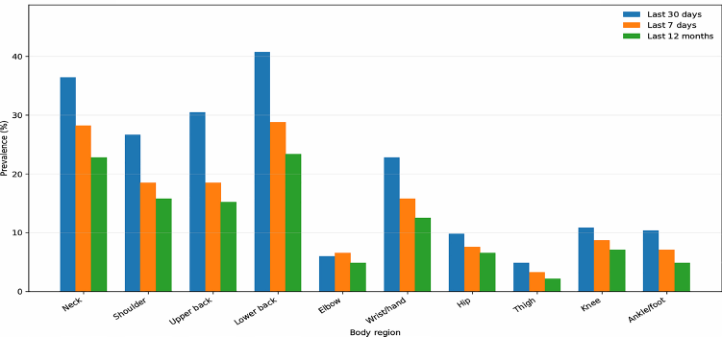
Prevalence of Musculoskeletal Pain and Key Predictors Musculoskeletal pain was most frequently reported in the lower back, neck, and upper back regions, as shown in Figure 1. Pain in other body regions was less prevalent.
Figure 1: Prevalence of musculoskeletal pain by body region and recall period (n = 184).
In the last 7 days, the most frequent pain sites were the lower back (28.8%) and neck (28.3%), followed by the shoulder and upper back (18.5% each).
The apparent chronicity of shoulder pain was strong when shorter recall periods were compared with 12-month shoulder pain. For shoulder pain, 26 of 49 participants who reported pain in the last 30 days also reported 12-month pain, compared with 3 of 135 participants without 30-day shoulder pain, yielding a crude OR of 49.74 (95% CI: 13.91–177.92). Similarly, 26 of 34 participants with shoulder pain in the last 7 days also reported 12-month pain, compared with 3 of 150 participants without 7-day shoulder pain, yielding a crude OR of 159.25 (95% CI: 39.63–639.94). These large estimates should be interpreted cautiously because they are influenced by very small cell counts in the non-recent-pain groups.
To clarify the large odds ratios observed for shoulder pain chronicity, Table 1 presents the underlying 2 × 2 counts and crude odds ratios based on the comparison between recent pain and 12-month pain.
Table 1: Crude odds ratios for shoulder pain chronicity based on shorter recall periods and 12-month pain (n = 184).
Table available in the original PDF paper.
OR 95% CI
Comparison 12-Month Pain: Yes Among Exposed
12-Month Pain: No Among Exposed
12-Month Pain: Yes Among Unexposed
12-Month Pain: No Among Unexposed
26 23 3 132 49.74 13.91– 177.92
Shoulder pain in last 30 days vs no shoulder pain in last 30 days
26 8 3 147 159.25 39.63– 639.94
Shoulder pain in last 7 days vs no shoulder pain in last 7 days Note: OR = crude odds ratio. The odds ratios compare the odds of reporting shoulder pain in the last 12 months among participants with recent shoulder pain versus those without recent shoulder pain.
These estimates should be interpreted cautiously because the small number of participants with 12-month shoulder pain but without recent shoulder pain may have inflated the odds ratios.
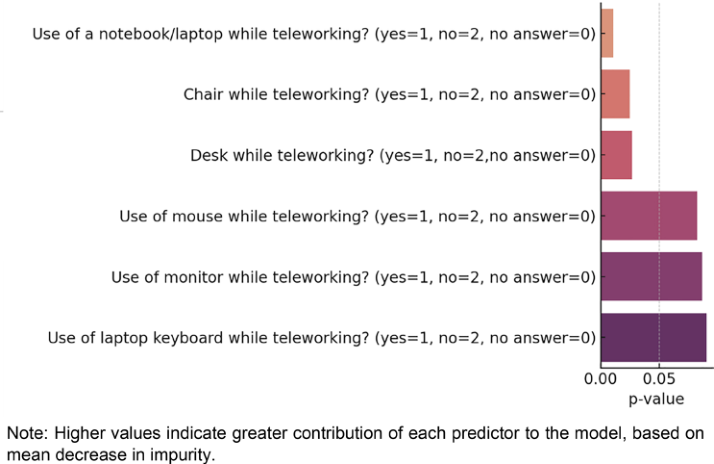
Figure 2 shows the relative importance of workstation and environmental predictors of musculoskeletal pain in the Random Forest model.
Figure 2: Relative importance of workstation and environmental predictors of musculoskeletal pain in the random forest model.
The main workplace predictors included notebook use, mouse and chair use, and prolonged sitting time. Suboptimal temperature control also emerged as a potential predictor in the models.
DISCUSSION
This study examined the prevalence of musculoskeletal pain among Brazilian teleworkers and explored ergonomic, environmental, and work-context factors associated with musculoskeletal outcomes, using complementary statistical and machine-learning approaches.
Prevalence and Distribution of Musculoskeletal Pain The high prevalence of musculoskeletal pain observed in this sample is consistent with growing evidence that telework, particularly when implemented rapidly and without adequate ergonomic support, is associated with increased musculoskeletal complaints. Lower back and neck pain were the most frequently reported, which aligns with other studies (Radulovic et al., 2021; Larrea-Araujo et al., 2021; Du et al., 2022), as well as participants’ reports of prolonged sitting, non-adjustable furniture, and extensive computer use.
Both bivariate and multivariable analyses highlighted the relevance of workstation configuration, mouse and chair use, thermal comfort, and prolonged sitting time in relation to musculoskeletal pain. These findings reinforce established ergonomic principles, indicating that sustained static postures, inadequate seating, and suboptimal environmental conditions contribute to musculoskeletal strain.
Musculoskeletal symptoms were highly prevalent among the surveyed remote workers, with more than half of the participants reporting pain in at least one body region. The most frequently affected sites were the lower back, neck, and shoulders, consistent with sustained seated work and intensive computer-based tasks. Beyond descriptive prevalence, poorer self- rated health status and physical inactivity were significantly associated with higher pain occurrence, suggesting that both general health perception and lifestyle factors contribute meaningfully to musculoskeletal vulnerability in telework contexts.
The regression analyses supported the relevance of workstation and environmental factors for region-specific musculoskeletal pain. In particular, mouse and chair use, suboptimal temperature control, and prolonged sitting time were consistently highlighted. The persistence analysis indicated marked chronicity for shoulder pain when short-term recall (7-day and 30-day) was compared with 12-month pain.
Limitations and Future Research Directions This study has several limitations. Its cross-sectional design precludes causal inference and temporal prediction of musculoskeletal outcomes. All data were self-reported, which may introduce recall or reporting bias, particularly for pain outcomes. Additionally, the sample consisted largely of highly educated teleworkers, which may limit generalizability to other occupational groups. The exposure-only Random Forest model was constrained by class imbalance, resulting in limited sensitivity at default thresholds. Future longitudinal studies with objective ergonomic assessments and repeated symptom measurements are needed to validate these findings and refine predictive screening approaches.
Musculoskeletal Pain in Teleworkers in Brazil 7 Future research should prioritize longitudinal designs to examine causal pathways between telework exposures and musculoskeletal outcomes. Integrating objective measures, such as posture tracking, computer-use logs, or wearable sensors, may improve risk prediction and reduce reliance on self-report. Moreover, threshold optimization and cost-sensitive learning approaches could enhance the practical utility of exposure-only screening models for occupational health surveillance in telework environments.
CONCLUSION
Musculoskeletal pain was highly prevalent in this sample of teleworkers, particularly in the lower back, neck, and upper back. The results point to modifiable workstation and environmental factors - mouse and chair use, thermal comfort, and prolonged sitting time - as key targets for preventive action. Although the chronicity of shoulder pain may need further investigation of clinical comprovation, it reforces the need for early ergonomic assessment, guidance, and monitoring to prevent symptom in home-based work settings.
REFERENCES
Bosma E; Loef B; Van Oostrom S; Proper, KI. (2023) The longitudinal association between working from home and musculoskeletal pain during the COVID-19 pandemic. Int Arch Occ Environ Health, 96:521-535. https://doi.org/10.1007/ s00420-022-01946-5 Cruz-Ausejo L, Copez-Lonzoy A, Vilela-Estrada AL, Valverde JJ, Bohórquez M,
Moscoso-Porras M. (2023) Can working at home be a hazard? Ergonomic factors associated with musculoskeletal disorders among teleworkers during the COVID-19 pandemic: A scoping review. Int J Occup Saf Ergon, 29 (4): 1335– 1344. https://doi.org/10.1080/10803548.2022.2127246. Du T, Iwakiri K, Sotoyama M, Tokizawa K. (2022) Computer and furniture affecting musculoskeletal problems and work performance in work from home during COVID-19 pandemic. J Occup Environ Med, 64(11):964–9. https://doi. org/10.1097/JOM.0000000000002622 Garcia, MG: Aguiar, B., Bonilla, S.; Yepez, N; Martin, BJ. (2024) Perceived
Physical Discomfort and Its Associations With HomeOffice Characteristics During the COVID-19 Pandemic. Human Factors, 66(3) 916–932. https://doi. org/10.1177/00187208221110683. Kadri Filho F, De Lucca SR. (2022) Telework conditions, ergonomic and psychosocial risks, and musculoskeletal problems in the COVID-19 pandemic. J Occup Environ Med, 2022;64(12): e811-7. https://doi.org/10.1097/JOM.0000000000002704 Larrea-Araujo C, Ayala-Granja J, Vinueza-Cabezas A, Acosta Vargas P. (2021)
Ergonomic risk factors of teleworking in Ecuador during the COVID-19 pandemic: a cross-sectional study. Int J Environ Res Public Health,18(10):5063. https://doi.org/10.3390/ijerph18105063 Milaković M, Koren H, Bradvica-Kelava K, Bubaš M, Nakić J, Jeličić P, Bucić L, Bekavac B, Čvrljak J and Capak M. (2023) Telework-related risk factors for musculoskeletal disorders. Front. Public Health, 11:1155745. https://doi. org/10.3389/fpubh.2023.1155745 Radulovic AH, Žaja R, Milošević M, Radulović B, Luketić I, Božić T. (2021) Work
from home and musculoskeletal pain in telecommunications workers during COVID-19 pandemic: a pilot study. Arh Hig Rada Toksikol, 72:232–239. https:// doi:10.2478/aiht-2021-72-3559
LISTED IN THE AHFE DIGITAL BOOKSTORE CATALOGUE
Explore the complete digital volume
Physical Ergonomics and Human Factors
Read this individual research paper free through the original publisher, or explore the full digital proceedings book.
ISBN 978-1-964867-99-1
Explore this ISBN in the AHFE Bookstore ↗Listed in the July 2026 bookstore catalogue; search by ISBN to confirm current availability · Digital book purchase optional