Vesna Spasojevic Brkic, Martina Perišić, Nemanja Janev, Aleksandar Brkic (2025). Quality Tools Application in Examining Discomfort Issues at Mining Machinery Operators’ Workplaces. In: Human Factors and Systems Interaction. AHFE Open Access, vol. 192, pp. 147–156. https://doi.org/10.54941/ahfe1006637
The significance of evaluating human factors issues encountered at mining machinery operation greatly exceeds the amount of available research, given that accidents in mining operations continue to be a recurring concern. This study included 97 Serbian mining machinery operators, who answered the questionnaire which examines injuries and discomfort issues at mining machinery operators’ workplaces. Descriptive statistics was conducted followed by quality tools: Pareto (ABC), Ishikawa, and control charts were performed. ABC analysis found that 41.7% of operators complained to back pain, mostly due to poor working conditions. Back pain is caused by repetitive movements, poor anthropometric adjustments, lack of training, environmental factors, and vibrations, according to the Ishikawa diagram. The attribute control chart shows that no points exceed the lower and upper limits. Thus, examined processes are controlled. A future research avenue is further data collection and expansion of the sample size, as well as the application of other quality tools.
With more people killed or injured than in any other business, the mining sector is still one of the leading contributors of pollution (Misita et al., 2024). Although the frequency of mining fatalities has significantly decreased, there are still a lot of these events (Kecojevic et al., 2007; Duarte et al., 2019; Noraishah Ismail et al., 2021). Careful evaluation of issues pertaining to corporate social responsibility, economic and environmental sustainability is necessary for the sustainable management of mining operations. The three sustainability-related challenges mentioned above for a mining operation force creation of new business models (Choi, 2015).
Ergonomics can certainly help since it aims to maximize performance (including productivity, health, and safety) by balancing the demands of mining work systems with the capabilities and limitations of mining machinery operators (Dempsey et al., 2018). Accordingly, the ergonomic adaption of the workplace, adherence to safety protocols and policies,
organizational and similar influencing variables are crucial in preventing incidents or accidents involving mining machinery and operator safety issues (Misita et al., 2024).
Since accidents involving heavy machinery operations have not significantly decreased, the importance of researching the ergonomic convenience of mining machines much outweighs the quantity of published publications. The reliability and validity of the questionnaire, which was recently adopted to investigate human factors issues in the workplaces of mining machinery operators, have been established by prior research such as Spasojevi´c Brki´c et al. (2024a), Spasojevi´c Brki´c et al. (2024b), and Misita et al. (2024). Quality tools are numerous and powerful concepts, techniques, methods, studies, and means, aimed at quality improvement (Spasojevic Brkic et al., 2013; Tomic et al., 2017), which are rarely used in the human factors field. The purpose of this paper is to examine data collected by the questionnaire about the workplace of mining machinery operators and apply quality tools such as Pareto/ABC analysis, Ishikawa diagrams, and control charts in aim to define the major discomfort problems of mining machine operators, its causes and possible solutions. It is structured as follows: previous research, methodology, results that contains Pareto analysis, Ishikawa analysis and p control chart and conclusions.
PREVIOUS RESEARCH The work of mining machinery operators is not ergonomically adapted enough, so the low safety, performance, and pollution indicators are not surprising (McPhee, 2004; Spasojevic Brkic et al., 2024a).
Whole-body vibration exposures when operating machines and vehicles, as well as the design of machinery for mining operations and maintenance, are becoming increasingly important concerns (Eger et al., 2007). Although the mining industry has acknowledged the connection between back and neck pain and extended sitting, inadequate cab design, and vibration, it has not yet taken any systematic action to address this issue (McPhee, 2004). A number of studies found links between the prevalence of operators’ low back pain and psychological risk factors (Sen et al., 2020). Mining machinery operators also may need to wear hearing protection devices since operating heavy mining equipment in underground mines has been found to be a source of noise that can cause hearing loss (Camargo et al., 2009; Manwar et al., 2016; Sen et al., 2020). Recently, it is evidenced that seat rotation, sick leave from work due to poor working conditions, and nonadjustable armrests or armrests that are not adjusted to the proper height are the main factors influencing the decline in the quality of the working conditions for operators on mining machines (Spasojevi´c Brki´c et al., 2024b).
The mining industry has recently shown an increasing interest in risk assessment and management challenges, as seen by the large number of publications and papers that focus on these issues (Tubis et al., 2020). For instance, risk based thinking and usage of the Fine and Kinney’s method, Plan-Do-Check-Act (PDCA) methodology and Strengths-Weaknesses-Opportunities-Threats (SWOT) analysis becomes very
Quality Tools Application in Examining Discomfort Issues 149
important in mining industry in aim to upgrade occupational safety management Rudakov et al. (2021). Also, there are certain risk assessment tools that has been developed for use as a leading indicator Hamman et al. (2019). Application of quality tools in upgrading mining operations is rarely applied (Isheyskiy and Sanchidrián, 2020). In that aim this paper focuses on quality tools application in examining discomfort issues at mining machinery operators’ workplaces.
METHODOLOGY
In this study, a questionnaire used contained demographic data, data about injuries and 8 questions about discomfort issues of operators in cabin interior space was utilized. The operators rated questions on a Likert scale of 1 to 5, with 1 indicating “strongly disagree” and 5 indicating “strongly agree”. Table 1 presents the list of questions in the questionnaire.
A total of 95 to 97 mining machinery operators (n), depending of the question, took part in the questionnaire. Their average age was 37.8 years, their stature was 179.37mm and weight 89.14kg in average. Mining machines that they operate were 5.9 years old.
Descriptive statistics of the received responses on questions were made; i.e., the range (R), minimum (Min), maximum (Max), mean (Mean), median (Med), standard deviation (SD), variation (Var), and measure of asymmetry were calculated and shown in Table 2. Subsequently, various quality tools were utilized on the gathered data, including the Pareto diagram, Ishikawa diagram, and p control charts.
Pareto and/or ABC analysis is common classification method (Dhoka, 2013) that distinguishes a notable minority from a less significant majority. The Ishikawa diagram is a tool utilized to analyze and illustrate the relationship between a specific effect and its possible causes (Ishikawa, 1986). Finaly, control charts serve as a graphical tool for assessing the stability of a process (Ishikawa, 1986). There are a couple of different kinds of control charts, such as p charts or x-R, but in this study, p charts are chosen because they show the characteristics of both the mean and the dispersion of the data process (Ishikawa, 1986).
Table 1: Questions about operators’ discomfort in cabin space.
Table available in the original PDF paper.
Mark Question Q1 I feel discomfort in some part of my body as a result of the reduced comfort in the cabin. Q2 I feel pain in some part of my body as a result of reduced comfort in the
cabin. Q3 I feel pain in my hands as a result of reduced comfort in the cabin. Q4 I feel pain in my legs as a result of reduced comfort in the cabin. Q5 I feel pain in my head as a result of reduced comfort in the cabin. Q6 I feel pain in my torso as a result of reduced comfort in the cabin. Q7 I feel pain in my neck as a result of reduced comfort in the cabin. Q8 I feel pain in my back as a result of reduced comfort in the cabin.
This section presents results on Pareto analysis, and application of Ishikawa diagram and control charts in analyzing discomfort issues.
Pareto Analysis and Ishikawa Diagram
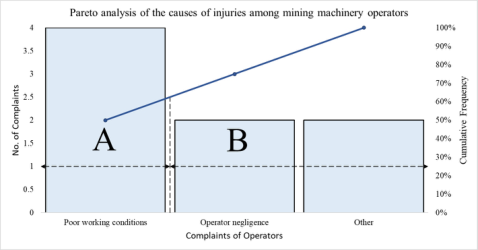
Table 3 presents the causes of operator injuries along with their respective counts and there can be seen that poor working conditions has the highest number of complaints.
Table 3: Causes of operator’s injuries.
Table available in the original PDF paper.
Cause of Injury No. of Complaints Poor working conditions 4 Operator negligence 2 Other 2 Total 8
Based on the data from Table 3, a Pareto analysis was conducted and its results are shown in Figure 1.
Figure 1: Pareto analysis of the relationship between the number of injuries and the causes of injuries to mining machine operators.
Quality Tools Application in Examining Discomfort Issues 151
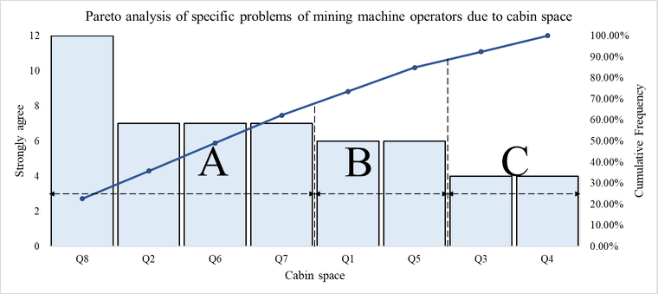
Furthermore, a Pareto analysis of the questions was conducted to identify only those who rated pain in a specific body part as a result of reduced comfort in mining machinery cabin with the highest score of 5. Table 4 contains the data for this analysis, while Figure 2 illustrates the Pareto analysis.
Figure 2: Pareto analysis of specific problems of mining machine operators.
The final Pareto analysis included the total number of operators who complained on the pain in a specific body part. The area of greatest increase (A) includes the following complaints due to the cabin space: I feel pain in some part of my body as a result of reduced comfort in the cabin, I feel pain in my torso as a result of reduced comfort, I feel pain in my neck as a result of reduced comfort and I feel pain in my back as a result of reduced comfort.
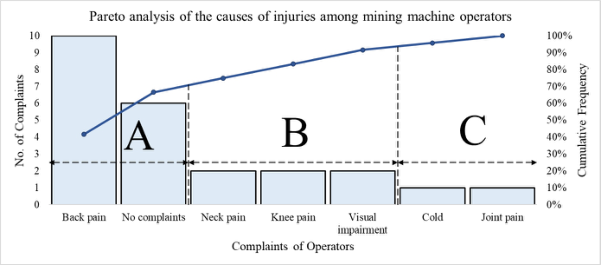
Specific operator complaints are given in Table 5, and the Pareto analysis on those issues is shown in Figure 3.
Table 5: Specific operator’s complaints.
Table available in the original PDF paper.
Complaints of Operators No. of Complaints Back pain 10
Continued
152 Brki´c et al.
Table 5: Continued Complaints of operators No. of complaints
Table available in the original PDF paper.
No complaints 6 Neck pain 2 Knee pain 2 Visual impairment 2 Cold 1 Joint pain 1 Total 24
Figure 3: Pareto (ABC) analysis of the number of complaints of mining machine operators.
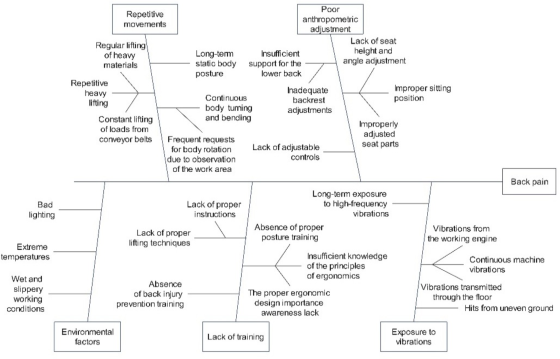
Pareto (ABC) analysis shows that the back pain is the most common cause of complaints. Considering that the Pareto (ABC) analysis indicated that the majority of complaints related to back pain (Figure 3), an Ishikawa diagram was created to identify the causes of the back pain and its sub-causes, since it is the most common cause, as illustrated in Figure 4.
Figure 4: Ishikawa diagram about back pain causes.
Quality Tools Application in Examining Discomfort Issues 153
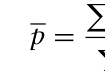
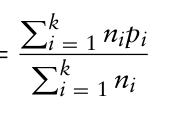
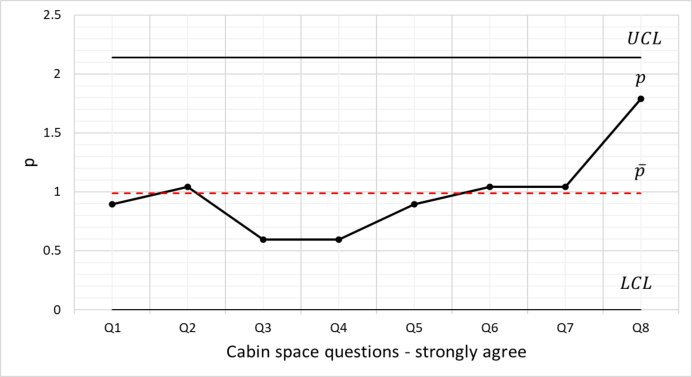
Control Charts A p control chart was created for the questionnaire. Table 6 presents the proportions, specifically the p-values, for the response “strongly agree,”while Figure 5 illustrates the control chart corresponding to these responses. The p value is calculated using the formula:
Pk
(1)
Equation reproduced from the original PDF.Equation reproduced from the original PDF.
Where Pk
Equation reproduced from the original PDF.
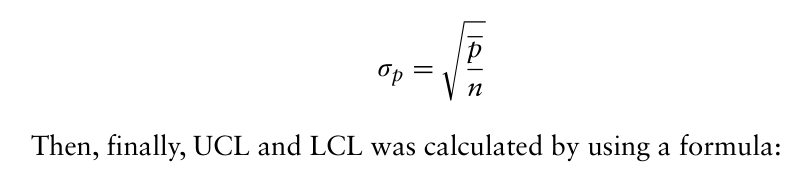
i = 1 ni is total number of answers. In order to calculate the upper (UCL) and lower (LCL) control limits, the standard deviation was first calculated, according to the formula:
Equation reproduced from the original PDF.Table 6: Shares of the “strongly agree” answers about discomfort in cabin space.
The analysis showed that no point exceeds the lower and upper control limits, which means that this process is under control, that is, that only random causes of variation can occur, and it can be considered a stable process.
154 Brki´c et al.
Figure 5: p control chart of “strongly agree” answers about discomfort in cabin space.
CONCLUSION
Since accidents involving heavy machinery operations have not dramatically decreased up to this this case, the importance of researching the ergonomic convenience of mining machines much outweighs the quantity of published publications. The reliability and validity of the questionnaire, which was recently adopted to investigate human factors issues in the workplaces of mining machinery operators, have been established by prior research. The purpose of this article was to examine the workplace of mining machinery operators using high-quality methods such as Pareto/ABC analysis, Ishikawa diagrams, and control charts. First, 96 mining equipment operators in Serbia completed the questionnaire. The information gathered was then subjected to an analysis using descriptive statistics. The response to the question “I feel discomfort in some part of my body as a result of reduced comfort in the cabin” had the lowest mean value in the range of 1.72- 2.08; nevertheless, the median had values of 3 and 4, indicating the need for additional analysis. According to the applied ABC analysis, the following attitudes of mining machine operators are grouped: back pain complaints and no complaints, within the area of the highest rise, that is, the area that contains the majority of the most operator complaints (A). Neck pain, knee pain, and vision problems are the three main reasons why mining machine operators complain, and they are all found in the area of considerable expansion (B). The complaints of mining equipment operators in Area (C), which is characterized by modest growth, include joint pain and cold. Back pain was listed by operators as one of the most frequent complaints (41.7%). Additionally, since poor working conditions account for half of the most frequent reasons why operators sustain accidents at work, Pareto analysis demonstrates that these conditions are the primary source of operator complaints. The Ishikawa diagram is used to analyze
Quality Tools Application in Examining Discomfort Issues 155
the reasons of poor working conditions and back discomfort in greater depth. Repetitive motions, poor anthropometric adjustment, lack of training, environmental factors, and vibration exposure are the main causes of back pain. On the other hand, poor lighting, wet and slippery conditions, extreme temperatures, unfavorable working positions, noise exposure, and the presence of toxic substances were the main causes of inadequate working conditions. Following the implementation of attribute control charts, analysis revealed that no point exceeded the lower and higher control boundaries. As a result, the processes under examination are under control, meaning that only random sources of variation can arise, and they may be regarded as stable processes. We could identify the main discomfort issues faced by mining machine operators and which concerns require particular attention based on the findings of the study of the use of the quality tools on the input data. Additional data gathering, sample size increase, and the use of other quality tools to address operator ergonomic issues are potential directions for future research.
ACKNOWLEDGMENT
This research was supported by the Science Fund of the Republic of Serbia, #GRANT No. 5151, Support Systems for Smart, Ergonomic and Sustainable Mining Machinery Workplaces – SmartMiner and by the Ministry of Science, Technological Development and Innovation of the RS - Agreement on financing the scientific research work of teaching staff at accredited higher education institutions in 2024, no. 451-03-65/2024-03/200105 and Eureka project No. 20495, Smart Toolbox for Mining’s Resilience, Sustainability And Financial Performance Improvement - SMARTMEN.
REFERENCES
Camargo, Hugo E., Smith, Adam K., Kovalchik, Peter G. and Matetic, Rudy J. (2009). Noise Source Identification on a Continuous Mining Machine, in: American Society of Mechanical Engineers pp. 187–194. Choi, Tsan-Ming (2015). Sustainable Management of Mining Operations with
Accidents: A Mean-Variance Optimization Model, Resources Policy Volume 46, pp. 116–122. Dempsey, Patrick G., Kocher, Lydia M., Nasarwanji, Mahiyar F., Pollard, Jonisha P.
and Whitson, Ashley E. (2018). Emerging Ergonomics Issues and Opportunities in Mining International Journal of Environmental Research and Public Health Volume 15, No. 11, pp. 2449. Dhoka, Dinesh (2013). ABC Classification for Inventory Optimization IOSR Journal of Business and Management Volume 15 No. 1 pp. 38–41. Duarte, J., Baptista, João S. and Torres Marques, A. (2019). Occupational Accidents
in the Mining Industry—A Short Review, in Occupational and Environmental Safety and Health, Arezes, Pedro M., Baptista, João S., Barroso, Mónica P., Carneiro, Paula., Cordeiro, Patrício, Costa, Nélson, Melo, Rui B., Miguel, A. Sérgio, and Perestrelo, Gonçalo (Eds.). pp. 61–69. Eger, T., Salmoni, A., Cann, A., and Jack, R. (2007). Whole-body vibration exposure experienced by mining equipment operators. Occupational Ergonomics, 6(3-4), pp. 121–127.
156 Brki´c et al.
Isheyskiy, Valentin and Sanchidrián, José A. (2020). Prospects of Applying MWD Technology for Quality Management of Drilling and Blasting Operations at Mining Enterprises, Minerals Volume 10, No. 10, pp. 925. Ishikawa, Kaoru (1986). Guide to Quality Control; Tokyo: Asian Productivity
Organization. Kecojevic, Vladislav. Komljenovic, Dragan. Groves, William and Radomsky, Mark (2007). An Analysis of Equipment-Related Fatal Accidents in U. S. Mining Operations: 1995–2005, Safety Science Volume 45 No. 8 pp. 864–874. Manwar, Veena D., Mandal, Bibhuti B. and Pal, Asim K. (2016). Environmental
Propagation of Noise in Mines and Nearby Villages: A Study Through Noise Mapping, Noise and Health Volume 18, No. 83, pp. 185. McPhee, B. (2004). Ergonomics in Mining. Occupational Medicine Volume 54, No. 5, pp. 297–303. Misita, Mirjana. Brki´c, Aleksandar. Mihajlovi´c, Ivan. Ðuri´c, Goran. Stanojevi´c,
Nada. Bugari´c, Uglješa and Spasojevi´c Brki´c, Vesna (2024). Decision Support System for Mining Machinery Risk Mitigation Driven by Ergonomics and Contextual Theory, Applied Sciences Volume 14, No. 15. pp. 6413. Noraishah Ismail, Siti, Ramli, Azizan and Abdul Aziz, Hanida (2021). Research Trends in Mining Accidents Study: A Systematic Literature Review, Safety Science Volume 143, pp. 105438. Rudakov, Marat, Gridina, Elena and Kretschmann, Jürgen (2021). Risk-Based
Thinking as a Basis for Efficient Occupational Safety Management in the Mining Industry, Sustainability Volume 13, No. 2, pp. 470. Sen, Abhijit, Sanjog, Jayakumar and Karmakar, Sougata (2020). A Comprehensive Review of Work-Related Musculoskeletal Disorders in the Mining Sector and Scope for Ergonomics Design Interventions, IISE Transactions on Occupational Ergonomics and Human Factors Volume 8, No. 3, pp. 113–131. Spasojevic Brkic, Vesna. Djurdjevic, Tijana. Dondur, Nikola. Klarin, Milivoj and
Tomic, Branislav (2013). An empirical examination of the impact of quality tools application on business performance: Evidence from Serbia. TOTAL Quality Management & Business Excellence, Volume 24, Nos. 5–6, pp. 607–618. Spasojevi´c Brki´c, Vesna. Mihajlovi´c, Ivan. Brki´c, Aleksandar. Misita, Mirjana and Periši´c, Martina (2024a). Transport and Mining Machinery Cabins’ Ergonomic Evaluation as a Path to Its Redesign, International Journal of Occupational Safety and Ergonomics Volume 30, No. 3, pp. 896–906. Spasojevi´c Brki´c, Vesna. Misita, Mirjana. Papic, Neda. Brkic, Aleksandar and
Periši´c, Martina (2024b). Ergonomic Adjustment Needs of Transport and Mining Machines: A Preliminary Study of Operators’ Attitudes in Serbia, in: Human Factors and Systems Interaction. AHFE Tomic, Branislav. Spasojevi´c Brki´c, Vesna. Karapetrovic, Stanislav. Pokrajac, Slobodan. Milanovi´c, Dragan. Babi´c, Bojan and Djurdjevic, Tijana (2017). Organizational culture, quality improvement tools and methodologies, and business performance of a supply chain. Proceedings of the Institution of Mechanical Engineers, Part B: Journal of Engineering Manufacture, Volume 231, No. 13, pp. 2430–2442. Tubis, Agnieszka. Werbi´nska-Wojciechowska, Sylwia and Wroblewski, Adam
(2020). Risk Assessment Methods in Mining Industry—A Systematic Review, Applied Sciences Volume 10, No. 15. pp. 5172.
LISTED IN THE AHFE DIGITAL BOOKSTORE CATALOGUE
Explore the complete digital volume
Human Factors and Systems Interaction
Read this individual research paper free through the original publisher, or explore the full digital proceedings book.
ISBN 978-1-964867-68-7
Explore this ISBN in the AHFE Bookstore ↗Listed in the July 2026 bookstore catalogue; search by ISBN to confirm current availability · Digital book purchase optional