Jose Lopez, Eshwara Prasad Sridhar, Tazim Ahmed, Yiran Yang, Shuchisnigdha Deb (2025). Developing Effective VR Training Simulations for Additive Manufacturing: A Modular Usability-Driven Design Approach. In: Human Factors and Systems Interaction. AHFE Open Access, vol. 192, pp. 10–18. https://doi.org/10.54941/ahfe1006623
Hands-on training for additive manufacturing (AM) often faces hurdles like high costs, safety concerns, and limited accessibility. Virtual Reality (VR)-based simulated environments present viable solutions by offering immersive, resource-efficient, and flexible learning environments. This paper introduces a modular, usability-driven design framework for developing effective VR training simulations for Powder Bed Fusion (PBF) processes in AM. Aimed at educators and developers, the framework features distinct modules covering VR familiarization, foundational PBF concepts and safety protocols, guided operational steps, and unguided practice. Key design principles include smooth teleportation for navigation minimizing simulation sickness, clear visual and auditory guiding cues, and accessibility considerations. The framework was evaluated with 12 students using the Simulator Sickness Questionnaire (SSQ) and the System Usability Scale (SUS). Results showed no participant withdrawal due to simulation sickness. System usability was rated favorably on a five-point scale, with most SUS scores between 68 and 78, indicating good to excellent usability. Participants reported confidence (3.25 ±0.45) while using this VR training platform and they required minimal technical support (0.67 ±0.65). This framework provides practical guidance for creating engaging, safe, and effective VR training for additive manufacturing.
Additive manufacturing (AM) has growing applications across industries (Haleem & Javaid, 2019) with rapid growth for 3D printing. The global AM market reached $25.92 billion in 2025 and is projected to grow to $125.94 billion by 2034, highlighting its economic impact (Zoting, 2025). Consequently, integrating AM skills into educational programs addresses the need to prepare students for the industrial landscape and meet the demand for AM expertise (Borgianni et al., 2022). Hands-on experience helps students
Developing Effective VR Training Simulations for Additive Manufacturing 11
obtain skills needed to thrive in this industry, while more detailed knowledge prepares them for complex roles (To et al., 2025).
However, traditional hands-on training for Powder Bed Fusion (PBF)- based 3D printing faces considerable obstacles. The prohibitive cost of certain PBF machines ($170k-$400k+) and materials ($260-$450/kg) creates substantial financial hurdles for educational institutions (Lydia, 2025). Significant operational expenses, energy demands, and lengthy manufacturing times are ill-suited to academic schedules and further constrain practical training. Safety requirements for handling potentially hazardous metal powders (due to flammability and inhalation risks) compound these issues, necessitating complex protocols and adding further complexity to the learning environment. Overcoming these challenges is vital for practical and sustainable education solutions.
Prior research has shown that VR can improve student understanding, engagement, and skill development in engineering education (Campos et al., 2022, Hidrogo and Zavala, 2022; van der Meer et al., 2023; Ghazali et al., 2024; Mørk et al., 2024). It creates immersive learning environments without physical materials, saving resources, and offers scalable access to virtual equipment, addressing limitations like high costs and access to physical machines. Simulations, particularly through VR, foster quicker learning with immediate feedback and repeated training while offering a safe environment for practicing operational procedures involving hazardous materials.
While studies show VR boosts engagement and performance, a gap persists in developing a comprehensive framework for PBF training. Earlier studies have demonstrated effective system design for experiential learning in additive manufacturing and highlighted the use of VR in engineering education (Ahmed et al., 2024; Ghazali et al., 2024; Rafa et al., 2024). Building on these previous works, our current study extends these findings with a focus on a modular VR framework for PBF training.
This paper focuses on a design framework for creating VR training applications for PBF additive manufacturing. While VR is used in broader manufacturing training, this work provides details relevant to PBF requirements. The framework outlines design stages using a user-centered approach based on established VR user experience (UX) practices. It has a modular structure adaptable to different languages, courses, skill levels (from basic navigation to advanced PBF operations), and potentially other AM technologies. By addressing elements like navigation, user interaction, simulation sickness mitigation, and accessibility, this framework aims to guide the development of usable VR training tools that support learning outcomes in AM education.
METHODOLOGY & DESIGN FRAMEWORK Our methodology has three main parts: the overall design framework, key design considerations, and the evaluation methodology.
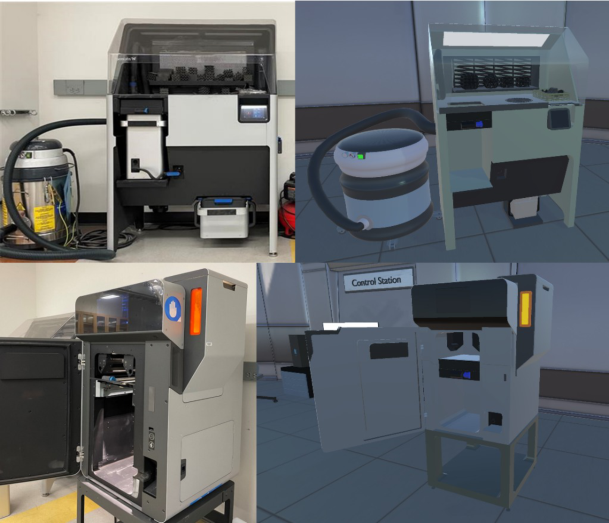
Overall Design Framework We designed a one-to-one digital model of the PBF printer (Figure 1), with every element closely matching the physical dimensions and layout of the
actual equipment. This replication enabled users to experience realism, ensuring the training experience is engaging and directly transferable to practical operations (Newman et al., 2022). Creating the 1:1 scaled digital model of the printer laid the foundation for our modular design.
Figure 1: Physical PBF stations vs. digital model.
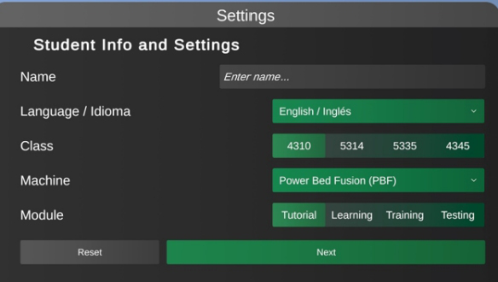
The VR training environment is accessed using a scene selector that directs users into four modules (See Figure 2) The first module (VR familiarization) is an introductory tutorial that teaches basic VR navigation and interaction. This module helps users get comfortable with the platform before progressing to more advanced tasks. The second module covers core concepts, including the basic features of additive manufacturing, printer safety, and material handling. The third module provides guided training that explains each step of the printer’s operation. The fourth module is an unguided practice area where users can work through the workflow and apply what they have learned. This modular approach offers flexibility and supports adaptive learning by allowing users to progress at their own pace and revisit modules as needed.
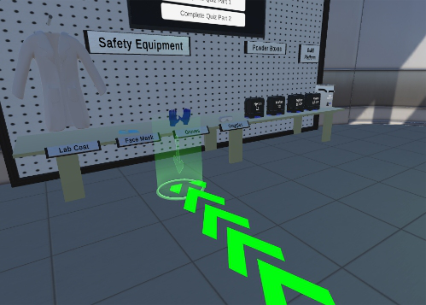
Design Considerations Navigation and Locomotion Navigation is directed by simple arrows on the ground to guide users through the environment (Figure 3). Locomotion within the VR environment is done using teleportation. This aimed to reduce simulation sickness, a common issue of continuous virtual space movement. Teleportation allows users to
Developing Effective VR Training Simulations for Additive Manufacturing 13
move between locations instantly, minimizing sensory mismatches that lead to discomfort (Khundam, 2021). This design choice ensures that users can focus on learning and interacting with the training content without being distracted or hindered by physical discomfort.
Figure 2: VR scene selector with modules.Figure 3: Navigation and locomotion guidelines.
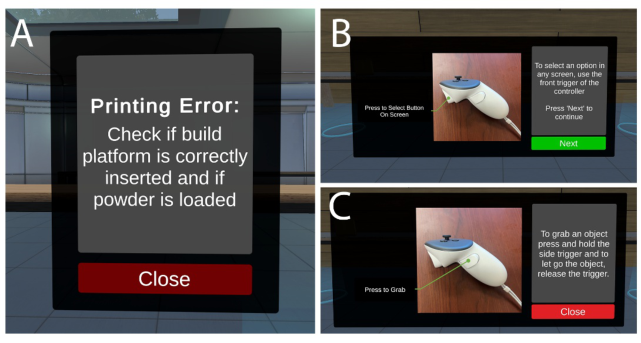
Interaction and User Interface (UI) The user interface is designed for simplicity and clarity. Color-coded buttons provide visual cues for different functions (Figure 4), while auditory feedback confirms actions when a user interacts with an object or completes a task. This approach reduces cognitive load, making it easier for users, especially beginners, to navigate the system. An intuitive interface allows users to focus on learning the PBF process rather than operating the system, ensuring a productive training experience.
The training framework uses inclusive design to support all learners. Clear visual contrast and additional language instructions (Spanish) help accommodate varying needs. These measures remove barriers and make the VR environment more accessible, allowing a wider range of users to benefit from the training without difficulty.
Figure 4: User interface (A – Red “Close” button for error check; B – Green “Next” button for tutorial screen; C – Red “Close” button for tutorial screen).
Evaluation We implemented the VR training module in a classroom with 12 student participants drawn from additive manufacturing and engineering education courses. This controlled setting helped us monitor system performance and gather data on usability.
The Simulator Sickness Questionnaire (SSQ) measured three symptom categories: nausea, oculomotor discomfort, and disorientation (Kennedy et al., 1993). The SSQ consisted of 16 items rated on a 4-point scale from 0 (none) to 4 (severe). In our study, participants completed the SSQ at three points: before putting on the VR headset, after a 5-minute familiarization tutorial, and after a 15-minute training session.
The System Usability Scale (SUS), with ten items, was used to evaluate our VR training tool’s usability (Brooke, 1996). Respondents rated statements on a 5-point scale, from 1 (strongly disagree) to 5 (strongly agree). These responses were converted to a score out of 100, with higher scores indicating better usability. In our evaluation, scores above 68 are considered good, while those above 73 are considered excellent (Bangor et al., 2008; Deb et al., 2017).
Experimental Procedure The experimental procedure was divided into several steps. First, participants attended a VR familiarization session to learn basic navigation and interaction, ensuring they felt comfortable in the virtual space. Next, they engaged with the system’s modules, moving from a guided operational walkthrough to an unguided practice session. Throughout the training, we periodically evaluated participants using the SSQ to monitor for any simulation sickness. After completing the training, participants completed the SUS survey to share their feedback on the system’s ease of use, complexity,
Developing Effective VR Training Simulations for Additive Manufacturing 15
and overall experience. This process helped us gather performance data while keeping users safe and engaged.
RESULTS AND DISCUSSION
Simulator Sickness (SSQ Outcomes) No participant scored above five at any stage, indicating that the system effectively minimized simulation sickness. These results suggest that the design choices allowed users to engage with the VR training without significant discomfort.
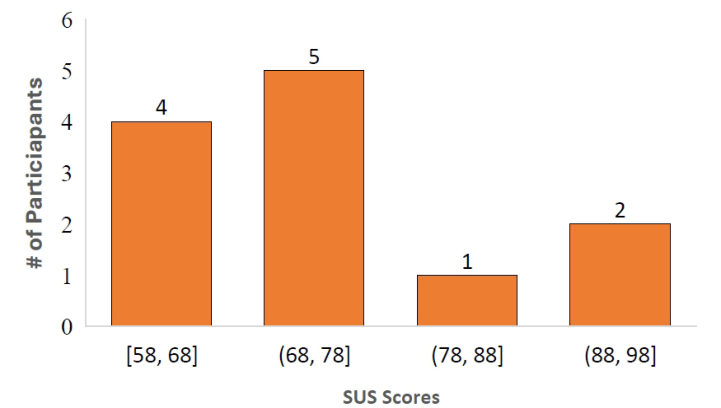
Usability (SUS Outcomes) Usability was evaluated using the System Usability Scale (SUS). Figure 5 shows that most participants rated the system in the 68 to 78 range. Table 1 lists the average responses and standard deviations for each of the ten SUS items, covering ease of use, complexity, confidence, and learnability.
Figure 5: Distribution of system usability scale (SUS) scores among participants.
Positive feedback was seen for statements like “I think that I would like to use this system frequently” (Mean = 3.25, SD = 0.45) and “I felt very confident using the system” (Mean = 3.25, SD = 0.62), showing that users felt comfortable and confident. Some moderate ratings for statements such as “I found the system very cumbersome to use” (Mean = 1.67, SD = 0.89) and “I thought there was too much inconsistency in this system” (Mean = 1.83, SD = 0.83) point to areas for improvement. Additionally, the low scores for “I found the system unnecessarily complex” (Mean = 0.75, SD = 0.45) and “I think that I would need the support of a technical person to use this system” (Mean = 0.67, SD = 0.65) indicate that the system is not overly
complex. The findings suggest that the system is generally usable and user- friendly, although refining consistency and navigation could enhance the overall experience further.
Table 1: SUS Items - mean scores and standard deviations.
Table available in the original PDF paper.
Items Mean (SD) I think that I would like to use this system frequently. 3.25 (0.45) I found the system unnecessarily complex. 0.75 (0.45) I thought the system was easy to use. 3.08 (0.79) I think that I would need the support of a technical person to be
0.67 (0.65)
able to use this system.
I found the various functions in this system were well integrated. 2.75 (0.75) I thought there was too much inconsistency in this system. 1.83 (0.83) I would imagine that most people would learn to use this system
2.83 (0.83)
very quickly.
I found the system very cumbersome to use. 1.67 (0.89) I felt very confident using the system. 3.25 (0.62) I needed to learn a lot of things before I could get going with this
1.25 (1.22)
system.
DISCUSSIONS The SSQ results confirm that the VR training environment effectively minimized simulation sickness symptoms, ensuring a safe learning experience. Users found the system usable and comfortable, as indicated by the SUS scores. However, varying SUS ratings suggest areas for improvement, particularly in navigation consistency and interface clarity. Feedback matches our design goals, with low SSQ scores and positive SUS ratings reflecting the success of strategies like teleportation for movement and clear visual cues. One major limitation is our sample size of 12 participants. While the system is mainly usable and reduces simulation sickness, improvements in consistency and navigation could enhance the user experience. Future studies with larger samples could refine and validate our findings.
CONCLUSION
Our study presents a VR training framework designed to support Powder Bed Fusion operations with realism and flexibility. By creating a one-to- one scale digital model and using a modular approach, the framework offers an introductory tutorial, core concept learning, guided training, and an unguided practice mode. We integrated straightforward navigation, teleportation complemented by visual cues, and a simple user interface and accessible design features. Evaluation with 12 student participants showed that the system maintained low simulation sickness levels and achieved generally favourable usability ratings. While the overall performance supports the framework’s effectiveness, the results indicate potential improvements in navigation consistency and interface clarity. These findings demonstrate that our VR framework provides a safe and adaptable training
Developing Effective VR Training Simulations for Additive Manufacturing 17
solution, supporting a better understanding of PBF operations. Future work will refine these elements and validate the approach with a larger participant group.
ACKNOWLEDGMENT
This material is based upon work supported by the National Science Foundation under Grant No. 2202598.
REFERENCES
Ahmed, T., Lopez, J., Rai, S., Yang, Y., & Rahman, M. (2024). Simulator sickness and performance in AR vs VR: A comparative analysis applied to additive manufacturing. Human Factors in Design, Engineering, and Computing, 159(159). https://doi.org/10.54941/ahfe1005671 Bangor, A., Kortum, P. T., & Miller, J. T. (2008). An empirical evaluation of the
system usability scale. International Journal of Human–Computer Interaction, 24(6), 574-594. https://doi.org/10.1080/10447310802205776 Borgianni, Y., Pradel, P., Berni, A., Obi, M., & Bibb, R. (2022). An investigation into the current state of education in Design for Additive Manufacturing. Journal of Engineering Design, 33(7), 461-490. https://doi.org/10.1080/09544828.2022.2102893 Brooke, J. (1996). SUS: A quick and dirty usability scale. In P. W. Jordan, B. Thomas, B. A. Weerdmeester, & I. L. McClelland (Eds.), Usability evaluation in industry (pp. 189-194). London: Taylor & Francis Campos, E., Hidrogo, I., & Zavala, G. (2022). Impact of virtual reality use
on the teaching and learning of vectors. Frontiers in Education, 7, 965640. https://doi.org/10.3389/feduc.2022.965640 Deb, S., Carruth, D. W., Sween, R., Strawderman, L., & Garrison, T. M. (2017).
Efficacy of virtual reality in pedestrian safety research. Applied Ergonomics, 65, 449-460. https://doi.org/10.1016/j.apergo.2017.03.007 Ghazali, A. K., Ab. Aziz, N. A., Ab. Aziz, K., & Tse Kian, N. (2024). The usage of virtual reality in engineering education. Cogent Education, 11(1), 2319441. https://doi.org/10.1080/2331186X.2024.2319441 Haleem, A., & Javaid, M. (2019). Additive manufacturing applications in industry
4.0: a review. Journal of Industrial Integration and Management, 4(4), 1930001. https://doi.org/10.1142/S2424862219300011 Kennedy, R. S., Lane, N. E., Berbaum, K. S., & Lilienthal, M. G. (1993).
Simulator sickness questionnaire: An enhanced method for quantifying simulator sickness. The International Journal of Aviation Psychology, 3(3), 203-220. https://doi.org/10.1207/s15327108ijap0303_3 Khundam, C. (2021). A study on usability and motion sickness of locomotion techniques for virtual reality. ECTI Transactions on Computer and Information Technology (ECTI-CIT), 15(3), 347-361. https://doi.org/10.37936/ecti-cit.2021153.240834 Lydia. (2025, February 3). Metal powder bed fusion 3D printer compared by features and costs. Ebeam Machine. https://ebeammachine.com/metal-powder-bed-fusion- 3d-printer-compared-by-features-and-costs/ (Accessed: 8 April 2025) Mørk, G., Bonsaksen, T., Larsen, O. S., Kunnikoff, H. M., & Lie, S. S. (2024). Virtual
reality simulation in undergraduate health care education programs: Usability study. JMIR Medical Education, 10, e56844. https://doi.org/10.2196/56844
Newman, M. A. R. K., Gatersleben, B., Wyles, K. J., & Ratcliffe, E. (2022). The use of virtual reality in environment experiences and the importance of realism. Journal of Environmental Psychology, 79, 101733. https://doi.org/10.1016/j.jenvp.2021.101733 Rafa, R. R., Rahman, T., Kobir, M. H., Yang, Y., & Deb, S. (2024). Enhancing experiential learning through virtual reality: System design and a case study in additive manufacturing. Human Factors and Ergonomics in Manufacturing & Service Industries, 34(6), 649-666. To, T. T., Al Mahmud, A., & Ranscombe, C. (2025). A framework for integrating
additive manufacturing into engineering education: Perspectives of students and educators. European Journal of Engineering Education, 50(2), 298-319. Van der Meer, N., van der Werf, V., Brinkman, W. P., & Specht, M. (2023). Virtual reality and collaborative learning: A systematic literature review. Frontiers in Virtual Reality, 4, 1159905. https://doi.org/10.3389/frvir.2023.1159905 Zoting, S. (2025). Additive manufacturing market size to hit USD 125.94 Bn
by 2034. Precedence Research. https://www.precedenceresearch.com/additive- manufacturing-market (Accessed: 8 April 2025)
LISTED IN THE AHFE DIGITAL BOOKSTORE CATALOGUE
Explore the complete digital volume
Human Factors and Systems Interaction
Read this individual research paper free through the original publisher, or explore the full digital proceedings book.
ISBN 978-1-964867-68-7
Explore this ISBN in the AHFE Bookstore ↗Listed in the July 2026 bookstore catalogue; search by ISBN to confirm current availability · Digital book purchase optional