Elisabeth Broneder, Simone Formica, Christoph Weiß, Jaison Puthenkalam, Sebastian Egger-Lampl, Markus Karlseder, Astrid Holzinger, Monika Psenner, Juliana Krohn (2026). EnviPeace – A MR-based Learning System for Environmental Peacebuilding. In: Human Interaction and Emerging Technologies (IHIET 2026). AHFE Open Access, vol. 236, pp. 248–258. https://doi.org/10.54941/ahfe1008100
Climate change, pollution, and environmental degradation have significant effects on human well-being and ecosystems, resulting in extreme weather events and loss of biodiversity and livelihoods. Climate change poses a threat to peace and stability in states and societies. The majority of the countries most affected by climate change also experience armed conflicts, which increase vulnerabilities that can be further exacerbated by resource scarcity and environmental degradation. “Environmental peacebuilding” (EP), is an approach that aims at creating sustainable peace by integrating climate and environmental considerations into conflict prevention, management and resolution. This requires cooperation among various actors, such as governments, NGOs, international organizations, and local communities. Civilian and military experts working in crisis areas must acquire necessary knowledge and skills to incorporate these factors into their work. However, it is difficult to create realistic training situations since environmental and climate factors and their effects on crisis areas cannot be visualized in real-life simulation exercises. The integration of mixed reality (MR) technologies into the training process enables more realistic and immersive simulations of the effects of climate change, scarcity of resources, and environmental degradation. This helps the trainees to better understand the perspectives of the communities affected as well as the operational tasks and challenges faced by peacebuilding personnel deployed in contexts affected by climate change and conflict. EnviPeace provides an MR-based learning environment that enables teaching advanced peacebuilding and conflict transformation skills. It is designed for large outdoor areas, where virtual elements such as floods, droughts, local inhabitants, or refugee camps are overlaid onto the real world through MR glasses. Combining live actors with virtual characters creates rich, adaptive simulations. This paper describes the current state of the EnviPeace system, the results of the requirements analysis and the first results of the scenario tests.
Climate change, pollution and environmental degradation have far-reaching and serious consequences for human well-being and the environment.
EnviPeace – A MR-Based Learning System 249 Environmental and climate factors often drive or exacerbate conflict, threatening the peace, stability and security of affected states and societies (UN, 2024). Around 70% of the countries most affected by climate change also suffer from armed conflicts (UNEP, 2021). While the effects of environmental and climate change in conflict areas can drive and exacerbate conflict, the increasing exploitation and destruction of the environment and natural resource scarcity can also create new conflict hotspots (UN Peacekeeping, 2023). The growing field of research and practice known as “environmental peacebuilding” provides insights and guidance on how to respond to these security challenges (Krampe, 2021). Environmental peacebuilding aims to promote sustainable peace by addressing the question of how environmental and climate factors drive or exacerbate conflicts at local, regional, national and international levels. The successful implementation of environmental peacebuilding depends on joint efforts by governments, NGOs, international organizations, and local communities. Civilian and military professionals working in crisis areas can play a significant role in responding to climate- and environment-related peace and security challenges and must acquire the necessary knowledge and skills. Required skills include the ability to apply climate and environmental perspectives to conflict analysis, mediation, or the planning and coordination of evacuations, which contributes to enhanced situational and context awareness and effective interventions. Currently, there are mainly theoretical courses on environmental peacebuilding as it is difficult to create realistic training scenarios, as environmental and climate factors and their effects on crisis areas cannot be visualized in real-life simulation exercises. The use of mixed reality (MR) in training programs offers a promising solution for understanding and learning theories and the corresponding skills of environmental peacebuilding in a more practical way. It enables the development of realistic and comprehensive scenarios by adding additional dimensions (e.g., effects of climate change, environmental degradation, resource scarcity) to simulation exercises, allowing trainees a deeper immersion in the experiences of local communities in countries affected by climate change and conflict. Thus, integrating MR technologies into training can more realistically simulate environmental crises and conflicts, helping professionals to develop skills such as mediation, empathy, and situational awareness and improved understanding of affected groups.
MR and Virtual Reality (VR) technologies are widely used in training simulations, enabling realistic and interactive experiences through the integration of virtual components into real-world environments (Schönauer, 2020). They allow safe, cost-effective replication of complex and hazardous scenarios (Zechner, 2024). However, most applications focus on training first responders (Broneder, 2023; Schrom-Feiertag, 2023) or military personnel (Lee, 2025; Steven, 2023) but not NGOs or civil experts deployed in crisis areas, although this has been increasingly addressed through modular training programmes and initiatives, such as ENTRi (Aspr.ac.at, 2019) and CoESPU (Coespu.org, 2026), which focus on mission planning, situational awareness, security and first-line response skills. Existing scenarios are largely limited to indoor environments (e.g. critical infrastructure) and related hazards rather than outdoor settings. Recent studies highlight growing interest in
immersive and adaptive solutions for large-scale outdoor and mission exercises, especially for crisis management and security scenarios, where digital augmentation enhances realism and decision-making in uncertain situations (De Fino, 2025; Hannay, 2019). Research on training NGOs and civil experts for CSDP missions has advanced through projects such as SkillDrill, which provides a modular framework for crisis-related skill training, including map reading, situational awareness, mission planning and first aid (Broneder, 2025). While progress continues in security operations, humanitarian aid, peacebuilding, and broader crisis management applications remain underexplored in VR/MR training (Scorgie, 2024). Yet personnel in these domains require advanced competencies, such as decision-making and medical skills under stress, which various MR/VR training systems are targeting (Pinto, 2024; Clifford, 2019; Broneder, 2025).
The EnviPeace system addresses the gap in environmental peacebuilding through large-scale MR outdoor training with adaptive scenarios. This paper outlines EnviPeace – an MR-based learning environment, currently under development, for teaching essential environmental peacebuilding skills. To provide a compelling training experience it is designed for a large- scale outdoor area. MR glasses superimpose virtual elements such as floods or droughts, oil spills, illegal logging sites, checkpoints, local inhabitants, and refugee camps into the real environment. To enable an immersive and adaptable learning experience, actors are also involved in the training alongside virtual characters, combining multidimensional training with interpersonal interaction.
REQUIREMENTS ANALYSIS To ensure that personnel deployed in crisis areas affected by climate and environmental change are adequately prepared for their tasks, an analysis of competency and knowledge requirements in the context of environmental peacebuilding was conducted. This included the review of relevant academic literature and existing training formats as well as three requirement- workshops with end-users from the Austrian Ministry of Defence and the Austrian Centre for Peace between January and May 2025 to systematically collect end-user requirements and define concrete training scenarios for the MR-based learning environment. Within three workshops we analysed the effect of climate and environmental factors (floods, droughts, resource scarcity) on peace and security dynamics and identified key environmental peacebuilding skillsets and learning objectives. These were translated into a modular training framework aimed at creating awareness on the complexity of environmental peacebuilding. Based on this, participants defined two MR-based scenarios: 1) a narrative storytelling scenario on the lived realities of populations affected by climate change, environmental degradation, and conflict to create empathy and raise awareness on the environment, climate, peace and security nexus, and 2) an operational decision-making scenario simulating a checkpoint situation to train appropriate action while incorporating climate and environmental factors. Further, requirements for spatial and technical conditions, interaction design, avatar usage, the role of
EnviPeace – A MR-Based Learning System 251 trainers and actors, virtual assets, as well as preparation and debriefing needs for the application of MR-training scenarios in actual training settings were defined. This established a robust conceptual foundation for the technical implementation, piloting, and validation of the MR-training scenarios in subsequent project phases.
RESULTS OF THE USER REQUIREMENTS ANALYSIS The outcome of the requirements analysis is the definition of two MR-training scenarios that are described in the following subsections.
Awareness-Raising Scenario on the Environment, Climate, Peace and Security Nexus The awareness-raising scenario is a storytelling scenario, aiming to enhance understanding of the complex interlinkages between the environment, climate, peace and security and to foster empathy for populations affected by conflict and climate change. The MR-scenario places the user in the role of a civilian or military staff deployed to an area, where climate and environmental change have become major drivers and risk multipliers of conflict and insecurity. The scenario is set in a village that has experienced extreme weather events, including severe droughts followed by heavy rains and sudden flooding, coupled with environmental pollution caused by international companies and armed groups engaging in unsustainable resource extraction, as well as inter-communal conflict over scarce natural resources. An actor acting as community liaison assistant, guides the user through the village in a sequence of interconnected “user journeys” representing stages in an evolving storyline. Through these stations, the user experiences firsthand the consequences of climate change, environmental degradation and conflict. The MR scenario includes encounters with different stakeholders, including 1) a village elder and traditional leader, who explain how climate change and environmental degradation affect the local community and ecosystem, 2) a young man recently wounded in conflict over natural resources, 3) members of an armed group engaging in environmental crime, 4) a local environmental defender advocating for the rights and protection of nature, 5) farmers and herders describing the loss of their livelihoods, and 6) displaced people living in makeshift tents after floods forced them to relocate. At the end of the scenario, the user hears nature’s perspective on the situation and is tasked with envisioning the area five years later, with the village deserted, the forest eroded, and rivers dry. While the encounters with local villagers show how climate and environmental pressures destroy livelihoods and ecosystems, exacerbate community grievances, fuel conflicts and insecurity, the final station encourages reflection on the long-term consequences of the planetary triple crisis and the importance of joint efforts in climate action, environmental protection and peacebuilding. Mixed reality is used to augment the outdoor environment with virtual avatars, climate and environmental stressors, and infrastructure. At the end of the scenario, users gain a deeper understanding of the interlinkages between climate and environmental change, conflict, and insecurity, as well as empathy for affected populations.
Operational Decision-Making Scenario Under Conditions of Climate and Environmental Change The operational decision-making scenario focuses on a checkpoint situation in an area affected by conflict as well as climate and environmental change. The scenario is set at a road checkpoint and places the user in the role of mission staff, confronted with denial of passage for a humanitarian convoy. The convoy is delivering aid to an area that was recently flooded by heavy rains, causing mass displacement and the destruction of infrastructure and crops, leaving the local population without shelter, food and basic medical supplies. The checkpoint commander, played by an actor, denies access to the convoy, threatening the success of the mission. Trainees are expected to engage in access negotiations and balance considerations related to personal safety, mandate implementation, and potential consequence of their decisions for populations relying on humanitarian assistance. MR is used to augment the physical space with virtual military infrastructure such as Hesco barriers, watchtowers, and avatars controlling the checkpoint and conducting inspections. The scenario is designed to build competencies in negotiation, communication, and decision-making, while fostering understanding the implications of climate and environmental change on operational planning, mandate implementation, and crisis management missions.
ENVIPEACE TRAININGS SYSTEM Based on the outcomes of the requirements analysis and technical feasibility, the EnviPeace training framework provides flexible scenarios to raise awareness for the impact of climate and environmental factors on crisis areas and supports training in environmental peacebuilding skills. It teaches crucial skills like mediation and situational awareness. The learning environment is designed for large-scale outdoor areas. MR glasses superimpose virtual elements such as floods, droughts, local inhabitants, and refugee camps into the real environment. EnviPeace is a multi-user training system consisting of a trainer interface for creating and controlling scenarios, a MR app visualizing the virtual content in the user’s field of view and a server exchanging data between the users’ headsets. Trainers can create scenarios via a web-based interface by placing virtual assets and defining their behaviour. Virtual assets and characters can be placed anywhere on earth, meaning scenarios are not restricted to specific locations. According to terrain data from existing maps, assets are clamped to the physical ground. Trainers and trainees are equipped with glasses and mobile phones. The phones are needed for location and orientation tracking of the users. Due to the see-through MR-glasses they see virtual assets and characters placed within the real environment. Virtual characters react to trainees, trainer input or predefined behaviours configured in the trainer interface, such as performing specific tasks. Trainers can trigger a specific action or behaviour that was set in the trainer interface beforehand. Users can also trigger character interactions that were set in the trainer interface: virtual characters may speak to the user, approach or follow the user, or perform actions such as searching a car or person. Real actors also participate in the training, taking on roles such as a community
EnviPeace – A MR-Based Learning System 253 liaison assistant guiding trainees through a village affected by conflict and climate change or a guard at a checkpoint. Actors also wear MR glasses but interact directly with the trainees. The mix of virtual characters and actors creates a more immersive and convincing training experience, where actors handle key interactions while virtual characters extend the scenario through story telling or activities like illegal mining or cattle care.
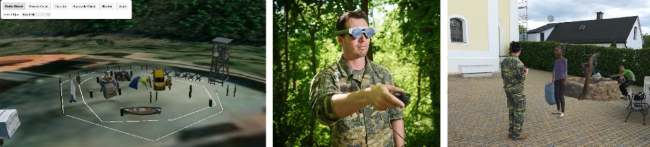
Trainer Interface The web-based trainer interface (see Figure 1 left) offers the possibility to set-up and configure training scenarios fast and easy. The backend of the trainer interface is based on a Django server. For the frontend Cesium. js is used, which offers a framework for rendering 3D models on a map. Various maps are supported (e.g. Google Earth, Google Photorealistic 3D Tiles, satellite maps). The trainer interface allows trainers to place virtual assets and characters into the scene. A virtual asset can be either a single asset or repeating elements like fence elements or anti-tank obstacles that are placed along a path drawn on the map repeatedly. Placed assets can be set to have various behaviours. Assets can either be static objects or move along paths according to trainer input. The trainer can configure behaviours like following a path, moving from one point to another or speaking. Speaking behaviours make use of Text to Speech (TTS) and require text input. Behaviours can be triggered either over time (e.g. a character walking along a line and starts talking when it reaches a specific point), by user input (e.g. when the user approaches the asset) or by trainer input. The system’s structure allows for the addition of new 3D models and animations via an admin panel on the server at later stages offering unprecedented scalability for training.
Figure 1: EnviPeace System: Left: Trainer Interface; Middle: User with MR-glasses; Right: User’s headset view showing other users and virtual objects blended into the real world.
Mixed Reality App The MR app (see Figure 1 right) is developed for the Magic Leap 2, which is a see-through device. Virtual elements are blended into the real environment. Each trainee, trainer and actor wears them and carries a mobile phone. The mobile phone acts as a GPS locator for the user. Location data is transmitted to the headset to position the terrain model correctly according to the
geographic location of the user. The user’s location is essential to place the virtual elements at the right location in relation to their position and viewing direction. The viewing direction is set according to the direction of true north. True north is currently set by the user in at setup step. The MR system is developed with the game engine Unity3D and uses the TTS engine Overtone for converting configured text to audio. The MR app also implements the Cesium framework as map and terrain model provider to place virtual elements at the correct location. The map is not rendered but used as the active terrain model and to provide occlusions (e.g. due to hills, infrastructure). The MR app acquires the scenario data from the MR server and sends its location continuously to the server. The rendering of the virtual elements is done directly on the MR glasses to enable an immersive training experience without delays.
Mixed Reality Server The MR server is hosting scenarios during training. Its task is to provide a common state of the scenario to all participants. It is developed as a Windows application in Unity3D using the same frameworks and plugins as the MR application. The server is connected to all headsets of the users. Data is exchanged between the MR glasses and the server using the Photon Fusion plugin. This is necessary to ensure all users experience the same state of the scenario. The MR server selects and hosts the scenario from the scenario list provided by the backend of the trainer interface. The users (trainer, trainees and actors) can then connect their MR headsets to it.
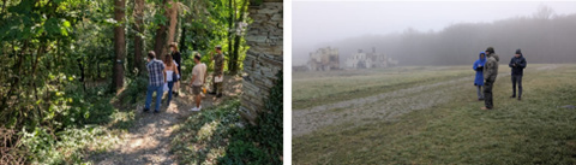
SCENARIO WORKSHOPS During the first development phase, scenario workshops were conducted together with the end-users to evaluate first prototypes and further refine the scenarios defined during the requirements phase. To ensure alignment with stakeholder requirements and training needs, potential environmental peacebuilding scenarios were discussed with civilian and military experts in two workshops. The first workshop took place at the Austrian Centre for Peace in an outdoor environment, and the second at a training facility of the Austrian Ministry of Defence. The first workshop focused on aligning the scenario with the practical challenges of outdoor MR use. The workshop began with a joint review of the scenario plan to ensure that proposed tasks were logically and technically sound. The team then visited the selected outdoor training environment (hiking path) to assess environmental conditions and practical constraints. During this site visit, each station of the scenario was mapped to specific locations, and potential challenges were assessed on site. The identified challenges were then discussed collectively, and the scenario plan was updated accordingly. Object placement in the trainer interface and the visibility of virtual elements under different lighting conditions were also evaluated by the end-users in the outdoor environment.
Figure 2: Impressions of the scenario workshops. Left: Hiking path at Stadtschlaining. Right: Second scenario test at the military facility.
For the second scenario workshop, a first draft of the checkpoint scenario was tested and evaluated with end-users. The workshop focused on assessing the current state of the MR app and trainer interface. Further, two software prototypes were demonstrated to assess how well users understand virtual avatars’ facial expressions and body language, as well as the feasibility of gesture-based interactions.
RESULTS OF THE SCENARIO WORKSHOPS The outdoor evaluation of the scenario plan revealed various important issues that need attention. Factors such as signal strength, lighting and safe movement while wearing MR headsets could only be assessed on site and led to changes in the scenario setup and location, including the decision to remove the headset when moving between stations due to safety reasons. Furthermore, limitations in terms of object and avatar placement were also identified, for example due to occlusion caused by foliage along the planned forest path. Challenges related to avatar interactions were also discussed, including strategies to avoid cross-interference when multiple participants speak to different avatars simultaneously and how eye contact should be managed when an NPC addresses a group.
The general usability of the trainer interface and the visibility of the digital objects were rated positively overall, but participants identified several opportunities for improvement. Objects placed via the trainer interface were sometimes floating, incorrectly sized or facing the wrong direction when viewed on site. Participants suggested enabling trainers to fine-tune object placement in terms of scale, height, and orientation directly on site through the MR glasses. Furthermore, clearer behaviour assignment for objects and avatars, as well as strategies to modify avatar behaviour during scenarios were also discussed.
During the second evaluation workshop, the trainer interface and MR application were assessed through participant interviews, a TAM2 questionnaire, and additional survey questions on environmental peacebuilding. Questionnaire participants were aged between 35 and 60, including 2 female and 6 male participants. Although the sample size was too small for conclusive findings, the interview and questionnaire responses highlight several key themes discussed in the subsequent analysis. Overall, the system was well received and achieved positive results in categories such as perceived usefulness, ease of use and job relevance. Participants found the MR-based training approach
interesting and useful, with high expectations that a fully developed system could provide a more immersive training. However, because the prototype was still limited in scenario adaptation and lacked relevant assets and interaction opportunities, ratings for its relevance to environmental peacebuilding were lower. This suggests that the system has strong potential but requires further technical development and stronger integration of environmental peacebuilding challenges into the training scenarios.
An additional prototype was provided to demonstrate how facial expressions and body languages can support more realistic interactions within the training scenarios. To evaluate the clarity of avatar expressions, users were asked to identify six basic emotions (joy, sadness, anger, fear, surprise and disgust) triggered when users approached the characters. While joy, sadness and anger were clearly recognized by most users, disgust was interpreted more ambiguously, for example as confusion or uncertainty. Fear and surprise were sometimes confused with one another, indicating that these animations require further refinement. Multiple users positively highlighted the highly detailed (motion-captured) facial animations and the good synchronisation between facial expressions and body language during post-test interviews. Some animations were perceived as somewhat exaggerated, although several participants considered this beneficial because it improved recognisability in the MR setting.
Additionally gesture-based interaction with virtual avatars was tested with the participants. The evaluation showed mixed results. Non-verbal interaction with avatars was considered important and positive, both for increasing trainee immersion and as an implicit way for actors in the MR environment to control avatar behaviour. Most tested gestures could be triggered by the participants after a short explanation. Participants were also asked to suggest additional gestures for the planned environmental peacekeeping scenarios. Suggestions included a pointer gesture to guide avatars or point at elements in the environments, palms held outwards to signal “Stop”, a downwards waving gesture for “Calm down” and military-style command gestures also commonly used in civilian contexts, such as waving someone closer or the OK hand sign. More complex gestures from these suggestions may be added as recognition improves.
CONCLUSION
This work highlights the technical prototype and the results of the scenario tests of the EnviPeace project. As outlined in the previous section. the prototypes were generally well received, with positive ratings for intention to use, perceived usefulness, and ease of use. Participants expect that a more developed system can improve immersion and support learning outcomes, while stressing that its success depends heavily on how easily it can be adapted to different environmental peacekeeping scenarios. Regarding avatar interaction, animations were mostly considered recognizable and believable, although slightly exaggerated, while hand gesture interaction received mixed results. The findings from the scenario tests will be incorporated into the three field trials at the training facilities of the Austrian Centre for Peace
EnviPeace – A MR-Based Learning System 257 (ACP) where the ACP and the Austrian Ministry of Defence and the Austrian Ministry of Foreign Affairs will test the system in the two defined scenarios.
ACKNOWLEDGMENT
The project EnviPeace is funded by the Austrian security research program KIRAS of the Federal Ministry of Finance.
REFERENCES
Aspr.ac.at. (2019). ENTRi - ACP. [online] Available at: https://www.aspr.ac.at/en/ education-training/training-programmes/entri#/ [Accessed 12 May 2026]. Broneder, E. et al. (2023) ‘MRespond–An Innovative and Flexible MR Training
System for First Responders’, in International Conference on Human-Computer Interaction. Springer, pp. 155–162. Broneder, E. et al. (2025) ‘A Scalable MR-Training System to Prepare Military and Civil Experts for Crisis Areas’, in Human Interaction and Emerging Technologies (IHIET 2025): Proceedings of the 15th International Conference on Human Interaction & Emerging Technologies (IHIET 2025) August 25–27, 2025, University of Vienna, Austria, pp. 240–250. Chandanani, M., Laidlaw, A. and Brown, C. (2025) ‘Extended reality and computer-
based simulation for teaching situational awareness in undergraduate health professions education: a scoping review’, Advances in Simulation, 10(1), p. 18. Clifford, R.M.S. et al. (2019) ‘Creating a stressful decision making environment for aerial firefighter training in virtual reality’, in 2019 IEEE Conference on virtual reality and 3d user interfaces (VR). IEEE, pp. 181–189. Coespu.org. (2026). Available at: https://www.coespu.org/articles/pre-deployment-
training-csdp-missions-developments-lessons-ways-ahead [Accessed 13 May 2026]. De Fino, M. et al. (2025) ‘On the user-based assessments of virtual reality for public safety training in urban open spaces depending on immersion levels’, Safety Science, 185, p. 106803. Hannay, J. E., & Kikke, Y. (2019, May). Structured crisis training with mixed reality
simulations. In ISCRAM 2019. Krampe, F., Hegazi, F. and VanDeveer, S.D. (2021) ‘Sustaining peace through better resource governance: Three potential mechanisms for environmental peacebuilding’, World Development, 144, p. 105508. Available at: https://doi. org/10.1016/j.worlddev.2021.105508. Lee, H., Cerino, E. S., & Lee, B. (2025). Effectiveness of VR-based Military Training
on Self-efficacy in Combat Performance. PRESENCE: Virtual and Augmented Reality, 34, 461–473 Pinto, R. et al. (2024) ‘A virtual reality simulation to examine the relationship between post-traumatic stress symptoms and decision-making in first responders’, Journal of Trauma & Dissociation, 25(5), pp. 597–612. Schrom-Feiertag, H., Regal, G. and Murtinger, M. (2023) “MED1stMR: Mixed
Reality to Enhance Training of Medical First Responders for Challenging Contexts”, arXiv preprint arXiv:2301. 13124 [Preprint]. Schönauer, C. et al. (2020) ‘Physical object interaction in first responder mixed reality training’, in Virtual, Augmented, and Mixed Reality (XR) Technology for Multi-Domain Operations. SPIE, pp. 61–73. Scorgie, D. et al. (2024) ‘Virtual reality for safety training: A systematic literature
review and meta-analysis’, Safety science, 171, p. 106372.
Steven, L. et al. (2023) ‘Empowering military in tactical and warfare area with virtual reality technology: a systematic literature review’, Procedia Computer Science, 227, pp. 892–901. United Nations (2024) “Climate, peace and security: what we need to know”.
Available at: https://www.un.org/en/peaceandsecurity/climate-peace-and-security- what-we-need-know [Accessed 13 May 2026] United Nations Peacekeeping (2023) “Conflict and natural resources”. Available at: https://peacekeeping.un.org/en/conflict-and-natural-resources [Accessed 13 May 2026] Zechner, O. et al. (2024) ‘Enhancing mixed reality simulation training technology
with real-time performance visualization: mixed methods study with medical first responders’, JMIR XR and Spatial Computing (JMXR), 1(1), p. e57655. UNEP (2021) “Climate action holds key to tackling global conflict”. United Nations Environment Programme. Available at: https://www.unep.org/news-and-stories/ story/climate-action-holds-key-tackling-global-conflict [Accessed 13 May 2026]
SEARCH THE AHFE DIGITAL BOOKSTORE BY ISBN
Explore the complete digital volume
Human Interaction and Emerging Technologies (IHIET 2026)
Read this individual research paper free through the original publisher, or explore the full digital proceedings book.