Miroslav Sili, Martin Bachler, Elisabeth Broneder, Réne Luigies, Niklas-Aron Hungerländer (2021). mHealthINX – The mental Health experience concept. In: Human Systems Engineering and Design (IHSED2021): Future Trends and Applications. AHFE Open Access, vol. 21. https://doi.org/10.54941/ahfe1001140
mHealthINX is an international research project that aims to design and develop a digital-based solution that supports older employees (55+) in pro-moting and strengthening their mental health. Age-related decline of physi-cal and cognitive abilities can raise challenges and stressful situations for older adults at work. Although older workers are in general more capable of managing and coping with stress-related situations than their younger coun-terparts, at some point, many become overwhelmed, can experience a de-crease in their productivity, or face a higher risk of health-related issues. mHealthINX seeks to alleviate these problems by providing a user-friendly digital solution that supports older employees in monitoring their stress lev-els, make themselves aware of stressors, and preventing stress-related conse-quences. The prototype will provide mental health assessments and mental health-promoting features such as cognitive training, mindfulness, and techniques and tools supporting users in learning to cope with stressors. This work aims to depict the mHealthINX solution's concept and highlight the in-terplay between it’s frontend components. Next to the concept, this work fo-cuses on the user experience and user involvement results gained from the first and second workshops held in Switzerland and the Netherlands.
Human Systems Engineering and Design (IHSED 2021) https://openaccess.cms-conferences.org/#/publications/book/978-1-7923-8987-0
INTRODUCTION
The mHealthINX solution combines three fundamental steps in mental health support: Indication, INtervention, and EXperience. The indication step allows users to measure, assess, and elaborate on their personal stress levels in a mobile and unobtrusive way. The intervention step focuses on the indication of critical stress levels and suggests personalized and context-sensitive interventions. The experience step tackles an entirely novel experience on interaction with digital mental health interventions. The approach uses synergies between classical, well-established technologies and innovative, future-oriented technologies. In public settings, such as the working environment, mHealthINX is designed to provide classical, unobtrusive, GUI- and 2D-based interventions directly on the user's smartphone. In very stressful situations and more private settings, such as in the user's home environment, mHealthINX provides innovative VR- and 3D-based interventions and training that help users manage their daily work in a stress-free manner.
MENTAL HEALTH INTERVENTION TYPES The mHealthINX solution is founded on extensive scientific research and elaboration of mental health interventions, grouped in following three categories: Relaxation and Mindfulness (RM), Tools and Education (TE), and Games & Exercises (GE), that aim to assess user's objective stress perception, well-being, and psychological factors at work continuously. RM interventions include generic relaxation interventions and work-specific interventions such as body scan and mindful walk (Creswell 2017). TE interventions focus on tools and aspects such as stress map, job crafting (Berg 2013), and Eisenhower Matrix (Hollmann et al. 2012). GE interventions include tools such as gratitude journal, cognitive puzzles, and exercises for resilience boost (Aegler et al. 2019). In total, 33 interventions have been elaborated and classified into these three intervention types. Some of them are applicable for the mobile App version, some for the VR App, and several can be used on both frontends.
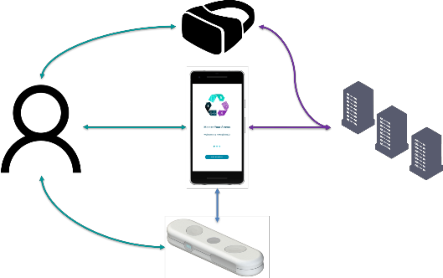
MHEALTHINX COMPONENTS As depicted in Figure 2 the mHealthINX prototype is composed of three backend systems (responsible for the user management, user status assessment, management of mental health interventions, and behavior change components). The mobile application represents the primary user interaction point of the system. The application provides 2D-based mental health interventions, assesses users' stress perception via psychological questionnaires, keeps track of users' progress, and guides users through the intervention process. From the technical point of view, the application connects the three backend sites, orchestrates the VR-based interventions, and integrates the Bluetooth-based bio-signal measurement device. The VR-based
Human Systems Engineering and Design (IHSED 2021) https://openaccess.cms-conferences.org/#/publications/book/978-1-7923-8987-0 application provides immersive training and relaxation exercises. The bio-signal SmartPWA measurement device measures ECG signals and derivates objective stress levels.
Figure 2. Illustration of the components and the interplay between the included components within the mHealthINX solution.
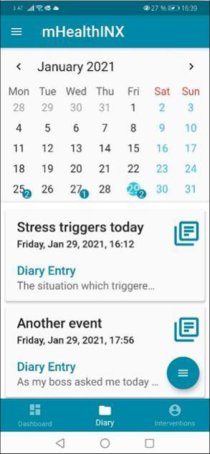
The mHealthINX Mobile Application As depicted in Figure 3. the mobile application offers three main sections.
Figure 3. Illustration of the main tree section of the mHealthINX mobile app, the dashboard on the left side, the diary in the middle, and the intervention list on the right side.
Human Systems Engineering and Design (IHSED 2021) https://openaccess.cms-conferences.org/#/publications/book/978-1-7923-8987-0
From the end-user perspective, these sections have been identified as the most relevant in daily use. The intervention section displays the prioritized list of mental health interventions that have been pre-selected for the particular user. The dashboard section represents the information center of the mHealthINX system. It high-lights suggested and scheduled interventions, it visualizes the current user progress, and it reminds users to complete their regular assessments and bio-signal measurements. The diary section offers the possibility to state own stressors and reflect on personal situations and events that caused either a stressful situation or stress relief. Figure 3 illustrates the three main screens of the mHealthINX mobile application. Other functionalities, such as user profile and the SmartPWA device pairing status, can be reached via the menu button in the upper left corner. Psychological questionnaires, suggestions to perform interventions, and motivational messages are delivered via notifications in an overlay mode.
The mHealthINX Virtual Reality Application The mHealthINX VR application is offered and carried out on Oculus Quest 2 VR glasses.
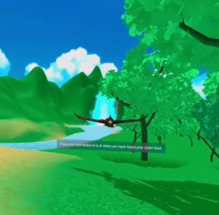
Figure 4. Illustration of three intervention types in the VR application, the relaxing environment on the left side, the relaxing game in the middle, and the mindful walk to the right.
At the current stage of development, the VR solution includes several relaxing photospheres, two relaxing games, and a mindful walk. Figure 4 illustrates the three implemented intervention types. The VR application is loosely coupled to the mHealthINX mobile application. Thus, VR-based interventions can be used independently. Still, the mobile application can also suggest VR-based interventions based on the user's status, such as the current stress level and/or preferred interventions and intervention types. Further details about the VR-based solution have been published in a separate publication (Broneder et al. 2021).
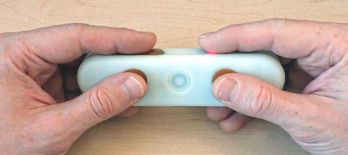
The mHealthINX Bio-signal Analysis Device The mHealthINX bio-signal analysis device is a sensor device intended to be held by the user with both hands, like a gamepad, as shown in Figure 5. It uses three
Human Systems Engineering and Design (IHSED 2021) https://openaccess.cms-conferences.org/#/publications/book/978-1-7923-8987-0 conductive surface areas touched by the user with their thumbs and left index finger to acquire a standard Einthoven I lead electrocardiogram (ECG; Figure 5, top signal). Further-more, the user's right index finger touches an optical sensor for photoplethysmography (PPG) to measure blood volume changes in the finger's microvascular bed. The stress quantification is based on the association of heart rate variability (HRV) parameters with stress (Kim et al. 2018). First, the heartbeats are isolated from the recordings (Bachler et al. 2012), and artifacts are removed (Suzuki et al. 2012). Second, HRV parameters are calculated according to "Heart rate variability - standards of measurement, physiological interpretation, and clinical use" (Task Force 1996), and finally, the long-term and short-term summary stress score are calculated from the statistical probability of the subject being "severely stressed" (Punita et al. 2016).
Figure 5. The usage illustration of the SmartPWA device on the left side and ECG measurements of the device on the right upper side and PPG signal on the right bottom side.
USER-CENTERED DESIGN & STAKEHOLDER INVOLVEMENT One of the key aspects of the mHealthINX project is the continuous user involvement and the User-Centered Design (UCD) approach.
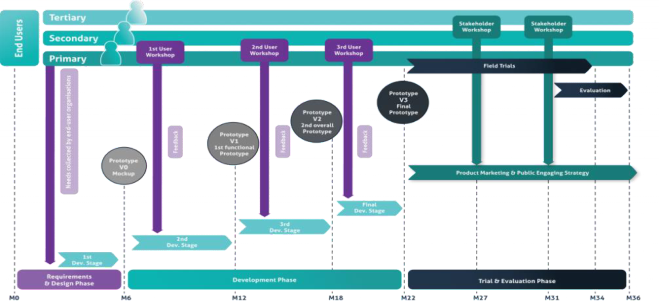
Figure 6. The user-centered design process highlighting the project timeline, three user
Human Systems Engineering and Design (IHSED 2021) https://openaccess.cms-conferences.org/#/publications/book/978-1-7923-8987-0 involvement workshops, the field trial, and the concurrent stakeholder workshops.
The project differentiates between three types of users: primary users (users who will use the mHealthINX solution), secondary users (e.g., companies willing to support their employees and HR departments), and tertiary end-users such as public sector service organizers and insurance companies. Figure 6 illustrates the user involvement process. During the development phase, user involvement focuses on primary and secondary users in three workshops. In each workshop, users have the possibility to explore, test, and give feedback on the current development stage and their wishes for further developments, functionality, usability, and new mental health interventions. Based on technical feasibility, this feedback is translated into new user requirements, which are used for the development of the next version. In total, the project considers four prototypes, namely the initial mockup-based proto-type version V0 and three functional prototypes version V1, V2, and V3. V3 will be used in the 12-month lasting field trial at the project's final phase. During this period, the project foresees two stakeholder workshops that aim to involve secondary and tertiary end- users to gain insights and results towards the commercialization of the prototype.
Workshop Design Until so far two user involvement workshops in Switzerland and the Netherlands have been performed. The first workshop utilized the mockup-based prototype, and the second workshop utilized the first functional prototype. With the mockup-based prototype users had the chance to experience the concept and the designs directly on a mobile phone. The first functional mobile app prototype was already implemented natively on the Android operating system. The VR application has been provided and implemented in both prototypes directly on the Oculus Quest device.
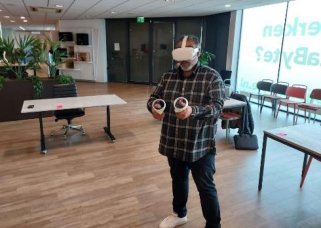
Figure 7. Illustration of the "coffee table"- approach result on the left, and a user testing the mHealthINX VR application on the right.
The workshops used the World-Café creative and collaborative approach to test the prototypes and devices as well as to assess the necessary functionality besides user experience and usability (including overall understandability, accessibility, and error tolerance). Figure 7 on the left highlights one concrete result out of the "coffee table"
Human Systems Engineering and Design (IHSED 2021) https://openaccess.cms-conferences.org/#/publications/book/978-1-7923-8987-0 approach where participants were asked to state their thoughts, wishes, and concerns in three different sections, namely, a) what should the system be able/not be able to do? b) in which situation should it offer support? and c) where could there be difficulties with the application? In total, 25 users between 50 and 62 years old participated in the first workshop (5 in Switzerland and 20 in the Netherlands), and 37 users between 50 and 65 years old participated in the second workshop (5 in Switzerland and 32 in the Netherlands).
Preliminary User Involvement Results and Postprocessing Results from the two performed workshops have been collected and summarized in project deliverables. The deliverables are used as the basis for the UCD process and stepwise improvement of the prototypes. Direct design and usability recommendations such as application color and icon preferences and overview and interaction/navigation suggestions have been directly addressed by the design and development team. Suggested features that require more implementation efforts have been evaluated regarding their technical feasibility and then translated into new user requirements. These new user requirements will further be included in the ongoing design and development process and translated into system requirements and implemented in upcoming prototypes. Despite the essential feedback about the usability and the understandability of the presented components (mobile app, VR app, and the SmartPWA device), workshop participants also gave valuable feedback about the system use in their daily live and daily routines. The following examples sketch some of these feedbacks: Users expressed that both the mobile and the VR application are in a way easy to use. However, the mobile app must be a bit more interactive so that users can see and follow their track and "feel" their results. The VR glasses were experienced as funnier, but users had different options for relaxing environments and games. Some users emphasized that they would prefer, e.g., a journey in space, a fantasy world, or a formula on race as a relaxing scenario. Regarding the SmartPWA bio-signal measurement device user expressed that it is easy to use and handy to hold but also that the required measurement time of 2 minutes might be too long. Also, they expressed their concerns regarding installation and maintenance, such as battery change and pairing with the mobile phone. On the non-functional dimension, users expressed their concern that the mobile phone might not be used at work, about a potential self-dependence on the system, or that the system might impose something that the person doesn't support, which in turn can cause additional stress.
REASONING, CONCLUSION, AND OUTLOOK The preliminary user results highlighted an improvement process. Users can identify individual benefits of the proposed components (mobile app, VR app, and the SmartPWA device). Still, they have difficulties imagining the overall benefit that can be carried out via the interplay of these components. A reason could be that at this stage of the development, the necessary guidelines, advice, and the overall pathway,
Human Systems Engineering and Design (IHSED 2021) https://openaccess.cms-conferences.org/#/publications/book/978-1-7923-8987-0 e.g., when to perform a bio-signal measurement, when to per-form a specific mobile app-based intervention, when to use the VR device, etc. have not been implemented yet. These routines are still under development, and they will be successively enrolled in the upcoming prototypes. Results underlined that both stressors and countermeasures are highly coupled with personal experiences, personal lifestyle, and basic personal attitude. Moreover, the preliminary user results highlighted also that mental health awareness and routines could not be addressed only from the technological perspective. Questions such as "how to find a right spot/space to calm down, relax, and to boost own resilience?" or the aspect of stigmatization and the fear to be outed as stressed need to be ad-dressed in a broader manner.
ACKNOWLEDGMENTS
The project mHealthINX is co-funded by the AAL Joint Programme (AAL-2019-6- 78-CP) and the following National Authorities and R&D programs in Austria, Switzerland, and the Netherlands respective FFG, Schweizer Eidgenossenschaft, ZonMw.
REFERENCES
Creswell, J. D. (2017). Mindfulness intervention Annual rev. of psychology, pp.
491-516. Berg, J. M., Dutton, J. E., Wrzesniewski, A. (2013). Job crafting and meaningful work. Hollmann, J., Geissler, A. (2012). Leistungsbalance für Leitende Ärzte:
Selbstmanagement, Stress-Kontrolle, Resilienz im Krankenhaus. Springer. Aegler, B., Heigl, F., Zischek, F. (2019). Das tut gut–Mini-AktivitätenAnsatz.
ergopraxis, 12(09), pp. 16-20. Broneder, E., Wagner, F., Weiß, C., et al. (2021). mHealthINX–A Virtual Reality- Based Occupational Stress Management Solution for Older Employees. Intern. Conf. on Human-Computer Interaction. Springer, pp. 249-256 Kim, H. G., Cheon, E. J., Bai, D. S., Lee, Y. H., Koo, B. H. (2018). Stress and heart
rate variability: a meta-analysis and review of the literature. Psychiatry investigation, 15(3), 235. Bachler, M., Mayer, C., Hametner, B., et al. (2012). Online and offline determination of QT and PR interval and QRS duration in electrocardiography. Joint Int. Conf. on Pervasive Computing and the Networked World. Springer, pp. 1-15 Suzuki, M., Hiroshi, T., Aoyama, T., Tanaka, M., Ishii, H., Kisohara, M., Hayano,
J. (2012). Nonlinear measures of heart rate variability and mortality risk in hemodialysis patients. Clinical Journal of the American Society of Nephrology, 7(9), pp. 1454-1460. Task Force of the European Society of Cardiology and the North American Society of Pacing and Electrophysiology. (1996). Heart rate variability: standards of measurement, physiological interpretation, and clinical use. Circulation, 93(5), pp. 1043-1065.
Human Systems Engineering and Design (IHSED 2021) https://openaccess.cms-conferences.org/#/publications/book/978-1-7923-8987-0
Punita, P., Saranya, K., Kumar, S. S. (2016). Gender difference in heart rate variability in medical students and association with the level of stress. National Journal of Physiology, Pharmacy and Pharmacology, 6(5), pp. 431-437.
Human Systems Engineering and Design (IHSED 2021) https://openaccess.cms-conferences.org/#/publications/book/978-1-7923-8987-0
LISTED IN THE AHFE DIGITAL BOOKSTORE CATALOGUE
Explore the complete digital volume
Human Systems Engineering and Design (IHSED2021): Future Trends and Applications
Read this individual research paper free through the original publisher, or explore the full digital proceedings book.
ISBN 978-1-7923-8987-0
Explore this ISBN in the AHFE Bookstore ↗Listed in the July 2026 bookstore catalogue; search by ISBN to confirm current availability · Digital book purchase optional