Elisabeth Broneder, Daniela Weismeier-sammer, Monika Psenner, Astrid Holzinger, Sebastian Egger-lampl, Markus Karlseder, Jaison Puthenkalam, Youssef Ibrahim (2024). SkillDrill – A Modular Training System for Preparing Civilian Experts for Peace Missions. In: Human Systems Engineering and Design (IHSED2024): Future Trends and Applications. AHFE Open Access, vol. 158, pp. 259–267. https://doi.org/10.54941/ahfe1005549
The EU’s Common Security and Defense Policy (CSDP) aims to strengthen civilian and military crisis management. To adequately meet the security policy challenges of peacekeeping, conflict prevention and strengthening international security, appropriately qualified personnel are required. To prepare them for these challenges, the EU has created training institutions and initiatives. Efforts to improve training include all actors such as police, military, diplomatic services, non-governmental peace and human rights institutions and NGOs. Training content ranges from general mission preparation to specialized courses. In the context of international crisis management (e.g., in humanitarian disasters), many actors must collaborate. It includes civilian, military, diplomatic and humanitarian dimensions of assistance or intervention, which require extensive skills on the part of experts deployed to the crisis area. Depending on the task, such skills include analysis, mediation, and intercultural competences. Deployed personnel also have to behave correctly in terms of safety in fragile areas and make decisions under stressful conditions. This extensive knowledge is taught in training courses consisting of theory and practical exercises (e.g., role plays). Training courses always result in high material and personnel expenses. Further, certain skills cannot be trained sufficiently due to a low level of immersion. Virtual Reality (VR) and Mixed Reality (MR) offer new possibilities for efficient and effective training. The SkillDrill project aims to address above mentioned challenges by providing a VR-/MR-framework to teach essential skills immersively. The framework offers modules for learning the following skills: (a) planning of international peace and humanitarian missions, (b) essential skills needed at the deployment site (c) self-aid and buddy aid in crisis areas. The framework consists of three layers of immersion (digital, VR, MR). The digital layer offers web-based course content on strategic planning. Course content like safety & security training (e.g., behavior at checkpoints), situational awareness and map reading is trained in VR to provide a higher level of immersion. The MR layer allows trainees to practice first aid skills for self-aid and buddy care on manikins while being virtually in the crisis area. This paper details the requirements analysis and technical specification of a training platform for preparing personnel for CSDP missions.
A focus within the framework of the EU’s Common Security and Defense Policy (CSDP) is to strengthen civilian and military crisis management. Planning, preparation, and execution of foreign missions require the cooperation of many actors as well as the thorough consideration of the mission’s different dimensions (civilian, military, humanitarian, diplomatic). Quality of planning and preparedness of personnel have a profound effect on the success of such missions. Depending on the task, deployed personnel require extensive skills including monitoring, mentoring, mediation, intercultural and interpersonal skills, and even patient care in the form of self and buddy care. Additionally, knowledge of appropriate behavior regarding safety and security in areas of deployment as well as decision- making skills in stressful situations are needed. Current training courses for strategic planning and mission preparation (e.g., safety and security training, patient care in crisis areas) incur high costs, require high logistical efforts and lack digital support. Therefore, trainings can only be conducted at fixed intervals and with rigid, inflexible schedules.
VR and MR technologies have greatly increased the level of immersion for visualization, training, and knowledge transfer in recent years. Virtual environments enable the recreation of training situations that are either resource-intensive, costly (Skryabina, 2017), dangerous to train or impossible to replicate in real life. There are numerous VR and MR projects for training first responders such as firefighters (Broneder, 2023) and paramedics (Schild, 2018; Mossel, 2021) and for cooperation between organizations. Humanitarian aid, peacekeeping and crisis management have so far received less attention in VR training. The focus here is on understanding cultural sensitivity and on security tasks, especially for military personnel, police, and NGOs (Ragazzoni, 2015; Kuc, 2019).
Training for patient care requires hands-on experience. Existing work uses mixed reality methods that offer haptic experience of training with manikins that are overlayed with injured virtual avatars. One approach uses green screen technology (Vourvachis, 2022), which allows for placing the manikin in a virtual environment. Another approach is based on marker tracking and inertia measurement (Broneder, 2023) to track manikins. Using this approach manikins can be moved within the physical environment and are not restricted to the green room.
The work proposed in this paper outlines a multi-layered system, currently under development, aimed at digitizing training for planning and preparing for foreign deployments. This is achieved by designing and creating a flexible, scalable, and modular training framework capable of accommodating three layers of immersion (digital, virtual reality, mixed reality), covering all aspects (from strategic mission planning to patient care in the field) while considering socio-cultural factors.
REQUIREMENTS ANALYSIS The end-user partners (Austrian Ministry of Foreign Affairs, ACP – Austrian Centre for Peace and the medical branch of the Austrian Federal Ministry
SkillDrill – A Modular Training System for Preparing Civilian Experts for Peace Missions 261
of Defense) have been involved in the development from the start of the project. To get a full picture of the status quo of training methods in the respective organizations, three workshops were organized to collect the necessary requirements. Furthermore, the training course “IPT (International Civilian Peacebuilding Training Program) Core Course for Peacebuilders” was observed in summer of 2023 to get first-hand experiences and thus a realistic picture of existing trainings. Altogether, three seven-hour workshops, two one-hour interviews with the training participants and two coordination meetings with the end-user partners were conducted from mid-October until the end of November of 2023.
The objective in the initial phase was not only to describe the status quo of existing trainings, but also to gain in-depth knowledge about the motivation of training participants, the didactic methods used in the different trainings and first-hand experience about how field trainings are executed. Illuminating the starting position and gaining knowledge about all facets of the trainings allowed for the utmost exploitation of end-user expertise, which is crucial for the development of a specifically tailored end-product.
Based on the collected requirements, coordination meetings together with the technical partners were organized to discuss first suggestions for training scenarios and the basic prerequisites for the translation of real-life training into the digital world. Priority was on defining the scenarios to fit into existing curricula in the future to ensure that end-user organizations can seamlessly implement the future technology into their training curricula.
Finally, a first draft of the future training modules was formulated, which is presented in the next section.
This process served as the base for an iterative design process in which the developed prototypes are regularly evaluated by representatives of the end-user partners (trainers and trainees) to ensure a successful transfer of requirements into an actual system. In total three demonstrations are planned where end-users can test and evaluate the system. This feedback will be incorporated into the subsequent development phase. This “participatory design process” and the “iterative development” of the solution is a well- known and recommended practice.
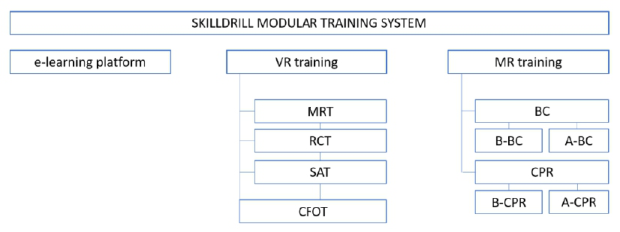
RESULTS OF USER REQUIREMENTS ANALYSIS The outcome of the requirements analysis is the description of training modules that are structured in three different layers: (a) digital layer, (b) VR layer and (c) MR layer, considering the need for digitalization into existing training and education methods. In this section the requirements for the individual training modules are described in more detail. Figure 1 gives an overview of the modules structured in the three layers. The modules are described in the following subsections.
Figure 1: The modular training system.
Digital Level – An E-Learning Platform for Mission Planning Current training approaches on the strategic planning of missions do not utilize any technological means. Due to the requirements that arose, digital tools can help to enhance training courses. Since course participants only get a paper map and a PDF that describes the current situation in crisis areas, it is hard to grasp the whole situation at once and start group discussions. Therefore, there is a need for an interactive map, that can easily be adapted by trainers (by e.g., adding and describing points of interest, adapting country and city names). Trainees should also get the possibility to take notes within the map. Different map layers are relevant to show only specific information. An E-learning platform needs to be provided in order to give the trainers a tool to manage user groups and distribute the interactive map. Course participants should be able to work together in the tool and upload their results.
Virtual Reality Level – Preparing Participants for Missions For training essential skills required in missions where a high level of immersion is required to simulate specific (and potentially dangerous) situations realistically, but the proper interaction with real-life objects is not needed or possible, training modules are defined on a VR layer. The modules of interest are (a) Map Reading Training (MRT), (b) Radio Communication Training (RCT), (c) Situational Awareness Training (SAT) and (d) Combined Field Orientation Training (CFOT).
Orientation in the field is a crucial prerequisite for mission success and a skill that needs to be trained repeatedly. Therefore, the MRT module’s goal is to train map reading in unknown outdoor environments using a virtual map and a compass. The trainees have to navigate to a mission destination (e.g., via specified coordinates). Therefore, the virtual environment needs to be as realistic as possible and include identifiable landmarks.
The RCT module emphasizes a clear and concise communication via radio (e.g., with the headquarter). Trainees will apply their theoretical skills regarding equipment and standard radio protocol taught in the classroom within a simulated environment. Training topics include general transmitting functions, initiating radio comms, spelling, numerals, “pro-words” and radio etiquette.
SkillDrill – A Modular Training System for Preparing Civilian Experts for Peace Missions 263
The SAT module simulates a crisis area, where trainees must assess the environment. They have to identify potential hazards and threats such as mine fields, detect suspicious situations, assess geographical circumstances or evaluate the behavior of strangers to determine whether they become a potential hazard.
The CFOT module comprises the MRT, RCT and SAT modules and combines all skills into a comprehensive scenario. A possible scenario could be an exploration mission in a specific area. Trainees will be virtually deployed to the area, equipped with a virtual map and compass, given a location that must be reached (map reading/orientation). Along their way they will encounter multiple hazards and threats (situational awareness), need to maintain contact with headquarters (radio communication) and assess the safety and security situation of the area to fulfil their mission.
Mixed Reality Level: Mission-Relevant First Aid Training The mixed reality (MR) level, representing the highest level of immersion within the SkillDrill system, emphasizes mission-critical first aid training. The requirements analysis identified key requisites essential to this domain: (1) the integration of authentic equipment within virtual environments, (2) the attainment of realism through the fusion of visual and haptic feedback in patient interactions, (3) realistic depictions of patients and injuries as well as environments, (4) the provision of graduated difficulty levels to accommodate diverse educational backgrounds within first aid or emergency medical services (EMS) and (5) the provision to add stress factors (loud noises, poor sights, effects of bystanders) to the simulation.
Two essential skills have been selected to be trained in MR: critical bleeding control and administering cardiopulmonary resuscitation (CPR).
Within the Bleeding Control (BC) module, a differentiation between basic bleeding control (B-BC) for trainees with limited prior knowledge and advanced bleeding control (A-BC) for paramedics and soldiers is required. Trainees should learn to identify critical bleedings and to apply appropriate treatments (e.g., apply tourniquets).
The CPR Module also splits into basic (B-CPR) and advanced (A-CPR) tiers, adhering to European Resuscitation Council Guidelines (Olasveengen et al., 2021) for basic life support. Trainees should obtain the skills to detect the need for CPR, call for support and apply the necessary CPR methods.
SKILLDRILL TRAINING FRAMEWORK Based on the outcomes of the requirements analysis and technical feasibility, the SkillDrill training framework offers training content on the three identified layers: (a) digital layer, (b) VR layer, (c) MR layer. From a technical perspective, the proposed system consists of six components: (a) a web application that offers a platform for teaching strategic planning for CSDP missions, (b) a VR application that offers modules for map reading, situational awareness, radio communication and the right behavior on checkpoints, (c) an MR application that offers modules for self-aid and buddy-aid like CPR and dealing with critical bleeding, (d) a trainer interface
for adapting training contents and controlling the medical MR scenarios, (e) a server application for forwarding changes from the trainer interface to the MR app, (f) a server application for distributing 3D content between the VR and MR apps in multi-user modules. The main components (a-d) are described below.
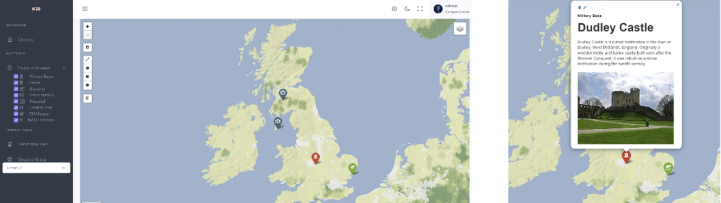
Training Platform for Planning of Missions The effectiveness of CSDP missions depends on the quality of planning. Since almost all strategic planners have a military background, the character of civilian missions must first be learned so that the planners can ask appropriate questions that help to define objectives, mandate, duration, exit strategy, risks, and challenges more precisely. To move from paper-only methods, enhance training possibilities and provide tools to better imagine the situation and increase the learning effect, SkillDrill will offer a web-based training platform where trainers can upload course material beforehand and create a digital map that they can enrich with essential information such as points of interests and images of locations to better imagine the situation and crisis areas. Trainees can work together in groups, access the training material and the enriched map. Moreover, they can mark certain areas, add markers, notes, and information that helps them to analyze the situation more efficiently. Further, they can upload their final outcomes. The trainer can review and evaluate the group’s results. Being a web-based solution, the platform allows for the possibility to provide the course online and thus ease access to the course from different locations. Figure 2 shows the current development state of the map.
Figure 2: Interactive map. Left: map with points of interests. Right: information about point of interest.
VR Modules to Prepare Experts for Missions Currently, the extensive knowledge for working in the field (e.g., monitoring, mediation, situational awareness) is taught in an appropriate training program consisting of theory and practice exercises (e.g., role plays). However, training courses are always associated with costs and personnel expenditure. Further, apart from the limited number of role players, the immersion and variation of scenarios are limited, and thus certain skills cannot be trained sufficiently. Therefore, SkillDrill will provide VR modules
SkillDrill – A Modular Training System for Preparing Civilian Experts for Peace Missions 265
for training skills that cannot be trained adequately in current training programs. According to the collected requirements, training scenarios will be created that show crisis areas where trainees have to analyze and evaluate the situation and detect potential dangers. Radio communication will be taught by e.g., reporting these dangers. To practice map reading, trainees have to navigate to a given target location within a virtual scenario. The mentioned scenarios will be implemented as single-user scenarios but can be easily extended to multi-user scenarios in the future.
Additionally, as a further use case of situational awareness training, a multi-user scenario for teaching the correct behavior on checkpoints will be implemented, since realistic communication between team members and other persons is essential. Trainers can act as checkpoint personnel by controlling virtual avatars. Trainees will approach checkpoints inside a virtual car and can talk to each other. Each trainee is represented in the scenario as a virtual avatar.
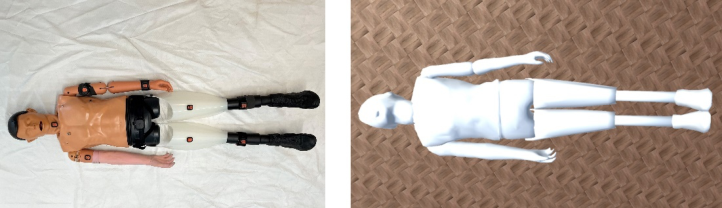
MR Training for Self-Aid and Buddy Care In missions, especially for civilian experts and military personell that do not have medical education, life-saving skills for self-help and comrade assistance are essential. Variations of training procedures are currently difficult and time-consuming because injuries have to be recreated using makeup. Apart from that, stress factors when in the field cannot be simulated with exercises in classrooms. This is precisely where MR is a suitable tool for supplementary training. Since the care of patients in crisis areas can only be trained efficiently by including emergency manikins and the necessary equipment, MR was chosen over VR. To keep full immersion, the HTC Vive Elite has been chosen since it provides video-passthrough of the real environment while keeping a high FOV in the virtual scenario. This allows tracking the manikin and visualizing it as a virtual patient in the virtual scenario. Thus, full immersion is achieved while still getting tactile feedback when practicing first aid on the patient. According to the requirements, the focus will lie on CPR and treating explosion and shot wounds with critical bleeding. Stressors will be brought into the scenario, such as gun shots, mosquitos, and barking dogs. Tracking of the manikin is achieved using the HTC Vive Ultimate tracker for the upper body tracking and the Movella Dot inertial sensors for limb and neck tracking. The sensor data is collected; joint angles are calculated and transmitted to the MR glasses where data is interpreted as body and limb movement. Figure 3 shows the manikin with the sensors and the view through the glasses.
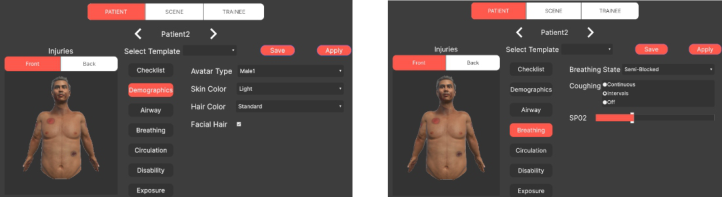
Trainer Interface To provide the possibility for trainers to adapt the medical MR simulation, a trainer interface will be developed. The trainer can define patients with different appearances, types of injuries and vital parameters. Moreover, they can add different stressors (e.g., persons shouting, dog barking) and evaluate trainees via checklists. They can also adapt the patient’s condition according to the trainee’s actions. Figure 4 shows the current version of the trainer interface.
Figure 3: Left: manikin with sensors; right: virtual avatar representing the avatar in the MR glasses.Figure 4: Screenshots of the trainer interface.
CONCLUSION
This work highlights the process and results of the user requirements analysis. It shows how especially VR and MR should enhance training possibilities and how end-user organizations were involved in the process of defining the training modules. The high variety of skills needed in missions is specifically discussed. The paper presents SkillDrill – a multi-layer (digital, VR, MR) system that offers training content for training essential skills for planning of and preparing for missions in an effective, efficient, and immersive way.
The project has started in 2023 and therefore is still under development. A first prototype will be evaluated together with end-users in November 2024. Two additional field trials are planned for March 2025 and August 2025. The feedback will be collected and will be incorporated into the subsequent development phase.
ACKNOWLEDGMENT
The project SkillDrill is funded by the Austrian security research program KIRAS of the Federal Ministry of Finance.
REFERENCES
Birt, J., Moore, E., & Cowling, M. (2017). Improving paramedic distance education through mobile mixed reality simulation. Australasian Journal of Educational Technology, 33(6). Broneder, E. et al. (2023). MRespond – An Innovative and Flexible MR Training
System for First Responders. In: Stephanidis, C., Antona, M., Ntoa, S., Salvendy, G. (eds) HCI International 2023 Posters. HCII 2023. Communications in Computer and Information Science, vol. 1836. Springer, Cham.
SkillDrill – A Modular Training System for Preparing Civilian Experts for Peace Missions 267
Ku´c, K., Trzci´nska, W. (2019). Preparation of Polish police officers for peace missions. Security and Defence Quarterly, 23(1), 126–143. Mossel, A., Schoenauer, C., Froeschl, M. et al. Immersive training of first responder
squad leaders in untethered virtual reality. Virtual Reality 25, 745–759 (2021) Olasveengen, Theresa M. et al. (2021). European Resuscitation Council Guidelines: Basic Life Support. Resuscitation, 161. 98–114. Doi: 10.1016/j.resuscitation.2021.02.009. Ragazzoni L, Ingrassia PL, Echeverri L, et al. Virtual Reality Simulation Training for Ebola Deployment. Disaster Medicine and Public Health Preparedness. 2015;9(5): 543–546. doi: 10.1017/dmp.2015.36. Schild J., D.: “EPICSAVE — Enhancing vocational training for paramedics with
multi-user virtual reality,” 2018 IEEE 6th International Conference on Serious Games and Applications for Health (SeGAH), 2018, pp. 1–8, doi: 10.110. Skryabina Elena, Gabriel: What is the value of health emergency preparedness exercises? A scoping review study, International Journal of Disaster Risk Reduction, Volume 21, 2017, Pages 274–283, ISSN 2212–42. Vourvachis, I., Giordanis, A., Nguyen, Q., Gyllencreutz, L., & Schrom-Feiertag, H. G. (2022). MED1stMR: An integrated Training Using a Mixed Reality Approach Featuring Haptic Feedback for Enhanced Realism - EUO’s Requirements. in SafeThessaloniki 2022 Proceedings (S. 301–303).
LISTED IN THE AHFE DIGITAL BOOKSTORE CATALOGUE
Explore the complete digital volume
Human Systems Engineering and Design (IHSED2024): Future Trends and Applications
Read this individual research paper free through the original publisher, or explore the full digital proceedings book.
ISBN 978-1-964867-34-2
Explore this ISBN in the AHFE Bookstore ↗Listed in the July 2026 bookstore catalogue; search by ISBN to confirm current availability · Digital book purchase optional