Cristina caramelo gomes (2024). The Role of Colour in Urban Place-Making: A Study of Public Art in Lisbon. In: Human Systems Engineering and Design (IHSED2024): Future Trends and Applications. AHFE Open Access, vol. 158, pp. 109–119. https://doi.org/10.54941/ahfe1005534
CITAD, Lusíada University of Lisbon, Rua da Junqueira, 188-198, 1349–001 Lisboa Portugal; CIAUD, Research Centre for Architecture, Urbanism and Design, Lisbon School of Architecture, Universidade de Lisboa, Portugal ↗
In the urban environment, public art stands out as a defining attribute that contributes to the cultural and social fabric. This encompasses a wide range of artistic expressions, including sculptures, paintings, murals, installations, performances, light and sound projections, and graffiti. These artistic elements not only shape the identity of a place but also serve as a means of representing the community's voice and honouring significant local figures. The presence of public art fosters interactions among individuals and instils a sense of belonging, ultimately enhancing the aesthetic appeal of the urban landscape and creating a more welcoming atmosphere.Amid a globalized context characterized by the repeated replication of building shapes, materials, textures, and colours with little regard for cultural and social context or sustainable principles, the establishment of a distinct cultural and social identity within the built environment becomes crucial. A deliberate focus on urban environment and community identity serves to nurture a sense of belonging and plays a pivotal role in the concept of place-making. This underscores the importance of human-centred design and the incorporation of diversity in shaping public spaces. Solutions must involve public participation and contribute to fostering meaningful interactions between individuals and their urban surroundings, ultimately enhancing the user experience.Thematic paintings and sculptures adorning building facades not only enhance visual interest but also serve to promote local and international artists, amplify community voices, and celebrate significant social and cultural figures. In this communicative process, colour emerges as a powerful tool for drawing attention, forging symbolic associations, enhancing aesthetic value, and eliciting human emotions and behaviours. Whether through vibrant, colourful compositions or subdued, monochromatic ones, the use of colour reinforces the intended message and enriches the communication process. This is evident not only in physically and socially challenged areas but also in traditional neighbourhoods, where the impact on the lived experience of residents and visitors is unmistakable. The presence of public art contributes to the vibrancy of communities, augmenting the local economy and fostering community well-being. Consequently, urban planners, architects, designers, and artists are called to collaborate in sculpting humanized public environments.This article seeks to achieve the following objectives: a) Foster a discourse on the impact of public art in shaping the concept of place-making. b) Examine how colour contributes to this process. To achieve these goals, the article proposes: c) A comprehensive review of literature related to public art, place-making, and colour. d) Analysis of select case studies located in Lisbon city. The intended outcome is to elucidate the interconnectedness of these key subjects, drawing insights from the analysed case studies to understand how the chromatic compositions contribute to conveying messages and how the presence of public art influences the identity of urban areas and communities.
Public art significantly enriches urban environments by adding aesthetic value and fostering community identity. This encompasses a wide array of expressions including sculptures, murals, installations, performances, and graffiti. Such artworks often serve as a voice for the community, highlighting important local figures and promoting a sense of belonging among residents and visitors alike. This not only makes areas more inviting but also anchors a unique identity within increasingly globalized urban landscapes where building designs and materials can otherwise appear homogenous and culturally disconnected.
In a world where urban development frequently overlooks local culture and sustainable practices, establishing a distinct cultural and social identity through public art becomes essential. It supports the concept of placemaking, where the sense of belonging and community engagement are pivotal. Incorporating principles of human-centred design and celebrating diversity are crucial in the planning of these spaces. Public involvement in these processes can further enhance interactions within the urban setting, elevating the overall user experience.
Artworks like thematic paintings and sculptures on otherwise blank building façades not only draw attention but also serve as a platform for local and international artists. They give a voice to community members and commemorate significant social and cultural figures, thereby enriching the narrative of the locality. Colour, whether vibrant or monochromatic, plays a critical role in these installations by attracting attention, creating symbolic associations, and evoking emotional responses.
Public art has proven to impact areas socially and physically, rejuvenating both traditional and damaged neighbourhoods. It boosts local economies and promotes well-being, demonstrating the importance of a collaborative approach among urban planners, architects, designers, and artists in crafting spaces that are not only functional but also inspiring. Such collaborative efforts are fundamental in shaping environments that truly cater to human experience, fostering communities that are vibrant, inclusive, and resilient.
INTERACTIONS BETWEEN USERS AND URBAN ENVIRONMENT – THE NEED OF QUALIFIED EXPERIENCES The integration of art and culture into the built environment plays a pivotal role in placemaking, significantly enhancing the character and vitality of urban spaces. Whether temporary or permanent, these artistic interventions lend a sense of permanence to architecture, transforming transitional spaces into destinations that enrich the experiences of commuters and tourists alike (Lee, 2018). Art and culture in urban settings facilitate a complex sensorial experience, engaging both physical and cognitive interactions among human and non-human actors, thus creating a rich tapestry of sensory input (Crouch, 2010). Architectural elements, finishing materials, paintings, sculptures, and live performances serve as a cartography of signs, not only directing users but also engaging their senses in a meaningful way. While technical and aesthetic enhancements have been crucial in qualifying urban spaces, focusing on aesthetic attributes significantly alleviates psychological strains on urban dwellers. The pleasure derived from engaging with art and culture is profound; however, it is the community’s engagement with these elements that imbues them with deeper symbolism and meaning. This active participation fosters more humanized spaces, enhances a sense of belonging, nurtures an ethic of care towards others and the environment, and boosts security (Vichealth, 2006).
The Role of Colour in Urban Place-Making: A Study of Public Art in Lisbon 111
Daily interactions with the urban environment—such as traversing streets and squares, engaging with commercial areas, and using transport facilities— shape user experiences and contribute to their overall appreciation of the city. However, the monotonous imagery of urban boredom is an often-overlooked issue that significantly impacts user perception, particularly in less frequented areas removed from historical or cultural hubs. Art and culture can effectively address these challenges, revitalizing public spaces and promoting mental health and wellbeing through inclusion, inspiration, beauty, and creativity (Zint, 2020; Siegel, 2018).
Art serves as a vital conduit for interaction within the community and between individuals and their environment. Yet, its impact is most profound when it reflects the voice of the community, thereby fostering identity and belonging, and enhancing engagement with visitors. Colour, as a critical element of this artistic expression, should be considered throughout the planning and design phases, not merely as an afterthought for decoration. Its thoughtful application influences the humanization of the built environment and the well-being of individuals, enhancing spatial functionality, wayfinding, and aesthetic appeal.
The relationship between users and the built environment hinges on how spatial features meet user needs and expectations. The functionalities, accessibility, geographic location, and aesthetic form of buildings play crucial roles in supporting users’ identities and daily routines. These elements facilitate interactions that help construct community and place identity, fostering a sense of belonging. Users perceive and engage with the built environment based on its usability, meaning, and the symbolism that resonates with their cultural and personal experiences.
Therefore, understanding the importance of visual perception in human interaction with space is essential. Colour, as a dominant quality of spatial design, is crucial for defining functional areas, enhancing wayfinding, and improving the overall aesthetic quality of a place. The strategic use of colour not only enriches the visual experience but also plays a fundamental role in fostering social interactions, shaping the identity of places, and enhancing the emotional and behavioural responses of those who inhabit or visit them (Gomes, 2022).
STREET ART Street art is a dynamic form of public art that enriches urban environments by stimulating discourse, challenging societal norms, and enhancing communal spaces. Often created without official sanction, this art form turns the city itself into an open-air museum, accessible to all, irrespective of one’s social or economic background. It encourages viewers to pause and engage with murals that transform ordinary building façades, walls, and sidewalks into vibrant canvases.
The very canvas of street art—the urban environment—allows it to be free and ubiquitous, making art accessible and fostering a sense of inclusivity. Through its presence in public spaces, street art democratizes art consumption and engages the community in creative processes (The Trendy
112 Gomes
Art, n.d.). By converting walls into visual narratives, street art not only reflects but also critiques local identity, history, and contemporary issues, thereby enhancing the storytelling of the place. Artists use motifs and colours strategically to communicate messages, reflect community sentiments, and strengthen local ties (2B.rocks, n.d.).
The ephemeral nature of street art—vulnerable to both the elements and the shifting dynamics of urban policy—mirrors the pulse of the city. Despite its often-temporary lifespan, it contributes significantly to neighbourhood revitalization, providing cultural allure and boosting local socio-economic and cultural activities. It enhances community security, belonging, and fosters interactions both among individuals and between people and their environment (Gomes, 2023).
The increasing recognition and acceptance of street art as a medium for community expression prompts a debate about its contribution to cultural heritage, both tangible and intangible. Proponents of its classification as tangible heritage point to the physical presence of street art, while others argue for its categorization as intangible heritage due to its social significance and transient nature, demonstrating street art’s unique position at the intersection of these two domains (Nomeikaite, 2017). Furthermore, street art is intrinsically linked to the urban environment and the perceptions of its observers, who imbue it with symbolic meanings and interpret its cultural messages, underscoring its deep integration within the fabric of urban life. Moreover, street art significantly impacts how individuals interact with their physical surroundings. It transforms everyday spaces into relational, unpredictable environments that enrich daily routines (Haldrup & Boerenholdt, 2015). This interaction between the art, the viewer, and the urban landscape goes beyond mere visual appreciation; it is an immersive experience that evokes emotions, communicates ideas, and often surprises its audience (Samson, 2015).
Local heritage, as viewed through the lens of street art, becomes a living part of the community’s narrative, encompassing memories and meanings that contribute to a collective sense of identity and continuity with the past (Hull, Lam & Vigo, 1994). Local heritage is a cultural and a sensorial experience for the user. The user, throughout the experience increases his knowledge, his critical believes and challenge his aesthetical sense. As Smith (2006) posits, heritage is not just to be observed but is itself a lived experience, suggesting that street art, by engaging people with the artwork and its setting, becomes a critical part of how communities experience and transmit their heritage (Nomeikaite, 2017). Street art transcends mere artistic expression to become a vital cultural force that shapes the aesthetic, social, and cultural fabric of urban life. It stands as an essential element of the modern cityscape, deeply influencing the community and urban identity.
CASE STUDIES Recently, urban environments have become canvases for artistic expression through street art, which not only beautifies spaces but also conveys potent social messages. Street art utilizes paintings, sculptural elements,
The Role of Colour in Urban Place-Making: A Study of Public Art in Lisbon 113
and installations to enhance community identity and encourage active involvement from locals. Its impact hinges on both the artists’ expression and the interpretations of diverse viewers—residents, visitors, or art enthusiasts. The primary goal is to foster interactions among people and between individuals and their environment.
Street art serves as a powerful statement, allowing artists the freedom to address and highlight significant issues, thereby sparking community-wide discussions and promoting dialogue on pertinent topics (Boscaino, 2021). This art form plays a crucial role in bridging gaps between different social and economic groups, enhancing a sense of inclusion and diminishing feelings of segregation. It boosts social cohesion by enabling interactions across various cultural, economic, and social divides.
The neighbourhoods of Quinta do Mocho and Alvalade in the Lisbon Metropolitan Area serve as exemplary case studies. Quinta do Mocho, located in Lisbon’s eastern suburbs, is known as a socially marginalized area, whereas Alvalade caters to a middle/high socioeconomic demographic. Despite these differences, both neighbourhoods have embraced street art, which articulates the voices of their communities through murals. These artistic interventions provide insights into the area’s histories and the people who have shaped the local culture, strengthening community ties and enhancing residents’ sense of belonging.
In both Quinta do Mocho and Alvalade, street art has attracted visitors drawn to the artists, techniques, or the stories behind the murals, adding significant economic, social, and cultural value. The success of street art in these areas can largely be attributed to the support of municipal entities that recognize and promote its potential for social engagement and urban regeneration. Art and culture are pivotal in fostering social innovation and constructing new realities. Through a dynamic interplay of communication, critical reflection, civic participation, and dialogue, street art transforms spaces and encourages collective engagement, thereby revitalizing urban environs and enriching community life.
Quinta do Mocho Located on Lisbon’s eastern outskirts, this socially challenged neighbourhood was developed to house economically disadvantaged residents. Historically afflicted by violence and drug issues, the area was insular, with minimal external interaction and significant stigma attached to its community. With scant municipal support and lacking urban amenities or public transportation, it remained isolated from the wider Lisbon Metropolitan Area, deterring private transport services due to safety concerns. The monotony of the area’s architecture was only occasionally interrupted by colourful clotheslines’ protection. Pedestrian walkways between buildings often became cluttered with discarded furniture, showcasing a blend of utilitarian use and neglect. In 2014, a transformative initiative by the European Council, the Communication for Integration, sought to change these perceptions with a three-day festival of cultural activities and street
114 Gomes
art, significantly reshaping the community’s identity and beginning to dispel longstanding stigmas (Silva, 2015).
Figure 1, 2 and 3: Examples of street art in Quinta do Mocho. Author Teresa Serpa, 2023.
The vibrant paintings on the façades of buildings in Quinta do Mocho showcase diverse chromatic palettes but share a common goal: to highlight the community’s unique characteristics (getLISBON, 2022). The increase in murals has spurred free guided tours led by local residents, helping visitors appreciate the artwork’s social and cultural significance. These initiatives, alongside long-standing collaborations with street artists, have enriched the neighbourhood and strengthened community ties by fostering interactions with people from various economic, social, and cultural backgrounds. These artistic interventions not only enhance the area’s aesthetic appeal but also transform building façades into meaningful landmarks for those experiencing the place.
Alvalade The Alvalade neighbourhood in Lisbon was developed post-World War II in response to urban migration from rural areas. Its design drew on English urbanism principles, incorporating neighbourhood units cantered around primary schools accessible via pedestrian routes, and employing functional zoning with a hierarchical road and commercial services layout. Initially designed to accommodate various social groups, Alvalade featured a mix of rental properties and social housing managed by municipal entities, aimed at residents with limited incomes. Despite this social diversity, residents primarily shared similar cultural backgrounds, with variations mostly in income and lifestyle.
Architecturally, Alvalade reflects Modernist principles, attracting a diverse demographic, including young intellectuals and creatives—architects, engineers, musicians, writers, and filmmakers. The neighbourhood was notably progressive in its gender dynamics, with a significant presence of women in paid professions, fostering new sociability types and creative networks. These characteristics helped mold Alvalade’s unique identity, emphasizing spaces for socialization and cultural engagement (André, Machado & Barata-Salgueiro, 2016).
The Role of Colour in Urban Place-Making: A Study of Public Art in Lisbon 115
Today, Alvalade is a vibrant community housing many students, due to its proximity to academic institutions, alongside a well-educated, aging retiree population. Reflecting its rich cultural tapestry, the municipality has prioritized cultural accessibility, especially for vulnerable groups like the elderly and children, and initiated projects to celebrate local identity. One such project is the Galeria dos Inesquecíveis (Gallery of the Unforgettable), which honours notable Portuguese personalities connected to the area through art (Pinto, 2021).
A prominent piece in this collection is a mural of Simone de Oliveira (Figure 4), a revered figure in Portuguese culture known for her contributions to music, theatre, and television. Painted by her grandson, artist André Mano, the mural is a grand 10x15m expression of personal and cultural memory. It depicts Oliveira with signature details like her expressive face and the cigarette between her fingers, alongside lyrics from “A Desfolhada,” her iconic song from 1969 that challenged political and social norms of the era. The mural, created using rollers and 300 cans of spray paint over a week, not only celebrates Oliveira’s 65-year artistic journey but also her role as a symbol of emancipation and inspiration to many (de Freguesia de Alvalade, n.d.a; Idealista, 2022).
Figure 4 and 5: Street art in Alvalade - Simone de Oliveira and José Cardoso Pires (de Freguesia de Alvalade, n.d.a; de Freguesia de Alvalade, n.d.b).
José Cardoso Pires (1925-1998) distinguished himself as a formidable figure in literature and is celebrated as one of the greatest Portuguese writers of the 20th century (Figure 5). His expansive body of work includes novels, chronicles, short stories, and essays. From a young age, Pires was a staunch anti-fascist and actively opposed the Salazar regime, the Portuguese nationalist dictatorship that spanned from 1933 to 1968. He participated in all major anti-dictatorship movements of his time and represented Portugal at numerous international cultural and literary events (de Freguesia de Alvalade, n.d.b). Known for his rigorous and demanding literary style, Pires authored eighteen books between 1949 and 1997. He never confined himself to any single literary group or genre, though he was primarily recognized
116 Gomes
as a novelist. Deeply integrated into the intellectual, literary, and political circles, Pires was a regular at various cultural and political events, engaging frequently with editors, newspapers, and through political interventions. Known for his fierce independence, he held a profound commitment to aesthetic and literary autonomy (Porto Editora, n.d.).
To honour his legacy, a mural dedicated to José Cardoso Pires was crafted by SKRAN, an artist celebrated for his vibrant geometric line illustrations that frequently feature animals or portraits. This artwork masterfully merges SKRAN’s distinctive colourful style with a portrait that reflects the essence of Pires’ life and literary contributions.
Gonçalo Ribeiro Telles (1922-2020) was a seminal figure in landscape architecture, particularly noted for his contributions to Lisbon’s green spaces, including the renowned gardens of the Calouste Gulbenkian Foundation (Figure 6). In the Alvalade neighbourhood, his design work is evident in Bairro das Estacas, where he ingeniously integrated housing blocks aligned east-west on pillars. This arrangement facilitated a seamless flow between the green spaces he designed and pedestrian pathways, merging residential interiors with the urban exterior and fostering a new way of interacting with the environment. His work in Bairro das Estacas stands as a benchmark of Modern architecture, embracing the Athens Charter’s principles of Light, Air, and Space as essentials of urban design (de Antigamente, 2016).
The mural dedicated to his legacy in Alvalade was crafted by the artist Styler over seven days, employing a palette of 90 colours applied with spray and roller paint (Notícias ao Minuto, 2021; de Freguesia de Alvalade, n.d.c).
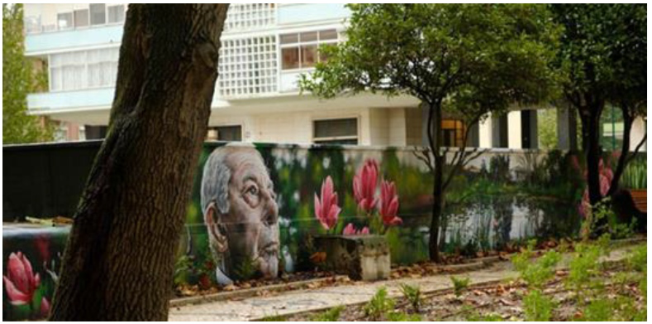
Dominated by shades of green, the mural not only visually represents Telles’ commitment to integrating green spaces in urban design but also emphasizes the essential role these elements play in enhancing individual well-being and encouraging social interactions. The varied greens serve as a reminder that even a monochromatic scheme can awaken the senses, convey deep messages, and enrich the aesthetics of built environments, highlighting the critical importance of nature in urban settings for physical and social health.
Figure 6: Examples of street art in Alvalade – Gonçalo Ribeiro Telles (Notícias ao Minuto, 2021).
The Role of Colour in Urban Place-Making: A Study of Public Art in Lisbon 117
ISSUES TO DISCUSS The integration of public art, particularly street art, in urban environments plays a transformative role in shaping the socio-cultural landscape of communities, with colour serving as a critical element in this artistic expression. Through the vibrant case studies of Quinta do Mocho and Alvalade, it is evident that the strategic use of colour does more than beautify a neighbourhood; it catalyses community engagement, fosters a sense of identity and belonging, and bridges diverse social and economic groups. The rich palettes employed in these communities—not just as aesthetic enhancements but as tools of communication—serve as points of pride and central hubs for communal interaction and cultural discourse.
Colour in street art intensifies the emotional connection and communicates messages that transcend linguistic barriers, making art accessible to all. It is the vibrancy of these hues that draws viewers in, offering them a new lens through which to view their environment. Colour enhances the visibility of social and cultural narratives, turning urban canvases into dynamic storytellers that reflect the community’s history and aspirations.
By embedding the community’s voice through colourful murals in the physical fabric of the neighbourhood, street art encourages a dynamic interaction between individuals and their environment, enhancing the quality of urban life and contributing to a more inclusive cultural heritage. This active engagement with art in public spaces highlights its potential to influence perceptions, encourage social cohesion, and foster a shared responsibility towards maintaining and enhancing communal living spaces.
As urban planners, architects, designers, and artists continue to collaborate, the strategic application of colour in public art stands out as a cornerstone for community development and personal well-being. Through thoughtful integration of vibrant, expressive colour palettes into the urban planning process, cities can evolve into spaces that not only meet functional needs but also nourish the souls of those who inhabit them. Thus, street art, with its profound use of colour, is not merely an aesthetic addition but a fundamental component of a thriving urban ecosystem that champions cultural richness, community spirit, and social sustainability.
ACKNOWLEDGMENT
This work was support by FCT - Fundação para a Ciência e Tecnologia, I.P. by project reference UIDB/04026/2020 and DOI identifier 10.54499/UIDB/ 04026/2020 (https://doi.org/10.54499/UIDB/04026/2020) and the Strategic Project with the references UIDB704008/2020 and UIDP/04008/2020.
REFERENCES
2B.rocks. (n.d.). Why is Urban Art so Popular? Unleashing the Vibrant Creativity. https://2b.rocks/why-is-urban-art-so-popular-unleashing-the-vibrant-creativity André, M., Machado, C., & Barata-Salgueiro, T. (2016). Inovação urbana, utopia e artes. O bairro de Alvalade em Lisboa, in BENACH, Nuria; ZAAR, Miriam Hermi; VASCONCELOS P. JUNIOR, Magno (eds.). Actas del XIV Coloquio Internacional de Geocrítica: Las utopías y la construcción de la sociedad del futuro. Barcelona.
118 Gomes
Boscaino, M. (2021). Developing a Qualitative Approach to the Study of the Street Art World. Street Art and Creativity. The future: Urban Creativity Studies, 7(2). Caramelo Gomes, C. & Gamito, M. (2022). Chromatic Identity of the urban tile
panels: The scenario of Lisbon subways stations. In Proceedings of the XVII Colour Conference 2022 (pp. 248–257). Florence, Italy. Caramelo Gomes, C. (2023). The impact of chromatic palettes in social neighbourhoods’ environments: Cause and consequence of human interactions. In Proceedings of the 15th Congress of the International Colour Association 2023 (pp. 550–557). Chiang Rai, Thailand. Crouch, D. (2001). Spatialities and the feeling of doing. Social & Cultural Geography, 2(1), 61–75. getLISBON. (2022, July 14). A Galeria de Arte Urbana da Quinta do Mocho · getLISBON. https://getlisbon.com/pt/descobrindo-pt/arte-urbana-quinta -do-mocho Haldrup, M., Bœrenholdt, J. O. (2015). Heritage as Performance. In: Waterton, E.,
Watson, S. (eds) The Palgrave Handbook of Contemporary Heritage Research. Palgrave Macmillan, London. Hull, R. B., IV; Lam, M.; Vigo, G. Place identity: Symbols of self in the urban fabric.
Land. Urban Plan. 1994, 28, 109–120. Idealista. (2022, April 26). Arte urbana: novo mural em Lisboa em homenagem a Simone de Oliveira. https://www.idealista.pt/news/ferias/turismo/2022/04/26/ 51988-arte-urbana-novo-mural-em-lisboa-em-homenagem-a-simone-de-oliveira Junta de Freguesia de Alvalade. (n.d.) a. Galeria dos Inesquecíveis | Mural
Simone de Oliveira. https://www.jf-alvalade.pt/tema-a-tema/espaco-publico/arte- urbana/simone-de-oliveira/ Junta de Freguesia de Alvalade. (n.d.) b. Homenagem José Cardoso Pires. https://www.jf-alvalade.pt/tema-a-tema/espaco-publico/arte-urbana/homenagem- jose-cardoso-pires/ Junta de Freguesia de Alvalade. (n.d.) c. Homenagem Gonçalo Ribeiro Telles.
https://www.jf-alvalade.pt/tema-a-tema/espaco-publico/arte-urbana/homenagem- goncalo-ribeiro-telles/ Lee, J. M. (2018). Hidden Cities: Reinventing the Non-Space Between Street and Subway. Publicly Accessible Penn Dissertations, 2984. https://repository.upenn.e du/edissertations/2984 Lisboa de Antigamente. (2016, February). Bairro das Estacas - Alvalade. https://lisb
oadeantigamente.blogspot.com/2016/02/bairro-das-estacas-alvalade.html Nomeikaite, L. (2017). Street art, heritage and embodiment. SAUC - Street Art and Urban Creativity, 3(1), 43–53. Notícias ao Minuto. (2021, January 19). Lisboa faz homenagem a Ribeiro
Telles através de mural em Alvalade. https://www.noticiasaominuto.com/cultura /1641531/lisboa-faz-homenagem-a-ribeiro-telles-atraves-de-mural-em-alvalade Pinto, S. P. (2021, March 31). Alvalade: Murais dão nova vida ao bairro. Sol. https: //sol.sapo.pt/2021/03/31/alvalade-murais-dao-nova-vida-ao-bairro/ Porto Editora. (n.d.). José Cardoso Pires na Infopédia [Online]. Porto: Porto Editora.
https://www.infopedia.pt/$jose-cardoso-pires Samson, K. (2015). Aesthetic Performativity in Urban Design and Art. In E.
Kristiansen, & O. Harsløf (Eds.), Engaging Spaces: Sites of Performance, Interaction and Reflection (pp. 292–326). Museum Tusculanum. Siegel, I. (2018). Art in transit systems may improve commuters’ mental health. Mobility LAB. https://mobilitylab.org/2018/06/12/public-art-on-transit- can-improve-mental-health-according-to-studies/
The Role of Colour in Urban Place-Making: A Study of Public Art in Lisbon 119
Silva, C. C. (2015, December 6). Como um bairro problemático se transformou numa galeria de arte pública. PÚBLICO. https://www.publico.pt/2015/12/06/loca l/noticia/quinta-do-mocho-como-um-bairro-problematico-se-transformou-num a-galeria-de-arte-publica-1716490 Smith, L. (2006). Uses of Heritage (1st ed.). Routledge. The Trendy Art. (n.d.). What Defines Street Art? https://thetrendyart.com/blogs/a
rt-blog/what-defines-street-art#:\protect$\relax\sim$:text=Street%20art%20is% 20a%20unique,paint%2C%20markers%2C%20and%20cardboard Vickery, J. (2007). The Emergence of Culture-Led Regeneration: A Policy Concept and Its Discontents. Centre for Cultural Policy Studies (University of Warwick): Coventry, UK. Zint, L. (2020). COLOR MATTERS: The Impact of Colour in Urban Public Space
on The User Mental Well-Being. https://issuu.com/lisabellzett/docs/color_matter s_paper_booklet_publication.
LISTED IN THE AHFE DIGITAL BOOKSTORE CATALOGUE
Explore the complete digital volume
Human Systems Engineering and Design (IHSED2024): Future Trends and Applications
Read this individual research paper free through the original publisher, or explore the full digital proceedings book.
ISBN 978-1-964867-34-2
Explore this ISBN in the AHFE Bookstore ↗Listed in the July 2026 bookstore catalogue; search by ISBN to confirm current availability · Digital book purchase optional