Cristina Carvalho, Marlene Couceiro, Gianni Montagna, Carla Costa Pereira, Figueiredo Carlos (2024). Bio dyes and Bio pigments: the sustainable approach in industrial textile dyeing and printing processes. In: Human Systems Engineering and Design (IHSED2024): Future Trends and Applications. AHFE Open Access, vol. 158, pp. 120–126. https://doi.org/10.54941/ahfe1005535
CIAUD, Research Center for Architecture, Urbanism and Design, Lisbon School of Architecture, Universidade de Lisboa, Rua Sá Nogueira, Polo Universitário do Alto da Ajuda, 1349–063 Lisboa, Portugal ↗
Unfortunately, The textile industry is a sector responsible for producing more than 2 billion tons of effluents/waste. A large part of the waste and effluents are discarded into the ecosystem, particularly in aquatic ecosystems, essentially after the finishing processes, which include dyeing and printing processes. Dyeing is one of the most polluting processes in the textile industry, representing a high source of pollution. According to the World Bank, the textile dyeing industries are responsible for more than 20% of the pollution of all water used at the industrial level. One of the serious problems related to the group of synthetic dyes is the level of chemical compounds used for their production, which has a high level of toxicity, corresponding to a carcinogenic and mutagenic potential. The problems mentioned have impacts on the environment and human health, as they can irritate people's skin, eyes, and respiratory tract. Likewise, several health problems such as neurotoxicity, carcinogenicity, reproductive toxicity, and developmental toxicity may arise due to exposure to wastewater pollution. One of the emerging areas of research is related to the exploration of obtaining natural dyes from microorganisms, known as Bio dyes or Bio pigments. However, the approaches used also limit the yield and performance of the formulations obtained, since the dyeing process occurs directly, through exposure of the microorganism to the substrate. Furthermore, to date, there is no solution applicable to continuous dyeing. This research work's main objectives are research and development to obtain dyes for application in textile finishing processes, namely dyeing, and printing, using bacterial metabolic processes for the biopro-duction of these bio dyes or bio pigments. Additionally, this research is expected to obtain dyeing and printing processes with a reduction in contaminated effluents, due to the high biodegradability of bio dyes or bio pigments to be developed through the metabolism of microorganisms, thus contributing to the reduction of decontamination processes of industrial effluents.
Bio Dyes and Bio Pigments: The Sustainable Approach in Industrial Textile Dyeing 121
INTRODUCTION
The Textile Industry is one of the most representative industries in the global industrial structure and has always assumed a prominent role in the national economy. Worldwide, and according to a study by Grand View Research, this industry represented 961.5 billion dollars in 2019 (Grand View Research - Global textile market 2020-2027).
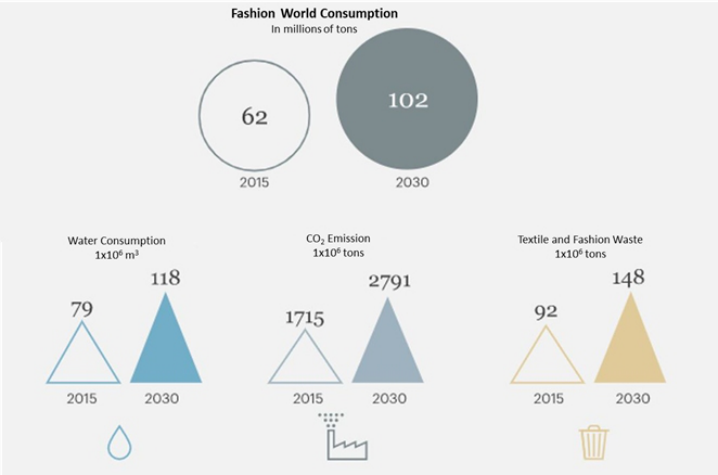
However, this sector represents the second most polluting industry in the world, and environmental impacts occur, above all, in terms of water consumption, soil erosion, CO2 emissions, and resulting residues and waste. This reality is enhanced by the exponential increase in the fashion industry, as shown in the following diagram:
Figure 1: Global consumption on textile and fashion (adapted from “The footprint of our clothes”, by Cátia Mendonça, 2019).
The textile industry is responsible for producing 2.1 billion tons of waste, most of which are discarded into the water ecosystem, essentially during the dyeing processes. Dyeing is one of the most polluting processes in the textile industry, representing a high source of pollution of water circuits and the environmental ecosystem. According to the World Bank, textile dyeing industries are responsible for 20% of industrial water pollution.
This reality becomes even greater when analyzing the quantities of dyes produced. Every year, it is estimated that around 10,000 types of dyes and pigments are consumed in the market, and 7x10⁵ tons of synthetic dyes are produced, for this sector. From this production, more than 200,000 tons of dyes are released into industrial effluents during the textile processing phases (dyeing and finishing) (Chequer et al., 2013).
One of the serious problems related to the group of synthetic dyes is the level of chemical compounds, which are used for their production, which have a high level of toxicity. In this context, the group of azo dyes stands out, for example, which predominate in most applications in textile processing, and which have carcinogenic and mutagenic potential. These problems mentioned not only have an impact in terms of environmental aspects, but also in terms of human health, as they can irritate people’s skin, eyes, and respiratory tract. Additionally, several health problems, such as neurotoxicity, carcinogenicity, reproductive toxicity, and developmental toxicity, may arise because of exposure to wastewater pollution.
In view of the problems presented, over the last few years, several sectors of industrial activity, and particularly the textile industry, have been the target of severe criticism due to their contribution to environmental pollution. To remedy these problems, government entities have been imposing strict ecological restrictions on chemical products used in textile processing, including even banning the sale of certain consumer goods that contain synthetic dyes and/or finishing agents considered toxic. The need to use reagents with reduced environmental impact has thus encouraged an increasing use of natural products, especially in areas such as dyeing and finishing of textile materials, sectors in which there has been a significant increase in the use of this type of compound in recent years.
Around the world, this growing concern about environmental safety and the creation of sustainable textiles is being translated into a demand and development of processes with less use of chemical products and research into “green” dyes, obtained from alternative and natural sources. In this context, dyeing using dyes of natural origin is gaining greater relevance and need in the market, being the target of great demand from brands and consumers.
STUDY DEVELOPMENT OF THE SPECIFICATIONS SYSTEMS TO OBTAIN BIO-DYE OR BIO-PIGMENT The structure of the different types of fibers is one of the factors that condition the fiber with bio dye interaction, through the type and quantity of functional groups available to participate in the bond environment (Booher, 2003). A description of a population’s capacity incorporates more than the basic anthropometrics or the cognitive capability of the average member of the user population (Michaelis, P. R. by Alphonse Chapanis, 1996).
Among the various types of fiber with bio-dye interactions that can be formed, their molecular strength and stability vary, in descending order, in covalent bond > ionic > hydrogen bond > dipole-dipole > Van der Waals forces > physical interaction (e.g.: entrapment in the material matrix).
In this way, hydrophilic fibers (e.g. cellulosic, protein, polyamide), composed of reactive functional groups, such as hydroxyl, carbonyl, and amide groups, will more easily interact with the functional groups present in the structure of hydrophilic bio dyes (through covalent, ionic bonds, hydrogen bonds, among others), thus resulting in a stronger and more stable interaction in the dyeing process. Likewise, lipophilic fibers (e.g. polyethylene, polypropylene), with poor structure or without functional
Bio Dyes and Bio Pigments: The Sustainable Approach in Industrial Textile Dyeing 123
groups, will preferentially interact with lipophilic bio dyes and, generally, through weaker bonds.
Additionally, fiber with bio-dye interactions is also modulated by the pH of the medium (which affects the global charge of the molecules and the degree of protonation of the functional groups, and consequently the strength of the interactions established) and by the temperature of the dyeing process (which increases the solubility of the bio dye, as well as the structural availability of fiber reactive domains).
Distinct microorganisms produce an extraordinary variety of pigments, including diverse chemical classes, such as carotenoids, melanins, flavins, phenazines, quinones, monascins, violacein or indigo (Venil et al., 2016).
The project aims to obtain bio dyes corresponding to red, blue, and yellow colours.
Several factors influence the production of microbial biodyes (Venil et al., 2014; Gonçalves & Vasconcelos, 2021), namely: (a) Abiotic factors, such as temperature, pH, crop oxygenation, among others. (b) Biotic factors, such as available carbon (C) and nitrogen (N) sources, C:N ratio, micronutrients, use of precursors and inducers of the biosynthetic pathway, growth phase when biosynthesis is initiated, among others.
The effect of these factors on the activation of the biosynthetic pathway and microbial physiology is also dependent on the genetic repertoire of the producing species and sometimes the strain (da Silva et al., 2021).
The effect of abiotic and biotic factors on the production of selected bio dyes will be systematically evaluated using a statistical rationale, based on the Plackett Burman design method (Venil et al., 2014; Gahlout et al., 2021). This method will allow the tracking and identification of factors (variables) that significantly affect the yield of the production process, positively (increasing it) and negatively (reducing it), about 3 parameters: (i) the amount of biomass, which reflects cell growth, (ii) the concentration of bio dye obtained per dm3 of culture, and (iii) the concentration of bio dye accumulated per mass of cells. The effects of synergy or antagonism between variables will also be evaluated by Response Surface Methodology associated with a Central Composite Design approach, to define a regression model for each bio dye under study, optimize the yield of the production process, and predict the maximum concentration possible to be obtained under the culture conditions used (Gahlout et al., 2021).
The acquisition of existing and characterized strains was considered an alternative to the process of creating internal strains, through extensive genetic manipulation protocols for heterologous and/or optimal expression of biosynthetic bio dye pathways, and subsequent validation of the constructed biological systems.
The bio dyes planned for production will therefore have the potential to dye a wide range of natural and synthetic fibers. However, the information available about the dyeing process in published studies is quite limited.
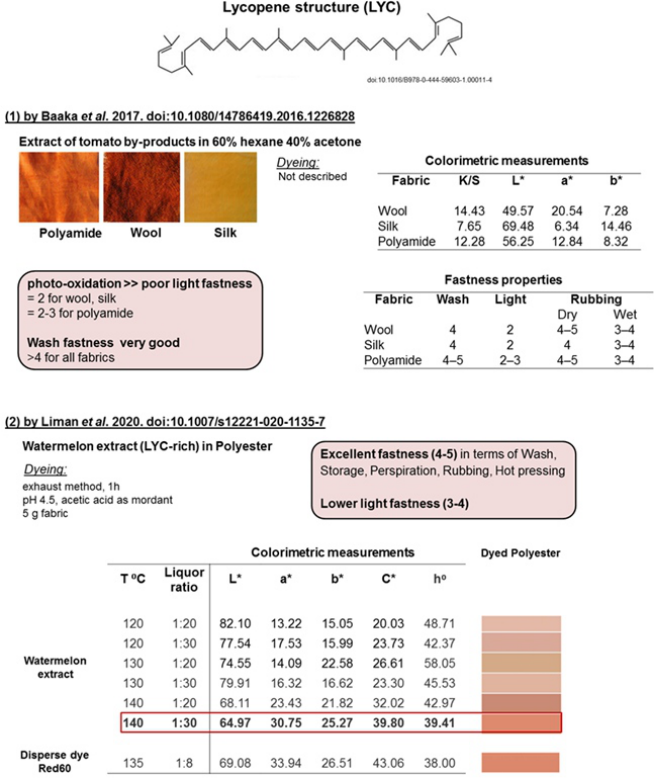
The following figures compile the information available for each bio-dye considered, resulting from the literature search (Bacame-Valenzuela et al., 2020). Several studies have used lycopene extracted from plant sources to dye natural and synthetic fibers (Figure 2).
Figure 2: Studies on the application of lycopene in extracts of plant material for dyeing textile fibers (Baaka et al., 2017; Liman et al., 2020). K/S, coloristic intensity; L*, brightness; a*, red/green hue coordinate (+a indicates red and -a indicates green); b*, coordinate of the yellow/blue hue (+b indicates yellow and -b indicates blue); C*, saturation (chroma); h◦, hue angle.
The dyeing of polyester fibers (5 g test material) with lycopene was also reported by Carvalho and Santos, 2015 and by Liu et al., 2020, supplemented with the oxidizing agents 2 g/L Ludigol AR and 1 g/L Levagol DLP, acetic acid as mordant, with a liquor ratio of 1:30, at pH 4.5 maintained with sodium acetate. Two heating methods were tested: method 1 consisted of heating by
Bio Dyes and Bio Pigments: The Sustainable Approach in Industrial Textile Dyeing 125 increasing the temperature 2
C/min to 60
C, and then 4
C/min to 140
C, stabilizing for 1 h; method 2 consisted of heating, increasing the temperature 7
C/min up to 140
C, stabilizing for 1 h. The bio dye was tested in a range of concentrations of 0.5%, 1%, 2%, 5% omf, and the colouring intensity was greater with the bio dye concentration of 5%, when dyeing was carried out with heating method 1, highlighted in figure 2.
CONCLUSION
This research work aims to obtain and produce bio colourants from microorganisms and their respective application in textile substrates, depending on the current industrial technologies of industrial textile dyeing and printing.
To date, no continuous dyeing processes using bio dyes or bio pigments produced from microorganisms have been reported. That said, the present project aims to investigate continuous and discontinuous dyeing processes in order to evaluate their effectiveness, by obtaining the bio dye from microorganisms, allowing to overcome the limitations of the processes that use direct dyeing in the bacterial culture medium, which have important limitations in the reproducibility of the process, as it depends on the direct application of the microorganism to the substrate, which implies consequences in the intensity of colour, fixation and brightness, fastness to washing and light.
In short, the present investigation of bio dyes/bio pigments reveals an innovative and sustainable potential in the development of new textile colourants, in order to replace the current synthetic dyes, with high levels of toxicity and associated carcinogenesis and consequently without any levels of biodegradability or environmental sustainability.
ACKNOWLEDGMENT
This work is supported by CIAUD Research Center of Architecture Urbanism and Design and by FCT Project no. 68924 GRANT NUMBER: T590517690- 00082967. Foundation for Science and Technology.
REFERENCES
Baaka, N., Haddar W., Ticha, M. B., Amorim, M. T. P., M’Henni; M. F. (2017).
Sustainability issues of ultrasonic wool dyeing with grape pomace colourant. pp. 1655–1662. https://doi.org/10.1080/14786419.2017.1285303. Bacame-Valenzuela, F. J., Pérez-Garcia, J. A., Figueroa-Magallón, M. L., Espejel-Ayala, F., Ortiz-Frade, L. A., & Reyes-Vidal, Y. (2020). Optimized production of a redox metabolite (pyocyanin) by Pseudomonas aeruginosa NEJ01R using a maize by-product. Microorganisms, 8(10), 1559. doi: 10.3390/microorganisms8101559. da Silva, A. J., de Souza Cunha, J., Hreha, T., Micocci, K. C., Selistre-de-Araujo, H. S., Barquera, B., & Koffas, M. A. (2021). Metabolic engineering of E. coli for pyocyanin production. Metabolic Engineering, 64, 15–25. doi: 10.1016/j.ymben.2021.01.002.
Booher, D. E. and Innes, J. E. (2003). The Impact of Collaborative Planning on Governance Capacity, https://hdl.handle.net/10419/23606. Carvalho, C., & Santos, G. (2015). Global Communities, Biotechnology and
Sustainable Design – Natural / Bio Dyes in Textiles. Procedia Manufacturing. 3, 6557–6564. doi: 10.1016/j.promfg.2015.07.956. Chequer, F. M. D., Oliveira, G. A. R., Ferraz, E. R. A., Cardoso, J. C., Zanoni, M. V. B., Oliveira, D. P. de (2013). Textile Dyes: Dyeing Process and Environmental Impact. ISBN: 978-953-51-0892-4. Edited by Melih Gunay, Turkey. doi: 10.5772/53659. Gahlout, M., Chauhan, P. B., Prajapati, H., Tandel, N., Rana, S., Solanki, D. &
Patel, N. (2021). Characterization, application and statistical optimization approach for enhanced production of pyocyanin pigment by Pseudomonas aeruginosa DN9. Systems Microbiology and Biomanufacturing, 1(4), 459–470. doi: 10.1007/s43393-021-00033-z. Gonçalves, T., Oliveira, B. T. M. & Vasconcelos, U. (2021). Uso de piocianina no tingimento de fibra de algodão. International Journal of Development Research, 11(2), 44127–44134. doi: 10.37118/ijdr.21064.02.2021. Gonçalves, T. & Vasconcelos, U. (2021). Colour me blue: The history and
the biotechnological potential of pyocyanin. Molecules, 26(4), 927. doi: 10.3390/molecules26040927. Liman, M. L. R., Islam, M. T., Hossain, M. & Sarker, P. (2020). Sustainable dyeing mechanism of polyester with natural dye extracted from watermelon and their UV protective characteristics. Fibers and Polymers, 21(10), 2301–2313. doi: 10.1007/s12221-020-1135-7. Liu, N., Liu, B. Wang, G., Soong, Y -H. V., Tao, Y., Liu, W., Xie, D.
(2020). Lycopene production from glucose, fatty acid and waste cooking oil by metabolically engineered Escherichia coli. Biochemical Engineering Journal. 155. doi.org/10.1016/j.bej.2020.107488. Michaelis, P. R. by Alphonse Chapanis (1996). Human Factors in Systems Engineering by Alphonse Chapanis 1996. p. 332. New York: John Wiley & Sons, Inc. ISBN 0-471-13782-0. https://doi.org/10.1177/106480469700500. Venil, C. K., Aruldass, C. A., Dufossé, L., Zakaria, Z. A. & Ahmad, W. A. (2014).
Current perspective on bacterial pigments: emerging sustainable compounds with coloring and biological properties for the industry–an incisive evaluation. RSC Advances, 4(74), 39523–39529. doi: 10.1039/C4RA06162D. Venil, C. K., Yusof, N. Z., Aruldass, C. A. & Ahmad, W. A. (2016). Application of violet pigment from Chromobacterium violaceum UTM5 in textile dyeing. Biologia, 71(2), 121–127. doi: 10.1515/biolog-2016-0031.
LISTED IN THE AHFE DIGITAL BOOKSTORE CATALOGUE
Explore the complete digital volume
Human Systems Engineering and Design (IHSED2024): Future Trends and Applications
Read this individual research paper free through the original publisher, or explore the full digital proceedings book.
ISBN 978-1-964867-34-2
Explore this ISBN in the AHFE Bookstore ↗Listed in the July 2026 bookstore catalogue; search by ISBN to confirm current availability · Digital book purchase optional