Cristina Carvalho, Gianni Montagna, Carla Costa Pereira, Carlos Manuel Figueiredo (2023). Biodyes: a new approach in textile dyeing and printing technological processes. In: Human Factors for Apparel and Textile Engineering. AHFE Open Access, vol. 86, pp. 62–70. https://doi.org/10.54941/ahfe1003641
CIAUD, Research Centre for Architecture, Urbanism and Design, Lisbon School of Architecture, Universidade de Lisboa, Rua Sá Nogueira, Polo Universitário do Alto da Ajuda, 1349–063 Lisboa, Portugal ↗
The textile industry is responsible for the production of more than 2 billion tons of effluents/waste, most of which are discarded into the ecosystem, namely and mostly into water ecosystems, essentially after the dyeing and printing processes. In fact, dyeing is one of the most polluting processes in the textile industry, representing a high source of pollution. According to the World Bank, the textile dyeing industries are responsible for more than 20% of the pollution of all water used at the industrial level.One of the serious problems related to the group of synthetic dyes is the level of chemical compounds used for their production, which has a high level of toxicity. In this context, the group of azo dyes stands out, for example, which predominate in most textile processing applications and have carcinogenic and mutagenic potential. These mentioned problems do not only have an impact in terms of the environment, but also in terms of human health since they can cause irritation to people's skin, eyes, and respiratory tract. Additionally, various health problems such as neurotoxicity, carcinogenicity, reproductive toxicity, and developmental toxicity can arise because of exposure to wastewater pollution.One of the emerging research domains is related to the exploration of obtaining natural dyes from microorganisms, known as Bio colorants. However, the approaches used also limit the yield and performance of the obtained formulations, since the dyeing process occurs directly, through the exposure of the microorganism to the substrate. Additionally, to date, there is no solution applicable to continuous dyeing.This research work has as its main objectives the research and development to obtain dyes for application in textile finishing processes, namely dyeing and printing, resorting to bacterial metabolic processes for the bioproduction of these same dyes. Complementarily, with this project, it is expected to obtain dyeing and printing processes with a reduction in contaminated effluents, because of the high biodegradability of the biodyes to be developed, thus contributing to the reduction of decontamination processes of industrial effluents.This project, therefore, aims to achieve the following research and development milestones:i. New biotechnological approach for obtaining the biodye;ii. High performance and functionalization of the biodye on textile substrates.iii. Reproducibility and uniformity of the process on various types of substrates.A differentiating approach will be investigated, through the metabolic study of the culture conditions of microorganisms, without resorting to genetic modification, and without the use of toxic chemical compounds, allowing, in this way, to generate a unique concept in the sector. As will be duly demonstrated given that, to date, Biodye solutions obtained from microorganisms for continuous dyeing are unknown.At the level of the proposed concept, it is intended to develop formulations of biodye in powder and/or liquid, with performances equivalent to synthetic dyes, to meet the facilities and operational needs of industrial textile dyeing and printing processes, directly responding to industry and market requirements. Effectively, this concept is unique and distinct in the sector, since the discontinuous dyeing solutions of biodyes (from microorganisms) available, occur by direct transfer of the color of the microorganism to the substrate, which entails high constraints in the productive processes in the industries of the sector, which do not have the capacity to adapt their infrastructures. The provision of a powder/and/or liquid formulation makes it possible to respond to this problem and needs.Within the scope of this research process, difficulties may be encountered in obtaining a sufficiently high production yield of biodyes using the different substrates to be tested. Although this is not expected for the production of the red biodye (using the E.coli microbiological strain), it may eventually occur in the production of the yellow and/or blue biodyes. In this case, the consortium team will investigate metabolic pathways of different bacterial and fungal strains to analyze alternatives for obtaining biodye with chromophores of different tones that are an added value for the needs of the sector, through the study and production based on Blakeslea trispora, or in fungi of the genus Penicillium. These strategies will enable the investigation of Biocolorant solutions with yields compatible with industrial needs.This research project also intends to demonstrate and validate the application of the biocolorant to textile ennoblement processes, in the specific case, industrial textile dyeing, and printing processes (batch and continuous) applied to a series of prototypes/pieces of clothing, with different compositions of textile fibers, for which it is intended to demonstrate high levels of intensity, saturation, and colorimetric solidity.
Biodyes: A New Approach in Textile Dyeing and Printing Technological Processes 63
INTRODUCTION
This project, therefore, aims to achieve the following research and deve- lopment milestones: i. New biotechnological approach for obtaining the biodye; ii. High performance and functionalization of the biodye on tex- tile substrates. iii. Reproducibility and uniformity of the process on various types of substrates. A differentiating approach will be investigated, through the metabolic study of the culture conditions of microorganisms, without resorting to genetic modification, and without the use of toxic chemical com- pounds, allowing, in this way, to generate a unique concept in the sector. As will be duly demonstrated given that, to date, biodye solutions obtained from microorganisms for continuous dyeing are unknown. At the level of the pro- posed concept, it is intended to develop formulations of biodye in powder and/or liquid, with performances equivalent to synthetic dyes, to meet the facilities and operational needs of industrial textile dyeing and printing pro- cesses, directly responding to industry and market requirements. Effectively, this concept is unique and distinct in the sector, since the discontinuous dyeing solutions of biodyes (from microorganisms) available, occur by direct tran- sfer of the color of the microorganism to the substrate, which entails high constraints in the productive processes in the industries of the sector, which do not have the capacity to adapt their infrastructures. The provision of a powder/and/or liquid formulation makes it possible to respond to this pro- blem and needs. Within the scope of this research process, difficulties may be encountered in obtaining a sufficiently high production yield of biodyes using the different substrates to be tested. Although this is not expected for the production of the red biodye (using the E.coli microbiological strain), it may eventually occur in the production of the yellow and/or blue biodyes. In this case, the consortium team will investigate metabolic pathways of diffe- rent bacterial and fungal strains to analyze alternatives for obtaining biodye with chromophores of different tones that are an added value for the needs of the sector, through the study and production based on Blakeslea trispora, or in fungi of the genus Penicillium. These strategies will enable the investigation of bio-colorant solutions with yields compatible with industrial needs. This research project also intends to demonstrate and validate the application of the bio-colorant to textile ennoblement processes, in the specific case, indu- strial textile dyeing, and printing processes (batch and continuous) applied to a series of prototypes/pieces of clothing, with different compositions of textile fibers, for which it is intended to demonstrate high levels of intensity, saturation, and colorimetric solidity.
The present investigation related to this work intends, therefore, to respond to the pressing needs of the textile industry, with regard to obtaining new typologies of sustainable dyes, which, at the same time, can respond to the characteristics and performance of synthetic dyes, in technological proces- ses. batch dyeing, continuous dyeing, conventional printing or digital printing on textile surfaces in the production of colored textiles, with reduced impact on the environment and human health.
It is known the potential that exists in the generation of color and a wide range of functionalities, from biotechnology, with regard to the metabolic pathway of certain microorganisms, in the specific case of bacteria such as
E. coli. The main advantages of the innovation proposed in the investigation of this project are, compared to synthetic dyes/pigments, its very low environ- mental impact, regarding the consumption of material and energy resources, environmental pollution, and non-toxicity of the resulting effluents (Gulzar et al., 2019). At the same time, the production of dyes from microorganisms, bacteria or fungi, presents benefits compared to natural alternatives of vege- table origin due to its independence from seasonal limitations and climatic conditions, as well as the rapid growth of some substances and therefore with much higher biological yields and subsequent industrial application (Pankaj & Kumar, 2016). The application of biodyes on textile substrates is an emer- ging research area (Liu et al. 2020), but with a high potential to respond to the pressing needs of the textile and fashion sector, in terms of sustainability.
However, there are still limitations to be overcome both in terms of its extraction, yield for its industrial application, and in terms of its compatibility with the different textile substrates of natural, artificial or synthetic origin, which will be the focus of the activities of this work. research. Effectively, the reluctance of the textile industry to use dyes other than synthetic ones, most used so far, is related precisely to the fact that non-synthetic compounds still do not offer guarantees in terms of textile quality and functionality (eg levels of fastness from color to light, color durability, namely fastness to washing, fastness to perspiration), which has made the application of dyes obtained by alternative processes in the textile industry in general unfeasible in pra- ctice. It is intended, therefore, to invert this paradigm with the realization of this project.
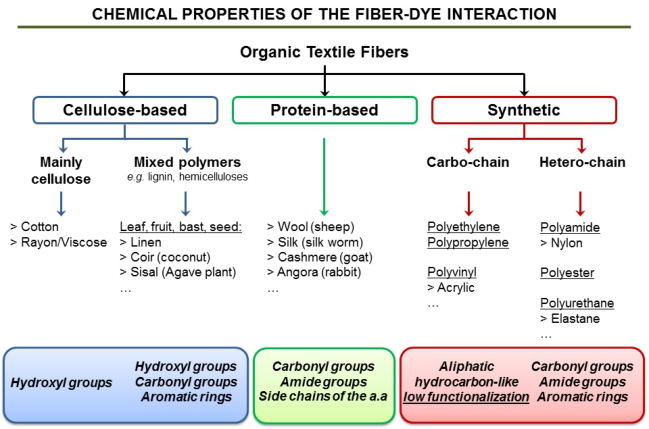
The structure of the various types of fibers is one of the factors that condi- tion the fiber-biodye interaction, through the type and amount of functional groups available to participate in the binding. The main functional groups of each type of fiber are represented in Figure 1.
Figure 1: Main types of textile fiber and the respective major functional groups pre- sent in its structure, which will play an essential role in the fiber-biodye interaction (Chattopadhuay, 2011; Choudhury, 2011; Grishanov, 2011; Koh, 2011; Lewis, 2011).
Biodyes: A New Approach in Textile Dyeing and Printing Technological Processes 65
STUDY OF THE SPECIFICATIONS OF THE PROCESS TO OBTAIN BIODYE Several factors influence the production of microbial biodyes (Venil et al. 2016; Gonçalves & Vasconcelos, 2021), namely: (a) Abiotic factors, such as temperature, pH, culture oxygenation, among others;
(b) Biotic factors, such as carbon (C) and nitrogen (N) sources available, C:N ratio, micronutrients, use of precursors and inducers of the biosynthetic pathway, and growth phase in which biosynthesis is initiated, among others.
The effect of these factors on biosynthetic pathway activation and micro- bial physiology is also dependent on the genetic repertoire of the producing species (and sometimes strain).
The effect of these factors on biosynthetic pathway activation and micro- bial physiology is also dependent on the genetic repertoire of the producing species.
The effect of abiotic and biotic factors on the production of selected biod- yes will be systematically evaluated using a statistical rationale, based on the Plackett Burman design method (Venil et al., 2014; Gahlout et al., 2021). This method will allow the tracking and identification of factors (variables) that significantly affect the yield of the production process, positively (incre- asing it) and negatively (reducing it), in view of 3 parameters: (i) the amount of biomass, which reflects cell growth, (ii) the concentration of biodye obtai- ned per liter of culture, and (iii) the concentration of biodye accumulated per mass of cells. The effects of synergy or antagonism between the variables will also be evaluated by Response Surface Methodology associated with a Central Composite Design approach, in order to define a regression model for each biodye under study, optimize the yield of the production process and predict the concentration maximum possible to obtain under the culture conditions used (Gahlout et al., 2021).
The approach planned in this research, a process was started to obtain several strains of bacteria and fungi/yeasts, through the acquisition of already existing and characterized strains.
Based on the literature and the availability for the transfer of biological material, the biodyes and microorganisms listed in Table 1. were considered.
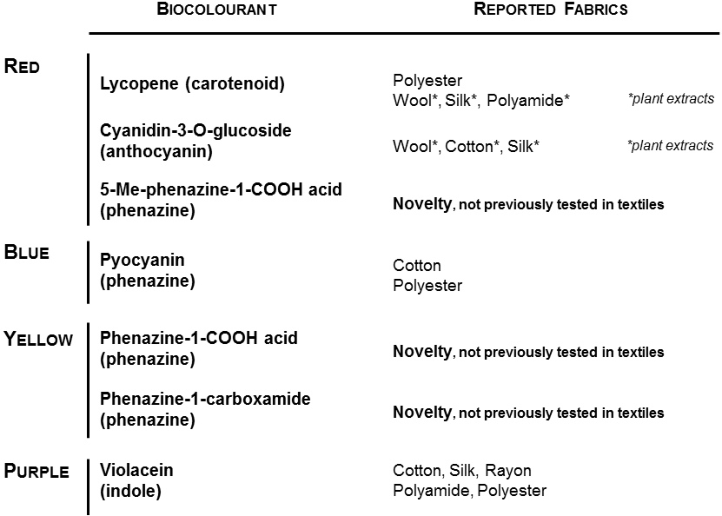
Study of the Conditions and Specifications of Some Tests Carried Out The textile fibers on which the biodyes to be produced by the strains were tested are listed in Figure 2.
The biodyes expected to be produced will thus have the potential to dye and print a wide range of natural and synthetic fibres. However, the informa- tion available on dyeing and printing processes in published studies is quite limited.
The first biodyes production tests were developed with the Gram-negative bacterium Pseudomonas aeruginosa (strain PA01), immediately available for this investigation. Its production of the blue pyocyanin biodye can reach 10 mg/L under culture conditions that stimulate the biosynthetic pathway, which is a higher value than that reported to produce the P. aeruginosa
Table 1. Microbial strains to be obtained to produce biodyes (Jones et al., 2015; Liman et al., 2020; Domröse et al., 2017; Schwartz et al., 2017; da Silva et al., 2021).
Table available in the original PDF paper.
Figure 2: Textile fibers on which the biodyes to be produced by the strains in the acquisition process were tested. 5-Me-phenazine-1-COOH acid, 5-methyl-phenazine- 1-carboxylic acid; phenazine-1-COOH acid, phenazine-1-carboxylic acid.
KU_BIO2 strain (2.6 mg/L) by DeBritto et al. 2020, in which the pigment was tested in cotton fiber dyeing.
Biodyes: A New Approach in Textile Dyeing and Printing Technological Processes 67
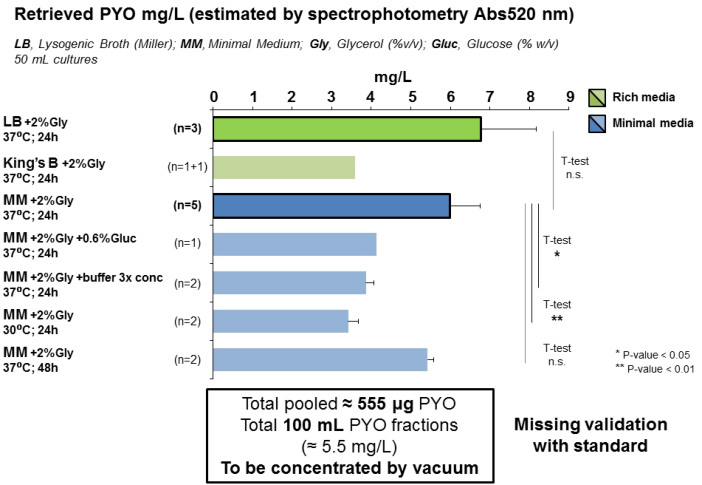
In the preliminary tests carried out to establish the pyocyanin production and extraction protocol (Figure 3), different conditions were tested:
- the use of rich Lysogenic Broth (LB) and King’s medium B (King’s B) rich media, as well as minimal mineral medium (MM);
- the carbon source, where glycerol is described as being preferred to sti- mulate the biosynthetic pathway. The use of 2% (v/v) glycerol as the only carbon source or with glucose supplementation was tested;
- the production temperature from 30
C to 37
C; - the production time, after 24 h and 48 h; - the buffering of the MM medium to an initial pH of 7.0, using a final concentration of 1× and 3× phosphate buffer, to reduce the inhibi- tory and rapid acidification of the culture, which is usually in the growth of P. aeruginosa with glycerol.
The highest concentrations of extracted pyocyanin were obtained from cultures of P. aeruginosa (strain PA01) in the rich LB medium or in the MM mineral medium, using 2% (v/v) glycerol, with a production time of 24 h at 37
C. The MM mineral medium can be used preferably since it will contain a smaller number of compounds that may contaminate or interfere with the extraction and purification of pyocyanin (e.g. medium components, cellular constituents, since the MM medium supports a smaller amount of biomass and lysis by chloroform that promotes a better separation between the organic and aqueous phases).
According to the estimate, a total of 550 µg of pyocyanin was obtained, in a total of 100 mL, corresponding to a solution of 5.5 mg/L. This solu- tion will then be concentrated in vacuo. According to the literature, and
Figure 3: Pyocyanin concentrations obtained in 50 mL of P. aeruginosa culture (strain PA01). Pyocyanin concentrations were estimated spectrophotometrically using the extinction coefficient at 520 nm (Abo-Zaid et al. 2015; Bacame-Valenzuela et al. 2020).
with information from the Textile Science and Technology Industry, it will be necessary to obtain concentrations in the order of hundreds of mg/L to apply the biodye in fiber tests, so the production and optimization of the biosynthesis of pyocyanin will have to continue.
CONCLUSION
Efforts to optimize pyocyanin production in P. aeruginosa will continue to be the main focus of research, including testing on additional culture media (eg King’s medium A and Pseudomonas Isolation medium), which were not included in the preliminary tests due to the unavailability of some reagents for its formulation. The use of other carbon sources will also be tested (such as carboxylic acids, individually or in combination with glycerol supplemen- tation) and the concentration of micronutrients, supplementation of amino acid precursors of the shikimate pathway (shikimate), which generates the intermediates for biosynthesis of phenazines in P. aeruginosa.
The acquisition process of pyocyanin-producing E. coli (strain 1M2L3H, from da Silva et al. 2021) is ongoing. Unlike P. aeruginosa, which is a Safety Level 2 bacteria, E. coli is a Safety Level 1 bacteria, widely validated for indu- strial applications. Thus, the production of pyocyanin by E. coli 1M2L3H will be privileged and considered, especially if concentrations higher than those obtained with P. aeruginosa (strain PA01) are obtained.
However, considering the low yield reported for strain PA01 and obtained in the tests carried out, when other microbial strains, producers of biodyes with higher yields, become available, the production of pyocyanin by P. aeru- ginosa (strain PA01) will not be considered a priority. The selection of the approach to follow will be carried out in a judicious way, taking into account production yield estimates, purification difficulty, monetary and environ- mental costs, possible toxicity of intermediate compounds or reagents, and process length.
ACKNOWLEDGMENT
The authors would like to acknowledge, this work is supported by CIAUD Investigation Center of Architecture Urbanism and Design and by FCT Pro- ject n.
68924 GRANT NUMBER: T590517690-00082967. Foundation For Science and Technology
REFERENCES
Abo-Zaid, G. A., Wagih, E. E., Matar, S. M., Ashmawy, N. A., & Hafez, E. E. (2015).
Optimization of pyocyanin production from Pseudomonas aeruginosa JY21 using statistical experimental designs. International journal of ChemTech research, 8(9), 137–148. Bacame-Valenzuela, F. J., Pérez-Garcia, J. A., Figueroa-Magallón, M. L., Espejel- Ayala, F., Ortiz-Frade, L. A., & Reyes-Vidal, Y. (2020). Optimized production of a redox metabolite (pyocyanin) by Pseudomonas aeruginosa NEJ01R using a maize by-product. Microorganisms, 8(10), 1559. doi: 10.3390/microorgani- sms8101559.
Biodyes: A New Approach in Textile Dyeing and Printing Technological Processes 69
Chattopadhyay, D. P. (2011). Chemistry of dyeing. In Handbook of textile and industrial dyeing. Volume 1 (pp. 150–183). Woodhead Publishing, USA. doi: 10.1002/9781119434436.ch4. Choudhury, A. R. (2011). Dyeing of synthetic fibres. In Handbook of textile and
industrial dyeing. Volume 2 (pp. 40–128). Woodhead Publishing, USA. doi: 10.1533/9780857094919.1.40. da Silva, A. J., de Souza Cunha, J., Hreha, T., Micocci, K. C., Selistre-de- Araujo, H. S., Barquera, B., & Koffas, M. A. (2021). Metabolic engineering of E. coli for pyocyanin production. Metabolic Engineering, 64, 15–25. doi: 10.1016/j.ymben.2021.01.002. DeBritto, S., Gajbar, T. D., Satapute, P., Sundaram, L., Lakshmikantha, R. Y., Jogaiah,
S., & Ito, S. I. (2020). Isolation and characterization of nutrient dependent pyo- cyanin from Pseudomonas aeruginosa and its dye and agrochemical properties. Scientific reports, 10(1), 1–12. doi:10.1038/s41598-020-58335-6. Domröse, A., Weihmann, R., Thies, S., Jaeger, K.-E., Drepper, T. & Loeschcke, A.,
2017. Rapid generation of recombinant Pseudomonas putida secondary metabo- lite producers using yTREX. Synthetic and Systems Biotechnology. 2, 310–319. doi:10.1016/j.synbio.2017.11.001. Gahlout, M., Chauhan, P. B., Prajapati, H., Tandel, N., Rana, S., Solanki, D. & Patel, N. (2021). Characterization, application and statistical optimiza- tion approach for enhanced production of pyocyanin pigment by Pseudomonas aeruginosa DN9. Systems Microbiology and Biomanufacturing, 1(4), 459–470. doi:10.1007/s43393-021-00033-z. Gonçalves, T. & Vasconcelos, U. (2021). Colour me blue: the history and the biotechnological potential of pyocyanin. Molecules, 26(4), 927. doi:10.3390/molecules26040927. Gonçalves, T., Oliveira, B. T. M. & Vasconcelos, U. (2021). Uso de piocianina no
tingimento de fibra de algodão. International Journal of Development Research, 11(2), 44127–44134. doi:10.37118/ijdr.21064.02.2021. Grishanov, S. (2011). Structure and properties of textile materials. In Handbook of textile and industrial dyeing. Volume 1 (pp.28–63). Woodhead Publishing, USA. doi: 10.1533/9780857093974.1.28. Gulzar, T., Farooq, T., Kiran, S., Ahmad, I., & Hameed, A. (2019). Green chemistry
in the wet processing of textiles. In S. ul-Islam & B. S. Butola (Eds.), The Impact and Prospects of Green Chemistry for Textile Duxford: Woodhead Publishing. Jones, J. A., Vernacchio, V. R., Lachance, D. M., Lebovich, M., Fu, L., Shirke, A.
N., Schultz, V. L., Cress, B., Linhardt, R. & Koffas, M. A. (2015). ePathOptimize: a combinatorial approach for transcriptional balancing of metabolic pathways. Scientific reports, 5(1), 1–10. doi:10.1038/srep11301. Koh, J. (2011). Dyeing of cellulosic fibres. In Handbook of textile and industrial dyeing. Volume 2 (pp. 129–146). Woodhead Publishing, USA. doi: 10.1533/9780857094919.1.129. Lewis, D. M. (2011). The colouration of wool. In Handbook of Textile and
Industrial Dyeing. Volume 2 (pp. 3–39). Woodhead Publishing, USA. doi: 10.1533/9780857094919.1.1. Liman, M. L. R., Islam, M. T., Hossain, M. & Sarker, P. (2020). Sustainable dyeing mechanism of polyester with natural dye extracted from watermelon and their UV protective characteristics. Fibers and Polymers, 21(10), 2301–2313. doi:10.1007/s12221-020-1135-7. Liu, N., Liu, B. Wang, G., Soong, Y-H. V., Tao, Y., Liu, W., Xie, D. (2020).
Lycopene production from glucose, fatty acid and waste cooking oil by meta- bolically engineered Escherichia coli. Biochemical Engineering Journal.155. doi.org/10.1016/j.bej.2020.107488.
Pankaj, V. P., & Kumar, R. (2016). Microbial pigment as a potential natural colorant for contributing to mankind. In N. Gupta & K. Biswas (Eds.), Research Trends in Molecular Biology. Kerala: Research Signpost. Schwartz, C., Frogue, K., Misa, J. & Wheeldon, I. (2017). Host and pathway engi-
neering for enhanced lycopene biosynthesis in Yarrowia lipolytica. Frontiers in microbiology, 8, 2233. doi: 10.3389/fmicb.2017.02233. Venil, C. K., Aruldass, C. A., Dufossé, L., Zakaria, Z. A. & Ahmad, W. A. (2014).
Current perspective on bacterial pigments: emerging sustainable compounds with coloring and biological properties for the industry–an incisive evaluation. RSC Advances, 4(74), 39523–39529. doi:10.1039/C4RA06162D. Venil, C.K., Yusof, N.Z., Aruldass, C.A.& Ahmad, W.A. (2016). Application of violet pigment from Chromobacterium violaceum UTM5 in textile dyeing. Biologia, 71(2), 121–127. doi: 10.1515/biolog-2016-0031.
LISTED IN THE AHFE DIGITAL BOOKSTORE CATALOGUE
Explore the complete digital volume
Human Factors for Apparel and Textile Engineering
Read this individual research paper free through the original publisher, or explore the full digital proceedings book.
ISBN 978-1-958651-62-9
Explore this ISBN in the AHFE Bookstore ↗Listed in the July 2026 bookstore catalogue; search by ISBN to confirm current availability · Digital book purchase optional