Alexandra Gabriela Ene, Mihaela Jomir, Carmen Mihai, Constantin Jomir (2023). Structural Analysis Of The Signaling Buoy Used In Relaying Areas Of Live Bivalve Mollusks. In: Human Factors for Apparel and Textile Engineering. AHFE Open Access, vol. 86, pp. 109–115. https://doi.org/10.54941/ahfe1003646
The diseases caused by the Norwalk virus (norovirus, Caliciviridae family), which produces gastroenteritis, and HAV (hepatitis A virus), and consequently generates infectious hepatitis, are the most common infections associated with the consumption of contaminated bivalve mollusks, raw or under-cooked. Moreover, the mutual commercial agreement between the EU and the USA regarding the export of live bivalve mollusks requires the adoption of a control program for the microbiological classification and monitoring of the production of this type of seafood, as well as the clear demarcation and signalling of the relaying areas. In this sense, in order to obtain the natural purification of live bivalve mollusks, the relaying areas, as freshwater, sea, estuaries or lagoons, must be demarcated and signaled with the help of buoys. The mathematical modeling of the geometric domain was performed with specialized software based on dimensional constraints specific to an algebraic surface of 2nd order – frusta of cones welded at large end, with different volumes for each frustum. The dimensions for the emerged/submerged frustum were: slant height: 630mm/800mm, radius of the larger circular front: 600mm/600mm and radius of the smaller circular front: 200mm/256mm. The Generative Structural Analysis module enabled the simulation of the behavior of the buoy both as a single entity and as a set of broken (individual) entities. The loads were carried out in the extreme conditions of the open sea, corresponding at: i) agitation state of 4 - 8 degrees Beaufort (wind speed 11 - 15 kt, respectively 20 - 88 km/h) and wave height of max. 1.5 m; ii) wind speed of 34 - 40 kt (62 - 74 km/h) and wave height of 6-7.5 m. Two types of constraints were considered both at the base and in the frusta joint area. Analysis of displacement fields and equivalent stresses (Von Mises) evidenced that the buoy is a rigid structure (with reduced maximum displacements, of 1.2e+003 mm, for 8bf), with an admissible resistance of emerged/submerged frustum 8.11e+ 009N_m2 /1.75e+009 N_m2 that enables the retrieve of the efforts due to the environment, as the possible cracks that might appear at the contact of the composite structure with the fluid in turbulent motion exceed the value of 7.83e+009N_m2 for the stress at 8bf. In addition, were considered for the emerged/submerged frustum: slant height: 630mm/800mm, radius of the larger circular front: 600mm/600mm and radius of the smaller circular front: 200mm/256mm. In this situation, a CAD/CAE environment enabled the simulation of the behavior of the buoy both as a single entity and as a set of broken (individual) entities was performed. Moreover, for the matrix made of 45%/55% PA6.6/PES fabric –corresponding to the emerged frustum and respectively 100% PA6.6 for the submerged frustum were used calculation algorithms specific to fabric design. The resulting variation intervals of the longitudinal, respectively transverse system, mass, width and connection were assessed. The buoy obtained based on mechanic-textile processing technologies will be subjected to experiments at the shore and in real conditions of use, in order to determine the corresponding technical resource.
The primary concern for human factors engineering is the need to effecti- vely integrate human capabilities with system interfaces to achieve optimal total system performance (use, operation, maintenance, support, and sustain- ment). According to European Union regulations, public health can be efficiently protected if its protection programs are based on representative results obtained from microbiological monitoring programs (Todd et al. 2019). Specifically, the assessment of the E. coli number or norovirus (the most common infections associated with the consumption of contaminated bivalve
mollusks, raw or undercooked) (Mor et al. 2017, Ludwig-Begall et al. 2018, Kemenesi et al. 2016, Kolawole et al. 2016, Arias et al. 2012, Nordgren et al. 2019) represent according to ISO TS 16649-3:2005 the referential provided by European Union legislation. On the other hand, the mutual commercial agreement between the European Union and the United States of America regarding the export of live bivalve mollusks requires the adoption of a con- trol program for the microbiological classification and monitoring of the production of this type of seafood (Neil et al. 1998), as well as the clear dema- rcation and signaling of the relaying areas. The key factors in the design and implementation of an effective program are represented by i) the samples of the species, ii) their location according to the source of contamination, iii) environmental variables, etc. Thus, to obtain the natural purification of live bivalve mollusks, the relaying areas, as freshwater, sea, estuaries, or lago- ons, must be demarcated and signaled with the help of buoys (ISO, 2005; Niculescu D., et al., 2021, Stoica E., 2021).
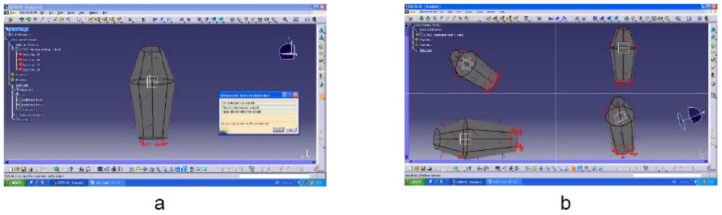
For creating the signalling buoy model used in areas of live bivalve mollu- sks, the preprocessing (performed with the help of a specialized software) was carried out in two directions: i) with constraint at the base having as result the functional model 1, (FM1) and ii) with constraint at the base and at the junction of the two trunks of the cone - superior and submerged, resulting the functional model coded as FM2.
Using the Generative Structural Analysis module, it was possible to gene- rate the structure with finite elements, respectively to obtain the discretization and loading of the material properties. The pre-processing imposed to follow the sequences related to the verification of the 3D model and the discreti- zation of the created geometry (finite element size, maximum error allowed between the real and the discretized model, element type, possible tolerance, and max no of attempts).
The functional characteristics of the composite structures from which the signalling buoy is to be made were predicted with the help of a specialised software that enabled setting the calculation parameters, making the effe- ctive calculations, processing, viewing, and exporting the numerical data. The numerical simulation was carried out under specific conditions of placement in the open sea.
For both stress conditions of the signaling buoy used in areas of live bivalve mollusks (4
Bf and at 8bf), the following results were visualized: the defor- mation of the structure under the effect of dynamic pressure, the Von Mises stress fields and the distribution of displacement vectors. The state of the tension in the system (potential cracks) was predicted using the Von Mises criterion.
MATERIAL AND METHODS The modeling of the geometric domain for the signaling buoy used in areas of live bivalve mollusks was done with the help of the sketcher application as a part of the integrated software system. The following dimensional constraints for the Part Design module used to obtain the 3D image for the emerged/su- bmerged frustum were considered: i) slant height: 630mm/800mm, ii) radius
Structural Analysis of the Signalling Buoy Used in the Areas of Live Bivalve Mollusks 111
of the larger circular front: 600mm/600mm, and iii) radius of the smaller circular front: 200mm/256mm. The Generative Structural Analysis module enabled the simulation of the behavior of the buoy both as a single entity and as a set of broken (individual) entities.
The calculation conditions were identified according to: i) the meteorolo- gical conditions specific to the open sea (Table 1); ii) constraints at the base of the solid and respectively at the base and at the junction of the two trunks of the cone - emerged and submerged.
The following materials were used: V1 for truncated cone to be suspended (submerged solid) and anchored in water and V2 for truncated cone (emer- ged solid). The characteristics of the materials used in this application are presented in Table 2.
Figure 1 presents the images resulting from the preparation of the simu- lation for 4bf in the following conditions: (a) clamping the base FM1, and (b) FM2 with clamping at the base and at the joining of the two trunks of the cone - emerged and submerged.
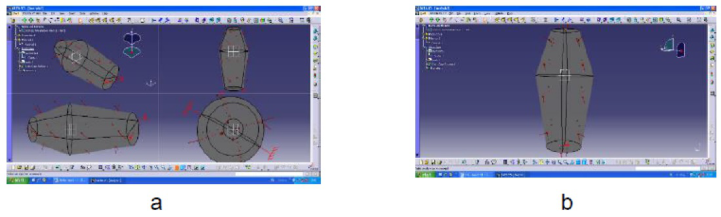
Preparation for simulation for 8bf considted in - clamping of the base FM1(a) and FM2 with clamping at the base and at the junction of the two trunks of the cone - emerged and submerged (b), but for additional efforts
Table 1. Meterorolgical conditions in the open sea (Niculescu et al.2021, Stoica et al.
Table available in the original PDF paper.
2021).
Beaufort Scale 4bf 8bf Wind speed 11 – 15 kt (20 - 88 km/h) 34 – 40 kt (62 - 74 km/h) Sea state max wave height 1.5 m; rising waves that roll.
wave height 6-7.5 m; big waves with an arched crest.
Table 2. Characteristics of the materials destined for signalling buoy used in the areas of live bivalve mollusks.
Row material warp 100% PA6.6 100% PA6.6 weft 100% PA6.6 100% PES Length density warp 940dtex/f140x1/160Z 940dtex/f140x1/160Z weft 940dtex/f140x1/160Z 1100dtex/f192x1/120Z Mass, g_m2 530±27 510±26 Braking resistance, min. daN, U/B 75/72 69/61 Tear resistance, min., daN, U/B
28/26 26/20
Braking elongation., %, warp/weft
Figure 1: Pre-processing a. FM1 – constraints at the base of the submerged area, b. FM2 – constraints at the base of the submerged area and in the area where the cone trunks join – simulation at 4bf.Figure 2: Pre-processing a. FM1 – constraints at the base of the submerged area, b. FM2 – constraints at the base of the submerged area and in the area where the cone trunks join – simulation at 8bf.
that may appear in the structure, corresponding to a state of agitation of seas with the values presented in Table 1, and represented in Figure 2.
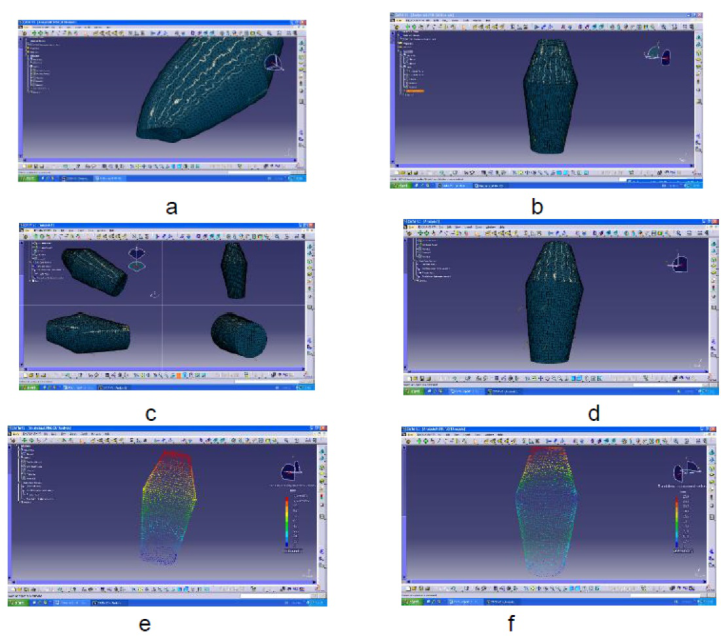
After checking the FM1 and FM2 developed with finite elements, these were solved with the help of the included solver, that also enabled to visualize: i) the deformed state of the two FMs, ii) the von Mises stress fields in the two models, iii) the displacement fields and the sections (through Cut Plane Analy- sis). The images associated with the calculation of the deformation FM1 and FM2 at 4 bf and 8 bf are presented in Figure 3.
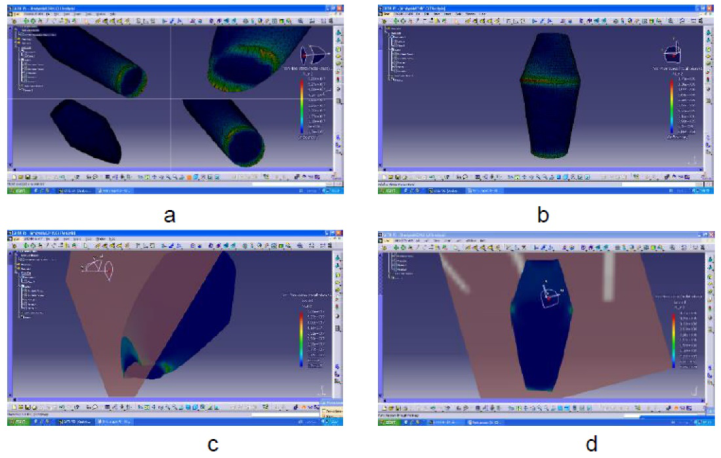
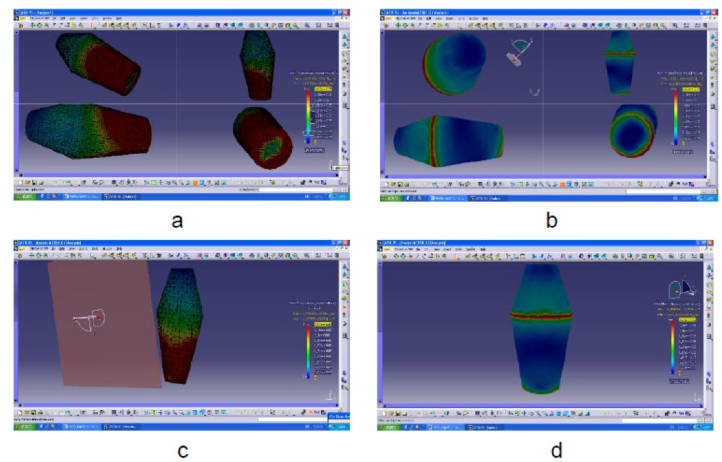
The values obtained for Von Mises are visualized in Figure 4 for both functional models differentiated by the clamping method and requested at 4 bf. Figure 5 highlights the values obtained for the two functional models requested in an 8bf scenario.
RESULTS AND DISSCUSSION The calculated values for the displacement fields are 1.2e + 003 mm, for FM1 and [0; 25.9] mm for FM2, in the case of the stress at 8bf, those calculated at 4bf being imperceptible, which proves that the functional models can be considered rigid bodies that can resist against the action of the dynamic forces developed in the open sea.
The calculated Von Mises values for FM1 are in the range [4.84e + 004; 3.77e + 006] N_m2 for the stress at 4bf and [1.127e + 007; 7.83e + 009]
Structural Analysis of the Signalling Buoy Used in the Areas of Live Bivalve Mollusks 113
Figure 3: Visualization of deformations from a. FM1 and b. FM2 requested at 4bf; c. FM1 and d. FM2 requested at 8bf and of the travel fields for e. FM1 and b. FM2 requested at 8bf. Deformation direction: from offshore to shore.
N_m2 for the stress at 8bf. Since the admissible resistance of V1 is 8.11e + 009N_m2 and 1.75e + 009 N_m2 for V2, it follows that the stru- cture from which the frusta is made will withstand the specific conditions for 8bf.
Additionally, the minimum and maximum stresses inside FM1, evidenced with the help of cut plane analysis, could be retrieved by the composite material.
For FM2, with clamping at the base and at the junction of the two cone trunks, the von Mises nodal values for stress at 4 bf are in the range [4.84e + 004; 3.77e + 006] N_m2.
For the stress at 8bf, the calculated Von Mises values are in the range [6.94e + 006; 6.50e + 008] N_m2, below the admissible values of the two composite structures from which the frusta is made, so they will be able to retrieve the loads developed in the open sea.
CONCLUSION
The mathematical modeling of the geometric domain was performed with specialized software based on dimensional constraints specific to an algebraic
Figure 4: Visualization of nodal values of Von Mises stress for a. FM1, b. FM2 and sections c. FM1 and d. FM2 requested at 4bf. Request: direction – wide-shore.Figure 5: Visualization of nodal values of Von Mises stress for a. FM1, b. FM2 and sections c. FM1 and d. FM2 requested at 8bf. Request: direction – wide-shore.
surface of 2nd order – frusta of cones welded at large end, with different volumes for each frustum.
Analysis of displacement fields, and equivalent stresses (Von Mises) evide- nced that the buoy is a rigid structure (with reduced maximum displacements, of 1.2e + 003 mm, for FM1 at 8bf, with an admissible resistance of
Structural Analysis of the Signalling Buoy Used in the Areas of Live Bivalve Mollusks 115 emerged/submerged frustum 8.11e+ 009N_m2 /1.75e + 009 N_m2 that enables the retrieve of the efforts due to the environment, as the possible cracks that might appear at the contact of the composite structure with the fluid in turbulent motion exceed the value of 7.83e + 009N_m2 for the stress at 8bf.
ACKNOWLEDGMENT
This scientific paper is funded by the Ministry of Research, Innovation, Digi- talisation within Program 1 - Development of the national RD system, Sub- program 1.2 - Institutional Performance - RDI excellence funding projects, Contract no. 4PFE/2021.
REFERENCES
*** Agreement between the European Union and the United States of America on the mutual acceptance of results of conformity assessment (2019). *** ISO (2005). Technical Specification ISO TS 16649-3, Switzerland. Arias A., Bailey D., Chaudhry Y., Goodfellow I (2012). “Development of a reversegenetics system for murine norovirus 3: Long-term persistence occurs in the caecum and colon”. Pt 7J. Gen. Virol. 93:1432–1441. Kemenesi G., Gellért Á., Dallos B., Görföl T., Boldogh S., Estók P., Marton S.,
Oldal M., Martella V., Bányai K., et al. (2016) - Sequencing and molecular mode- ling identifies candidate members of Caliciviridae family in bats. Infect. Genet. Evol. doi: 10.1016/j.meegid.2016.04.004. Kolawole A. O., Rocha-Pereira J., Elftman M. D., Neyts J., Wobus C. E. (2016) – “Inhibition of human norovirus by a viral polymerase inhibitor in the B cell culture system and in the mouse model”. Antivir. Res. 2016; 132:46–49. Ludwig-Begall L. F., Mauroy A., Thiry E. (2018): “Norovirus recombinants: Recur-
rent in the field, recalcitrant in the lab—A scoping review of recombination and recombinant types of noroviruses”. J. Gen. Virol. doi: 10.1099/jgv.0.001103. Mor S. K., Phelps N. B. D., Ng T. F. F., Subramaniam K., Primus A., Armien A. G., McCann R., Puzach C., Waltzek T. B., Goyal S. M. (2017) “Genomic characte- rization of a novel calicivirus, FHMCV-2012, from baitfish in the USA”. Arch. Virol. 2017; 162:3619–3627. doi: 10.1007/s00705-017-3519-6. Neill J. D., Meyer R. F., Seal B. S. (1998). “The capsid protein of vesicular exanthema
of swine virus serotype A48: Relationship to the capsid protein of other animal caliciviruses”. Virus Res. doi: 10.1016/S0168-1702(98)00013-6. Niculescu D., Vl˘asceanu E., Marin D., Mateescu R. (2021) – “GIS-Based Assessesment of the Romanian Marine and Coastal Areas Hydrodynamical Characte- ristics as Part of Maritime Spatial Planning”, Revista Cercet˘ari Marine - Revue Recherches Marines - Marine Research Journal: Vol 51 No 1 (2021): Cercet˘ari Marine - Recherches Marines. Nordgren J., Svensson L. (2019) “Genetic Susceptibility to Human Norovirus
Infection: An Update. Viruses”. doi: 10.3390/v11030226. Stoica E., Nenciu M., Creang˘a S. M, TanaseM. S, Marin D., Ciuca A. M, P˘atras.cu V., (2021) “Assessment of the Marine Litter on the Romanian Black Sea Beaches”, Revista Cercet˘ari Marine - Revue Recherches Marines - Marine Research Journal: Vol 51 No 1: Cercet˘ari Marine - Recherches Marines. Todd K. V., Tripp R. A. Human Norovirus Experimental Models of Infection (2019).
“Viruses”. doi: 10.3390/v11020151.
LISTED IN THE AHFE DIGITAL BOOKSTORE CATALOGUE
Explore the complete digital volume
Human Factors for Apparel and Textile Engineering
Read this individual research paper free through the original publisher, or explore the full digital proceedings book.
ISBN 978-1-958651-62-9
Explore this ISBN in the AHFE Bookstore ↗Listed in the July 2026 bookstore catalogue; search by ISBN to confirm current availability · Digital book purchase optional