Carmen Mihai, Alexandra Gabriela Ene, Mihaela Jomir (2022). Assessment of the Mechanical Behaviour of the Maritime Signaling Systems Based on Textiles Using Descriptive Statistics. In: Human Factors for Apparel and Textile Engineering. AHFE Open Access, vol. 32, pp. 206–211. https://doi.org/10.54941/ahfe1001557
The maritime signaling systems with textile components are light, flexible and efficient solutions [1, 4] and for their digital construction the researches were focused both on the prediction of the DB medium values and of those of the technical and functional characteristics. The designed and developed testing programme generated data on the system, by reaching the critical parameters; effectiveness; responsiveness; compatibility by evaluating the system in real interoperability conditions. Evaluation was a continuous, intensive process that involved: data analysis; defining the decisive parameters according to the operational requirements; establishing the degree of fulfillment of the technical performances; issuing hypotheses and conclusions regarding the progress registered in the technique and costs. It was demonstrated that the analised outliers, represented by the mechanical characteristics of the composite materials, component of the signaling system (braking resistance, tear resistance, braking elongation) and their joints (material-material and material – grain-gross band) do not have a negative impact on the textile structure, because they have values higher than the average for each set, so they will not influence the behavior and the functionality of the system in ground or open sea experimentation conditions.
The maritime signaling systems are designed and developed as floating stru- ctures, anchored in well-defined zones in order to delimit the navigable channels, to guide the navy equipage, to moor vessels in lieu of anchoring, to mark the positioning of various submerged objects, etc. (Benedict, 2016; Burmeister, et al. 2015). According to the international rules, these systems should have standardized colors and shapes in order to enable the safe pas- sageways indications (Timmins, et al. 2009; Yeo, et al. 2015). The maritime signaling systems with textile components are light, flexible and efficient solutions and for their digital construction the researches were focused both on the prediction of the DB medium values and of those of the technical and functional characteristics. The specific techniques of the linear model- ling and of the restrictions related to the convexity of the multitude of the
Assessment of the Mechanical Behavior of the Maritime Signaling Systems 207
admissible solutions and of the objective function (at most of a local mini- mum) have been used. The values for 3D CAD design parameters have been obtained based on the hydro meteorological characteristics of the open areas of the coast and on the values of the loading, resistance loss and ultimate load coefficients. Accomplished signaling system consists in: - main elements of the two modules, respectively the two variants of composite structures (upper and submersible modules); - subassemblies necessary for its execution and placement in the previously established aquatic conditions, respectively subassemblies for fixing ME: anchor chains and “dead head” type anchor, and execution parts: zipper and slider # 8, handle band, horizontal rein- forcement band, module core, PA6.6 Nm40 /3 thread. The evaluation of the information regarding the system during its entire functionality until its decommissioning in safe conditions, more precisely the estimation of the operational behavior was realized by planning the test-evaluation activity. Testing-evaluation ensured the substantiation of a data set usable in the pro- cess of correct assessment of: the performance-cost ratio, the requirements imposed by the user, the potential problems that may occur under the usage conditions, thus being able to appreciate in a real and concrete way the dimensions of their achievement technological capacity.
MATERIAL AND METHODS Testing program, on the ground, of the signaling system located at max. 10 m deep, in the maritime and fluvial areas, included the mechanical analysis of the material-material joints with seam code 6.03.01 / 301 and material - grosgrain seam band 2.01.01 / 301. The characteristics of the textile mate- rials used to obtain the signaling system are presented in table 1. For all the values of the studied characteristics (breaking strength in warp and weft, resi- stance to joining material: warp and weft; material and resistance to joining material - grosgrain band) descriptive statistical methods were used, enabling: description of the result groups (obtained as a result of experiments) and implicitly of the scores as well as the characterization of the results and their prediction/generalization for larger populations.
To calculate the parameters of the previously highlighted distributions, a specialized program was used for highlighting of the mean, median, modulus and standard deviation after modifying the output for all the distributions considered in order to:
assess the: percentile values (corresponding to the division of values into equal groups); parameters related to the dispersion (scattering) of the data around the central value - in this case - the average; parameters that define the central tendencies (average and median); asymmetry (skewness) and vaulting (kurtosis) of the distribution (compared to the normal one).
trace both the histograms and normal distribution curves, and the boxplot graphics (considered the most important in the descriptive analysis).
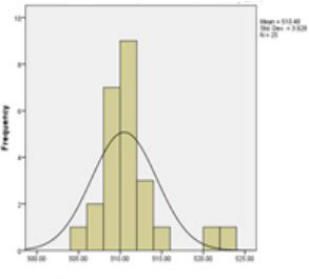
These enabled the simultaneous representation of level indicators (ave- rage, median) and dispersion. The histograms drawn for all 12 studied characteristics (6 for superior module and 6 for submersible module) are
Table 1. Characteristics of the signaling system. Component materials.
Table available in the original PDF paper.
Characteristics Superior Module Submersible Module
750/510 450/320
Raw material:Warp 100% PA6.6 100% p-aramid Raw material:Weft 100% PA6.6 100% PA6.6 100% p-aramid, Rapport 2:2 Length of density: Warp 1100dtex/f140x1/160Z 1680dtex/f1000x1 Length of density: Weft 1100dtex/f140x1/160Z 1100dtex/f140x1/160Z 1680dtex/f1000x1, Rapport 2:2 Mass, g_m2 470±24 280±14 Breaking resistance, min. daN, warp/weft 28/26 12/14 Tear resistance daN, warp/weft 130/130 70/70 Breaking elongation, max., %, warp/weft
Figure 1: Histograms for variable - braking resistance in weft at the material-material and material – grosgrain band joints.
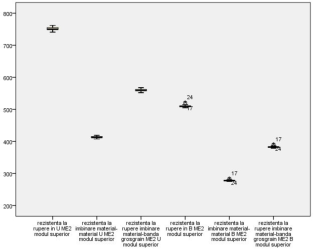
presented in Figure 1, and the boxplot graphs for the same characteristics (Figure 2).
The values registered after the mechanical testing performed for the material-material and grosgrain band material joints both for the compo- site material used in the manufacture of the upper module and for the one used for the submersible module are presented in table 2.
From the analysis of the graphs it is observed that: - for the submerged module, in warp, the variables tear strength, material-material joint resi- stance and material-material joint tear strength resistance show outlieri the values no. 9 (472 daN, 255 daN and 352 daN) from the database; - for the upper module, in weft, the variables resistance to, resistance to joint material-material and resistance to rupture joint material-band grosgrain pre- sent outlieri the values no. 17 (520 daN, 286 daN and 390 daN) and 24 (523 daN, 285 daN and 392 daN) from the database.
These outliers do not have a negative impact on the structure, because they have values higher than the average for each set (see Table 3) so they
Assessment of the Mechanical Behavior of the Maritime Signaling Systems 209
Figure 2: Box plot Graphics - for variable of the superior and submersible modules.Table 2. Mechanical characteristics of the modules of the signaling system.
Table available in the original PDF paper.
Characteristics, Warp/Weft Superior Module Submersible Module Braking resistance, min. daN, 751/510 450/321 Resistance to material-material joint, daN, 413/278 248/177 Resistance to material-grossgrain band joint, daN 560/382 337/241
will not influence the behavior of the signaling system in ground or offshore experimental conditions.
In addition, no extreme cases were reported at distances greater than 3 “box” lengths (see Figure 2).
RESULTS AND DISCUSSION
In order to evaluate the mechanical behavior of the signaling system, an extensive study based on descriptive statistics has been conducted. The obtained results evidenced the following:
the coefficient of variability in the case of all samples is below 15%, so the spread is very small, the average of the set of values being representative, so the populations are homogeneous.
for the upper module, the skewness values demonstrate the shift to the left of the data distribution for all variables (the mean is higher than the median). However, for the weft variables: tensile strength, material-to- material strength and tensile strength of the grosgrain material-band joint, the value 1,914 highlights the tendency to move away from the normal distribution of this variable.
However, for none of the characteristics is there a departure of the distribution from the theoretical normality.
for the submersible module, the vaulting index, in the weft, is negative for the breaking strength, the material-material joint resistance and the material-band joint breaking strength, so the curve is platicurtica, (there is a strong variation of the variable in parallel with a weak variation of
Table 3. Statistics.
Table available in the original PDF paper.
Characteristics, Median Std. Deviation Minimum Maximum
412.500 2.47459 407.55 419.10
Superior Module - Warp Braking resistance, min. daN, 750.000 2.49926 741.00 762.00 Resistance to material-material joint, daN
558.750 3.35195 552.05 567.69
Resistance to material-grossgrain band joint, daN
277.950 2.14059 275.22 285.03
Superior Module - Weft Braking resistance, min. daN, 510.000 2.92768 505.00 523.00 Resistance to material-material joint, daN
382.500 2.94576 378.75 392.25
Resistance to material-grossgrain band joint, daN
247.500 3.67149 237.60 259.60
Submersible Module - Warp Braking resistance, min. daN, 450.000 2.31181 432.00 472.00 Resistance to material-material joint, daN
337.500 2.73385 324.00 354.00
Resistance to material-grossgrain band joint, daN
176.000 2.00721 170.50 184.25
Superior Module - Weft Braking resistance, min. daN, 320.100 3.28583 310.00 335.00 Resistance to material-material joint, daN
240.000 2.46437 232.50 251.25
Resistance to material-grossgrain band joint, daN
frequencies). This proves that all data have a normal distribution, so para- metric tests can be applied. Positive kurtosis values for the other variables demonstrate a leptocortical distribution.
the interquartile range deviates demonstrates that there is no great vari- ability of the data. For all variables the value of the 25% percentile and that of the 75% percentile, the variability of the data is almost non-existent.
boxplot graphics. The diagrams clearly show the 5 values of a distribution: the minimum value, the first quartile, the median, the third quartile and the maximum value, which demonstrates the degree of scattering of the values, confirming the lack of variability of the variables.
Under these conditions, the possible loads to appear in the system, as a result of the action of the external dynamic forces (due to the wind speed and the change of its direction) will be evenly distributed on the anchoring system (straps), without material destruction. Also, its geometry will be kept intact even in conditions of 4 bf.
CONCLUSION
The results obtained, based on the statistical analysis on the groups of vari- ables (as a result of the mechanical tests) enable their generalization for
Assessment of the Mechanical Behavior of the Maritime Signaling Systems 211
larger populations, so for the entire lot from which the respective sample of composite material was selected.
The statistical experiments performed on the population formed by the variants of composite materials revealed that: - in case of joining material - material, the breaking strength decreases both in the warp and in the corn by about 55% compared to the breaking strength determined according to the standard test procedure of the tested material; - in case of joining the material - grosgrain tape decreases by about 75% in both systems compared to the breaking strength of the composite material tested according to the standard. This observation is particularly important in the process of designing the woven structure (made after CAD) because it must be taken into account when establishing structural parameters (density in warp, density in corn, binding, raw material, mass) and assembly and adjustment for the machines from the preparation of the weaving and weaving (advance, drum height, width in the back, navigation, graft entry/exit, unevenness of the rear cross member, etc.).
It can be concluded that all data have a normal distribution, so parametric tests can be applied to characterize the populations considered.
The creation of a statistical panel was not considered, because the frequ- ency of category II defects would be a maximum of 20 defects reported at a length of 100 ml, at a width of 170 cm.
Under these conditions, it was considered that the values of the mechanical characteristics remain constant for the entire batch from which the sample is selected.
ACKNOWLEDGMENT
This scientific paper is funded by the Ministry of Research and Innovation within Program 1 - Development of the national RD system, Subprogram 1.2 - Institutional Performance - RDI excellence funding projects, Contract no. PFE/2022.
REFERENCES
Benedict, K., Kirchhoff, M., Gluch, M., Fischer, S., Schaub, M., Baldauf, M. (2016).
‘Simulation-Augmented Methods for Safe and Efficient Manoeuvres in Harbour Areas’, Int. J. Mar. Navig. Saf. Sea Transp., (10), 193–201. Burmeister, H.C., Bruhn, W., Walther, L. (2015). ‘Interaction of Harsh Weather Operation and Collision Avoidance in Autonomous Navigation’. Int. J. Mar. Navig. Saf. Sea Transp., (9), 31–40. Timmins, I.,J., O’Young, S., (2009). ‘Marine communications channel modeling
using the finite-difference time domain method’, IEEE Transactions on vehicular technology, 58, (6), 2626–2637. Yeo, J.M., Yu, Y.S., Han, J.S., Park, S., Kim, J.U. (2015). ‘Design and Establishment of Database on the AtoN Properties for AtoN Simulator’, Int. J. e-Navig. Marit. Econ., (3), 123–131.
LISTED IN THE AHFE DIGITAL BOOKSTORE CATALOGUE
Explore the complete digital volume
Human Factors for Apparel and Textile Engineering
Read this individual research paper free through the original publisher, or explore the full digital proceedings book.
ISBN 978-1-958651-08-7
Explore this ISBN in the AHFE Bookstore ↗Listed in the July 2026 bookstore catalogue; search by ISBN to confirm current availability · Digital book purchase optional