Ah Pun Chan, Wai Ching Chu, Kwan Yu Lo, Kai Yuen Cheong (2022). Improving the Apparel Virtual Size Fitting Prediction under Psychographic Characteristics and 3D Body Measurements Using Artificial Neural Network. In: Human Factors for Apparel and Textile Engineering. AHFE Open Access, vol. 32, pp. 94–105. https://doi.org/10.54941/ahfe1001543
Background3D virtual simulation prototyping software combined with computer-aided manufacturing systems are widely used and are becoming essential in the fashion industry in the earlier stages of the product development process for apparel design. These technologies streamline the garment product fitting procedures, as well as improve the supply chain environmentally, socially, and economically by eliminating large volumes of redundant samples. Buyers can easily evaluate virtual samples that are showcased with full rotation views and visual draping effects without relying on physical prototypes before confirming orders. The approved designs can be transferred to the production line immediately, which shortens the communication, development, and production lead time between suppliers and buyers. Issues of non-standardized selection on garment sizing, ease allowance, and size of 3D avatar for creating 3D garments have been addressed by many researchers. Understanding the relationship between body dimensions, ease allowance, and apparel sizes before adopting virtual garment simulation is fundamental for satisfying high customer demands in the apparel industry. However, designers find difficulties providing the appropriate garment fit for customers without fully understanding the motivation and emotions of customers’ fitting preferences in a virtual world.A statement of objective The main purpose of this study is to investigate apparel sizes for virtual fitting, particularly looking at garment ease with consideration to body dimensions and the psychographic characteristics of subjects.SignificanceThe quantitative relationship between the pattern measurements, psychological characteristics, and 3D body measurements contributes to improving virtual fit predictions for implementing mass customization in the apparel industry. This new approach and the proposed method of virtual garment fitting model prediction on garment sizes using an Artificial Neural Network (ANN) is significant in prediction accuracy. The results of this project provide sustainable value in providing an ideal communication tool between manufacturers, retailers, and consumers by offering “perfect fit” products to customers. The project will also achieve the concept of mass customization and customer orientation, and generate new size fitting data that could bring a new level of end-user satisfaction.MethodsThe study proposes to develop a virtual garment fitting prediction model using an ANN for improving virtual garment design in terms of its fitting and sizing. The project investigated apparel sizes for virtual fitting with consideration of body dimensions and psychographic characteristics of subjects on garment ease for improving the size prediction of 3D garments. We recruited 50 subjects between the ages 18-35 years old to conduct 3D body scans and a questionnaire survey for physical and psychological segmentation, as well as fitting preferences evaluation through co-design operations on virtual garment simulation using a commercial software called Optitex. Discussion of resultsThe ease preferences from subjects were significantly different from the preset values on the software. The results from the study demonstrate that ANN is effective in modeling the non-linear relationship between pattern measurements, psychological characteristics, and body measurements. The pattern parameters predicted by the ANN model were accurate. The squared correlation coefficient (R2) increased from 0.96 to 0.99 after considering different segmentations of psychographic characteristics. The ANN prediction model is proven to be an effective method for garment pattern drafting, which can achieve an individual fit and is useful for implementing the virtual fitting model.
Improving the Apparel Virtual Size Fitting Prediction under Psychographic Characteristics 95
INTRODUCTION
Nowadays, 3D virtual garment simulation technology benefits apparel design, virtual fitting, pattern drafting, and production management. It also contributes significantly from garment manufacturing to retail sales (Nayak and Padhye, 2018). 3D virtual simulation prototyping software combined with computer-aided manufacturing systems are widely used in the fashion industry. They are becoming essential to the industry in the earlier stages of the product development process for apparel design (Ashdown, 2013). These technologies streamline the garment fitting procedures and improve the sup- ply chain environmentally, socially, and economically by eliminating large volumes of redundant samples (Sizemic, 2012). 3D virtual garment simula- tion software consists of 2D pattern drafting, 2D pattern grading, 3D virtual simulation, and 3D sewing. The physical properties of fabrics, texture effects, and fit tension are taken into account during the virtual prototyping proces- ses. Buyers can evaluate virtual samples through showcases with full rotation views with visual draping effects without needing to rely on physical prototy- pes before confirming orders (Boorady & Hawley, 2008; Browzwear, 2020; CLO, 2020; EFI, 2020). The approved designs can be transferred to the pro- duction line immediately, which shortens the communication, development, and production lead time between suppliers and buyers. There is no doubt that the application of 3D virtual garment simulation will be more accessible and important in the next few decades in the fashion industry (Gupta et al., 2014). To demonstrate the 3D virtual prototypes to the buyers, designers have to create the 2D patterns by adjusting the garment measurements, refining the garment size and dimensions between each size of a garment, and choose a suitable male or female 3D avatar from the software for 3D fitting and mode- ling their design collections (Boorady & Hawley, 2008; Browzwear, 2020; CLO, 2020; EFI, 2020). However, what would be the most appropriate ele- ments for creating the fitted 3D prototypes for the customers? The elements include: i) garment dimensions and measurements, ii) ease allowances among each size of the garment, and iii) the size selection of the 3D avatar in the 3D simulation software. Previous studies revealed that understanding specific body shapes and size categories could improve garment fit and bring a posi- tive impact on sustainable development in the fashion industry (Bougourd & Treleaven, 2014; Shin & Baytar 2014). In other words, an accurate and efficient sizing system must be built under a good understanding of garment fit and body shapes (Gupta & Zakaria 2014). That positive impact on the sustainable clothing industry highly relies on using 3D technology and anth- ropometric data to establish a reliable and consistent standard of garment fit for meeting the high demands of customer needs, and also to create indivi- dualized products for them (Fralix, 2001). Body scanning technology plays an important role (Petrova and Ashdown, 2008; Loker et al., 2005) in sizing strategy in the ready-to-wear clothing market (Schofield et al., 2006). The utilization of scanning technology and the application of 3D anthropome- tric data by manufacturers are moving from the traditional fit method into the virtual domain (Gupta et al., 2014). Many fashion companies use 3D
body scanners to produce custom-fitted garments for their customers and improve their sizing system by identifying customers’ body shapes and pro- portions (Song & Ashdown, 2012; Loker et al., 2005; Yeung et al., 2010; Manninen, 2011). Therefore, understanding the relationship between body dimensions and apparel sizes before adopting the virtual garment simulation is fundamental for satisfying high customer demands in the apparel industry.
The size variation in garments is determined by the measurement diffe- rences in each section of the body, such as the chest, hip, body length, etc. However, there is no universal rule on garment grading, and different com- panies use different rules or standards for their products. Furthermore, an extra amount of ease allowance is necessary for providing sufficient room for body movements and comfort when considering the size fitting of gar- ments. Ease allowance is a critical factor for influencing garment comfit and fitting (Chen et al., 2006). The garment with the right amount of ease could satisfy consumers’ expectations of fit. It influences how the garment forms the fit on the body, the comfort, movement, and the overall perception of fit (Li et al., 2013; LaBat, 1987). Ease allowance is important for designers and clothing technologists when developing size charts for ready-to-wear clothing (Chan, 2014; Hernández et al., 2018). Without identifying ease allowance standards, virtual fitting of 3D designs will be incorrect during the design processes. In previous studies, Thomassey & Brunjaux (2013) quantified the ease allowance in 3D prototyping and used body scanning data to evaluate the right amount of 3D ease in garments. Chan (2014) developed a standard body measurement size chart through fit tests by manipulating the required ease allowance from an anthropometric survey. The above research proves that identifying the relationship between ease allowance and body sizes is important in improving the sizing system. Although garment ease allowa- nce correlates with 3D body measurements, the findings are insufficient to quantify and identify the appropriate amount of ease allowance for 3D pro- totyping and design (Thomassey & Brunjaux, 2013). Besides, the motivation for evaluation and preferences on ease allowance in the virtual world was not explored in their studies. This proposed study will re-evaluate the traditional ease charts in terms of consumers’ garment fit satisfaction.
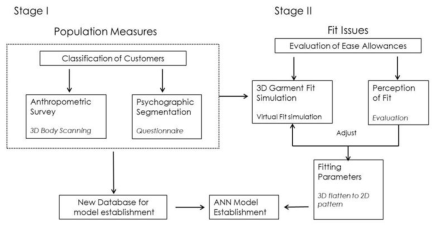
Based on the research gap and previous studies, a conceptual framework for this project is shown in Figure 1. This study consisted of two stages of data collection; 50 participants aged 18 – 39 were invited to both sessions. In the related studies conducted by Song & Ashdown (2012), which deve- loped patterns for basic pants optimized for three lower body shape groups through 3D body scans, 83 female participants were recruited. Apart from anthropometric data collected by body scanning, it also required to obtain their psychological orientation through a questionnaire survey, while their preferences on ease allowance were recognized through co-design operation on virtual garment simulation.
METHODOLOGY
Extended from previous research and to address the research gap in using 3D virtual garment simulation, this project was to investigate apparel sizes
Improving the Apparel Virtual Size Fitting Prediction under Psychographic Characteristics 97
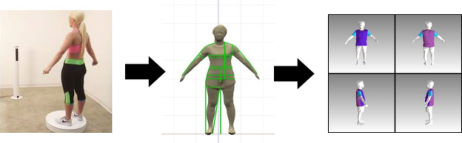
Figure 1: Conceptual framework of the study.Figure 2: Co-design experiment on virtual fitting (Import the scanned point cloud into Optitex).
for virtual fitting with consideration of body dimensions and psychographic characteristics of subjects on garment ease for improving the size prediction of 3D garments. We recruited 50 subjects between the ages of 18 and 35 years old to conduct 3D body scans and a questionnaire survey for physi- cal and psychological segmentation, as well as fitting preferences evaluation through co-design operations on virtual garment simulation using a com- mercial software called Optitex (Figure 2). The ease preferences of subjects were significantly different from the preset values on the software. The non- standardized selection on garment sizing, ease allowance, and size of the 3D avatar for creating the 3D garments were critical fitting issue problems for 3D design.
Subject Selection and Identification of Body Dimensions Classification of the anthropometric (i.e., body measurement and shapes) and psychographic data from subjects was collected by 3D body scanning and structural questionnaire survey respectively. To classify body types, anth- ropometric data (body sizes/ shapes) from subjects was collected using a 3D body scanner device called Styku. It is a 3D body scanner operated with intuitive, multi-platform software. It can perform full-body body scan- ning, create 3D model views, identify body shapes, and visualize body shapes and measurements. The advanced recognition technology on the device can automatically identify the different body parts, e.g., hip and bust point, etc., which helps obtain accurate body circumferences, volume, and surface areas.
Instruments for Psychographics Segmentation After body scanning, subjects were taken part in an interview to complete a structured questionnaire about psychological orientation (Lifestyle orienta- tion, AIO). It consisted of two main sections: 1) demographic information (i.e., age, education level, income, and occupation); 2) 13 fashion life- style statements (Ko et al., 2007) and activities-related AIO items. Based on the lifestyle dimension proposed by Plummer (1974), work, hobbies, social events, vacation, entertainment, club membership, community, shop- ping, and sports were the 9 activities adopted in studies on AIOs. AIO items were commonly used as the instrument to measure the lifestyle of people and evaluate the subjects’ preferences of activities that they engaged in and spent time on (Thompson and Kaminski, 1993; Kucukemiroglu, 1999; Kay- nak and Kara, 2001; Kara et al., 2006; Spillan et al., 2007; Lee et al., 2009).
Instruments for 3D garment fit simulation After identifying the clusters of subjects with different distinctive body types and psychographic characteristics, the next step was to examine their disti- nctive preferences in clothing across the clusters. The same group of subjects participated in the virtual fit customization lab through co-design customi- zation using the virtual fit simulation CAD software, Optitex. In the context of mass customization, virtual try-on and 3D garment simulation are used as tools for customers to evaluate the design and fit of the garment. Optitex is a 3D software that combines features of CAD and CAM for the cloth- ing industry and enables body modeling and garment fit simulation. The adjustable 3D fit model for garment simulation on a computer simulates the garment fit on the subject’s virtual body figure based on the fabric properties (Loker et al., 2008, Zhu et al., 2018).
Co-design Experiment of Virtual Fit Evaluation In the co-design experiment for virtual fit customization, a virtual fitting model, or virtual body, was built for each subject according to their scanned data and point cloud data captured by the 3D scanner. Optitex digitalized how garments were fitted on their virtual body and simulated the drape and fitting effects for the subjects’ evaluation. Each subject was then asked to co-design the clothing fit for the upper garment items, i.e., T-shirt by instant manipulation of the amount of seam allowance on different body parts, such as the chest, waist, hem, armhole, sleeve, and shoulder width, etc. Optitex provides a reliable and speedy simulation demonstrating how the series of studied items fit on the subjects’ virtual body, which allows subjects to evaluate garment sizes and forms accurately and indicate their preference of ease allowance by successive try-and-error in a co-design appro- ach. If a garment fit is accepted, the 3D garment form will be flattened to a 2D pattern. For each subject, sets of preferred ease charts for vari- ous items would be generated based on the flattened dimensions of the 2D pattern.
Improving the Apparel Virtual Size Fitting Prediction under Psychographic Characteristics 99
Table 1. Parameters of artificial neural network prediction model in this study.
Table available in the original PDF paper.
Parameters in the Artificial Neural Network Program Input, Output and Hidden Units In order to develop a virtual garment fitting prediction model, artificial neu- ral network (ANN) was applied. In the size fitting prediction model, the input units are P (Perception of Fitting Parameters by Consumers’ Psycholo- gical Orientation) and B (Body Parameters), which are important in pattern drafting, and the output units are G (Pattern Parameters). The parameters are summarized in Table 1. The below activation function was used in the standard backpropagation algorithm applied in this study. The function was chosen because the form of the data (especially the target values) was conti- nuous, and the simple relationship between the value of the function and its derivative.
In this study, C language was used for writing a program for ANN trai- ning and application. The data was written into a data file format named “input.dat” for program training. According to Hecht-Nielsen (1990, 1992), it is not necessary to train the data until the total squared error reaches the minimum. The author suggested using two datasets for the training: i) a set of input units for training, and ii) a set of checking pairs for training- testing. Therefore, another file named “checking.dat” was used for the ANN training-testing. The number of checking pairs is an issue. Since there is no established guideline on the optimum number of checking pairs for ANN training. A general rule is that at least one-tenth of total training data is used as checking pairs. In the author’s Ph.D. research (Chan, 2005), it was found that one-tenth of total training data was sufficient and significant for the model checking, therefore we suggest starting with this number of che- cking sets in this study for further trials and errors. According to Fausett (1994), too small and too large values for initial weights can affect the per- formance and accuracy of the model. The significant weights and learning rate for model training were set to random values between -0.5 and 0.5 and 0.01 in the author’s Ph.D. study (Chan, 2005). Therefore, the weight intervals and the learning rate is suggested for program training in this study. Model training is not stopped unless the mean square error, i.e., the error between the training data and target data of each epoch, is below a pre-set value of 0.002 (Fan et al 1998, 2001&2009, Chan, 2005). After the mean square error was below the pre-set value, training stops when both the mean square
Table 2. Psychographic characteristic of subjects.
Table available in the original PDF paper.
P1 P2 P3 P4 P5 mean 51.80 46.08 41.87 39.67 43.30 min 48.00 38.00 36.00 36.00 41.00 max 55.00 52.00 46.00 43.00 45.00 SD 3.11 4.01 3.04 3.51 1.64
errors of the training pairs and checking pairs approach the minimum. In this application program, in C language, two files were needed. The first one is the “weight.dat” from the training program, and the second is the scaled- down input data named “input.dat”. This input data only contains body parameters. The application will read these two files and apply the activa- tion function for model training. The results were shown in a new file named “application.dat”. This file contains the predicted pattern parameters, which are the pattern measurements.
RESULTS AND DISCUSSIONS Descriptive Data of Psychographic Characteristics
Table 2 shows the psychographic mean scores of 50 subjects among 5 groups after segmenting by K-means clustering analysis. P4 is the lowest AIO involvement group on spending their leisure time, interests as well as opi- nions with regard to their lifestyle. The mean score of the psychographic characteristics was P4 with 39.67, whereas P1 had the highest score of 51.80.
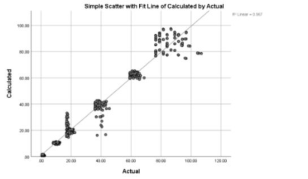
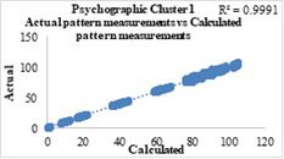
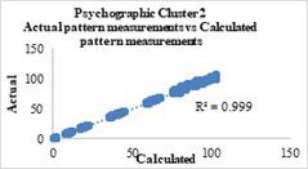
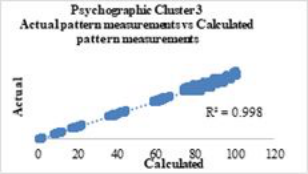
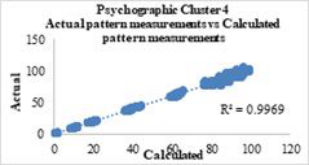
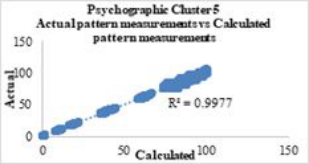
Artificial Neural Network Prediction Model of T-shirt Pattern Measurements The database of the above segments was used for further evaluation in this study. To model the complex non-linear relationship, Artificial Neural Netw- ork (ANN) was applied. The prediction of T-shirt pattern measurements against the actual T-shirt pattern measurements from all 50 subjects was esta- blished (Figure 3). As seen in figure 3, most data fit the 45o trend line, and the squared correlation coefficient (R2) was 0.967. This means that the predi- cted results are close to the target values. After considering the psychographic characteristics from the customers, the ANN prediction accuracy on virtual garment sizes improved, where the squared correlation coefficient (R2) incre- ased from 0.96 to 0.99 for those 50 subjects from 5 different psychographic clusters (Figure 4-8). The ANN prediction model is proven to be an effective method for garment pattern drafting, which can achieve an individual fit and is useful for implementing the virtual fitting model.
Ease Allowances Preferences Prediction of T-Shirts under Psychographic Characteristic and 3D Body Measurements Using Artificial Neural Network After identifying the clusters of psychographic characteristics and establish- ing the prediction model on fitting preferences by ANN from 50 subjects,
Improving the Apparel Virtual Size Fitting Prediction under Psychographic Characteristics 101
Figure 3: Actual pattern measurements vs calculated pattern measurements using ANN from 50 subjects.Figure 4: Cluster 1 actual pattern measurements vs calculated pattern measurements using ANN.Figure 5: Cluster 2 actual pattern measurements vs calculated pattern measurements using ANN.Figure 6: Cluster 3 actual pattern measurements vs calculated pattern measurements using ANN.
the ease allowance preferences can be identified (Table 3). Compared with other groups, P4 and P1 prefer smaller ease allowances at the neckline, shoul- der width, front and back length, chest girth, and bottom edge. P4 and P1 have similar ease allowance preferences on the pattern parameters (T1 - T10). Although different groups have different preferences on ease allowances, the relationship is not linear correlated. Therefore, the model comparison within
Figure 7: Cluster 4 actual pattern measurements vs calculated pattern measurements using ANN.Figure 8: Cluster 5 actual pattern measurements vs calculated pattern measurements using ANN.Table 3. Ease preferences from different groups.
each AIO group with considering consideration of other parameters such as body dimensions from subjects will be used in further studies.
CONCLUSION
The ease preferences of subjects were significantly different from the pre- set values on the software. The results from the study demonstrated that ANN is effective in modeling the non-linear relationship between pattern measurements, psychological characteristics, and body measurements. The pattern parameters predicted by the ANN model were accurate. The squa- red correlation coefficient (R2) increased from 0.96 to 0.99 after considering different segmentations of psychographic characteristics. The ANN predi- ction model is proven to be an effective method for garment pattern drafting, which can achieve an individual fit and is useful for implementing the virtual
Improving the Apparel Virtual Size Fitting Prediction under Psychographic Characteristics 103
fitting model. The quantitative relationship between the pattern measure- ments, psychological characteristics, and 3D body measurements contributes to improving virtual fit predictions for implementing mass customization in the apparel industry. This new approach and the proposed method of vir- tual garment fitting model prediction on garment sizes using an Artificial Neural Network (ANN) is significant in prediction accuracy. The results of this project provide sustainable value in providing an ideal communication tool between manufacturers, retailers, and consumers by offering the “per- fect fit” products to customers. The project will also achieve the concept of mass customization and customer orientation and generate new size-fitting data that could bring a new level of end-user satisfaction.
ACKNOWLEDGEMENT
This paper was fully supported by a grant from the Research Grants Cou- ncil of the Hong Kong Special Administrative Region, China (Project No. UGC/FDS25/H05/21).
REFERENCES
Ashdown, S. (2013). “Not craft, not couture, not ‘home sewing’: Teaching creative patternmaking to the iPod generation.” International Journal of Fashion Design, Technology and Education, 6(2), 112–120. Boorady, L. M., & Hawley, J. M. (2008). “The wonders of technology.” Clothing
and Textiles Research Journal, 26(2), 131–142. Bougourd, J. & Treleaven, P. (2014). “National size and shape surveys for apparel design.” Anthropometry, Apparel Sizing and Design, 141. Browzwear. (n.d.). (2020) “Fashion Design Software.” Retrieved February 14, 2020,
from https://browzwear.com/ Chan, A. C. K. (2014). “The development of apparel sizing systems from anthropometric data.” In Anthropometry, apparel sizing and design (pp. 167–196). Woodhead Publishing. Chan, A. P. (2005). “Prediction of men’s dress shirt pattern from 3D body measure-
ments (Doctoral dissertation, The Hong Kong Polytechnic University).” Chen, Y., Happiette, M., Bruniaux, P., Ng, R., & Yu, W. (2006). “Estimation of ease allowance of a garment using fuzzy logic.” In Fuzzy Applications in Industrial Engineering (pp. 367–379). Springer, Berlin, Heidelberg. Chen, Y., Zeng, X., Happiette, M., Ng, R., Bruniaux, P., Yu, W., (2006). “Estimation
of ease allowance of a garment using fuzzy logic. In: Kahraman, C. (Ed.),” Fuzzy Applications in Industrial Engineering, vol. 201. Springer, Berlin e Heidelberg, pp. 367–379. CLO: “3D Fashion Design Software. (n.d.). (2020), “ Retrieved Feb 14, (2020), from https://www.clo3d.com/ EFI Optitex. (2020), “Fashion Design Software: 2D/3D CAD CAM (n.d.).” Retrieved
February 14, (2020), from https://optitex.com/ Fan, J., & Hunter, L. (1998). “A worsted fabric expert system: Part II: An artificial neural network model for predicting the properties of worsted fabrics.” Textile research journal, 68(10), 763-771. Fan, J., Newton, E., Au, R., & Chan, S. C. F. (2001). “Predicting garment drape with
a fuzzy-neural network.” Textile Research Journal, 71(7), 605–608.
Fan, J. (2009). “Applications of artificial intelligence in fabric and garment engineering.” Engineering Apparel Fabrics and Garments, 361. Fausett, L. V. (1994). ”Fundamentals of neural networks: architectures, algorithms,
and applications (Vol. 3).” Englewood Cliffs: prentice-Hall. Fralix, M. (2001). “From mass production to mass customization.” Journal of Textile and Apparel, Technology and Management, 2 (2), 1–7. Gupta, D., & Zakaria, N. (2014). “Anthropometry and the design and production
of apparel: An overview. Anthropometry, Apparel Sizing and Design.” United Kingdom: Woodhead Publishing Ltd, 34–66. Gupta, D., & Zakaria, N. (Eds.). (2014). ”Anthropometry, apparel sizing and design.” Elsevier Hecht-Nielsen R., (1990). “Theory of the Backpropagation Neural Network,”
International Joint Conference on Neural Networks, Washington Hecht-Nielsen, R. (1992). “Theory of the backpropagation neural network.” In Neural networks for perception (pp. 65–93). Academic Press. Hernández, N., Mattila, H., & Berglin, L. (2018). “A systematic model for impro-
ving theoretical garment fit.” Journal of Fashion Marketing and Management: An International Journal. Kara, A., Campus, Y., Rojas-Méndez, J. I., Kucukemiroglu, O., Harcar, T., & Campus, B. (2006). “An empirical analysis of store brand purchase behavior using structural equation model.” Enhancing Knowledge Development in Marketing, 181. Kaynak, E., & Kara, A. (2001). “An examination of the relationship among con-
sumer lifestyles, ethnocentrism, knowledge structures, attitudes and behavioural tendencies: a comparative study in two CIS states.” International Journal of Advertising, 20(4), 455-482. Ko, E., Kim, E., Taylor, C. R., Hoon Kim, K., & Jeong Kang, I. (2007). “Crossnational market segmentation in the fashion industry: A study of European, Korean, and US consumers.” International Marketing Review, 24(5), 629–651. Kucukemiroglu, O. (1999). “Market segmentation by using consumer lifestyle
dimensions and ethnocentrism: An empirical study.” European Journal of Mar- keting, 33(5/6), 470–487. LaBat, K. L. (1987). “Consumer Satisfaction/Dissatisfaction with the Fit of Readyto-wear Clothing.” University of Minnesota. St. Paul.Laitala, K., & Boks, C. (2012). Sustai-
nable clothing design: use matters. Journal of Design Research 14, 10(1-2), 121–139. Lee, H. J., Lim, H., Jolly, L. D., & Lee, J. (2009). “Consumer lifestyles and adoption of high-technology products: a case of South Korea.” Journal of International Consumer Marketing, 21(2), 153–167. Li, W. H. (2013). ”An investigation of design preferences and interrelationship betw-
een aesthetics and fitting concerns in Hong Kong menswear fashion (Doctoral dissertation,” The Hong Kong Polytechnic University). Loker, S., Ashdown, S., & Schoenfelder, K. (2005). “Size-specific analysis of body scan data to improve apparel fit.” Journal of Textile and Apparel, Technology and Management, 4(3), 1–15. Loker, S., Ashdown, S., & Carnrite, E. (2008). “Dress in the third dimension: Online
interactivity and its new horizons.” Clothing and Textiles Research Journal, 26(2), 164–176. Manninen, H. (2011). “Bodymetrics launched new body scanner using primesense technology.” Retrieved 2 Jun 2019, from http://www.forbes.com/sites/jenniferh
Improving the Apparel Virtual Size Fitting Prediction under Psychographic Characteristics 105
icks/2011/10/24/bodymetrics-creates-3d-body-scanner-for-new-look/#5f95ced 949e7 Nayak, R., & Padhye, R. (2018). “Artificial intelligence and its application in the apparel industry.” Automation in Garment Manufacturing (pp. 109–138). Woodhead Publishing Petrova, A., & Ashdown, S. P. (2008). “Three-dimensional body scan data analysis
body size and shape dependence of ease values for pants’ fit.”Clothing and Textiles Research Journal, 26(3), 227-252. Plummer, J.T. (1974), “The concept and application of life style segmentation”, Journal of Marketing, Vol. 38 No. 1, pp. 33–7. Schofield, N. A., Ashdown, S. P., Hethorn, J., LaBat, K., & Salusso, C. J. (2006).
“Improving pant fit for women 55 and older through an exploration of two pant shapes.” Clothing and Textiles Research Journal, 24(2), 147–160. Shin, E., & Baytar, F. (2014). “Apparel fit and size concerns and intentions to use virtual try-on: Impacts of body satisfaction and images of models’ bodies.” Clothing and Textiles Research Journal, 32(1), 20–33. Sizemic (2012). “A service developed to commercialise Size UK data,” retrieved 2 Jun
2019, from http://www.sizemic.eu/products-and-services/size-survey-data.html Song, H. K., & Ashdown, S. P. (2012). “Development of automated custommade pants driven by body shape.” Clothing and Textiles Research Journal, 0887302X12462058. Spillan, J. E., Chaubey, M. D., Ziemnowicz, C., Singh, N., & Vyas, B. J. (2007).
“Effects of lifestyle dimensions and ethnocentrism on Indian consumers’ buying decisions: an exploratory study.” Journal of International Business Research and Practice, 1, 5–17. Thomassey, S., & Bruniaux, P. (2013). “A template of ease allowance for garments based on a 3D reverse methodology.” International Journal of Industrial Ergonomics, 43(5), 406–416. Thompson, A.M. and Kaminski, P.F. (1993), “Psychographic and lifestyle antece-
dents of service quality expectations”, Journal of Services Marketing, Vol. 7 No. 4, pp. 53–61. Yeung, H. T., Choi, T. M., & Chiu, C. H. (2010). “Innovative mass customization in the fashion industry.” In Innovative quick response programs in logistics and supply chain management (pp. 423-454). Springer Berlin Heidelberg. Zhu, X. J., Lu, H., & Rätsch, M. (2018). “An interactive clothing design and per-
sonalized virtual display system.” Multimedia Tools and Applications, 77(20), 27163–27179.
LISTED IN THE AHFE DIGITAL BOOKSTORE CATALOGUE
Explore the complete digital volume
Human Factors for Apparel and Textile Engineering
Read this individual research paper free through the original publisher, or explore the full digital proceedings book.
ISBN 978-1-958651-08-7
Explore this ISBN in the AHFE Bookstore ↗Listed in the July 2026 bookstore catalogue; search by ISBN to confirm current availability · Digital book purchase optional