Mihaela Jomir, Sorin Mihai Radu, Alexandra Gabriela Ene, Carmen Mihai, Constantin Jomir (2023). Experimental Data Management for the Panel Joints of the Naval Emergency Shuttle. In: Human Factors for Apparel and Textile Engineering. AHFE Open Access, vol. 86, pp. 54–61. https://doi.org/10.54941/ahfe1003640
In marine transport, the risks leading to disasters are associated to the sea and its hazards; in particular, being related both to the state of the ship, competency of the crew members and to the transport of hazardous chemical products or nuclear wastes. Seen from another point of view, spilled oil represents an extremely precious raw material resource, which, through efficient processing, can be reintroduced into the economic value chain. For this purpose, oil fractions can be collected by various means and transported from the spill site to the areas specially designed for the reprocessing treatments application. The naval emergency shuttle (NES) is a floating, collapsible and towable unit fabricated from textile-reinforced composite material that is used for vertical temporary storage and horizontal transport of water – petroleum hydrocarbon (crude oil) compound recovered after various disasters occurred in the brackish sea habitat. The new developed NES innovative solution involves advanced materials based on composite structures with textile matrix covered with hypalon for construction of the main shuttle module architecture and with PVC for the two floating elements achievement. Advanced techniques (for joining the panels) and certified methods (for threads and composite materials experimentation) have been used in order to evaluate the mechanical, chemical, structural characteristics for: threads (100%PA6.6 – 600dtex x 3 and 300dtex x 3; 100%PES 250 x 3 dtex), the composite materials (matrix covered with neoprene, PVC and hypalon) and the types of joints that will be used in its construction. The composite materials were joined using different techniques and seams (301-LSa-1, 301-SSd2-4, 301-SSa-1, etc.) and were tested to assess the maximum strength and elongation at maximum force and tear strength (wing shaped composite material specimen). The management of the obtained data collection consisting of: resistance to breaking, loop and knot - for 3 types of thread used to join the panels; strength, elongation at break and tear force for 3 type-dimensions of specimens (trouser, wing and tongue shaped composite material specimens. During the experimental trials the performed statistical analyses evidenced that the statistical populations are homogeneous (coefficient of variability is max. 13%, for the joint composite material), so the parametric tests can be applied, the identified higher values (compared with averages) of the outliers do not have a negative impact and will not influence the behavior of the NES in real conditions (open sea with possible 4 – 6 Beaufort degree). The conclusions obtained as a result of the statistical analysis enabled the establishment of value ranges for the technical-operational characteristics of the NES, respectively: storage capacity: 5 m3 -500 m3; maximum navigation speed: 3 knots; length: 17.7 – 25m, width: 4.1 – 5 m; breaking strength: min. 500 daN; tearing force: min. 800 N.
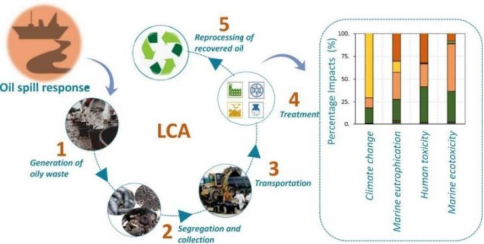
Spilled oil can represent also an extremely valuable raw material resource, which, through efficient processing, can be reintroduced into the economic value chain. (Baker JM et al. 2001, Saleem S. et al. 2022, Zhou, 2022). For this purpose, oil fractions can be collected by various means and transported from the spill site to areas arranged specially where specific treatments for reprocessing could be applied. (Luo H., 2018, Sang Q., 2014, Wang J., et al. 2014). A sequence of generic stages, in response to oil spills, includes the phases of their segregation and collection by various means, transport and reprocessing treatments - Figure 1 (Mahrabian S. et al. 2018, Afsharpoor, A et al. 2010).
The naval emergency shuttle (NES) is a floating, collapsible and towable unit fabricated from textile-reinforced composite material, used for vertical temporary storage and horizontal transport of water – petroleum hydrocar- bon (raw oil) compound recovered in the event of disasters from brackish sea
Experimental Data Management for the Panel Joints of the Naval Emergency Shuttle 55
Figure 1: Schema managementului deseurilor petroliere (Saleem S. et al., 2022).
habitat. The proposed NES will be made of composite materials with textile matrix covered with hypalon - for the main module of the shuttle and four floating elements made of composite material covered with PVC.
For the digital and experimental design of NES, the experimental plan was focused on the determination of the main characteristics of the: i) threads (100%PA6.6 – 600dtex x 3 and 300dtex x 3; 100%PES 250 × 3 dtex), ii) composite materials (45%/55% p-aramid / PA6.6 covered with PVC and 50%/50% p-aramid/PES covered with hypalon) and iii) types of joints that will be used in its construction.
The composite materials were joined using different techniques and seams (301-LSa-1, 301-SSd2-4, 301-SSa-1) and were tested for assessing the maxi- mum strength and elongation at maximum force and tearing force (wing shaped) composite specimen material).
The obtained database that included the values for: breaking, loop and knot resistances evaluated for 3 types of threads used to join the pan- els; strength, breaking elongation and tear force for the joined panels was managed with the help of a specialised software.
MATERIALS AND METHODS
The variants of threads used to join the panels and the panels fabricated from composite materials were subjected to a complex experimental program in the accredited laboratories. The obtained database, with 1800 values for thre- ads and 1200 values for the combined flexible panels, was analysed through descriptive statistics analysis.
Summaries for the characteristics of the 3 types of yarns (9 independent variables, respectively breaking resistance, knot resistance and loop resistance for each type of yarn), as well as for the characteristics of the two flexible composite materials combined with 4 types of seams and used to make the floating and hull element (12 independent variables) are presented in Table 1 and Table 2.
For all the considered distributions (9 for threads and 12 for panels made of composite materials) were calculated the: i) values corresponding to the division into equal groups, ii) parameters related to the data scattering and iii) asymmetries and the vaulting of the distributions were calculated.
Table 1. Resistance characteristics for the threads used for joining the panels.
Table available in the original PDF paper.
Summaries.
Y1 - 100% PA6.6
Yarn Characteristics
600dtex x 3 Y2 - 100% PA6.6
300dtex x 3 Y3 - 100% PES 250dtex x 3 Breaking resistance, N Mean Statistic 96.22 42.93 54.40 Minimum Statistic 95.75 45.58 633.38 Maximum Statistic 96.88 40.49 46.13 Std. Deviation Statistic 0.22 1.12 4.14 Skewness Statistic 0.672 -0.290 -0.027 Kurtosis Statistic 0.775 -0.199 -0.690 Knot resistance, N Mean Statistic 51.95 28.26 31.18 Minimum Statistic 54.64 36.62 38.44 Maximum Statistic 49.02 21.92 23.96 Std. Deviation Statistic 1.07 3.41 3.27 Skewness Statistic -0.169 0.441 -0.290 Kurtosis Statistic 0.768 0.317 -0.371 Loop resistance, N Mean Statistic 143.54 75.11 74.16 Minimum Statistic 150.52 82.31 80.16 Maximum Statistic 135.53 69.50 67.75 Std. Deviation Statistic 2.62 2.80 3.27 Skewness Statistic -0.030 0.704 -0.223 Kurtosis Statistic 1.57 0.392 -0.918
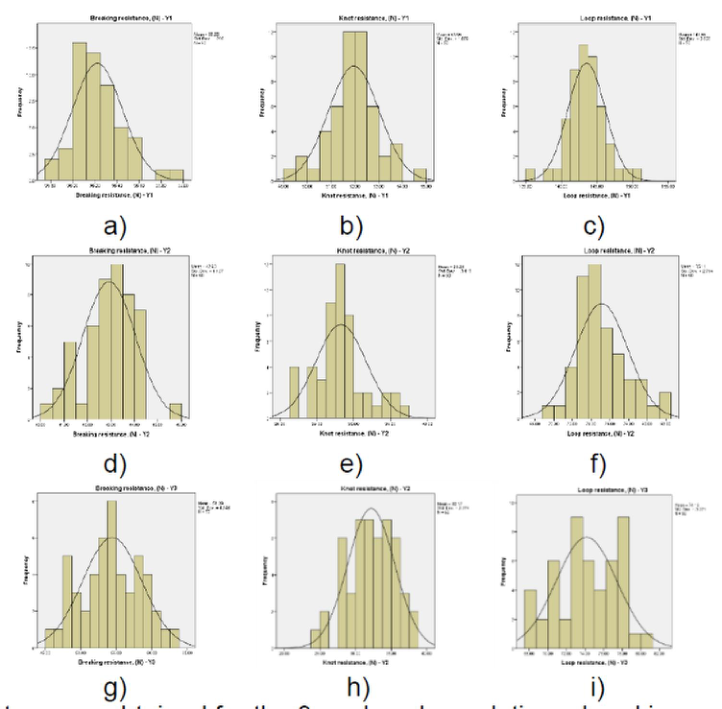
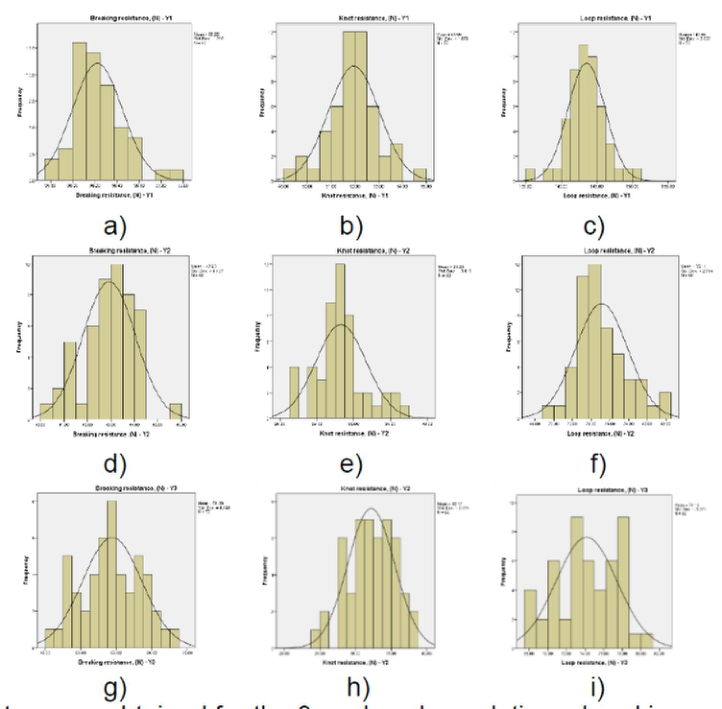
In addition, the histograms corresponding to each independent variable that characterise the thread variants were drawn (Figure 2) and the level and dispersion indicators were represented simultaneously (Figure 5).
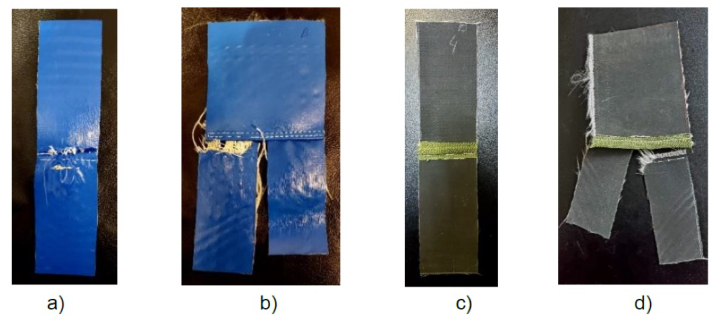
The types of seams used to join the panels are shown in Figure 3 and aspects from the test in Figure 4.
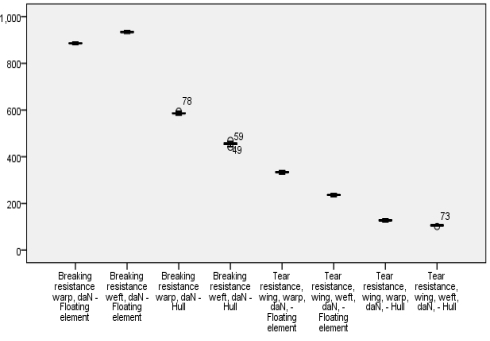
The physical-mechanical characteristics of the tested flexible panels and the values of the fundamental indicators resulting from the statistical analysis are presented in Table 2 and Figure 5.
It was recorded that obtained outliers do not negatively impact the finished structures (floating elements and hull), because their values are higher than the necessary ones for retreiving the shock loads that can be developed in real conditions of usage in the open sea, for a state of sea agitation of 4–6 degrees Beaufort.
RESULTS AND DISCUSSIONS The statistical analysis carried out for the populations of threads and joined flexible composite materials demonstrated that the coefficient of variability for Y1, Y2, Y3 and composite materials for floating element and hull is below 11%, so the average for each set of values (50 for threads and 100 for the joined panels) is representative, and consequently the populations are homogeneous.
Experimental Data Management for the Panel Joints of the Naval Emergency Shuttle 57
Table 2. Resistance characteristics for jointed composite panels. Summaries.
For threads: - the drawn histograms (9 independent variables) evidenced that there is no tendency for the average to deviate from the median, the skewness values not exceeding ±1.96.
- the negative kurtosis values recorded for breaking resistance (Y2 and Y3), knot resistance and loop resistance (Y3) demonstrate that the distribution is platykurtic, so there is a large variation in the values of the respective variable, simultaneously with the weak variation in frequencies.
Figure 2: Histograms obtained for the 9 analysed populations: breaking resistance a) Y1, d) Y2, g) Y3; knot resistance b) Y1, e) Y2, h) Y3; loop resistance for c) Y1, f) Y2, i) Y3.Figure 3: Joining types used for panels testing: a) 301-LSa-1, b) 301-SSa-1, c) 301-SSd2-4, d) 301-BSa-4.
- the semi-quartile amplitude and the interquartile variation coefficient demonstrate that for all 9 variables there is no great data variability (for example, the interquartile variation coefficient does not exceed 25%), so the series reveals a high degree of homogeneity, the average being representative.
For NES panels made of flexible composite material: - the values obtained after the descriptive statistical analysis highlighted the fact that all 12 independent variables (breaking resistance in warp and
Experimental Data Management for the Panel Joints of the Naval Emergency Shuttle 59
Figure 4: Tests at the level of loins of the flexibe panels: a) sample of strip type, join with 301-LSa-1; b) sample of fin type, join with cu 301-SSa-1; c) sample of strip type, join with 301- SSd2-4; d) sample of fin type, join with 301- BSa-4.Figure 5: Boxplot graphics – for variables of the floating element and hull.
weft, breaking elongation in warp and weft, tear resistance, wing probe, in warp and weft) have an average close to the median, the values skewness being included in the interval [-0.263, 0.233].
- positive kurtosis values recorded for breaking resistance in warp and weft and tear resistance, wing sample, in weft for hull made from 50%/50% p-aramid/ PES, as well as breaking elongation in warp for floating element made from 45%/55% p- aramid / PA6.6 demonstrated that these variables have a leptokurtic distribution, with a small variation of the variable in parallel with a strong variation of the frequencies.
- the interquartile variation coefficient is below 21%, so for all 12 vari- ables there is no data variability, and the series present a high degree of homogeneity, for which the average is representative.
- the boxplot graphs demonstrated that there is no great variability in the data.
Whiskers were drawn from the lowest to the highest detected value and are positioned within 1.5 “box” lengths. Thus, for breaking resistance in warp – hull, case 78 (value 239.14 daN), breaking resistance in weft – hull, cases 49 and 59 (values 582.04 daN and 590.09 daN) and tear resistance, wing probe in weft – hull, case 73 (value 100.92 daN) are considered outliers because they are positioned at 1.5-3 lengths from “box”. There were no extreme cases, i.e. values at more than 3 box lengths.
CONCLUSION
Statistical analysis conducted evidenced the following: statistic populations are homogeneous (coefficient of variability is max. 11%, for the joint com- posite material), so the parametric tests can be applied, the identified higher values (compared with averages) of the outliers do not have a negative impact and will not influence the behaviour of the NES in real conditions (open sea with possible 4 – 6 Beaufort degree).
The values for strength, breaking elongation and tear force obtained for composite material specimens enabled the determination of the values ran- ges for the technical-operational characteristics of NES, respectively: storage capacity: 5 m3 -500 m3; maximum navigation speed: 3 knots; length: 17.7 – 25m, width: 4.1 – 5 m; breaking strength: min. 500 daN; tearing force: min. 800 N.
ACKNOWLEDGMENT
This publication of this scientific paper is funded by the Ministry of Research, Innovation, Digitalisation within Program 1 - Development of the national RD system, Subprogram 1.2 - Institutional Performance - RDI excellence funding projects, Contract no. 4PFE/2021 and by UEFISCDI within PNCDI III, PED 792 /2022.
REFERENCES
Afsharpoor, A.; Lee, G.; Kam, S. (2010) - Mechanistic simulation of continuous gas injection period during surfactant-alternating-gas (SAG) processes using foam catastrophe theory. Chem. Eng. Sci., 65, 3615–3631. Baker JM. Oil Pollution*. In: Steele JH, editor. Encyclopedia of Ocean Sciences
(2018) Modeling polymer enhanced foam flow in porous media using an impro- ved population-balance foam model. In SPE Improved Oil Recovery Conference; Society of Petroleum Engineers: Tulsa, OK, USA. Mehrabian, S.; Acosta, E.; Bussmann, M. (2018) - Oil-particle separation in a falling sphere configuration: Effect of viscosity ratio & interfacial tension. Int. J. Multiph. Flow 2018, 98, 120–127. Saleem S, Hu G, Li J, Hewage K, Sadiq R. (2022) - Evaluation of offshore oil spill
response waste management strategies: A lifecycle assessment-based framework. Journal of Hazardous Materials. 432:128659.
Experimental Data Management for the Panel Joints of the Naval Emergency Shuttle 61
Sang, Q.; Li, Y.; Yu, L.; Li, Z.; Dong, M (2014). Enhanced oil recovery by branched-preformed particle gel injection in parallel-sandpack models. Fuel 2014, 136, 295–306. Wang, J.; Liu, H.; Wang, Z.; Xu, J.; Yuan, D. (2013) - Numerical simulation of
preformed particle gel flooding for enhancing oil recovery. J. Pet. Sci. Eng, 112, 248–257. Zhou Haiyan, Davarpanah Afshin (2020) - Hybrid Chemical Enhanced Oil Recovery Techniques: A Simulation Study, Symmetry, 12(7)1 1086.
LISTED IN THE AHFE DIGITAL BOOKSTORE CATALOGUE
Explore the complete digital volume
Human Factors for Apparel and Textile Engineering
Read this individual research paper free through the original publisher, or explore the full digital proceedings book.
ISBN 978-1-958651-62-9
Explore this ISBN in the AHFE Bookstore ↗Listed in the July 2026 bookstore catalogue; search by ISBN to confirm current availability · Digital book purchase optional