Carmen Mihai, Alexandra Gabriela Ene, Constantin Jomir (2023). Prototyping of the experimental lifting parachute system. In: Application of Emerging Technologies. AHFE Open Access, vol. 115, pp. 94–102. https://doi.org/10.54941/ahfe1004306
Aquatic accidents and incidents due to the hydro-meteorological conditions or to the carelessness of the crew (that can generate failures and collisions between ships), the research of the wrecks and of the lifting of various archaeological, speleological, ecological, geological underwater objects, require the usage of the lifting parachute that represents an extremely useful equipment in these situations.The paper presents the prototyping of the dispensable and executable system including the description of the working environment represented by the fluid medium which can be used as a basis for formulating the requirements imposed for: i) product development (type-dimensions, engineering characteristics, raw material, maximum working depth, object weight flushed), and ii) operation in blue water (open sea where there are no visual reference points to determine the positioning in the water column, and where depth monitoring and strict buoyancy control are needed).From a mathematical point of view, it was considered that, in a marine or oceanic wave, as the depth increases, the circular movement of the fluid particles on the surface transforms and their movement could be described by a set of hyperbolic differential equations.The values of the total force necessary to raise the "wreck" to the surface were determined as a function of the: i) weight of the outside and inside deposits, ii) adhesion force on the bottom of the water, iii) theoretical lift capacity and actual lift capacity. It was demonstrated that for a parachute of a certain shape, with dimensions of 55cm x 55 cm, at a pressure of 8 bar, the maximum weight that can be lifted to the surface is 15,000 kgf. In addition, the following specific coefficients for the aquatic systems design were considered: coefficient of floating area: 0.84; block coefficient: 0.652; belt convergence coefficient: 1.03, etc.The system thus developed was tested with the help of a specialized software, based on the following working assumptions: the medium is continuous, so the mass distribution is continuous in the analysed volume; the infinitesimal internal forces in the environment are considered average statistical values of the interaction forces between the constituent elements; the environment is loaded with concentrated forces Fi and distributed loads pi. These input data enabled to evidence the deformations under the effect of dynamic pressure, Von Misses nodal values, the distribution of displacement vectors and errors. The same set of input data will be used for testing the system under real conditions of usage.
Marine operations, including rescue/recovery/repair of a ship or its parts, cargo or other sunken objects, are very complicated and of high-risk for both personnel and the ecosystem.
In such cases, interventions are made as a consequence of some (mechan- ical) malfunctions, especially if they occurred close to the coast, explosion- s/fires, the fury of nature (storms, tsunamis, etc.), collisions, armed attacks, that generate the failure, partial or total sinking, breaking/fracturing of the hull, damage to the transport infrastructure, etc. In the situation of salvage operations for sunken objects, an action plan that often includes refloating operations, water pumping, cleaning of the wreck, partial or total removal
Prototyping of the Experimental Lifting Parachute System 95
of bunkers or toxic/polluting cargo from the damaged ship, etc. is required. In addition, marine operations can include the lifting to the surface of some artifacts or various repairs of the submerged infrastructure.
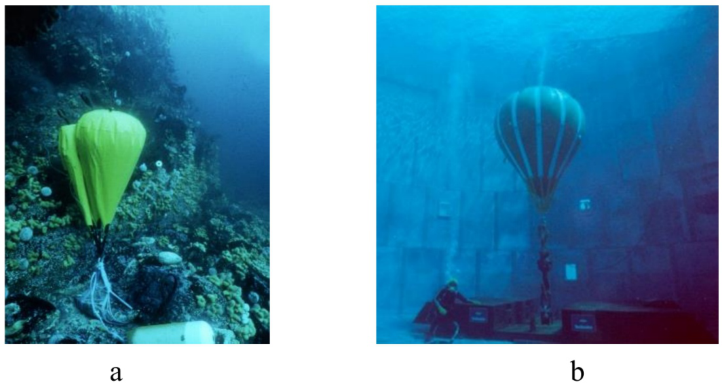
The marine interventions of lifting objects from the depths or placing them in the position of buoyancy require specialized equipment, such as buoyancy and flotation equipment, which use the Archimedean force (Figure 1 a, b).
Figure 1: a. JFD parachute lifting bags; b. MarineBuoy.
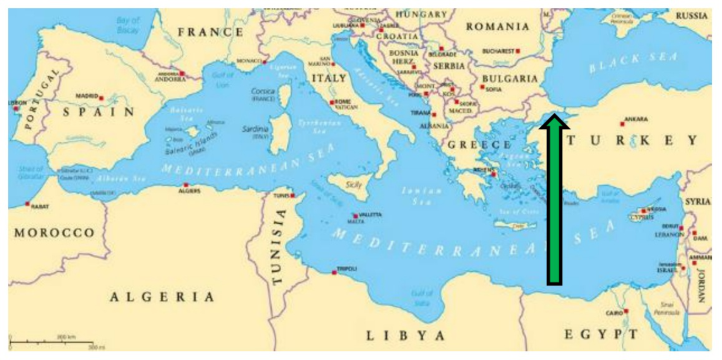
The system to be prototyped will operate in the Black Sea, where the forma- tion of water masses is controlled by: communication with the Mediterranean Sea, through the Bosphorus and Dardanelles straits (Fig. 2) and the supply of fresh water from the continent, (coming from the Danube, Dniester, Dnieper, Bug, Don, Kuban) that add up to approximately 300km3/year and which, together with precipitation (300km3/year) exceed the volume of water evapo- rated: 353km3/year (Murray et al., 2005). Thus, the thermohaline circulation model is explained for the transfer of water masses between the two large water basins, with a water flow that includes a surface current that trans- ports 600 kmc/year of water with reduced salinity from the Black Sea to the Mediterranean Sea and a deep current that transports 300 kmc/year of salt water in the opposite direction.
It is evident that the two thresholds highlighted above determine the accel- eration of currents and implicitly the appearance of turbulence. This aspect will be highlighted with the help of the boundary conditions that will be necessary to find the solutions of the hyperbolic differential equations.
The work presents the steps taken in order to prototype a system that is used for action in blue water, respectively: i) the description based on a set of hyperbolic differential equations of the fluid and its interaction with the flushing system; ii) the definition with the help of CAD/FEM of the types and the dimensions of the system required for raising to the surface a non- homogeneous weight (in terms of shape) of 15 tf, from a depth of min.
70m, corresponding to a pressure of 8 bar. Predictions are also presented regarding the further development of the flushing system, for depths of over 150m.
Figure 2: Comunication between the Black Sea and Mediterranean Sea (Strait Bosfor – Dardanele).
MATERIALS AND METHODS
The oceanographic characteristics of the Black Sea are different from those of the Mediterranean Sea, with which it is directly connected, as well as the Planetary Ocean, due to the specific evolution on the geological time scale.
The vertical temperature profile in the deep basin presents the following stratification (Vespremeanu, 2005) Table 1.
Table 1. The vertical profile of the temperature in the deep basin of the Black Sea.
Table available in the original PDF paper.
Layer type Characteristics The mixing layer between the surface and 10–12 m deep, with differences of 1-1.5
C between the upper and lower limit The layer of the seasonal thermocline
between 10–12 m and 40–50 m deep, in that the thermal gradient reaches 12 – 14
C Cold Intermediate Layer (SIR)
between 40–50 m and 125–150 m deep, in which the temperature drops by 1-1.5
C The intermediate layer between 125 - 150 m and 1500 m deep, in which it has a thermal inversion takes place, characterized by a slight increase in temperature from 8
C to 8.88
C The deep layer below 1500 m depth, in which the temperature increases from 8.883
C (at 1500 m depth) to 8.896
C (at 1800 m depth), then it remains constant until the greatest depths (potential temperature of 8.9
C).
Prototyping of the Experimental Lifting Parachute System 97
The turbulences generated as a result of the difference in salinity and implicitly in density between the water masses in the upper horizon (17.5 – 18.5%) and those in depth (∼22.2%), were considered as distinct horizons, and the water column was considered as an elastic membrane (n = 2) in the wave equation. So, the rate of change of density with depth determines the static stability of a water mass or its ability not to be moved in vertical profile (Pickard and Emery, 1993). The three horizons of the marine area induced by water density are well known: oxic, suboxic and anoxic. The upper, oxic layer is positioned between 0–−40m deep and is well oxygenated, the water temperature is between 2-24
C, the salinity is between 17-18%.
At the depth of −40–−100m is the suboxic horizon where the concentra- tions of O2 and H2S are extremely low (Vespremeanu, 2004). The anoxic depth layer extends between −100m and the bottom of the sea, is completely devoid of O2 and has a high concentration of H2S, temperatures of 8-8.8
C and higher salinity values, up to 22.3%. Additionally, the vertical profile of salinity distribution presents three floors (Vespremeanu, 2005) (Table 2).
Table 2. The salinity distribution in the Black Sea.
Table available in the original PDF paper.
Layer type Characteristics The mixing layer between 0 – 30 m deep, 18 –18.25% The halocline between 30 – 200 m, 21.5% The intermediate and deep layers More than 200m deep, 22.5%.
The Black Sea is considered the typical example of an anoxic basin, because below the depth of 150–180 m there is no dissolved oxygen, its place being taken by hydrogen sulphide, whose concentration increases with depth (Pickard and Emery, 1993). In the conditions and restrictions presented pre- viously, for the description of the fluid in which the dredging activities take place in the Black Sea, from different depths, the following conditions were imposed:
- the fluid equation is defined at any point of the domain from xOy; - the fluid velocities are known on the boundary of the domain; - part of the fluid is considered elastic, with two of negligible dimensions in relation to the third; - the vibrations of a portion, far enough from the ends, are targeted for modeling, so that they are not influenced by the portion of interest (similar to the infinite string); - any point of the fluid under study moves in a plane perpendicular to Ox, so the distance A0A=u, is a function of time t, i.e. u=u(x,t).
The problem was therefore reduced to identify a function u=u(x,t) defined on the domain considered, C2(), =[0,1]XR that satisfies the previous conditions. More exactly, the movement of the fluid portion can be con- sidered known if this function is known. To determine it, we started from the well-known equation of plane waves, to which it was considered:
c2 = ρ T0 , where ρ = fluid density, T0 = the tension to which the portion of the fluid is subjected in the resting position.
Equations and mathematical formulas are available in the original paper PDF.
∂t )t = 0 = g (x) , x ∈[0, 1], where f admits derivatives of the second ordinal and g of the first ordinal, on [0,1]
- the characteristic equation ( dt dx)
2 − 1 c2 = 0 decomposes into dx- cdt = 0 and dx+cdt = 0, and the general solutions are: two families of characteristic curves defined by x-ct=C1 and x+ct=C2
- through substitutions and successive integrations it is obtained: i R x−ct
f (x −ct) −1 c
x0 g (τ) dτ
Equations and mathematical formulas are available in the original paper PDF.
i ,
R x + ct
f (x + ct) −1 c
x0 g (τ) dτ
[Equation or mathematical symbol available in the original paper PDF]
f (x −ct) + f (x + ct)
+ 1 2c R x + ct
x−ct g (τ) dτ, with a unique solution.
In this manner, for the portion of the fluid under study, where at the initial moment the position is given by:
f(x), x ∈[0, 1] 0, x ∈R\[0, 1]
f (x −ct) + f (x + ct)
. It can be stated with certainty that the disturbance of the fluid portion on an interval propagates in both directions through a direct wave with speed c and another inverse with speed -c. Initially, the waves are overlapped, then they separate and move away from each other in opposite directions. Based on a specialized software, the ranges of variation of the pressure on the contour and on the surface for the flotation parachute were determined, as well as its adequate capacity, knowing that in the case of constructive over- dimensioning, a rapid ascent out of control will result and with disastrous consequences (Boyle’s law - pressure reduction causes air to expand).
Additionally, in order to carry out the structural analysis, the use of a com- posite material, with textile reinforcement, whose main physical-mechanical characteristics are presented in Table 1.
RESULTS AND DISCUSIONS The post-processing consisted of: i) solving the model with finite elements, ii) visualization of the structure deformation under the effect of dynamic pressure, von Mises stress fields, principal stresses and iii) study the results obtained as a result of modeling the geometric domain and the material.
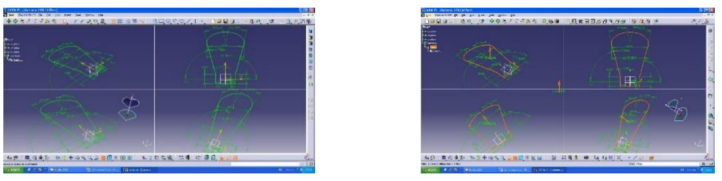
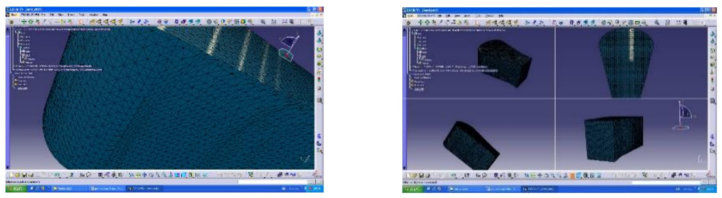
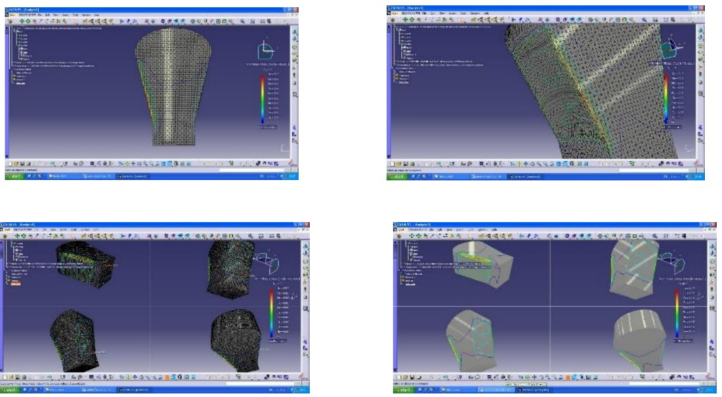
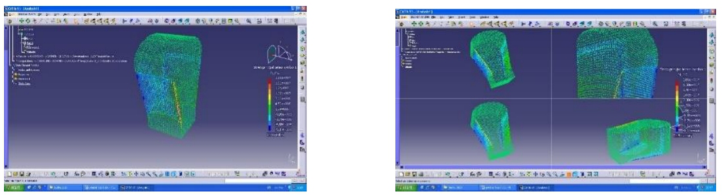
Figures 4, 5 and 6 presents the images obtained after solving the equations.
Prototyping of the Experimental Lifting Parachute System 99
Table 3. Physical-mechanical characteristics of the composite material.
Table available in the original PDF paper.
Composite material LP Mass, g/sqm, min 875 Breaking resistance, warp/weft, daN, min 650/650 Constructive shape Figure 3 Admissible resistance N_sqm 8.95e + 009
Figure 3: Sketcher and part design.Figure 4: Deformation single and multiple view.Figure 5: Von Mises stress (nodal values) – single and multiple view.Figure 6: Stress principal tensor single and multiple view.
The ranges of variation for von Mises (nodal values) are [0; 1e + 007] N_m2, respectively [−9.37e + 006; 1.85e + 007] N_m2 for tensor main stress, and the composite material from which the fluting parachute is made has an admissible resistance of the order of 8.95e + 009N_m2, which proves that the material will withstand in real conditions of usage.
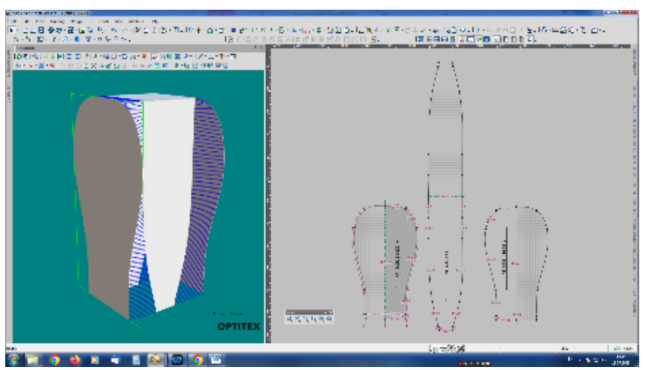
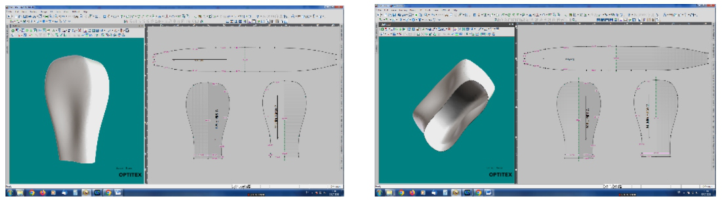
The experimental design of the flotation parachute was carried out with the help of the EFI Optitex software. The completed stages are presented successively in Figures 7 and 8.
Figure 7: Pattern design 2D. Scale 1:5.Figure 8: Multiplication and visualisation of the 3D model.
Prototyping of the Experimental Lifting Parachute System 101
For the construction of the system, the following coefficients specific to the design of aquatic systems were considered: coefficient of floating area: 0.84; block coefficient: 0.652; belt convergence coefficient: 1.03, ultimate resistance coefficient: 2.11, abrasion coefficient: 0.56.
The calculated values of theoretical and actual lift capacities demonstrated that for a parachute of the shape represented in the Fig. 8, realised from a composite material with textile reinforcement with the characteristics pre- sented in Table 3, and the dimensions of 275 x 500 × 175 cm (upper shell x height x opening - Fig. 8), the lift capacity is of 15000kg (33000 lb).
By using the presented set of equations, it was demonstrated that the por- tion of fluid corresponding to a pressure of 8 bar (approx. 75 m depth) will not disturb the lifting system by creating unforeseen turbulences.
CONCLUSION
The dispensable and executable system made will be used to explore the requirements and the design options of other systems (even for systems work- ing in tandem or in groups), which can work for depths of more than 150 m (interlayer temperature of 8.88
C, salinity on the halocline floor of 21.5%, with the remark related to the fact that above 150 m and up to 180 m there is no dissolved oxygen, its place being taken by hydrogen sulphide) and weights of over 90,000 kgf.
ACKNOWLEDGMENT
This scientific paper is funded by the Ministry of Research, Innovation, Digitalisation within Program 1 - Development of the national RD sys- tem, Subprogram 1.2 - Institutional Performance - RDI excellence funding projects, Contract no. 4PFE/2021.
REFERENCES
Aniculaesei Gheorghe (2022) – Ecuatii parabolice si hiperbolice, Editura Universitatii Al. I. Cuza, Iasi, pp. 39 – 55. Aniculaesei, G. (2003), Ecuatii diferentiale si ecuatiile fizicii matematice, Editura
Universitatii “Al. I. Cuza” Iasi. Bevan, John, et al. (2005). “3: Applied techniques”. The Professional Divers’s Handbook (second ed.). Alverstoke, Gosport, Hampshire: Submex Ltd. pp. 174–177 ISBN 978–0950824260. Gaf-Deac Ioan I., et al., - Confruntation and competition: challenges in terms of
integration/ networking of value chains, - W.5, European Integration and Global- isation. New Challenges, The 3rd Intl. Economic Scientific Research – Theoretical, Empirical and Practical Approaches, ESPERA 2015, International Academic Pub- lishing Group, Peter Lang, 2015, Deutsche Nationalbibliothek, Internationaler Verlag der Wissenschaften, pp. 459–465, DOI: 10.3726/978-3-653-06571-8 Gaf-Deac Ioan I., et al., (2015) “New development: from linear to nonlinear economy. Challenges from the perspective of sustainable development”, - W.1, Romania’s Sustainable Economic and Social Development. Models, Scenar- ios, Evaluations, The Romanian Academy, The 3 rd Intl. Economic Scientific Research – Theoretical, Empirical and Practical Approaches, ESPERA 2015, ISBN
978-3-631-67330-0, E-ISBN 978-3-653-06571-8, E-ISBN 978-3-631-69664, E- ISBN 978-3-631-69665-1, DOI: 10.3726/978-3-653-06571-8. Haragus, D., (2001) Ecuatii cu derivate partiale, Editura Universitatii de Vest, Timisoara. Ionac, N., Ciulache, S., (2007) - Esen¸tial în meteorologie ¸si climatologie. Edit.
Universitar˘a, Bucuresti. Murray, J. W., Stewart, K., Kassakian, S., Krynytzky, M., Dijulio, D., (2005) - Oxic, Suboxic and anoxic conditions in the Black Sea. In: Gilbert, A., Yanko- Hombach, V., Panin, N. (Eds.), Climate change and coastline migration as factors in human adaptation to the circumpontic region: from past to forecast, Kluwer Pub. Open University, 2007. Seawater: Its Composition, Properties and Behaviour. Butterworth-Heineman, Oxford. Radulescu, C. V., Gaf-Deac, I. I., Bran, F., Manescu, C. O., Bodislav, D. A. and
Burlacu, S., 2023. The Mix of Resources, Security and Sustainability of the Energy Complex in Romania in the European Context. Amfiteatru Economic, 25(63), pp. 447–462. DOI: 10.24818/EA/2023/63/447 Pickard si Emery, 1993. Descriptive Physical Oceanography: An Introduction.
(5th edn.). Pergamon Press. Oxford, p. 320. Radulescu, C. V., Gaf-Deac, I. I., Bran, F., Manescu, C. O., Bodislav, D. A. and Burlacu, S., 2023. The Mix of Resources, Security and Sustainability of the Energy Complex in Romania in the European Context. Amfiteatru Economic, 25(63), pp. 447–462. DOI: 10.24818/EA/2023/63/447 Staff (August 2016). “15: General Safety Requirements. 15.19 Lifting Bags”. Guid-
ance for Diving Supervisors IMCA D022 Rev. 1. International Marine Contractors Association pp. 15–18. Vespremeanu, 2005. Geografia Marii Negre. Editura Universitara. Bucuresti.
LISTED IN THE AHFE DIGITAL BOOKSTORE CATALOGUE
Explore the complete digital volume
Application of Emerging Technologies
Read this individual research paper free through the original publisher, or explore the full digital proceedings book.
ISBN 978-1-958651-91-9
Explore this ISBN in the AHFE Bookstore ↗Listed in the July 2026 bookstore catalogue; search by ISBN to confirm current availability · Digital book purchase optional