Mihaela Jomir, Alexandra Gabriela Ene, Carmen Mihai (2023). The incremental development of a collapsible aerial module for the management of the calamity generated by soil drought. In: Application of Emerging Technologies. AHFE Open Access, vol. 115, pp. 47–55. https://doi.org/10.54941/ahfe1004301
Extended areas of the planet are experiencing drought, a natural phenomenon that occurs due to a prolonged period of abnormally low rainfall or when water is insufficient. Drought is a critical global problem affecting the environment, economies and social well-being of communities around the world, with severe impacts on agriculture, wildlife, water supplies and public health.The most efficient technique for protecting the soil against pedological drought is represented by mulching, a technique that enables the preservation of the soil moisture (by reducing evaporation) and limitation of the weed growth (lack of light forces etiolation and exhaustion). In addition, considering that an extraordinary variety of living beings could be developed under the mulch, the most important being represented by the Oligochaeta taxon and Annelida family, through mulching, digging and loosening operations are eliminated.The paper presents the stages of the incremental iterative development of a collapsible aerial module used for mulching the soil affected by extreme pedological drought, starting from the specific requirements imposed to the functional system by the real conditions of usage. The phases of iterative development were completed, starting from the digital and experimental design, the realization and testing of the system. Thus, the initialization phase included the digitization sequences corresponding to the digital design of the system and performance evaluation through testing (sketcher, part design, assembly design and generative structural analysis) for 3 distinct requirements: i) the module has a load with a mass of 5000 kg, t0=0 s; ii) part of the load is placed and there is a remaining part of 2000 kg, t1=t0+ɛ s, and iii) the module is empty, t2= t0+ɛ+ɤ s. The testing was carried out for all the 3 different situations as a function of time and the deformation under the effect of dynamic pressure, Von Mises stress fields and distribution of displacement vectors and errors were visualised.The possible cracks of the system were predicted using the Von Mises criterion, according to which the limit state of the solid body appears when the specific potential energy that modify the shape reaches the characteristic limit value of the material (allowable resistance of min +010N_m2). The second phase of the incremental development consists in the experimental design with the help of the Optitex Pattern Making PDS (EFI Optitex) software, obtaining the type-dimensions of the system and the multiplication (2D pattern construction, 3D simulation and visualization).The incremental development approach leads to a rapid development and realization of the functional model used in the case of pedological drought, and its systematic testing in real conditions of usage will determine both the improvement of the type-dimensional parameters, and the definition of the technological process.
Drought is a critical global problem that affects the environment, economies and social well-being of communities around the world, being associated with a severe impact on agriculture, wildlife, water supply and public health. The management of interventions in these cases is particularly important (Gâf -Deac Ioan I., et al., 2015).
There are several types of draught classified according to their causes and impacts. These include:
Meteorological Drought: This type of drought occurs when there is a pro- longed period of below average rainfall or when the rate of evaporation
is greater than the rate of rainfall. It is the most common type of drought and is often associated with hot and dry weather conditions.
Agricultural Drought: Agricultural drought occurs when there is a penury of water that affects agricultural production and animal life. It is caused by a lack of soil moisture and can have serious economic consequences for farmers and rural communities.
Hidrological Drought: Hydrologic drought occurs when water levels in rivers, lakes, and groundwater are lower than usual. (Gâf-Deac Ioan I., et al., 2015). It can have serious impacts on water supplies, aquatic ecosystems and hydropower production.
Socio-Economic Drought: Socio-economic drought occurs when there is a water penury that affects human activities such as water supply, indus- try and recreation. (Gâf-Deac Ioan I., et al., 2022). It can have significant social and economic effects, especially in urban areas (Andrei J.V. et al., 2021, Andrei J.V. et al., 2022). The decrease of the soil water reserve corre- sponding to the watering depth, below the easily accessible water content is considered “pedological drought” (Andrei J.V. et al., 2022).
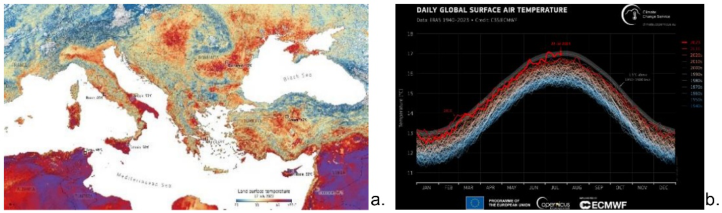
According to climatologists, if meteorological drought persists for a long period, then it turns into pedological drought (i.e., the lack of water reserves in the soil). If these phenomena still persist for a long period of time, the last stage associated to hydrological drought will be occurred (i.e., the level of rivers and lakes decreases at the regional level). Figure 1a presents the image obtained by ESA as a result of processing the data received from Copernicus Sentinel for the morning of July 17, 2023. It is worth noting the positive dif- ference between the surface temperature of the soil and the air temperature, which due to the climate changes that dominate the planet, will probably be more frequent and larger, with particularly severe consequences for the whole planet. Figure 1b illustrates the time series recorded by the Coperni- cus Climate Change Service (C3S), consolidated and processed by The World Meteorological Organization (WMO), every year for daily surface air temper- ature, starting with 1940 (blue line) and until this year. The years 2020 – 2023 are drawn with lines from brick red (2020), dark red (2016) and bright red (2023). The grey band with dotted line represents the 1.5
C threshold above preindustrial level (1850–1900) and its uncertainty.
It is clearly highlighted that on July 6, 2023, the air temperature recorded as an absolute record in August 2016 was exceeded. Moreover, starting with the month of May, the global average sea surface temperature was the highest, compared to the values recorded since meteorological observations are made, contributing to the increase of air and soil temperatures.
The predictions made by the WMO evidence the fact that, with a 98% likelihood in the next period (years 2024 – 2028), in at least one year the values recorded for July 2023 will be exceeded.
The most used technique for protecting the soil against pedological drought is represented by mulching, a technique that allows preserving soil moisture (by reducing evaporation) and limitation of the weed growth (lack of light forces etiolation and exhaustion). Application of mulching layers, mainly in the form of agricultural residues (wheat straw, barley or rye) or
The Incremental Development of a Collapsible Aerial Module 49
heterogeneous wood residues produced “in situ” or “ex situ” (chips, strands, chips, branches or logs) is a widely used technique for mitigating soil erosion after fires and for revegetation, due to its cost-effectiveness.
Figure 1: a.Temperature of surface of the land in the morning of 17 July 2023, during a heatwave - Copernicus Sentinel data (2023), processed by ESA; b. Global daily surface air temperature (◦C) from 1 January 1940 to 23 July 2023.
Moreover, through mulching, digging and loosening operations are elim- inated, because an extraordinary variety of living beings develops under the mulch, the most important of which being the Oligochaeta taxon, the Annelida family. In Romania, in 2017, the area dedicated to the cultivation of cereals was 5.11 million hectares, approximately 39% of the country’s agricultural area.
The paper presents the stages of incremental iterative development of a col- lapsible aerial module used for mulching soil affected by extreme pedological drought using digital techniques, both for performance evaluation through testing, and for establishing technical execution documentation.
MATERIALS AND METHODS
The initialization phase included the digitalisation sequences corresponding to the digital design of the system and the performance evaluation through testing (sketcher, part design, assembly design and generative structural anal- ysis) for the following 3 distinct requirements: i) for the situation where the module has a mass load of 5000 kg, t0=0 s; ii) for the case where he placed part of the load and still has 2000 kg, t1=t0+ε s and iii) for the situation where the module is empty, t2= t0+ε+γ s.
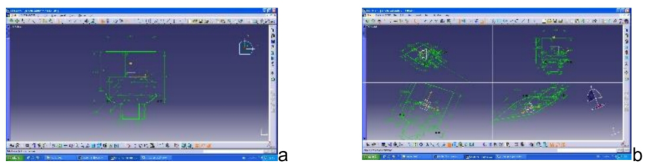
Figure 2: MF multi-role collapsible aerial module for pedological drought design - sketcher a. MF dimensioning, b. ISO-constrained diagnostic and analysis report for MF geometry (construction), c. General status report for default profiles of MF.
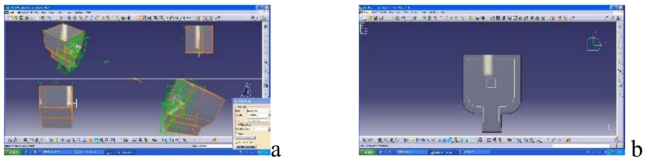
The CAD report drawn up in the second phase of project implemen- tation, corresponding to the functional model (MF) multi-role collapsible aerial module for pedological drought included the digitalisation sequences, respectively: a. Sketcher – with the sketching application of the integrated module (Figures 2, 3). b. Part Design – creation of the MF 3D (Figure 4). c. Assembly Design – with the module integrated in the software (Figure 5).
Figure 3: MF multi-role collapsible aerial module for pedological drought design - sketcher. a. MF curves application – single view, b. MF for part design – multi view.Figure 4: MF multi-role collapsible aerial module for pedological drought design – part design: a. Multiview; b. Single view.Figure 5: MF multi-role collapsible aerial module for pedological drought design - assembly design. Pocket definition: 3000 mm.
The main physical-mechanical characteristics of the composite material used are presented in Table 1.
Table 1. Physical-mechanical characteristics of the composite material.
Table available in the original PDF paper.
Composite material V1 Mass, g/sqm, min 480 Breaking resistance, warp/weft, daN, min 350/350 Constructive complex shape Parallelepiped, pyramid trunk and parallelepiped
The Incremental Development of a Collapsible Aerial Module 51
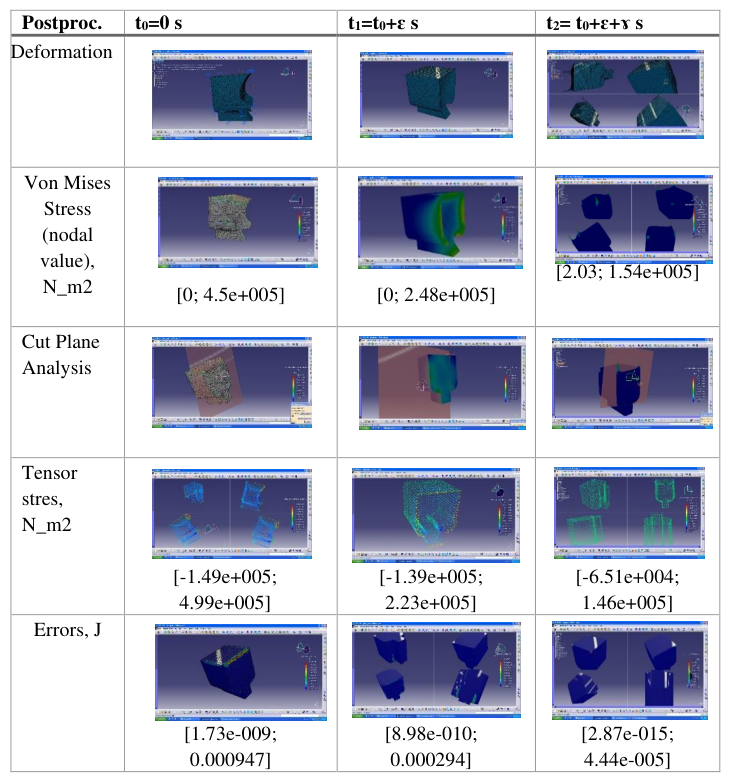
RESULTS AND DISCUSIONS The testing was carried out for all the 3 situations differentiated according to time, visualizing the following characteristics: deformation under the effect of dynamic pressure, Von Mises stress (nodal value), tensor stress and errors errors.
The possible cracks of the system were predicted using the Von Mises cri- terion, according to which the limit state of the solid body occurs when the specific potential energy modifying the shape reaches the limit value characteristic of the material (permitted resistance of min +010N_m2).
With the help of the Generative Structural Analysis module, it was possi- ble to generate the structure with finite elements in two stages represented by the discretization and the introduction of the properties of the finite ele- ments (Table 2). The solution of the model with FEM created for MF was generated with the help of specialized software. The post-processing enabled the visualization of the results for 3 distinct situations, respectively:
Table 2. Post-processing values.
A. For the situation when the MF has a load with a mass of 5000 kg, t0=0 s;
B. For the case when MF has taken over part of the load and still has potential for 2000 kg, t1=t0+ε s;
C. For the situation where the MF is empty, t2= t0+ε+γ s.
The values resulted from post-processing are presented in Table 2. The values obtained after the tests highlight that:
- the assembly can be considered a rigid body that will withstand the real conditions of use regarding: forward resistance, helicopter movement speed, load weight, transverse and longitudinal oscillations. - the ranges of variation obtained for Von Mises stress and tensor stress demonstrate that the composite material from which the whole assembly is built will withstand the specific conditions highlighted previously.
It was necessary to calculate both the Von Mises stress and the principal stresses, because, if for von Mises the state of stress is described by 6 Cauchy stresses (mathematical combination of all components of both axial and shear stresses that vary from point to point and represents a reasonable indicator for the possible occurrence of failure) (Jefferson AD et al., 2004, Gerring John et al., 2004, Touraj Gholami et al., 2004), for the principal stress ten- sor - the directions in which the assembly under test is clearly highlighted it is in a state of pure tension or compression. (Jalal Nikoukaran et al., 1999, Vijayaraghavan Athulan et al., 2005, Lee, K. 1999, Handren A. Amin, 2008). Additionally, the minimum and maximum values obtained for the interior of the assembly (mulch), and represented with the help of cut plane analysis, highlight the fact that the composite material will resist to the action of the dynamic forces developed in real conditions of usage.
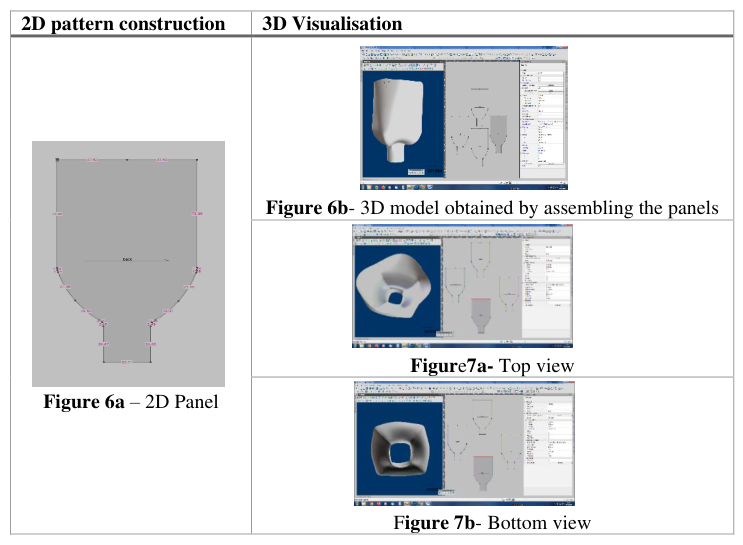
The second phase of the incremental development was focused on the experimental design with the help of the Optitex Pattern Making PDS (EFI Optitex) software, obtaining the type-dimensions of the system and the mul- tiplication (2D pattern construction, 3D simulation and visualization). The completed stages are presented in Table 3.
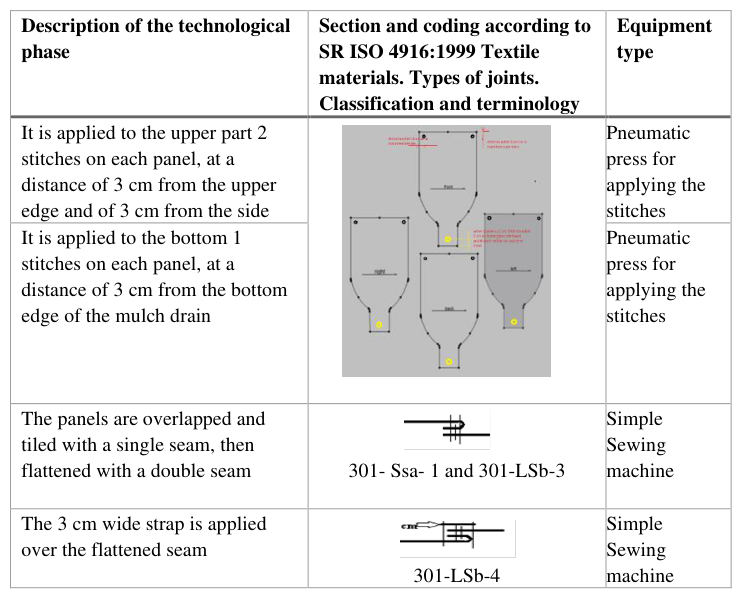
In addition, the technical execution documentation (phases of the techno- logical flow, equipment used and types of joints) for the panels of the air module was drawn up (Table 4).
The last two phases of the technological flow were performed manu- ally mainly the one related to the insertion of the suspensions through the upper and lower stitches, the final length of the suspension attached to the upper stitches being 1.5 m, and to the lower ones of 4 m.
The Incremental Development of a Collapsible Aerial Module 53
Table 3. CAD design stages.Table 4. Technical documentation for the execution of panels.
CONCLUSION
The incremental iterative development of a collapsible aerial module used for mulching the soil affected by extreme pedological drought was based on a waterfall sequence in which each iteration participated in the realization of a part of the assembly. This part actually represents the input for the next iteration, respectively: analysis – design – development – testing.
For each new iteration, the elements defined by the previous iterations were detailed, added and modified (e.g., the type-dimensions of the assembly - the technological flow of its realization).
The validation of the assembly was carried out through its virtual testing, therefore, the collapsible aerial module developed so far will be tested under real conditions of use, by mulching the soil in the south-west of Europe, the area with high water stress, with an extreme level of humidity, of 0% – 20%.
ACKNOWLEDGMENT
This scientific paper is funded by the Ministry of Research, Innovation, Digitalisation within Program 1 - Development of the national RD sys- tem, Subprogram 1.2 - Institutional Performance - RDI excellence funding projects, Contract no. 4PFE/2021.
REFERENCES
American Political Science Review, Vol. 98, No. 2. Andrei J. V., Avram S., B˘ancescu I., Gâf-Deac I. I., Gheorghe C., (2021) “Evolution of Romania’s Economic Structure and Environment Degradation – An Assess- ment Through LMDI Decomposition Approach”, Risk Manag Health Policy, Vol. 2021:14, pp. 3505–3521. https://doi.org/10.2147/RMHP.~S299617 Andrei J. V., Avram S., B˘ancescu I., Gâf-Deac I. I., Gheorghe C. A. and Dia-
conu A. I., (2022) “Decoupling of CO2, CH4, and N2O agriculture emissions in the EU”. Front. Environ. Sci., Sec. Environmental Economics and Manage- ment, Technology-Enabled Circular Economy Practices in Energy Production and Consumption Patterns, DOI: 10.3389/fenvs.2022.920458. Gâf-Deac Ioan I., et al., (2015) “New development: from linear to nonlinear economy. Challenges from the perspective of sustainable development”, - W.1, Roma- nia’s Sustainable Economic and Social Development. Models, Scenarios, Evalu- ations, The Romanian Academy, The 3rd Intl. Economic Scientific Research – Theoretical, Empirical and Practical Approaches, ESPERA 2015, ISBN 978-3- 631-67330-0, E-ISBN 978-3-653-06571-8, E-ISBN 978-3-631-69664, E-ISBN 978-3-631-69665-1, DOI: 10.3726/978-3-653-06571-8. Gâf-Deac, I. I.; Jaradat, M.; Bran, F.; Cre¸tu, R. F.; Moise, D.; Platagea Gombos,
S.; Breaz, T. O., (2022) “Similarities and Proximity Symmetries for Decisions of Complex Valuation of Mining Resources in Anthropically Affected Areas”. Sustainability, 14, 10012./ Vol. 14, Issue 16. Gerring John (2004), “What Is a Case Study and What Is It Good for?”, Boston University. Handren A. Amin, (2008) “A comparative study of 2CAD-integrated FE-programs
using the linear static analysis”, Master Thesis, Halmstad University, pp. 26–46. Jalal Nikoukaran and Ray J. Paul (1999). “Simulation Practice and Theory”, Volume 7, Issue 1, Pages 1–14.
The Incremental Development of a Collapsible Aerial Module 55
Jefferson AD, Barr BIG, Bennett T and Hee SC (2004) “Three-dimensional finite element simulations of fracture tests using the Craft concrete model”. Computers and Concrete, 1 (3), August, pp. 261–284. ISSN 1598-8198. Lee, K. (1999) “Principles of CAD/CAM/CAE Systems”, 1st ed. Boston, MA:
Addison-Wesley. Touraj Gholami, Jürgen Lescheticky and Ralf Paßmann (2003). “Crashworthiness Simulation of Automobiles with ABAQUS/Explicit”. ABAQUS Users’ Conference. Vijayaraghavan Athulan (2005) “Comparative Study of Finite Element Simulation
Software”, University of California, Berkeley.
LISTED IN THE AHFE DIGITAL BOOKSTORE CATALOGUE
Explore the complete digital volume
Application of Emerging Technologies
Read this individual research paper free through the original publisher, or explore the full digital proceedings book.
ISBN 978-1-958651-91-9
Explore this ISBN in the AHFE Bookstore ↗Listed in the July 2026 bookstore catalogue; search by ISBN to confirm current availability · Digital book purchase optional