Frederic Meyer, Sven Hinrichsen, Elio Padoano (2024). A Structured Method for the Selection of Business Processes Suitable for Robotic Process Automation. In: Human Systems Engineering and Design (IHSED2024): Future Trends and Applications. AHFE Open Access, vol. 158, pp. 10–20. https://doi.org/10.54941/ahfe1005524
As companies increasingly adopt software applications to improve business efficiency, often digitization gaps arise when legacy systems fail to integrate with new applications. These gaps often result in redundant task execution across incompatible systems. Robotic Process Automation (RPA) emerges as a solution by automating such tasks. However, selecting the right processes that will be subjected to RPA is crucial to avoid failures and resource waste. Therefore, this paper introduces a four-stage method to evaluate processes for RPA suitability, grounded on the Analytic Hierarchy Process (AHP). By systematically analyzing scientific literature and incorporating weights from RPA experts, this paper sheds light on the complex nature of process selection criteria for RPA. Tested in a company, the method facilitates the process selection, indicating its practical applicability.
The ongoing digitization holds the potential to increase the efficiency of business processes significantly. However, the rising adoption of software applications often leads to digitization gaps due to interfaces and data processing incompatibilities (Riedl and Beetz, 2019; Syed et al., 2020). For instance, data processing incompatibilities can arise if different software applications cannot share data automatically. As a consequence, employees must compensate for these gaps by performing repetitive and monotonous tasks (Flechsig et al., 2022; Smeets et al., 2021). Emerging automation technologies, such as Robotic Process Automation (RPA), address these challenges by automating informational work processes and thus removing some barriers to companies’ digital transformation. RPA refers to a software-based approach for automating interactions with a user interface by mimicking human behavior through a software robot (Wewerka and Reichert, 2020). In this way, RPA provides the opportunity to focus on more creative work while increasing motivation and productivity (Flechsig et al., 2022).
A Structured Method for the Selection of Business Processes 11
For a successful implementation of RPA, it is crucial to select suitable processes based on RPA-specific criteria (Enríquez et al., 2020; Wellmann et al., 2020). Thereby, a process is considered suitable if, on the one hand, automating a process leads to significant operational impacts. On the other hand, a process must meet specific criteria to be technically automatable. Choosing unsuitable processes often results in failure of automation initiatives (Padmini et al., 2021). To avoid resource waste, it is essential to assess the suitability of processes in the early phases of automation projects. An aspect to consider, however, is that RPA-specific criteria might vary across companies and processes, which underlines the lack of general criteria validity (Viehhauser and Doerr, 2021). Accordingly, evaluating a process for RPA suitability is one of the major challenges (Gronau et al., 2021; Syed et al., 2020). Moreover, there is scarce methodological support for identifying, prioritizing, and selecting suitable processes for RPA (Viehhauser and Doerr, 2021). Therefore, the objective of this paper is to address the existing gap by developing a structured method for identifying, prioritizing, and selecting suitable processes for RPA.
RESEARCH METHODOLOGY For developing the process selection method, first, a Systematic Literature Review (SLR) was conducted to ascertain the current state of research on process selection criteria following the Preferred Reporting Items for Systematic Reviews and Meta-Analysis (PRISMA) (Page et al., 2021). Subsequently, a qualitative content analysis was applied to identify and analyze the process selection criteria within the articles, enabling the categorization and definition of these criteria. Next, the process selection method was developed. In the first step, the Analytic Hierarchy Process (AHP) in the context of Multi-Criteria Decision-Making (MCDM) was employed to determine the criteria weights by pairwise comparison (Saaty, 2008). In the second step, a questionnaire for evaluating the process suitability was developed. Finally, the developed selection method was tested in a company for demonstrating its applicability in a real-world setting.
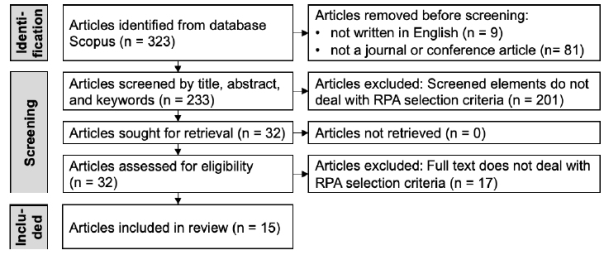
LITERATURE REVIEW ON PROCESS SELECTION CRITERIA The SLR on identifying articles, dealing with process selection criteria was conducted on 07/19/2023 in the multidisciplinary database Scopus with the search term: TITLE-ABS-KEY (“robotic process automation” AND “method” OR “framework” OR “procedure” OR “criteria”). “TITLE-ABS- KEY” was added to search for the combination of terms used in the titles, abstracts, and keywords. In addition, a filter was applied to exclude all records that did not appear as a journal or conference article or were not written in English. Papers that did not meet these requirements were excluded to ensure the papers’ relevance, and scientific quality. The process for selecting relevant articles is shown in the flow chart in Figure 1. After filtering and screening, 15 out of 323 papers were identified as relevant.
Figure 1: Article selection process (adapted from Page et al., 2021).
Table 1 provides an overview of the publications included in the SLR.
Table 1. Publications included in the literature review.
Table available in the original PDF paper.
No. Author No. Author No. Author [1] Axmann, Harmoko 2022 [6] Herm et al. 2023 [11] Timbadia et al. 2020 [2] Axmann et al. 2023 [7] Leshob et al. 2018 [12] Viehhauser, Doerr 2021 [3] Costa et al. 2023 [8] Ortmeier et al. 2023 [13] Wanner et al. 2019 [4] Eulerich et al. 2022 [9] Riedl, Beetz 2019 [14] Wellmann et al. 2020 [5] Farinha et al. 2023 [10] Spanoudakis et al. 2023 [15] Yadav, Panda 2022
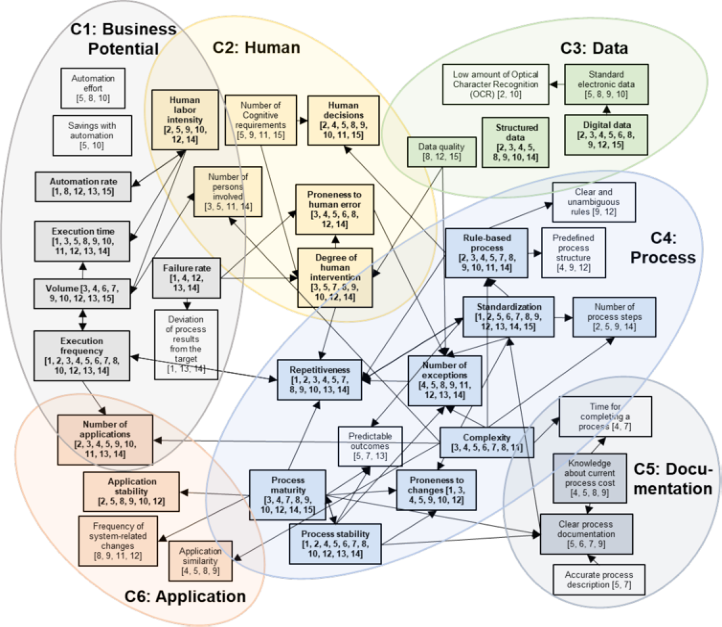
The following synthesis of the selection criteria is based on a qualitative content analysis. For this purpose, the selection criteria were extracted from the relevant publications. The selection criteria were then collected and pre-sorted thematically. Criteria with the same content and designations were summarized. To reduce the complexity, only criteria were included that appeared at least twice in the literature. Based on this reduction, 39 selection criteria were classified into six different clusters, shown in Figure 2. A cluster contains similar criteria in terms of content. To represent the relationships between individual selection criteria, directional arrows were used. These arrows were based on different interpretations found in the literature, showing how various authors understand the connections between criteria.
Out of the 39 selection criteria identified in the qualitative content analysis, a reduced selection of 29 criteria was made for further consideration in this paper. The reduction of the criteria is based on the number of mentions in literature, which must be mentioned at least four times. In summary, the selection criteria identified in the qualitative content analysis are defined in Table 2.
In conclusion, the SLR revealed some critical limitations regarding process selection criteria. Within the articles: (1) the number and type of criteria vary considerably; (2) the terminology and definition of criteria are inconsistent, which makes it difficult to compare; (3) the level of detail varies considerably, from atomic, single criteria to aggregated criteria composed of multiple atomic criteria; (4) the criteria partially influence each other, so they are not independent.
A Structured Method for the Selection of Business Processes 13
Figure 2: Qualitative content analysis on process selection criteria.Table 2. Definition of process selection criteria.
Table available in the original PDF paper.
Cluster Criteria Definition Execution frequency Frequency at which a process is executed.
Business Potential Execution time Time required to execute a process from start to finish. Volume Time spent on process execution within a given period of time (execution frequency x execution time). Automation rate Proportion of already automated process steps. Failure rate Proportion of process steps with errors. Human Human decisions No. of human decisions required for process execution. Degree of human intervention Degree of human intervention required for process execution. Proneness to human error Proneness to error when humans execute a process. Human labor intensity Level of human effort required for process execution. No. of cognitive requirements Level of human cognitive abilities required for process execution. No. of persons involved No. of persons involved in process execution. Data Digital data Extent to which data is in a digital format. Structured data Extent to which data is in a predefined structure. Standard electronic data Extent to which data conforms to recognized formats.
Table 2. Continued.
Table available in the original PDF paper.
Cluster Criteria Definition Process Standardization Degree to which a process is always executed in the same way. Process stability Reliability of process outcomes. Repetitiveness Degree of recurring tasks during process execution. Rule-based process Extent to which a process is based on predefined rules. Process maturity Extent to which a process is formally defined. No. of exceptions No. of deviations from predefined process execution. Complexity Degree to which a process is difficult to automate. Proneness to changes Degree to which a process is susceptible to changes. No. of process steps No. of individual actions within a process. Documentation Knowledge about current process cost
Understanding of the costs associated with process execution. Clear process documentation Degree to which a process is documented. Application No. of applications No. of software applications involved in a process. Application stability Performance reliability of a software application. Frequency of system- related changes
Susceptibility of a software application to undergo modifications. Application similarity Degree of similarity between software applications.
DEVELOPMENT OF A PROCESS SELECTION METHOD Method Description
The process selection method is intended to serve for the structured determination of processes suitable for RPA and consists of the following four steps: (1) Identification: Employees across various departments identify process candidates from their daily work. By employing a process identification questionnaire, each employee selects three process candidates for RPA. (2) Pre-selection: Next to process identification, the questionnaire is designed to reduce the number of processes identified from three to one. For the remaining process, a detailed analysis of the characteristics concerning RPA-suitability is conducted by a separate process evaluation questionnaire. (3) Prioritizing: The subsequent assessment of the process evaluation questionnaire is carried out by an interdisciplinary RPA team. The team collects the completed questionnaires for each department and evaluates them using the AHP. As a result, a suitability ranking of the processes is received. (4) Selection: The most suitable processes for RPA are selected within the RPA team. Thereby, the selection is based on the ranking of the processes determined with the AHP. The processes with the highest rankings are discussed within the team, which finally selects one or more suitable processes for RPA implementation. To maximize the benefits of RPA, it is often preferable to implement more than one process at a time, as long as they sufficiently fulfill the process selection criteria.
A Structured Method for the Selection of Business Processes 15
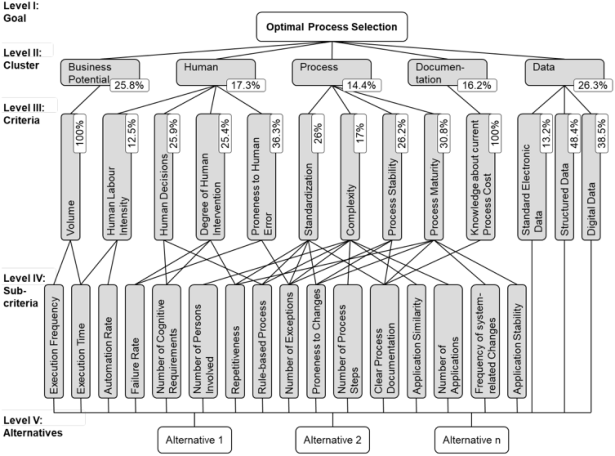
Determine Criteria Weights As prerequisite for selecting suitable processes for RPA, the elements identified in the SLR, consisting of criteria and clusters, need to be weighted. Following the AHP as one of the most recognized methods in the context of MCDM, introduced by Thomas L. Saaty in the 1970s (Saaty, 1977; Thakkar, 2021), a hierarchical decision model according to Figure 3 is developed first. The next step involves weighing the elements of each hierarchical level. The weightings are determined in a survey by RPA experts with a (1–9) scale for pairwise comparing the importance of an element with respect to the corresponding element of the next higher level in the hierarchy. Even though using expert judgments might seem less objective than numerical measurements, the interpretation of any data is inherently subjective (Saaty, 2008). This assumption supports the approach of using expert judgments in contexts involving intangible and multifaceted criteria like those in RPA. To reach RPA experts, consulting companies with expertise in RPA were invited to participate in the survey. Furthermore, the survey was shared in RPA expert groups on LinkedIn. In turn, 16 completed data sets were obtained and considered for determine the criteria weights. The data show that 69 % of the surveyed participants have at least three years of experience with RPA, while 50 % of the participants are very familiar with RPA-specific selection criteria.
For calculating the criteria weights, the specialized AHP software Super Decisions is used. Since the weightings of the elements in the decision model are based on 16 RPA experts, an aggregation of the individual assessments is necessary. This procedure is also referred to as group decision, where the pairwise comparisons of the decision makers are aggregated by applying the geometric mean (Forman and Peniwati, 1998; Ishizaka and Nemery, 2013). Figure 3 shows the aggregated weightings of the elements in the hierarchy. Accordingly, “Data” represents the most important cluster for optimal process selection, with 26.3 %, followed by “Business Potential” with 25.8 %, “Human” with 17.3 %, “Documentation” with 16.2 %, and “Process” with 14.4 % relative importance. The “Business Potential” cluster only consists of the “Volume” criterion; therefore, pairwise comparisons are not possible. Consequently, the “Volume” criterion has a relative weight of 100 %.
Questionnaires for Process Identification and Evaluation So far, only the criteria weights based on expert assessments exist for the method to be developed. Since the method aims to select suitable processes for RPA, it is necessary to evaluate them with the selection criteria identified in the literature. For this reason, a process evaluation questionnaire must be developed. When developing the questionnaire, it must be considered that the users of the questionnaire are employees from different departments of a company. For this reason, care must be taken to ensure the respondents are able to answer the items in the questionnaire. Consequently, detailed questions, such as those relating to costs caused by process execution, cannot be answered by process users in case of doubt. Based on these aspects, the
questionnaire is divided into two sections with a total of 22 items. Next to demographic items, the first section contains items identifying three possible processes from the participants’ daily work. In addition, a first preselection of a process is made. The corresponding items of the first section are shown in Table 3.
Figure 3: Weighted AHP model for optimal process selection.Table 3. Items of the process identification questionnaire.
Table available in the original PDF paper.
No. Definition I1 Name the three tasks you perform on the computer in your daily work routine that are most repetitive. I2 Sketch the main steps for one of the three tasks you named on paper. Choose the task that is easiest to describe. Use the following graphic as a support. I3 Which of the three tasks you named did you outline?
In the second section of the questionnaire, the process candidates selected by the participants are subjected to a detailed evaluation based on RPA- specific selection criteria. Table 4 shows the items for evaluating process candidates.
Following the questionnaire, the processes are evaluated and ranked according to the automation potential for RPA based on the hierarchical decision model in Figure 3. For this purpose, the values of the process characteristics obtained by the scales of the process evaluation questionnaire are transferred to the decision model in Super Decisions. These values are then multiplied by the weights of the elements linked in the hierarchy. Based on these calculations a priority order for RPA-suitability of the process candidates in form of a ranking is obtained.
A Structured Method for the Selection of Business Processes 17
Table 4. Items of the process evaluation questionnaire.
Table available in the original PDF paper.
No. Definition I1 On average, how often do you perform your task? I2 On average, how long does it take to complete your task? I3 How many essential task steps does your task consist of (e.g.: open program; enter login data; copy data entries)? I4 How many employees besides you are involved in processing your task? I5 How often do processes or contents of your task change? I6 How many different programs are used to perform your task? I7 On average, how often is your task interrupted by program crashes? I8 How often are the programs used for your task affected by changes (introduction of a new program or change of user interface)? I9 The data for performing my task are available digitally. I10 The data for executing my task are available in tables or forms (structured data). I11 The data for performing my task are in a computer-readable format. I12 The data for executing my task is automatically exchanged between different programs through interfaces. I13 My job often requires decisions based on judgment. I14 Within my task, individual task steps repeat. I15 My task can be described down to the last detail by clear rules. I16 My task always follows the same procedure down to the last detail. I17 My task is documented down to the last detail. I18 What is the average frequency of incorrectly executed task steps in your task? I19 What percentage of the steps in your task are already automated?
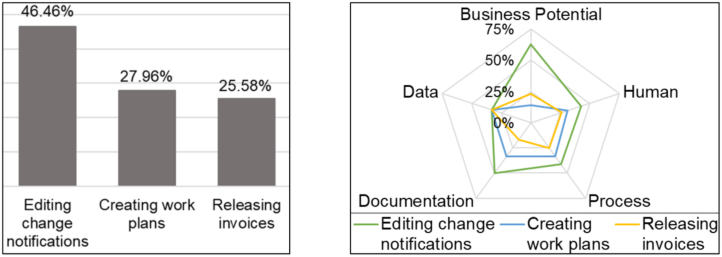
APPLICATION OF THE PROCESS SELECTION METHOD TO A CASE-STUDY To demonstrate the effectiveness of the process selection method under real conditions, it was subjected to an initial test in the industrial engineering department of a machine-building company. Three employees evaluated a process of their daily work, based on the questionnaires, containing the items from Table 3 and Table 4. Utilizing the Super Decisions software, the processes were analyzed and prioritized. As depicted in Figure 4 (left), the “editing change notifications” process emerged as the top choice with a 46.46 % preference. A radar diagram in Figure 4 (right) further detailed its strengths, especially in the “business potential” and “documentation” cluster. Further analysis revealed that automating this process, which is performed three times per day for 45 minutes each, would save 11.25 hours weekly. This amounts to a 0.28 full-time equivalent (FTE) based on a 40-hour workweek, highlighting significant automation potential. Overall, the demonstration underscores the method’s effectiveness in identifying and prioritizing processes suitable for automation with RPA.
Figure 4: Ranking of the evaluated processes (left); radar diagram for process prioritization with respect to the clusters (right).
CONCLUSION AND FUTURE RESEARCH This paper introduces a structured method for identifying, prioritizing, and selecting processes suitable for RPA by applying the AHP with questionnaire- based analysis and the engagement of 16 RPA experts for determine the weights of process selection criteria. An initial demonstration of the method in a machine-building company showed its practical applicability for identifying and prioritizing suitable processes for RPA.
Future efforts should focus on applying this method in a real-world setting to validate the long-term suitability of the selected processes. With respect to the identified selection criteria, it becomes clear that there is a need for standardizing the criteria in order to improve the process selection in organizations. Future research should also investigate the criteria independence, for example by factor analysis and refine the construct of selection criteria, possibly through extending the literature review as well as including expert interviews. Additionally, the weightings of the selection criteria can be refined by expanding the sample size of RPA experts to increase the method’s reliability. Overall, this paper contributes a methodological framework for selecting processes for RPA, emphasizing the importance of further development in this area due to the complex nature in RPA decision-making.
ACKNOWLEDGMENT
This research paper in the project KIPRO is funded by dtec.bw – Digitalization and Technology Research Center of the Bundeswehr which we gratefully acknowledge. dtec.bw is funded by the European Union – NextGenerationEU.
REFERENCES
Axmann, B., Harmoko, H. (2022). Process & Software Selection for Robotic Process Automation (RPA). In: Tehniˇcki glasnik, Vol. 16, No. 3, pp. 412–419. Axmann, B., Harmoko, H., Malhotra, R. (2023). The Assessment of Robotic Process
Automation Projects with a Portfolio Analysis: First Step - Evaluation Criteria Identification and Introduction of the Portfolio Concept. In: Tehniˇcki glasnik, Vol. 17, No. 2, pp. 207–214.
A Structured Method for the Selection of Business Processes 19
Costa, S., Mamede, H. S., Mira, M. (2023). A method for selecting processes for automation with AHP and TOPSIS. In: Heliyon, Vol. 9, No. 3. Enríquez, J. G., Jiménez-Ramírez, A., Domínguez-Mayo, F. J., García-García, J. A.
(2020). Robotic Process Automation: A Scientific and Industrial Systematic Mapping Study. In: IEEE Access, Vol. 8. Eulerich, M., Pawlowski, J., Waddoups, N. J., Wood, D. A. (2022). A Framework for Using Robotic Process Automation for Audit Tasks. In: Contemporary Accounting Research, Vol. 39, No. 1, pp. 691–720. Farinha, D., Pereira, R., Almeida, R. (2023). A framework to support Robotic process
automation. In: Journal of Information Technology. Flechsig, C., Anslinger, F., Lasch, R. (2022). Robotic Process Automation in purchasing and supply management: A multiple case study on potentials, barriers, and implementation. In: Journal of Purchasing and Supply Management, Vol. 28, No. 1. Forman, E., Peniwati, K. (1998). Aggregating Individual Judgments and Priorities
with the Analytic Hierarchy Process. In: European Journal of Operational Research, Vol. 108, No. 1, pp. 165–169. Gronau, N., Bender, N., Bertheau, C., Lauppe, H. (2021). Robotic Process Automation statt neuem ERP-System. In: ERP-Management, Vol. 17, No. 1. GITO Verlag. Herm, L.-V., Janiesch, C., Helm, A., Imgrund, F., Hofmann, A., Winkelmann, A.
(2023). A framework for implementing robotic process automation projects. In: Information Systems and e-Business Management, Vol. 21, No. 1, pp. 1–35. Ishizaka, A., Nemery, P. (2013). Multi-Criteria Decision Analysis – Methods and Software. Chichester, UK: John Wiley & Sons Ltd. Jeeva Padmini, K. V., Perera, G. I. U. S., Dilum Bandara, H. M. N., Silva, R. K. O. H.
(2021). A Decision Support Tool to Select Candidate Business Processes in Robotic Process Automation (RPA): An Empirical Study. In: Smys, S., Balas, V. E., Kamel, K. A., Lafata, P. (Ed.). Inventive Computation and Information Technologies. Lecture Notes in Networks and Systems, Vol. 173. Singapore: Springer. Leshob, A., Bourgouin, A., Renard, L. (2018). Towards a Process Analysis Approach to Adopt Robotic Process Automation. In: IEEE International Conference on e-Business Engineering, pp. 46–53. Xi’an, China. Ortmeier, C., Langer, A., Welzel, K., Abraham, T., Herrmann, C. (2023). Process-
oriented evaluation system for the use of robotic process automation. In: Herberger, D., Hübner, M., Stich, V. (Ed.). Proceedings of the Conference on Production Systems and Logistics, Vol. 1, pp. 169–178. Hannover, Germany: publishing. Page, M. J., McKenzie, J. E., Bossuyt, P. M., Boutron, I., Hoffmann, T. C., Mulrow, C. D., Shamseer, L., Tetzlaff, J. M., Akl, E. A., Brennan, S. E., Chou, R., Glanville, J., Grimshaw, J. M., Hróbjartsson, A., Lalu, M. M., Li, T., Loder, E. W., Mayo-Wilson, E., McDonald, S., McGuinness, L. A. (2021). The PRISMA 2020 statement: An updated guideline for reporting systematic reviews. In: British Medical Journal, Vol. 372, No. 71. Riedl, Y., Beetz, R. (2019). Robotic Process Automation: Developing a Multi-
Criteria Evaluation Model for the Selection of Automatable Business Processes. In: Americas Conference on Information Systems, Proceedings 4. Cancún, Mexico. Saaty, T. L. (1977). A Scaling Method for Priorities in Hierarchical Structures. In: Journal of Mathematical Psychology, Vol. 15, No. 3, pp. 234–281. Saaty, T. L. (2008). Decision making with the analytic hierarchy process. In: Int. J.
Services, Sciences, Vol. 1, No. 1, pp. 83–98.
Smeets, M., Jürgen Ostendorf, R., Rötzel, P. (2021). RPA for the financial industry: Particular challenges and outstanding suitability combined. In: Czarnecki, C. and Fettke, P. (Ed.). Robotic Process Automation: Management, Technology, Applications, pp. 263–284. Berlin, Boston: De Gruyter Oldenbourg. Spanoudakis, N., Batakis, N., Matsatsinis, N. F. (2023). Utility-Based Robotic
Process Automation Candidate Projects Ranking. In: Matsatsinis, N. F., Kitsios, F. C., Madas, M. A., Kamariotou, M. I. (Ed.). Operational Research in the Era of Digital Transformation and Business Analytics, BALCOR 2020. Springer Proceedings in Business and Economics. Cham: Springer. Syed, R., Suriadi, S., Adams, M., Bandara, W., Leemans, S. J. J., Ouyang, C., ter Hofstede, A. H. M., van de Weerd, I., Wynn, M. T., Reijers, H. A. (2020). Robotic Process Automation: Contemporary themes and challenges. In: Computers in Industry, Vol. 115, No. 103162. Thakkar, J. J. (2021). Introduction. In: Multi-Criteria Decision Making. Studies in
Systems, Decision and Control, Vol. 336. Singapore: Springer. Timbadia, D. H., Jigishu Shah, P., Sudhanvan, S., Agrawal, S. (2020). Robotic Process Automation Through Advance Process Analysis Model. In: 2020 International Conference on Inventive Computation Technologies, pp. 953–959. Coimbatore, India, 2020. Viehhauser, J., Doerr, M. (2021). Digging for Gold in RPA Projects – A Quantifiable Method to Identify and Prioritize Suitable RPA Process Candidates. In: La Rosa, M., Sadiq, S., Teniente, E. (Ed.). Advanced Information Systems Engineering. CAiSE 2021. Lecture Notes in Computer Science, Vol. 12751. Cham: Springer. Wanner, J., Hofmann, A., Fischer, M., Imgrund, F., Janiesch, C., Geyer-Klingeberg, J.
(2019). Process Selection in RPA Projects – Towards a Quantifiable Method of Decision Making. ICIS 2019, Proceedings 6. Munich, Germany. Wellmann, C., Stierle, M., Dunzer, S., Matzner, M. (2020). A Framework to Evaluate the Viability of Robotic Process Automation for Business Process Activities. In: Business Process Management: Blockchain and Robotic Process Automation Forum. Lecture Notes in Business Information Processing, Vol. 393. Cham: Springer. Wewerka, J., Reichert, M. (2020). Robotic Process Automation - A Systematic
Literature Review and Assessment Framework. Available online: https://arxiv.or g/pdf/2012.11951v1 (accessed on: 2023-05-16). Yadav, N., Panda, S. P. (2022). A Path Forward for Automation in Robotic Process Automation Projects: Potential Process Selection Strategies. 2022 International Conference on Machine Learning, Big Data, Cloud and Parallel Computing, pp. 801–805. Faridabad, India.
LISTED IN THE AHFE DIGITAL BOOKSTORE CATALOGUE
Explore the complete digital volume
Human Systems Engineering and Design (IHSED2024): Future Trends and Applications
Read this individual research paper free through the original publisher, or explore the full digital proceedings book.
ISBN 978-1-964867-34-2
Explore this ISBN in the AHFE Bookstore ↗Listed in the July 2026 bookstore catalogue; search by ISBN to confirm current availability · Digital book purchase optional