Mingxuan Ding, Yu Wang, Yanhua Xu, Jiejun Dai (2026). Age-Friendly Design of In-Vehicle AR-HUD Interface Based on the KANO-AHP-QFD Integrated Model. In: Human Factors in Aging and Special Needs. AHFE Open Access, vol. 214, pp. 32–44. https://doi.org/10.54941/ahfe1007571
Addressing the issues of low acceptance and high cognitive load associated with in-vehicle Augmented Reality Head-Up Displays (AR-HUD) among the elderly driving population, this study aims to investigate the critical requirements and design strategies for age-friendly AR-HUD interface design. Based on the integrated KANO-AHP-QFD model, this paper identifies the needs of elderly users regarding vehicle AR-HUD interfaces. Firstly, the KANO model is employed to classify the attributes of elderly user requirements. Secondly, the Analytic Hierarchy Process (AHP) is applied to calculate and rank the weights of these requirements, thereby identifying twelve core design elements for AR-HUDs. Finally, Quality Function Deployment (QFD) theory is utilized to construct a House of Quality (HoQ) for age-friendly AR-HUD interface design, transforming vague user needs into quantifiable design parameters. Through weight calculation and prioritization, this approach provides design strategies and practical guidance for the development of age-friendly vehicle AR-HUD interfaces. Subsequently, a design scheme for a vehicle AR-HUD interface that satisfies the needs of the elderly is derived based on these identified design elements. By employing the KANO-AHP-QFD model, accurate elderly user requirements can be obtained and translated into specific design elements with a clear order of importance, thereby guiding age-friendly AR-HUD design. This research offers a viable pathway to reduce the cognitive burden on elderly drivers and enhance driving safety and interactive experience.
Based on population projection data, the population of people aged 65 and above in China is expected to reach 480 million by 2050. Population aging has already become a fundamental demographic reality and a long-term social development feature of China at the present stage and for the foreseeable future. Against the macro-social background of continuously increasing population aging, investigating an age-friendly augmented reality head-up display (AR-HUD) to assist older adults in driving can not only effectively mitigate safety hazards such as restricted driving vision and insufficient road condition recognition ability among older drivers, reduce the probability of Received April 24, 2026; Revised May 30, 2026; Accepted June 19, 2026; Available online July 20, 2026
Age-Friendly Design of In-Vehicle AR-HUD Interface 33 traffic accidents, and enhance driving safety for older adults, but also holds significant practical implications for improving the age-friendly intelligent in-vehicle device system and promoting the construction of age-friendly intelligent transportation (Anstey et al., 2005).
In highly complex traffic scenarios, drivers are required to process a large volume of dynamic information, which often induces a high level of cognitive load and consequently leads to a significantly increased risk of accidents, with the impact being even more pronounced on older drivers (Wang et al., 2026). Augmented reality head-up displays (AR-HUD) can improve safety by projecting navigation prompts directly into the driver’s forward field of view. To date, researchers have achieved fruitful results in the areas of in-vehicle AR-HUD interface workload and driving performance (Wickens et al., 2026). However, few studies have proposed AR-HUD interface design strategies based on the needs of older users. User needs serve as a critical guide for the direction of in-vehicle AR-HUD interface design and constitute the core basis for evaluating user experience quality. Therefore, focusing on the needs of older adult users, this study analyzes the target users of in-vehicle AR-HUD, takes into account the characteristics and requirements of the special group of older adults, and integrates the KANO model, AHP, and QFD. By combining the needs of older users with existing problems in the current in-vehicle AR-HUD interface, this study conducts design practice through the innovative design of an age-friendly in-vehicle AR-HUD interface. The aim is to optimize the user experience of the age-friendly in-vehicle AR-HUD interface in terms of interaction, aesthetics, and functionality, thereby addressing the current problems of restricted driving vision and insufficient road condition recognition ability among older drivers, and ultimately reducing the driving burden on older adults.
Analysis of the Research Model and Construction of the Design Process Analysis of the Research Model
In the design process, common theories and methods for interface design research primarily fall into two broad categories: qualitative and quantitative. These include models such as the KANO model, QFD (Quality Function Deployment), AD (Axiomatic Design), AHP (Analytic Hierarchy Process), and TOPSIS (Technique for Order Preference by Similarity to Ideal Solution) (Liu et al., 2025). The KANO model, proposed by Noriaki Kano of the Tokyo University of Science, is a requirement classification and prioritization model. It acquires, classifies, and ranks user requirements through questionnaire surveys and two-way evaluation forms, analyzing the nonlinear relationship between the degree of function fulfillment and user satisfaction, and is used to guide product function planning and resource investment decisions (Shahin et al., 2013). Applying the KANO model enables correlation analysis between different requirements and satisfaction with age-friendly AR-HUD design. The AHP model, proposed by Professor Thomas L. Saaty of the University of Pennsylvania, is a quantitative calculation and evaluation method for multi- criteria decision-making. By establishing a hierarchical model and judgment
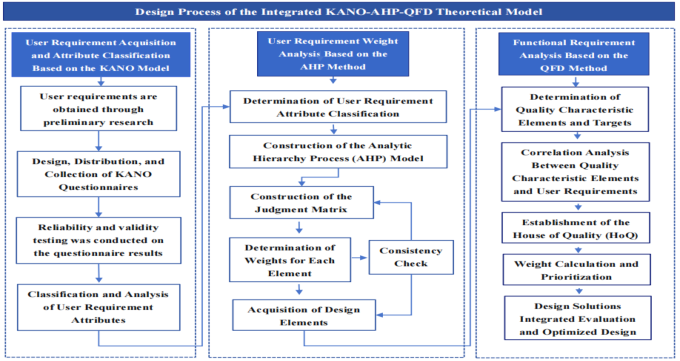
matrices, it can determine the weights of relevant factors in a concise, systematic, efficient, and impartial manner, and feasibly conduct statistical analysis on multiple aspects of design to define the primary needs and design priorities of older users for AR-HUD (Lin et al., 2014). QFD, proposed by Japanese scholar Yoji Akao in 1966, is a systematic method for translating user requirements into specific product design specifications. QFD constructs a “House of Quality” to establish structured relationships between user requirements and design elements, thereby identifying the priority hierarchy of design features and formulating targeted design strategies and quantitative objectives. By utilizing the QFD model, the prioritized needs of older adults are transformed into vehicle AR-HUD interface design elements and their importance is quantified, thus yielding a feasible age-friendly vehicle AR-HUD interface design scheme (Wu et al., 2020). Therefore, based on the organization and analysis of the strengths and limitations of the above models, this paper integrates the advantages of each model by synthesizing the KANO-AHP-QFD research model for application in age-friendly vehicle AR-HUD interface design (see Figure 1).
Figure 1: Design process of age-friendly vehicle AR-HUD interface integrating KANO- AHP-QFD (Mingxuan Ding, 2026).
Application of the Integrated KANO-AHP-QFD Research Method in the Design of Age-Friendly Vehicle Augmented Reality Head-Up Display Interfaces KANO-Based User Requirement Acquisition and Classification
The age-friendly in-vehicle AR-HUD is an augmented reality head-up display interface specifically designed for special user groups such as older adults. Compared with young and middle-aged drivers, older drivers experience significant declines in visual and cognitive abilities. Therefore, to optimize the age-friendly in-vehicle AR-HUD, it is necessary to conduct specialized research and analysis on the actual needs of the elderly population and to integrate user needs with satisfaction in interface design.
Age-Friendly Design of In-Vehicle AR-HUD Interface 35 The survey subjects of this study were elderly individuals aged 60 and above from Wujin District and Zhonglou District, Changzhou City, Jiangsu Province, China. The survey focused on areas with dense elderly populations, including residential communities, community health service centers, and parks and squares. Wujin District and Zhonglou District of Changzhou City have a large vehicle consumption market, a relatively high number of retired individuals, and a high standard of living. This study adopted a self-administered online questionnaire. To enhance survey convenience, an approach combining interviewer-read questions with on-site respondent answers, followed by interviewer recording, was also adopted. A total of 108 individuals were approached for interviews, of whom 23 refused to participate due to lack of willingness or other reasons. A total of 85 questionnaires were distributed; after excluding 5 invalid questionnaires, 80 valid questionnaires were finally obtained, yielding an effective response rate of 94.12%. Through the literature review method, key elements of in-vehicle AR-HUD design derived from previous studies were referenced. Based on these and the research focus of this study—the key elements of age-friendly in-vehicle augmented reality head-up display interface design—a total of 15 initial user needs were identified from three aspects: interaction, aesthetics, and functionality.
The KANO questionnaire employed a two-factor Likert rating scale, with values ranging from 1 to 5, corresponding to the following response options: “Satisfied” (5), “It should be that way” (4), “Neutral” (3), “Indifferent” (2), “Tolerable” (1), and “Very dissatisfied”. After consolidating the questionnaire results, formulas were applied to calculate the KA, KO, KM, KI, KR and KQ values for each user requirement indicator. The KANO attribute of each requirement was determined based on the maximum value among these coefficients. Subsequently, the KANO model evaluation system and user satisfaction coefficients were employed to classify the attribute types of the user requirements obtained from the survey (Wang et al., 2020) (see Table 1).
Analysis of User Requirement Weights for Age-Friendly Vehicle AR- HUD Based on AHP Construction of the AHP Model for the Age-Friendly Vehicle AR-HUD
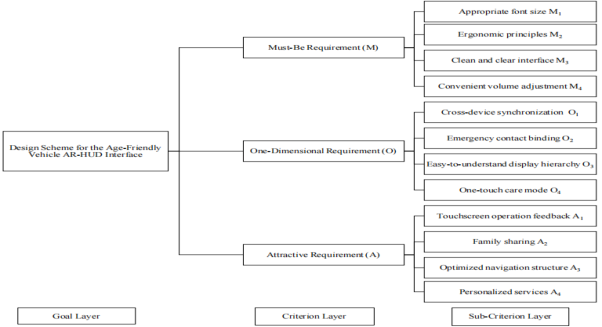
Following the classification of user requirements using the KANO model, the Analytic Hierarchy Process (AHP) was employed to rank the importance of the user requirements, thereby further clarifying their respective weights and the design priorities of the age-friendly vehicle AR-HUD. Based on the KANO questionnaire analysis, the 15 requirements were categorized into must-be requirements (M), one-dimensional requirements (O), attractive requirements (A), and indifferent requirements (I). These requirements were subsequently consolidated into 12 design elements, which served as evaluation indicators for the age-friendly vehicle AR-HUD. An AHP model for the age-friendly vehicle AR-HUD design was then constructed accordingly (see Figure 2).
Figure 2: Hierarchical analysis model of age-friendly vehicle AR-HUD interface design (Mingxuan Ding, 2026).
Age-Friendly Design of In-Vehicle AR-HUD Interface 37 Calculation of User Requirement Weights for the Age-Friendly Vehicle AR-HUD Based on AHP To ensure the scientific validity and objectivity of the user requirement weighting results, this study invited 15 researchers specializing in age- friendly vehicle AR-HUD to score the judgment matrices. The weight values of user requirements for the age-friendly vehicle AR-HUD were then derived through calculation, and the results were obtained (see Table 2).
Analysis of Design Elements for the AR-HUD Interface of Age- Friendly Vehicles Based on QFD QFD serves as an effective tool for translating user requirements into design elements and can output the weights of design elements. Building upon the AHP hierarchical analysis, this study employs the QFD House of Quality to construct a relationship matrix between user requirements and design elements, thereby clarifying the weight proportion of each design element and ultimately determining the core design elements (Pimolphan et al., 2024).
Mapping and Analysis of User Requirements - Design Elements This study adopted the Delphi method, inviting four professors specializing in human-computer interaction research, four human-computer interaction designers, and two industrial designers to provide modification suggestions for the ten elements, in order to determine the final design elements for the AR-HUD interface of age-friendly vehicles. Through three rounds of expert interviews, the design elements were merged, filtered, supplemented, and optimized until all expert opinions converged, and the finalized design elements were summarized (see Table 3).
Construction of the QFD House of Quality for Age-Friendly Vehicle AR-HUD Interface Design Based on the importance results of user requirements derived from the AHP hierarchical analysis and the two-dimensional user requirement–design element matrix, the QFD House of Quality for the age-friendly vehicle AR-HUD interface design was constructed. In the House of Quality, the left wall represents user requirements and their corresponding weights, while the roof represents the various design elements. The correlations between user requirements and design elements were scored as follows: strong correlations were assigned a weight of 1.5, denoted by “
”; moderate correlations were assigned a weight of 1.2, denoted by “◎”; and weak correlations were assigned a weight of 1, denoted by “△” (Bhattacharya et al., 2005). The final weight of each design element was calculated as the sum of the products of all user requirement weights and their corresponding correlation scores under that element. In the design scheme of the age-friendly vehicle AR-HUD interface, priorities should be established according to the weight indices, with primary and secondary design elements receiving greater emphasis, while the expression of tertiary design elements should be correspondingly de-emphasized (see Table 4).
Table 3: Age-friendly vehicle AR-HUD user requirement–design element transformation table (Mingxuan Ding, 2026).
Table available in the original PDF paper.
User Requirement Attribute
User Requirement Indicator
Design Element Design Element Summary
Must-Be Requirement (M)
Appropriate font size M1 Compatibility Fault Tolerance
Design Strategy and Practice of AR-HUD Interface for Aging-Friendly Vehicles The design research on age-friendly vehicle AR-HUD aims to assist manufacturers in meeting the explicit needs of elderly users and exploring their potential needs. Through interface design that is simple and easy to use, aesthetically pleasing and reasonable, warm and caring, and highly interactive, it can help elderly users reduce cognitive load during driving and enhance driving safety and satisfaction in complex environments. Based on the analysis of elderly users’ needs, this paper uses weighted calculation values to merge, filter, classify, and sort their importance, and maps them one by one to design elements. This study proposes corresponding solutions from three dimensions: function, interaction, and aesthetics, based on 12 user needs.
Design Aimed at Enhancing the Functionality of AR-HUD for Aging- Friendly Vehicles Enhancing the physiological adaptability of elderly drivers and tailoring vehicle AR-HUD symbols to meet the ergonomic needs of the elderly are the fundamental and crucial functional objectives of designing an age-friendly in-vehicle AR-HUD interface. In terms of functionality, the design should prioritize meeting the high recognition needs of elderly users on the interface. This is crucial for compensating for their visual decline and ensuring efficient information acquisition. Secondly, it should incorporate assisted driving, progressive warning modes, and emergency contact binding to provide strong reminders before danger strikes, further preventing disasters. In case of issues, it should allow quick and convenient contact with family members for timely and effective assistance. Lastly, it should cater to the cognitive behavioral characteristics of the elderly, which are related to users’ ability to smoothly understand and perform operational tasks. The interface design should be de-layered to enhance the usability of the AR-HUD interface (Hwang et al., 2016).
Design Aimed at Enhancing the Interactivity of AR-HUD for Aging-Friendly Vehicles Meeting the human-computer interaction needs of older drivers is a fundamental and important functional consideration in the design of in-vehicle AR-HUD interfaces. In terms of interactivity, the design should first fulfill older users’ need for low operational load on the interface, which is crucial for maintaining operational fluency and avoiding misoperations. Second, it should satisfy the need for natural interaction that aligns with the cognitive and behavioral characteristics of older adults, which relates to whether users can efficiently complete information input and instruction transmission. Personalized service modes and one-touch care modes can be established to make operations more convenient and better suited to the needs of older vehicle owners. Finally, it should meet users’ interaction needs for reversible operations, clear feedback mechanisms, and multimodal error-tolerant design, all of which are associated with users’ trust in system reliability and their intention to continue using the system (Grogna et al., 2018).
Age-Friendly Design of In-Vehicle AR-HUD Interface 41 Design Aimed at Enhancing the Aesthetics of AR-HUD for Aging- Friendly Vehicles
Visual aesthetics is an indispensable user experience element in the design of AR-HUD interfaces for aging-friendly vehicles. Good visual design requires ensuring a clear overall interface layout, reasonable information density, simple and unified style, and adopting a color scheme that aligns with the physiological characteristics of the elderly. In terms of visual presentation, based on the high-priority requirements of “appropriate font size” and “simple and clear interface”, the interface should support adaptive adjustment of font size to ensure text readability, and set a high-contrast theme to enhance visual recognition efficiency. In addition, functional icons should be accompanied by prominent text descriptions to avoid cognitive barriers caused by relying solely on graphical symbols (Hou et al., 2025).
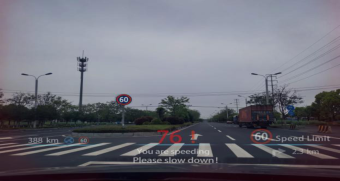
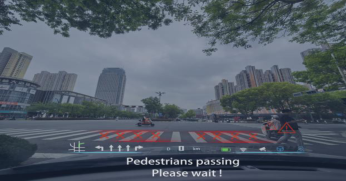
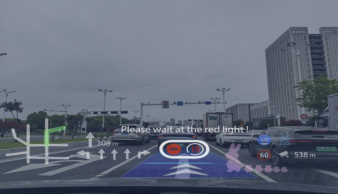
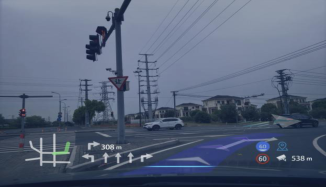
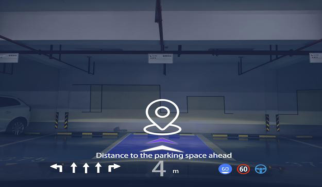
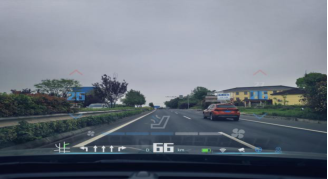
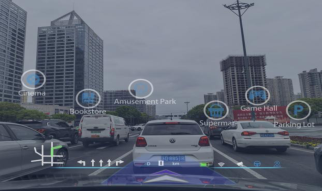
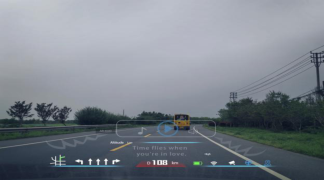
These design strategies are not simply based on the superposition of strategies according to the ordering of design elements, but focus on the in-depth optimization of design elements with higher weights, thereby constructing a set of vehicle AR-HUD interface design schemes that can significantly enhance the satisfaction of elderly users. The specific design scheme is as follows (see Figure 3-5).
Figure 3: Progressive warning for the AR-HUD interface of age-friendly vehicles (Mingxuan Ding, 2026).Figure 4: Progressive warning for the AR-HUD interface of age-friendly vehicles (Mingxuan Ding, 2026).Figure 5: Age-friendly vehicle AR-HUD interface assisted driving mode (Mingxuan Ding, 2026).Figure 6: Age-friendly vehicle AR-HUD interface assisted driving mode (Mingxuan Ding, 2026).Figure 7: Ergonomic common functions of AR-HUD interface for aging-friendly vehicles (Mingxuan Ding, 2026).Figure 8: Ergonomic common functions of AR-HUD interface for aging-friendly vehicles (Mingxuan Ding, 2026).Figure 9: Personalized settings for the AR-HUD interface of age-friendly vehicles (Mingxuan Ding, 2026).Figure 10: Personalized settings for the AR-HUD interface of age-friendly vehicles (Mingxuan Ding, 2026).
CONCLUSION
Against the backdrop of an increasingly intensifying trend of population aging, the design of age-friendly vehicle AR-HUD interfaces to assist older drivers can not only effectively mitigate safety issues arising from the deterioration of driving abilities among the elderly, but also enhance their travel convenience and quality of life. Guided by the user requirements of the age-friendly vehicle AR-HUD, this paper adopts an integrated KANO- AHP-QFD research methodology to conduct innovative design of the age- friendly vehicle AR-HUD from three dimensions: functionality, interaction, and aesthetics. On the one hand, this study achieves precise collection and scientific translation of older drivers’ needs, thereby enhancing the R&D targeting of innovative design for age-friendly in-vehicle AR-HUD interfaces. On the other hand, by performing weight calculations based on requirement analysis and further unfolding the correspondence decisions between requirements and design elements, the entire design process becomes more efficient, scientifically grounded, and objective. This study effectively explores methods for vehicle AR-HUD interface design, including enhancing interface interaction, improving driving safety for older adults, strengthening driving care for the elderly, and promoting simplicity and ease of use in age- friendly AR-HUD interfaces. Although the integrated research method and design process adopted in this paper are developed around the age-friendly vehicle AR-HUD interface, the underlying approach is equally applicable to general design problems and can serve as a valuable reference for other user requirement-driven product design endeavors.
REFERENCES
Anstey, K.J.; Wood, J.; Lord, S.; Walker, J.G. (2005). Cognitive, sensory and physical factors enabling driving safety in older adults, in: Clinical Psychology Review, Volume 25, pp. 45–65. Bhattacharya, A., Sarkar, B., and Mukherjee, S. K. (2005). Integrating AHP with
QFD for robot selection under requirement perspective, International Journal Of Production Research, Volume 43, No. 17, pp. 3671–3685. Grogna, D., Verly, J. G., ed. (2018). The impact of drowsiness on in-vehicle humanmachine interaction with head-up and head-down displays, Multimedia Tools and Applications, Volume 77, No. 21, pp. 27807–27827. Hou, G. H., Dong, Q., and Wang, H. W. (2025). The Effect of Dynamic Effects
and Color Transparency of AR-HUD Navigation Graphics on Driving Behavior Regarding Inattentional Blindness, International Journal of Human-Computer Interaction, Volume 41, No. 12, pp. 7581–7592. Hwang, Y., Park, B. J., and Kim, K. H. (2016). Effects of Augmented-Reality Head-up Display System Use on Risk Perception and Psychological Changes of Drivers, ETRI JOURNAL, Volume 38, No. 4, pp. 757–766. Li, S.; Zhang, X.; Wen, K.; Jiang, J. (2024). Research driven by user demand for
the design of a cross-border travel credential bag, in: Sustainability, Volume 16, No. 21. article 9547. DOI: 10.3390/su16219547 Lin, C. (2014). Application of CEPR to fashion design scheme selection, in: International Journal of Clothing Science and Technology, Volume 26, No. 4. pp. 316–329.
Liu, Z.Z.; Zhang, C.; Ji, X.R.; Yi, X.Y.; Yao, J. (2024). Design of breastfeeding chairs for maternity rooms based on Kano-AHP-QFD: User requirement-driven design approach, in: Heliyon, Volume 10, No. 10. p. e31287. Liu, Xiao. Zhou, Meiyu and Yang, Jiayi. (2025). Research on Human-Computer
Interaction Interface Design of Electric Vehicles for Elderly Users, Academic Journal of Computing & Materials Science Research, Volume 3, No.1, p. 230. Pimolphan Apichonbancha., Rong-Ho Lin and Chun-Ling Chuang. (2024).
Integration of Principal Component Analysis with AHP-QFD for Improved Product Design Decision-Making, in: Applied Sciences, Volume 14, No. 14, p. 5976. DOI: 10.3390/app14145976 Shahin, A.; Pourhamidi, M.; Antony, J.; Hyun Park, S. (2013). Typology of KANO models: A critical review of literature and proposition of a revised model, in: International Journal of Quality and Reliability Management, Volume 30, No. 3. pp. 341–358. DOI: 10.1108/02656711311299863 Wang, T., ed. (2020). A method for product form design of integrating interactive
genetic algorithm with the interval hesitation time and user satisfaction, in: International Journal of Industrial Ergonomics, Volume 76, No. 102901. DOI: 10.1016/j.ergon.2019.102901 Wickens, C. (2021). Attention: Theory, Principles, Models and Applications, in: International Journal of Human-Computer Interaction, Volume 37, pp. 403–417. Wu, X.; Hong, Z.; Li, Y.; Zhou, F.; Niu, Y.; Xue, C. (2020). A function combined
baby stroller design method developed by fusing KANO, QFD and FAST methodologies, in: International Journal of Industrial Ergonomics, Volume 75, p. 102867.
LISTED IN THE AHFE DIGITAL BOOKSTORE CATALOGUE
Explore the complete digital volume
Human Factors in Aging and Special Needs
Read this individual research paper free through the original publisher, or explore the full digital proceedings book.
ISBN 978-1-964867-90-8
Explore this ISBN in the AHFE Bookstore ↗Listed in the July 2026 bookstore catalogue; search by ISBN to confirm current availability · Digital book purchase optional