Hiroto Miyatake, Momoko Nakatani, Emi Fuse, Naoki Mukawa, Shigeki Saito, Yuki Taoka (2026). Evaluation of a Model of Relational Expectation Misalignments in Care: Case study of a public nursing home in Japan. In: Human Factors in Aging and Special Needs. AHFE Open Access, vol. 214, pp. 12–20. https://doi.org/10.54941/ahfe1007569
Solving caregiving issues requires a perspective that captures the interaction between caregivers and care recipients, rather than focusing on a single individual. We previously developed a model to systematically analyze the "expectation misalignments" between two parties. This study verified the applicability of this model using video observations and reflection workshops at a nursing home. We analyzed two contrasting cases. In the case of Resident B (dementia with high physical ability), the model successfully visualized a "behavioral conflict" caused by a lack of prediction, highlighting the need for environmental design. Conversely, in the case of Resident A (high cognitive ability), while behavioral expectations appeared aligned, the workshop revealed a "latent discrepancy" caused by the resident's "over-adaptation" to the caregivers' busyness. The results suggest that while the model is effective for structuring observable interactions, it requires extension to represent "hidden expectations" and "personal backgrounds" that are not expressed in action. Future work will aim to implement this model as a practical reflection tool for caregivers to design appropriate conflict resolution strategies.
With the progression of an aging population, the number of people requiring daily care in diverse settings, such as homes and facilities, is increasing. Such care practices inherently occur within relationships involving two or more parties, and their actions and judgments depend strongly on the context of interaction with the other party (Lyons et al., 2002). Even with the same pair of caregiver and care recipient, the relationship fluctuates dynamically depending on the situation and their physical and mental states. Even in situations where both parties intend “desirable care for the other,” it is not rare for actions and their reception to fail to align, resulting in tension and friction. Such discrepancies in interaction, namely “expectation misalignments,” not only increase the psychological and social burden on caregivers but also carry the risk of leading to a decline in the care recipient’s motivation for independence, or in the worst case, inappropriate care and accidents.
Evaluation of a Model of Relational Expectation Misalignments in Care 13 Therefore, to improve the quality and environment of care, an approach that focuses on the interactions among the multiple individuals involved in care, rather than on a single subject, is essential. Indeed, research in the care domain discusses the shift from Person-centered care to Relationship- centered care, emphasizing the perspective that all care relationships emerge within the context of interaction (Beach et al., 2006). It has been pointed out that quality care is underpinned by positive and bidirectional relationships (Gurung & Chaudhury, 2025), and also in robot research within dementia care, it has been shown that the relationship between the caregiver and care recipient significantly influences design outcomes (Hsu et al., 2025).
Design initiatives aiming to improve care environments are expanding to diverse areas, including transfer assistance, alleviation of loneliness (Tunc et al., 2023) caregiver support (Layton et al., 2023), and communication improvement (Probst et al., 2024). However, many of these efforts tend to designate only one of the involved parties as the primary user, focusing on support based on individual needs. In other words, a perspective that targets the interaction itself between the two parties remains insufficient.
On the other hand, turning to psychological theories that explain human relationships and behavioral principles, frameworks exist that explain the influence of expectations of others on behavior and relationships, such as Expectancy Violations Theory (Burgoon, 1978) and Expectation States Theory (Berger et al., 1977). Additionally, the Theory of Planned Behavior (TPB) (Ajzen, 1985) is widely used as a model to explain individual behavioral choices. However, many of these theories focus on specific cognitive aspects or primarily on the “individual” decision-making process. Consequently, they are not sufficient to describe and explain the dynamically changing relationships and discrepancies in interaction between two parties in care settings.
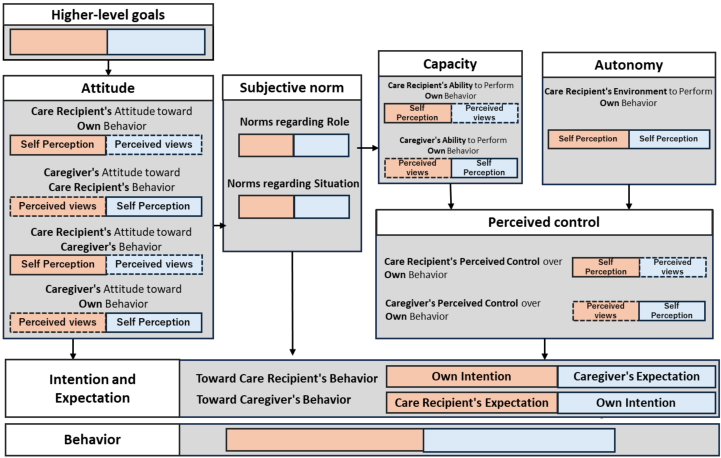
PROPOSED FRAMEWORK Given this background, in our previous study (Miyatake et al., 2026), the authors proposed a framework focusing on the expectation misalignments to explain conflicts arising between caregivers and care recipients (Figure 1). Specifically, we extended concepts from behavioral control theories, such as the Theory of Planned Behavior (TPB), which explain individual behavioral choices, into a dyadic context. By centering on the “conflict” that arises between the two parties, we constructed a model that systematically captures the structure of mutual expectation misalignments. Previous research suggests that this model not only visualizes the factors contributing to dyadic conflict but also promotes awareness of factors previously unrecognized by the parties involved, potentially serving as a catalyst for conflict resolution. In this study, to apply this model to the analysis of observational data, we employ an improved version (Model Ver.2) in which the subjects and objects of the constituent elements have been more clearly redefined. This model explains the actions taken by the caregiver and the care recipient using three components: “Attitude toward the behavior,” “Subjective Norm,” and “perceived behavioral control.” For each of these three components, the model
compares the individual’s self-perception with the other party’s prediction, thereby enabling the visualization of elements where discrepancies occur.
Figure 1: Refined model visualizing the structure of relational expectation misalignment within a caregiving dyad.
RESEARCH OBJECTIVE & RESEARCH QUESTION The objective of this study is to verify whether this model is applicable to complex cases of expectation misalignments occurring in actual care settings, specifically, whether it can appropriately describe these events. To this end, this study addresses the following research questions (RQs):
RQ1: What characteristics of expectation misalignments exist within the activities occurring in actual care facility settings?
RQ2: To what extent can these cases be appropriately described and explained by the proposed “Expectation Misalignments Model (Ver.2)”?
A distinct feature of this study is that it analyzes real-time cases captured through participant observation and video recording in actual care facilities, rather than relying on interviews recalling past episodes or reports from third parties.
METHOD
Data collection for this study was conducted with the cooperation of a special nursing home for the elderly in Japan. This facility serves elderly individuals certified as requiring Long-Term Care Level 3 or higher, for whom home care is difficult. The residential area is composed of three units connected by a single long corridor. In this study, we focused on one of these units, where approximately 20 elderly individuals reside. The living environment of this unit consists of approximately three multi-bed rooms, each containing
Evaluation of a Model of Relational Expectation Misalignments in Care 15 about six beds, and two common spaces where residents enjoy meals and watch television. Within each room, the beds can be partitioned by curtains, and storage shelves and televisions are placed at each bedside, reflecting a standard multi-bed room environment.
Data collection consisted of two stages: video recording to document objective behaviors, and reflection workshops to extract subjective behavioral intentions. The recording was conducted on December 15, 2025. Regarding camera placement, fixed cameras were installed to capture the overall space and flow lines: one in the corridor, one in each common space, and two inside the resident rooms. In addition, to capture subtle interactions, facial expressions, and physical contact, we utilized a camera following one specific caregiver and a camera for close-up shots of care scenes such as transfer assistance. During the recording, researchers were present at the site but restricted themselves to observation without intervening, so as not to hinder natural care practices.
On the day following the recording, an approximately 60-minute reflection workshop was conducted involving the three recorded caregivers and three researchers acting as facilitators. The purpose of this workshop was to verbalize and collect the expectations and intentions of the parties involved, which are not recorded in the video footage. Specifically, while playing back the recorded video, we asked questions such as “What was the intention behind choosing that action?” and “What reaction were you expecting from the resident at that time?” to extract the information necessary for applying the cases to the model. We also conducted supplementary inquiries regarding the residents’ daily conditions and differences in care policies among staff members.
Two residents were selected from the collected video data for detailed analysis. First, to capture the mutual expectation misalignments between caregiver and care recipient, which is the main objective of this study, we considered it necessary for the internal state of the individual to be verbalized. Therefore, we focused on Resident A, who possesses the highest communication ability within the facility. Although Resident A finds it difficult to move below the neck due to paralysis and requires assistance in all aspects of daily life, her cognitive function is preserved, enabling clear communication with caregivers. In this study, we analyzed scenes of her transfer assistance and daytime daily living activities in conjunction with information from the workshop.
Next, to capture diverse characteristics of discrepancies corresponding to RQ1, we focused on Resident B, who possesses characteristics contrasting with those of Resident A. Although verbal communication is difficult for him due to severe dementia, his physical function is extremely high; he can move freely within the facility using a wheelchair and ingest meals by himself. In this study, we addressed cases where Resident B moved outside the area intended by caregivers, such as entering dangerous areas or other residents’ rooms without permission, and analyzed these instances together with information from the workshop.
We describe the analysis results from the workshop and the application to the proposed model for these two cases with distinct characteristics. In
applying the cases to the model, the items regarding self-perception and prediction by the caregiver and care recipient were populated by two authors through discussion, based on the actual behaviors in the video data and the statements made by the parties themselves during the workshop.
RESULT
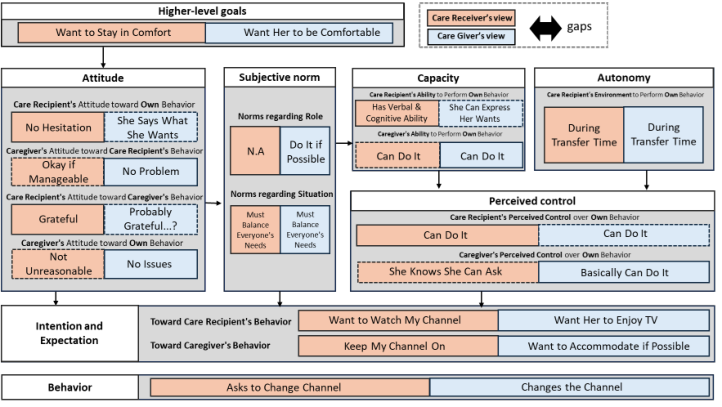
Case A In the case of Resident A, many instances were confirmed where expectations were aligned in terms of behavior. As a representative example, this study applied the model to a case where Resident A requested a caregiver to tune the television to her preferred channel during morning transfer assistance, and the caregiver complied with the request. The results are shown in Figure 2 below.
Figure 2: Model applied to Case A.
As this figure indicates, no significant discrepancies were observed in each component of the model, visually demonstrating that no behavioral expectation misalignments occurred within the model framework.
However, despite the fact that clear expectation misalignments in the form of actions or verbalizations were not observed in the recorded data, several instances were observed during the reflection workshop where interpretations of Resident A’s perception differed among the caregivers. While one caregiver suggested that “Resident A might be feeling confused because the detailed procedures of transfer assistance differ depending on the caregiver,” another caregiver argued that “since she has not made any remarks herself, she probably does not mind.” If Resident A had clearly expressed dissatisfaction or confusion through “actions” or “verbalizations,” the perceptions of all caregivers would likely have been consistent. Therefore, the very fact that interpretations among caregivers were divided strongly suggests the
Evaluation of a Model of Relational Expectation Misalignments in Care 17 possibility of a latent expectation misalignment within Resident A; that is, she harbors a misalignment at the cognitive level that is not expressed as observable behavior.
Case B
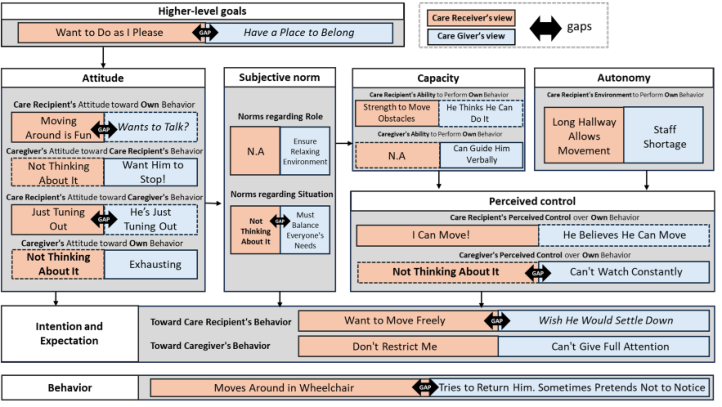
Figure 3 presents the results of applying the model to the case where Resident B moves around freely, causing the caregiver to struggle with the response.
Figure 3: Model applied to Case B.
While the caregiver fundamentally holds a negative attitude toward Resident B’s moving around, Resident B appeared to enjoy the activity. Furthermore, whereas the caregiver feels a burden in attempting to control this behavior, it is inferred that Resident B is completely unaware of this burden. Due to their position as a facility staff member and the presence of other residents requiring assistance, the caregiver possesses a norm that they should provide care to all residents in a balanced manner. On the other hand, it is surmised that Resident B does not possess such a norm. Regarding Resident B’s ability to move around in a wheelchair, both parties mutually understand that he possesses this capability, as evidenced by observations such as his physical strength to move obstructing wheelchairs by himself.
Based on these elements, while Resident B holds the intention to move freely, the caregiver desires for him to settle down, resulting in a discrepancy in their actions. The application of the case to the model suggests the possibility that Resident B lacks awareness regarding many of these elements in the first place.
DISCUSSION
Case A: High Cognitive Function and Restricted Mobility The reason why behavioral expectation misalignments were not observed in this instance can be discussed based on the application of the model as
follows. First, although Resident A’s physical functions are significantly limited, both parties understood these capability limitations. Furthermore, since she possesses the ability for clear verbal communication, it was possible for Resident A to convey her requests to the caregiver and for the caregiver to receive those requests verbally. Additionally, because Resident A has preserved cognitive functions, she possesses social norms such as “considering the surrounding situation and other residents,” and it is conceivable that these did not conflict with the norms held by the caregivers. Regarding the norms held by Resident A, this is evident from her daily behavior obtained from the workshop, where she prioritizes the wishes of other residents regarding the channel of the shared television and accepts the situation.
However, the discrepancy in recognition among caregivers that was highlighted in the workshop is inferred to be produced precisely by Resident A’s high ability and strong norms. Because Resident A has high cognitive function and can judge situations, she perceives the busyness of the caregivers. Consequently, there is a possibility that she is engaging in over-adaptation (McPherson et al., 2007), such as suppressing her original requests or altering her remarks depending on the caregiver.
In other words, while expectation misalignments manifest as “physical behavioral discrepancies” in Case B (dementia with high physical function), structural characteristics were suggested in Case A (physical paralysis with high cognitive function) where discrepancies tend to become latent within the user as “discrepancies in recognition and information.” The currently proposed model structures expectation misalignments primarily starting from discrepancies expressed as actions or remarks. Therefore, in cases like Resident A, where the individual intentionally adjusts their actions or remarks to maintain superficial consistency, there is a limit to expressing the internal unfulfillment of intentions or endurance using the model diagram alone. Consequently, it is considered necessary to extend the elements of the model in the future so that it can infer and reflect not only behavioral expectation misalignments but also remarks and actions processed internally by the user.
Case B: High Physical Mobility and Cognitive Impairment The application of the model to this case indicated the possibility that elements such as the prediction of others’ expectations and social norms are structurally absent in Resident B’s behavioral decision-making process. This visualization reveals that the first step toward resolution is for caregivers to accept the fact that mutual expectation misalignments are structurally inevitable, rather than holding excessive expectations toward Resident B that he will understand verbal instructions or intuitively sense the situation.
Based on this acceptance, the direction of solution design naturally shifts. As long as expectations cannot be established, solutions dependent on interpersonal communication and human resources, such as changing verbal cues or constant monitoring, reach their limits. Instead, resources should be allocated to the design of the external environment. Specifically, in addition to defensive design such as physical access restrictions to dangerous areas,
Evaluation of a Model of Relational Expectation Misalignments in Care 19 active design is required to satisfy Resident B’s behavioral intentions, such as providing objects that attract his interest more than moving around.
However, identifying what Resident B holds a positive attitude or interest toward other than moving around requires understanding the background of his positive attitude toward moving around; that is, it is necessary to infer what interests he held before the onset of his current condition.
The currently proposed model describes variables strictly within the interaction of the moment, and it does not explicitly specify how such past background information influences current intentions. In the care of elderly people with dementia like Resident B, incorporating personal background as a component of the model was suggested as a future improvement point to enhance the validity of the model.
CONCLUSION
In this study, to elucidate the characteristics of mutual expectation misalignments occurring between caregivers and care recipients in actual settings, we conducted fieldwork and workshops at a special nursing home for the elderly and verified the applicability of the proposed model to the collected cases.
The results of the analysis indicated that the proposed model has the potential to structurally visualize both the state where expectations are aligned at the behavioral level (Case A) and the state where physical discrepancies occur at the behavioral level (Case B) using a single framework.
On the other hand, challenges regarding the model toward practical application were also identified. First, since the current model focuses primarily on behavioral interactions, it is unable to sufficiently represent latent expectations that were not outwardly expressed as actions. Second, the model lacks the temporal element of past background, which shapes the attitude toward the current behavior.
Future work will involve refining the model by incorporating these elements. The ultimate goal is to implement this model not merely as an analytical framework but as a reflection tool for caregivers. We aim to construct a support system that enables caregivers to objectively view the mechanisms of misalignments through the model and to design appropriate resolution strategies themselves.
ACKNOWLEDGMENT
We wish to express our gratitude to the special nursing home for the elderly and its staff members for their cooperation with the video recording and the workshop.
This study is funded by JST RISTEX Japan (Grant Number: JPMJRS25M2).
REFERENCES
Ajzen, Icek. 1985. “From Intentions to Actions: A Theory of Planned Behavior.”
In Action Control, 11–39. Berlin, Heidelberg: Springer Berlin Heidelberg.
Beach, Mary Catherine, Thomas Inui, and Relationship-Centered Care Research Network. 2006. “Relationship-Centered Care. A Constructive Reframing.” Journal of General Internal Medicine 21 Suppl 1 (S1): S3–8. Berger, Joseph, Thomas L. Conner, and M. Hamit Fisek, eds. 1974. Expectation
States Theory: A Theoretical Research Program. Cambridge, MA: Winthrop. Burgoon, Judee K. 1978. “A Communication Model of Personal Space Violations: Explication and an Initial Test.” Human Communication Research 4 (2): 129–42. Gurung, S., & Chaudhury, H. (2025). Relationship-centered care for older adults in
long-term care homes: A scoping review. Journal of Applied Gerontology, 44(9), 1513–1532. Hsu, Long-Jing, Alex Foster, Selma Sabanovic, and Chia-Fang Chung. 2025.
“Designing with Dynamics: Reflections on Co-Design Workshops between People Living with Dementia and Their Care Partners.” In Proceedings of the 2025 CHI Conference on Human Factors in Computing Systems, 1–16. New York, NY, USA: ACM. Layton, N., Lalor, A., Slatyer, S., Lee, D.-C. A., Bryant, C., Watson, M., Khushu, A., Burton, E., Oliveira, D., Brusco, N. L., Jacinto, A., Tiller, E., & Hill, K. D. (2023). Who cares for the carer? Codesigning a carer health and wellbeing clinic for older care partners of older people in Australia. Health Expectations, 26(6), 2644–2654. Lyons, K. S., Zarit, S. H., Sayer, A. G., & Whitlatch, C. J. (2002). Caregiving as a dyadic
process: Perspectives from caregiver and receiver. The Journals of Gerontology: Series B, Psychological Sciences and Social Sciences, 57(3), P195–P204. McPherson, C. J., Wilson, K. G., & Murray, M. A. (2007). Feeling like a burden: Exploring the perspectives of patients at the end of life. Social Science & Medicine, 64(2), 417–427. Miyatake, H., Mukawa, N., Nakatani, M., Saito, S., & Taoka, Y. (2026, May 18–21).
Toward modeling relational expectation misalignments in care: An exploratory extension of the theory of planned behavior for design [Paper presentation]. 19th International Design Conference (DESIGN 2026), Cavtat, Dubrovnik, Croatia. Probst, Freya, John Ratcliffe, Erika Molteni, Nikitia Mexia, Jessica Rees, Faith Matcham, Michela Antonelli, et al., 2024. “A Scoping Review on Human- Centered Design Approaches and Considerations in the Design of Technologies for Loneliness and Social Isolation in Older Adults.” Design Science 10 (e39): e39. Tunc, S., F. Nijboer, G. D. Ludden, L. S. van Velsen, and M. Tabak. 2023. “Scenario-
Based Co-Design with Older Adults: A Design Case on Decreasing Loneliness.” International Journal of Design 17 (2): 99–113.
LISTED IN THE AHFE DIGITAL BOOKSTORE CATALOGUE
Explore the complete digital volume
Human Factors in Aging and Special Needs
Read this individual research paper free through the original publisher, or explore the full digital proceedings book.
ISBN 978-1-964867-90-8
Explore this ISBN in the AHFE Bookstore ↗Listed in the July 2026 bookstore catalogue; search by ISBN to confirm current availability · Digital book purchase optional