Yuki Taoka, Anna Saito, Miyuki Katsuyama, Shigeru Owada, Shigeki Saito, Momoko Nakatani (2026). Evaluation of Participant Impressions in a Reflection Workshop Using VR Scenarios Replicating Toddler Tantrums. In: Metaverse, Virtual Environments and Game Design. AHFE Open Access, vol. 217, pp. 65–71. https://doi.org/10.54941/ahfe1007655
Parental responses to toddler tantrums are critical to child development, yet reflecting on these high-stress moments is often hindered by self-reporting biases and the unique nature of each child's behavior. This study proposes a novel reflection system that uses Virtual Reality (VR) and the metaverse to facilitate objective, collaborative review. We developed a VR scenario simulating a three-year-old’s tantrum in a public space, capturing participants' physical movements and gaze data. These logs were then reconstructed in a metaverse environment for a collaborative reflection workshop. Twelve parents of preschool-aged children participated in this study. During the reflection sessions, participants experienced from multiple perspectives, observing the tantrum scenario from their own perspective, a peer’s viewpoint, a bystander’s position, and the child’s perspective. Qualitative analysis of the sessions and post-interviews indicated that the system effectively prompted participants to articulate insights, including differences in parenting styles and the physical presence of adults from a child’s perspective. While participants noted that the simulation lacked certain real-world stressors like daily fatigue, the high immersion and the ability to compare reactions to standardized stimuli provided insights difficult to achieve through traditional discussion. These results suggest that VR-mediated, multi-perspective reflection is a promising tool for parenting support and behavioral training.
Parental engagement plays a critical role in a child’s overall development. Specifically, parent-child interactions during early childhood are considered essential to the development of a child’s emotion regulation (Eisenberg et al., 1996). Among these interactions, parental responses to a child’s temper tantrums often induce significant stress for both parents and children, potentially leading to ineffective parenting behaviors (Morris et al., 2011). Reflective practice, in which parents review and reconsider their actions, is effective for improving their behaviors. Current initiatives include peer discussions among parents to alleviate stress and share experiences to refine their responses. However, the nature of a tantrum is highly dependent on a Received February 6, 2026; Revised April 7, 2026; Accepted April 27, 2026; Available online July 20, 2026
child’s individual characteristics, making it difficult for parents to simulate specific scenarios based solely on secondhand accounts mentally. This lack of vivid situational representation may hinder parents’ ability to empathize with others’ experiences, thereby limiting the translation of peer discussions into actionable personal learning. Moreover, reflections based on retrospective self-reporting are susceptible to “social desirability bias” (Eisenberg et al., 1996). Parents may unconsciously provide socially acceptable answers or fail to accurately recognize their own problematic behaviors (Pinquart, 2017).
In specific settings such as childcare facilities (Fujita et al., 2023) and parent training programs (Fukkink, 2008), video-based reflection has been used to support practitioners in reviewing their behavior. However, in the context of home-based parenting, continuous video recording is challenging due to privacy concerns. Additionally, tantrums frequently occur in public spaces where recording is difficult. Because the onset of a tantrum is difficult to predict, capturing the moments immediately preceding and following the tantrum is nearly impossible.
Recently, there has been increasing attention on technology-assisted reflection (Baumel et al., 2016). Virtual Reality (VR), in particular, offers superior presence and is widely used for training across various fields (Jensen & Konradsen, 2018). Furthermore, metaverse environments enable collaborative discussion, offering the potential to serve as a three-dimensional, immersive space for dialogue (Taoka et al., 2024).
This study proposes a workshop format in which participants experience a VR scenario simulating a child’s temper tantrum, followed by a reflective dialogue with other participants in a metaverse space while observing their own recorded actions. This method allows participants to compare their different responses to identical child behaviors. By eliminating variables arising from differences in children’s traits or behaviors, the discussion can focus specifically on the variations in parental responses. The scenario used in this study replicates a three-year-old boy having a tantrum in a public space, recreating not only the child’s behavior but also the surrounding environment and bystanders.
This study aims to clarify the characteristics and efficacy of VR-based reflection on parenting experiences, with the expectation that this approach can be applied to future parenting support programs. To evaluate the proposed method, we experimented with 12 parents. Participants first experienced the VR scenario individually, then formed pairs to reflect on their actions, sharing their intentions and emotions while observing their own and their partner’s movements. We used VRChat for the metaverse reconstruction, replicating not only the participants’ positions and hand movements but also their gaze data at the time of the event. In addition to audio and video recordings of the dialogue, post-workshop interviews were conducted. The effectiveness of the proposed system is evaluated through a qualitative analysis of the reflective dialogue in the metaverse and the participants’ impressions.
DEVELOPMENT OF THE VR SCENARIO AND REFLECTION SYSTEM The proposed reflection method consists of two activities: (1) an individual task involving interaction with a temper tantrum in a VR environment, and
Evaluation of Participant Impressions in a Reflection Workshop Using VR Scenarios 67 (2) a collaborative reflection conducted in a metaverse based on the recorded interaction. The metaverse environment reconstructs the participant’s responses using behavioral logs, enabling participants to engage in evidence-based discussions by revisiting their actual movements during the virtual scenario.
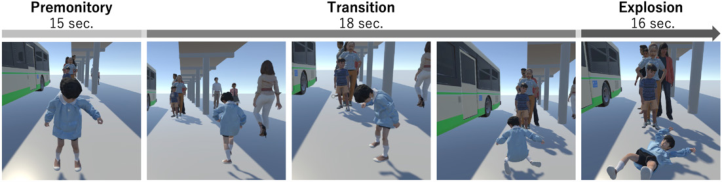
VR Scenario Design The VR tantrum scenario was designed to simulate a common, everyday situation where a child’s behavior progressively escalates, requiring the participant to intervene. The scenario was developed by an author specializing in child behavioral psychology. The scenario requires the participant to assume the role of a parent (mother or father) and respond to a three-year-old child’s tantrum in a public space. The progression is divided into three phases (Figure 1): premonitory, transition, and explosion. The scenario follows a predetermined progression regardless of the user’s intervention to ensure consistency for comparison during reflection. The scenario lasted approximately one minute, capturing the sequence from the onset of the tantrum to its conclusion. The participants experienced the scenario on a head-mounted display (HMD, PICO 4 Enterprise). To ensure natural interaction, participants did not use handheld controllers; instead, they responded using free-body movements. Participants could move freely within the virtual space, allowing them to adjust their proximity to the child. The initial position was set in front of the child’s avatar, placing the participant in a situation that required an immediate parental response. The environment included seven non-player characters (NPCs), five adults, and two children, all of whom served as bystanders who silently observed the tantrum. Ambient sounds, including the child’s voice, traffic noise, and the murmur of passersby, were integrated to increase immersion. The system was implemented using Unity, and the 3D animations of the child were created using motion capture data from an adult actor.
Figure 1: The scenario of the experience in VR.
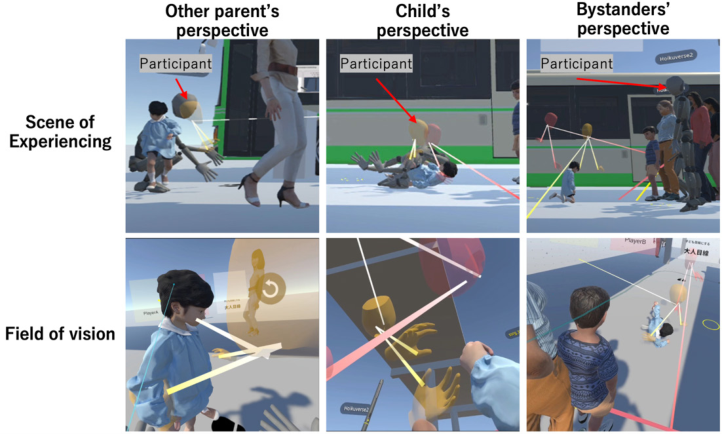
Reflection Environment in the Metaverse The virtual environment for reflection reconstructed the experience of an intervening tantrum using behavioral logs captured during the VR experience. Participants reflected by referencing past actions within the same spatial and temporal context. By creating the virtual environment in VRChat, a metaverse platform, multiple participants could simultaneously observe the scenario from various perspectives. The primary data presented included (Figure 2):
Environmental Data: Reconstructed movements and audio of the child and bystander avatars.
Behavioral Logs: Physical movement data of the participant (derived from HMD and sensor data).
Gaze Data: The participant’s focal direction, captured via the HMD’s integrated eye-tracker.
Figure 2: The scene of reflections in the metaverse.
Collaborative Reflection Workshop In the reflection workshop, two participants and one facilitator entered the metaverse environment. Participants were encouraged to “re-experience” the scenario by physically replicating their movements according to the presented logs. The workshop consisted of the following activities (Table 1).
Table 1: Workshop timeline.
Table available in the original PDF paper.
Activity Description Re-experience of Self response
Participants replicate their own original positioning and movements while referring to their own behavioral logs.
Re-experience and Exploration
While replicating their own actions, participants observe environmental factors they may have missed, such as bystander reactions or spatial layout.
Experience from Peer response
Participants mimic the other parent’s behavioral logs to experience different response styles and attentional patterns.
Experience from the Bystanders’ Perspectives
Participants observe the scene from the perspective of a passerby to examine how the parent-child interaction appears to others.
Experience from a Child’s Perspective
Participants experience the scenario from the child’s viewpoint, observing the parent’s distance, posture, and the timing of their verbal cues.
Evaluation of Participant Impressions in a Reflection Workshop Using VR Scenarios 69 Throughout these activities, the facilitator used semi-structured prompting, such as “Please share anything you notice or remember in the moment”, to elicit spontaneous insights. While one participant experienced their own and others’ perspectives, the other observed the scenario and the partner’s movements.
To accurately simulate the child’s perspective, the scale of the entire virtual world was increased by 1.5. This adjustment is based on findings that children aged 2 perceive the world approximately 1.39 times larger than adults (Zhang et al., 2022), which we applied to emphasize the perceptual differences between parent and child.
DATA COLLECTION AND ANALYSIS Twelve parents of preschool-aged children (ages 0–5) participated in this study. The participants were female, with a mean age of 38.1 years (range: 32–42). The experimental procedure consisted of an individual VR scenario experience followed by a collaborative reflection session conducted in pairs. Informed consent was obtained from all participants after a thorough explanation of the research objectives. The VR experience, including system orientation and practice, lasted 60 minutes, while the reflection workshop lasted approximately 120 minutes.
Following the workshop, semi-structured interviews were conducted to evaluate learning outcomes, perceived impact on future behavior, and overall experience (e.g., efficacy, burden, and areas for improvement). All dialogue from the workshops and interviews was transcribed and categorized to identify key patterns in the participants’ experiences.
RESULTS AND DISCUSSION
Overall Impressions Participants generally reported a high level of immersion. However, some expressed initial hesitation due to the novelty of the medium or noted discrepancies between the virtual child and their own children.
“When I was first asked to interact with the child in the VR space, I felt a bit of hesitation, wondering how I should approach a virtual child.” (Participant P1) Furthermore, some participants noted that while the situation was stressful, the absence of real-life context, such as physical exhaustion or time pressure, affected their emotional response. Others observed that the virtual child appeared older than their own children, leading to a perceived gap in behavioral expectations.
“The level of the tantrum felt realistic, but in reality, parental frustration often stems from a ‘war of attrition’—such as when a tantrum lasts for 30 minutes, or when you are exhausted or busy multitasking. Those prior conditions significantly change how a parent reacts.” (Participant P2)
In summary, while the VR experience was viewed positively for its immersive qualities, the artificiality of the setting and the lack of personal context created a sense of detachment from the participants’ habitual parenting environments.
Effects of Reflection Through Metaverse Re-Experience The analysis revealed that participants gained insights by experiencing both their own and their peers’ actions. While experiencing the other parent’s perspective, participants frequently commented on where other parents directed their attention to assess the situation. They also identified distinct parenting styles and the differences between their own tendencies and those of others.
“She (the other parent) is very patient. If that were me, and the child was lying on the ground, I might have just picked him up immediately instead of asking what was wrong. I felt she was truly acting from the child’s perspective.” (Participant G3-B) Experiencing the child’s perspective was particularly impactful. Many participants noted the novelty of this viewpoint and gained new awareness of their own physical presence.
“It’s difficult to see things from a child’s perspective in daily life. In VR, seeing the adults and the environment scaled up made me realize that adults can be much more intimidating than I imagined.” (Participant P1) Furthermore, re-experiencing the scene from the bystander’s perspective prompted discussion of the bystanders’ emotions. Overall, observing the scenario from multiple stakeholders’ perspectives within the metaverse facilitated diverse and multifaceted learning.
CONCLUSION
This study developed a VR scenario simulating a child’s temper tantrum and proposed a system that enables collaborative reflection by reconstructing participants’ behavior within a metaverse environment. Evaluation with 12 participants demonstrated that while VR-based reflection was effective for perspective-taking, particularly from the child’s viewpoint, led the participants’ insights on their behaviors. However, the findings also indicated that the limitations of a simulated environment, such as the absence of real- world stressors, remain influential. These findings contribute to the ongoing development of parenting support and training programs that use VR and the metaverse.
ACKNOWLEDGMENT
This study is funded by JST RISTEX Japan (Grant Number: JPMJRS25M2).
REFERENCES
Baumel, A., Pawar, A., Kane, J. M., & Correll, C. U. (2016). Digital parent training for children with disruptive behaviors: Systematic review and meta-analysis of randomized trials. Journal of Child and Adolescent Psychopharmacology, 26(8), 740–749. https://doi.org/10.1089/cap.2016.0048 Eisenberg, N., Fabes, R. A., & Murphy, B. C. (1996). Parents’ reactions to
children’s negative emotions: relations to children’s social competence and comforting behavior. Child Development, 67(5), 2227–2247. https://doi. org/10.1111/j.1467-8624.1996.tb01854.x Fujita, S., Taoka, Y., Owada, S., Nakatani, M., & Saito, S. (2023). Towards co-design with day care teachers based on in-situ behavioral data: A case study of a workshop for reflection based on video recordings. In Lecture Notes in Computer Science (Vol. 14034, pp. 255–268). Springer Nature Switzerland. https://doi.org/10.1007/978-3-031-35705-3_19 Fukkink, R. G. (2008). Video feedback in widescreen: a meta-analysis of
family programs. Clinical Psychology Review, 28(6), 904–916. https://doi. org/10.1016/j.cpr.2008.01.003 Jensen, L., & Konradsen, F. (2018). A review of the use of virtual reality headmounted displays in education and training. Education and Information Technologies, 23(4), 1515–1529. https://doi.org/10.1007/s10639-017-9676-0 Morris, A. S., Silk, J. S., Morris, M. D. S., Steinberg, L., Aucoin, K. J., & Keyes,
A. W. (2011). The influence of mother-child emotion regulation strategies on children’s expression of anger and sadness. Developmental Psychology, 47(1), 213–225. https://doi.org/10.1037/a0021021 Pinquart, M. (2017). Associations of parenting dimensions and styles with externalizing problems of children and adolescents: An updated meta- analysis. Developmental Psychology, 53(5), 873–932. https://doi.org/10.1037/ dev0000295 Taoka, Y., Nakatani, M., Sato, T., Kagohashi, K., Iwasawa, F., Hasegawa, S.,
Owada, S., & Saito, S. (2024). Co-design in virtual environments with 3D scanned childcare rooms in social virtual reality. Proceedings of the Design Society, 4, 1115–1124. https://doi.org/10.1017/pds.2024.114 Zhang, J., Dong, Z., Bai, X., Lindeman, R. W., He, W., & Piumsomboon, T. (2022).
Augmented perception through spatial scale manipulation in Virtual Reality for enhanced empathy in design-related tasks. Frontiers in Virtual Reality, 3(672537), 672537. https://doi.org/10.3389/frvir.2022.672537
LISTED IN THE AHFE DIGITAL BOOKSTORE CATALOGUE
Explore the complete digital volume
Metaverse, Virtual Environments and Game Design
Read this individual research paper free through the original publisher, or explore the full digital proceedings book.
ISBN 978-1-964867-93-9
Explore this ISBN in the AHFE Bookstore ↗Listed in the July 2026 bookstore catalogue; search by ISBN to confirm current availability · Digital book purchase optional