Hope Iyobosa Izevbigie (2026). Leveraging Emerging Technologies for Sustainable Growth and Competitive Advantage in The UK Events Sector. In: Human Interaction and Emerging Technologies (IHIET-AI 2026): Artificial Intelligence and Future Applications. AHFE Open Access, vol. 201, pp. 452–461. https://doi.org/10.54941/ahfe1007199
This study examines how emerging technologies such as artificial intelligence and the metaverse foster sustainable growth and competitive advantage in the UK events sector. Using the Technology–Organization–Environment (TOE) framework, the Dynamic Capability View (DCV), and Porter’s theory of competitive advantage, a systematic review of 42 peer-reviewed studies (2015–2025) was conducted. Findings show that AI enhances efficiency through data-driven options and carbon tracking, while the metaverse platforms expand inclusivity and experiential engagement. However, barriers including cost, governance, and digital inequality limit widespread adoption. The study concludes that sustainable digital transformation depends on organizational adaptability, ethical innovation, and collaborative policy frameworks. By integrating technology and sustainability, the UK events sector strengthens its global competitiveness while advancing responsible and inclusive industry practices.
Sustainability, according to the United Nations (2023), is the capacity to meet present needs without compromising the ability of future generations to meet theirs. Traditionally, sustainability discussions have focused on environmental conservation; however, this represents only one dimension of the triple-bottom-line framework, which also encompasses economic and social well-being (Kohe & Koutrou, 2024). This approach argues that organisations should pursue responsible practices balancing environmental, social, and financial considerations to ensure a stable and equitable future (Holmes et al., 2015). Therefore, achieving long-term sustainability within a shared resource system, or commons, depends on the quality of relationships, trust, and negotiation among organisational networks (Koutrou & Kohe, 2023). In recent years, the event and festival industries have undergone significant transformations driven by the adoption of artificial intelligence (AI) and other technological innovations. AI, is increasingly rising in importance across sectors, revolutionizing processes and experiences. These technological advances have reshaped event logistics, attendee engagement, and management.
Leveraging Emerging Technologies 453 Events, often unique and temporally limited, are carefully orchestrated by public or private entities and encompass a broad spectrum of activities (Garg & Modi, 2025). Their rarity and distinctiveness enable social interactions and economic transactions uncommon in everyday life (Jago & Shaw, 1998).
Technology has played a critical role in the growth and sustainability of the events industry (Koba, 2020) and as technological landscapes continuously evolve, the events sector adapts to these changes by digitalizing various planning and operational facets, bringing both opportunities and challenges (Garg & Modi, 2025). Technological innovation not only upgrades equipment but fundamentally transforms event execution (Garg & Modi, 2025). By integrating technology at the front-of-house and backstage, ICT tools serve both practical and experiential functions.
LITERATURE REVIEW
Events and festivals serve as measurable cultural indicators reflecting global competition, cooperation, and symbolic positioning among cities (Díez- Pisonero, 2025). These cultural manifestations foster identity formation, economic development, and political expression but also reveal tensions in urban development—between global-local dynamics, authenticity and commodification, and inclusiveness and exclusion (Harvey, 1989; Zukin, 1995). Event typologies range widely, from global mega-events like the Olympics and FIFA World Cup to smaller regional fairs and festivals. While large cities compete for major global events, smaller cities often adopt more sustainable, participatory medium- and small-scale formats, enabling them to join global networks via cultural specialisation (Qu & Zollet, 2023; Qu & Cheer, 2022).
Events contribute to tourism diversification and urban infrastructure modernization, particularly transport, accommodation, and cultural venues, catalysing the aestheticization of urban spaces (Díez-Pisonero, 2025). Hosting events now forms a core component of urban and regional development strategies, attracting diverse tourists and bolstering industry growth (Garg & Modi, 2025). However, environmental sustainability remains contested due to resource overuse, carbon emissions, and strain on urban services (Pereira et al., 2021).
Despite growing interest in sustainable events, understanding of how community participation enhances sustainability remains limited. Many event planners struggle with effective community engagement, missing opportunities to improve environmental and social outcomes (Karen, 2023). While the event management sector now stands at the intersection of traditional practices and rapid technological advancement (Liu-Latres & Cahyanto, 2023), AI and virtual reality (VR) experiences have increasingly drawn tourists to specific festivals and destinations (Iqbal et al., 2024). Sustainable branding further extends destination marketing by incorporating comprehensive views of sustainability and corporate social responsibility (Nascimento & Loureiro, 2024).
Industry events—such as summits, festivals, conferences, and webinars— serve as vital arenas for exploring financial alternatives and shaping market
454 Iyobosa boundaries. They not only connect stakeholders but also generate shared knowledge, attract investment, and forge consensus, ultimately influencing sectoral trajectories, including in emergent domains like impact finance (Andreu, Kremers & Rethel, 2024). However, the COVID-19 pandemic disrupted traditional event models, exposing structural vulnerabilities in cultural infrastructure. While Global North contexts often paused or digitised large-scale events, many Global South responses leaned toward digital festivals and grassroots initiatives, emphasising resilience and inclusivity (Pereira et al., 2021; Qu & Cheer, 2022). Thus, these varied responses prompt an urgent reassessment of cultural policy and preparedness strategies.
Recent frameworks such as UN-Habitat’s Culture 2030 Indicators and the World Council on City Data (WCCD) have integrated cultural metrics into sustainability assessments, aligning with Sustainable Development Goals (SDGs) 11.4 and 8.3. Unlike earlier tools that focused primarily on economic indicators, these new frameworks enable cross-city comparisons of cultural vibrancy and are increasingly employed in policy and budgetary planning (UCLG, 2021; OECD, 2022). This shift demonstrates a growing recognition of culture’s role in sustainable development, moving beyond traditional metrics.
Logistics Infrastructure and Environmental Sustainability in Event Management Logistics infrastructure—comprising transportation, storage, distribution systems, and crowd control—plays a crucial role in delivering efficient, safe, and satisfying event experiences (Müller, 2015; Getz & Page, 2007; Cerezo- Esteve et al., 2022). However, smooth logistics require effective collaboration between organisers, municipal authorities, and service providers to prevent congestion and delays (Kanaujiya & Tiwari, 2022). Whereas earlier literature focused primarily on operational efficiency, recent studies place increasing emphasis on sustainability.
For instance, Cerezo-Esteve et al. (2022) and Ballarano et al. (2022) advocate for low-emission transport options, walkable venues, and cycle parking to reduce carbon footprints. Similarly, large-scale art and entertainment events, which typically generate significant waste and energy consumption, are now adopting renewable energy, eco-friendly materials, and waste reduction strategies as standard practice (Mancini, 2023). Thus, the literature reflects a shift from logistical optimisation to a more holistic model integrating environmental sustainability.
Technological Advances and Power Dynamics Technological advancements are not only reshaping operations but also altering power dynamics within the events and cultural sectors. According to Ozdemir et al. (2023), control is increasingly shifting from institutions to consumers, empowered by data and interactivity. In parallel, Costa (2022) highlights that digitisation is expanding the experimental and governance capacities of cultural sectors.
Leveraging Emerging Technologies 455 Moreover, while AI and big data are heralded as central to the fifth industrial revolution (Sharma et al., 2024), blockchain remains comparatively underexplored in terms of customer experience (Saraf et al., 2024). Nevertheless, blockchain plays a pivotal role in securing transactions and enabling advanced user analytics within the metaverse (Wang & Shin, 2022; Alvarez-Risco et al., 2022). Therefore, although the technological literature broadly supports innovation, it diverges in its coverage and understanding of specific tools—especially regarding end-user interaction.
The Metaverse and Hybrid Events in the Event Industry The emergence of the metaverse—an amalgamation of AR, VR, and web- based platforms—is significantly transforming the event industry. As Singh et al. (2024) note, it facilitates immersive, interactive experiences that transcend traditional online formats. This shift gained further momentum during the COVID-19 pandemic, which catalysed the adoption of hybrid events blending virtual and physical components (Davis et al., 2009; Arpaci et al., 2022).
Unlike webinars or standard digital formats, metaverse-based events incorporate features like virtual networking, gamified engagement, and new monetisation models, including virtual merchandise and sponsorship (Singh et al., 2024). These experiences are not only more interactive but also offer real-time analytics and data collection, allowing organisers to design more targeted and adaptive strategies (Singh et al., 2024). Compared to earlier digital tools, the metaverse offers a more data-rich and immersive environment.
Importantly, metaverse adoption is influenced by several factors. Performance expectancy (i.e., belief in improved outcomes), effort expectancy (ease of use), social influence, and facilitating conditions (infrastructure and support) all play a role (Akour et al., 2022; Shen et al., 2021). In contrast to past technologies which may have struggled with usability or infrastructure limitations, these factors highlight the evolving complexity of technology adoption in the events sector.
Furthermore, while Singh et al. (2024) argue that the metaverse redefines event planning by enabling adaptability and innovation, this optimism must be contrasted with concerns about inclusivity, access, and the digital divide—particularly in less-resourced settings. Hence, while the metaverse is a powerful enabler, its potential benefits are contingent on equitable access and organisational readiness.
Theoretical Framework This study is grounded in three theoretical lenses: the Technology– Organization–Environment (TOE) framework (Tornatzky & Fleischer, 1990), the Dynamic Capability View (DCV) (Teece et al., 1997), and Porter’s (1985) theory of competitive advantage.
The TOE framework identifies technological, organisational, and environmental factors that influence technology adoption. It is used here to analyse the contextual enablers and barriers in sustainable event management
456 Iyobosa (Xu et al., 2025). The DCV provides insight into how event firms adapt and reconfigure capabilities to respond to dynamic environments. It emphasises agility, ambidexterity, and innovation as sources of competitive advantage (Kaur, 2022a; Kimiti & Kilika, 2018; Wójcik, 2015).
Porter’s framework contributes a strategic perspective, focusing on how organisations create value while controlling delivery costs, particularly under pressure to meet sustainability expectations (Kaur, 2019).
Together, these theories allow for an integrated understanding of how digital tools reshape sustainability, innovation, and competitiveness in the events sector.
METHODOLOGY
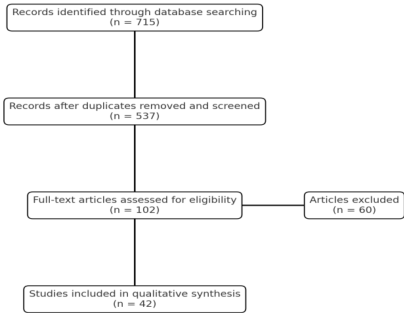
This study adopted a systematic literature review approach guided by PRISMA principles to examine the integration of AI and metaverse technologies in sustainable event management. Peer reviewed sources from 2015 – 2025 were retrieved from Scopus, web of science, and google scholar using keywords AI, Metaverse, Sustainability and event industry. A total of 42 relevant studies were thematically analysed using the technological organisation environment (TOE), Dynamic capability view (DCV) and Porter’s (1985) frameworks to identify patterns linking technological adoption, sustainability and competitive advantage.
Figure 1: PRISMA diagram (designed by author).
DISCUSSION
The findings of this study reveals that the integration of AI and metaverse technologies is reshaping the UK events sector’s sustainability landscape, with implications spanning environmental efficiency, social engagement and economic competitiveness. Three major themes emerged from the synthesis of the reviewed studies; technological readiness and adoption drivers, dynamic capabilities and organizational adaptability, and strategic value creation through digital transformation.
Leveraging Emerging Technologies 457 Technological Readiness and Adoption Drivers
Consistent with the Technology–Organization–Environment (TOE) framework, adoption of AI and metaverse tools within the event management is influenced by three interdependent factors; perceived technological advantage, organizational capability and environmental pressure. Studies by Akour et al. (2022) and Xu et al. (2025) indicate that organizations with strong digital infrastructures and leadership commitment demonstrate higher adoption rates. However, barriers persist, including high implementation costs, lack of interoperability between digital systems, and data governance concerns (Saraf et al., 2024).
Environmental pressures, particularly those tied to carbon reduction and sustainable tourism policies, act as catalysts for digital innovation (OECD, 2024). The literature suggests that regulatory incentives and stakeholder expectations increasingly drive event organizations towards AI-based analytics for energy optimization, smart crowd management, and carbon tracking (Mancini, 2023). Hence, while technological readiness varies across firms, sustainability imperatives are accelerating digital adoption within the sector.
Dynamic Capabilities and Organizational Adaptability Applying the dynamic capability view (DCV), the review finds that successful integration of AI and metaverse technologies depends heavily on an organization’s ability to sense, seize and reconfigure resources in response to environmental change (Teece et al., 1997). Firms with advanced sensing capabilities leverage AI-driven data insights to anticipate audience trends and sustainability risks. For example, machine learning tools have been employed to predict attendance patterns, manage waste streams, and personalize experiences, enhancing both operational efficiency and satisfaction (Sharma et al., 2024).
Seizing capabilities manifest in strategic partnerships and cross-sector collaborations, enabling access to metaverse platforms and virtual experience providers (Singh et al., 2024). Meanwhile, reconfiguring capabilities involve restructuring workflows and retraining staff to operate in hybrid event environments. This adaptability is a key differentiator: organizations that cultivate continuous learning and experimentation achieve higher sustainability performance and competitive positioning (Kaur, 2022a).
Strategic Value Creation and Competitive Advantage Drawing on Porter’s (1985) theory of competitive advantage, the synthesis highlights that digital transformation yields dual benefits- cost reduction and differentiation. AI automates resource-intensive tasks such as scheduling, logistics coordination, and post-event analytics, reducing operational waste and costs (Cerezo-Esteve et al., 2022). At the same time, metaverse based experiences foster differentiation through immersive engagement, expanding reach to a global audience, and new revenue streams. However, this technological leap also introduces new power dynamics. As Ozdemir
458 Iyobosa et al. (2023) note, data driven personalization redistributes influence from organizers to consumers, compelling organizations to adopt transparent governance and privacy measures. Consequently, competitive advantage increasingly stems from ethical innovation, i.e. the responsible use of AI and immersive technologies to create value while maintaining social trust.
CONCLUSION
This systematic literature review concludes that AI and metaverse technologies are enablers of sustainable transformation and competitive advantage in the UK events sector. By synthesizing evidence across diverse studies, it demonstrates how digital tools can optimize logistics, reduce environmental impact, and enrich cultural participation while opening new avenues for innovation and differentiation. Grounded in the TOE, DCV and Porter’s frameworks, the analysis reveals that organizational adaptability and ethical governance are central to realizing the full potential of these technologies. Firms that build dynamic capabilities, invest in green digital infrastructure and embrace inclusive digital transformation are best positioned lead in an increasingly sustainability driven global market. However, persistent challenges, such as cost barriers, digital inequalities and governance issues, necessitate multi-stakeholder collaboration and policy support. Future research should continue to evaluate the long-term societal impacts of AI and metaverse adoption and explore mechanisms for ensuring equitable access to digital sustainability benefits.
Ultimately, the convergence of sustainability and technological innovation presents not only a strategic imperative but also an opportunity for the UK events industry to redefine its global identity as a model for responsible, technology-enabled growth.
ACKNOWLEDGMENT
The author would like to acknowledge Dr Olukemi Olaniran, Dr Imani Silver Kyaruzi and Doris Uwa Izevbigie for taking time to proofread, give feedback and encouragement.
REFERENCES
Andreu, M., Kremers, R. and Rethel, L. (2024). Curating reflexivity: industry events and the performative politics of alternative finance. New Political Economy, 30(2), pp. 240–253. doi:https://doi.org/10.1080/13563467.2024.2418080. Akour, I.A., Al-Maroof, R.S., Alfaisal, R. & Salloum, S.A., 2022. A conceptual
framework for determining Metaverse adoption in higher institutions of Gulf Area: An empirical study using hybrid SEM-ANN approach. Computers and Education: Artificial Intelligence, 3, p. 100052. Alvarez-Risco, A., Del-Aguila-Arcentales, S., Rosen, M.A. & Yáñez, J.A., 2022.
Social Cognitive Theory to assess the intention to participate in the Facebook Metaverse by citizens in Peru during the COVID-19 pandemic. Journal of Open Innovation, 8(3), p. 142.
Leveraging Emerging Technologies 459 Arpaci, I., Karatas, K., Kusci, I. & Al-Emran, M., 2022. Understanding the social
sustainability of the Metaverse by integrating UTAUT2 and big five personality traits: A hybrid SEM-ANN approach. Technology in Society, 71, pp. 102–120. Ballarano, D., Patella, S.M. & Asdrubali, F., 2022. Sustainable transportation for events: A systematic review. Sustainability, 14, p. 15815. Cerezo-Esteve, S., Inglés, E., Segui-Urbaneja, J. and Solanellas, F. (2022). The
Environmental Impact of Major Sport Events (Giga, Mega and Major): A Systematic Review from 2000 to 2021. Sustainability, 14(20), p.13581. doi:https:// doi.org/10.3390/su142013581. Costa, P., 2022. Valuing culture and creativity impacts in a global technological era: Reshaping the analytical framework. European Planning Studies. https://doi.org/ 10.1080/09654313.2021.2023109 Davis, A., Murphy, J., Owens, D., Khazanchi, D. & Zigurs, I., 2009. Avatars, people,
and virtual worlds: Foundations for research in metaverses. Journal of the Association for Information Systems, 10(2), pp. 90–117. Díez-Pisonero, R. (2025). Events and Festivals as Strategic Tools for Understanding and Assessing the Symbolic Reconfiguration of the World Urban System. Urban Science, [online] 9(6), p. 223. doi: https://doi.org/10.3390/urbansci9060223. Garg, R. & Modi, R.K., 2025. Revolutionizing festival tourism: Harnessing
technology for event branding. In Technological Innovation and AI for Sustainable Development in Events and Festivals (pp. 27–36). Wallingford: CABI. Getz, D. & Page, S.J., 2007. Event studies: Theory, research and policy for planned events. Abingdon: Routledge. Harvey, D., 1989. The condition of postmodernity: An enquiry into the origins of
cultural change. Oxford: Blackwell. Holmes, K., Hughes, M., Mair, J. & Carlsen, J., 2015. Events and sustainability.
Abingdon: Routledge. Iqbal, M.S. & Fikri, S.M., 2024. In Pakistan, the choice of requirements for Islamic easy house financing by Meezan Bank. International Journal of Management Research and Emerging Sciences, 14(1). Jago, L.K. & Shaw, R.N., 1998. Special events: A conceptual and definitional
framework. Festival Management and Event Tourism, 5(1–2), pp. 21–32. Karen, A., 2023. The importance of sustainability in event planning. [online] Available at: https://www.theeventcompany.com/news/the-importance-of-sustainability-in- event-planning [Accessed 27 February 2025]. Kanaujiya, A. & Tiwari, G., 2022. Urban transport for sustainable events: A review.
Transport Policy, 115, pp. 93–103. Kaur, V., 2019. Knowledge-based dynamic capabilities. Cham: Springer International Publishing. Kaur, V. (2022a). Knowledge-based dynamic capabilities: a scientometric analysis of
marriage between knowledge management and dynamic capabilities. Journal of Knowledge Management. doi:https://doi.org/10.1108/jkm-02-2022-0112. Kimiti, P.G. & Kilika, J.M., 2018. Organizational resources, industry velocity, attention focus and firm’s performance: A review of literature. International Journal of Business and Management, 13(5), p. 185. Koba Y. (2020) Internet marketing communication in event tourism promotion. In:
Hassan A. and Sharma A. (eds) The Emerald Handbook of ICT in Tourism and Hospitality. Emerald Publishing, Bingley, UK, pp. 149–164. Kohe, G.Z. and Koutrou, N. (2024). Sustainability, the Athens Marathon and Greece’s sport event sector: lessons of resilience, social innovation and the urban commons. Sport in society, pp.1–26. doi:https://doi.org/10.1080/17430437.2024 .2341063.
in a post-Olympic metropolis: Analyzing forces, structures, and opportunities in Greece’s civil society landscape. Local Development & Society, pp. 1–21. doi:https://doi.org/10.1080/26883597.2023.2269491. Liu-Lastres, B. & Cahyanto, I.P., 2023. Are we always ready? Examining event professionals’ approaches to risk and crisis management and resilience. Tourism Management Perspectives, 46, p. 101073. Mancini, P., 2023. Environmental sustainability in large-scale events: Challenges and
opportunities. Journal of Sustainable Tourism Management, 31(4), pp.560–578. Müller, M., 2015. Event logistics and infrastructure: Managing flow and safety.
Event Management, 19(3), pp. 345–360. Nascimento, J. & Loureiro, S.M.C., 2024. Mapping the sustainability branding field: Emerging trends and future directions. Journal of Product & Brand Management, 33, pp.234–257. OECD, 2024. Effective results frameworks for sustainable development. [online]
Available at: https://www.oecd.org/en/publications/effective-results-frameworks- for-sustainable-development_aaa4bb52-en/full-report.html [Accessed 27 April 2025]. Ozdemir, O., Dogru, T., Kizildag, M. & Erkmen, E., 2023. A critical reflection on digitalization for the hospitality and tourism industry: Value implications for stakeholders. International Journal of Contemporary Hospitality Management, 35(9), pp.3305–3321. Pereira, L., Jerónimo, C., Sempiterno, M., Lopes da Costa, R., Dias, Á. & António,
N., 2021. Events and festivals contribution for local sustainability. Sustainability, 13, p. 1520. Porter, M.E., 1985. Competitive advantage: Creating and sustaining superior performance. New York: The Free Press. Qu, M. & Cheer, J.M., 2022. Community art festivals and sustainable rural
revitalisation. In Walters, L. & Picard, D., eds. Events and sustainability. London: Routledge, pp. 18–37. Qu, M. & Zollet, S., 2023. Rural art festivals and creative social entrepreneurship.
Event Management, 27, pp. 1219–1235. Saraf, K., Bajar, K., Jain, A. & Barve, A., 2024. Assessment of barriers impeding the incorporation of blockchain technology in the service sector: A case of hotel and health care. Journal of Modelling in Management, 19(2), pp. 407–440. Sharma, M., Tomar, A. & Hazra, A., 2024. Edge computing for Industry 5.0:
Fundamental, applications and research challenges. IEEE Internet of Things Journal. Shen, B., Tan, W., Guo, J., Zhao, L. & Qin, P., 2021. How to promote user purchase in Metaverse? A systematic literature review on consumer behavior research and virtual commerce application design. Applied Sciences, 11(23), p. 11087. Singh, S.V., Singh, P.C., Singh, K. & Nain, A., 2024. Role of Metaverse in events
industry: An empirical approach. In New technologies in virtual and hybrid events (pp.164–183). Hershey: IGI Global. Teece, D.J., Pisano, G. & Shuen, A., 1997. Dynamic capabilities and strategic management. Strategic Management Journal, 18(7), pp. 509–533. Tornatzky, L.G. & Fleischer, M., 1990. The process of technological innovation.
Lexington: Lexington Books. UCLG, 2021. Annual report of the Committee on Social Inclusion, Participatory Democracy and Human Rights. [online] Available at: https://www.uclg-cisdp.org/ sites/default/files/documents/files/2021-12/EN%20Annual%20report%202021. pdf [Accessed 4 February 2025].
Leveraging Emerging Technologies 461 United Nations, 2023. Sustainability. [online] Available at: https://www.un.org/en/
academicimpact/sustainability [Accessed 27 April 2025]. Wang, G. & Shin, C., 2022. Influencing factors of usage intention of Metaverse education application platform: Empirical evidence based on PPM and TAM models. Sustainability, 14(24), p. 17037. Wójcik, P., 2015. Exploring links between dynamic capabilities perspective and
resource-based view: A literature overview. International Journal of Management and Economics, 45(1), pp. 83–107. Xu, D., Huang, B., Shi, S. and Zhang, X. (2025). A Configurational Analysis of Green Development in Forestry Enterprises Based on the Technology–Organization– Environment (TOE) Framework. Forests, [online] 16(5), pp. 744–744. doi:https:// doi.org/10.3390/f16050744. Zukin, S., 1995. The cultures of cities. Oxford: Blackwell.
LISTED IN THE AHFE DIGITAL BOOKSTORE CATALOGUE
Explore the complete digital volume
Human Interaction and Emerging Technologies (IHIET-AI 2026): Artificial Intelligence and Future Applications
Read this individual research paper free through the original publisher, or explore the full digital proceedings book.
ISBN 978-1-964867-77-9
Explore this ISBN in the AHFE Bookstore ↗Listed in the July 2026 bookstore catalogue; search by ISBN to confirm current availability · Digital book purchase optional