Pawel Krolas, Stefan Trzcielinski, Jowita Trzcielinska, Ishtyak Hossain, Rida Kamal, Jussi Kantola (2026). Assessment of the Competency and Safety Behaviour of Crane Operator Trainees: A Case Study Based on Conventional and Immersive (VR) Crane Operation Training. In: Metaverse, Virtual Environments and Game Design. AHFE Open Access, vol. 217, pp. 1–11. https://doi.org/10.54941/ahfe1007648
Publisher statistics will load when you open Metrics.
AHFE OPEN ACCESS OPEN ACCESS CONFERENCE PROCEEDINGS PAPER
Assessment of the Competency and Safety Behaviour of Crane Operator Trainees: A Case Study Based on Conventional and Immersive (VR) Crane Operation Training
Crane operation is a crucial profession, which requires extensive technical knowledge along with situational awareness. Specifically, overhead crane operation requires knowledge of hazard identification, special attention to safety, and spatial awareness due to the nature of safety-critical lifting inside a facility. This case study involves the crane operator trainees who have undergone three kinds of training: attending a theory class related to overhead crane operation, followed by operating a real crane, and finally, participating in a virtual reality-based immersive training inside a simulated environment that resembles the real scenario. A “Hermippe Crane Training Questionnaire” consisting of 62 questions was developed and filled out by the 13 training participants. This questionnaire serves as an assessment tool and judges participants' competency and safety knowledge based on the following seven criteria: Regulations and Technical Knowledge, Maintenance and Inspection Competence, Safety Behaviour and Compliance, Operational Skills and Load Handling, Hazard Awareness and Situational Awareness, Communication and Team Coordination, and Confidence and Learning Orientation. Item- and subscale-level descriptive statistical analyses were conducted to analyze the participants' responses in order to identify the participants' competence level after the training. This study offers practical advice regarding the future curriculum development for crane operation training by identifying strengths and gaps in the operators’ competence development. It also provides evidence of the importance of a mixed training method that combines theory, immersive- and hands-on training rather than just stand-alone traditional approaches.
Crane operation is one of the most high-stakes industrial processes, which requires a higher percentage of operator competence, situational awareness (SA), and complete adherence to safety protocols. Accidents and injuries related to crane operation may not be the most common type of incident, but they are potentially very harmful and pose a greater risk of fatality (Sadeghi et al., 2021). Research regarding offshore crane operation suggests that 20% of crane-related accidents are caused by structural failure, whereas 80%–90% stem from operator error (Tiwari et al., 2026). According to a Received February 20, 2026; Revised April 7, 2026; Accepted April 27, 2026; Available online July 20, 2026
study related to the Spanish construction industry, of 1314 crane accidents (2012–2021), 0.61% were fatal, causing 62 incidents of death (Herrera-Pérez et al., 2023).
Communication breakdown between the crane operator and shopfloor workers is another crucial factor responsible for these accidents (Lingard et al., 2021). Operators play the most crucial role, as the success of crane operation is directly linked to their handling skills. Inexperience in crane operation is another major reason behind fatal accidents. Herrera-Pérez et al. (2023) pointed out that 63.33% of the total reported incidents involved operators with less than one year of experience. These numbers indicate that crane operators must undergo training sessions which involve not only technical training, but also human-centred elements such as knowledge, safety behaviour, and the development of situational awareness to ensure overall safe operation in high-risk operations.
Traditionally, crane operator training is conducted using real equipment with a combination of practical instructions and classroom or theory-based learning. Practical training involves setting up a real workplace scenario, which often requires the use of heavy machinery that increases the cost of training (Dhalmahapatra et al., 2021). Sometimes it is difficult to provide training in a real workspace due to the constraints on space and time allowances. Another major concern is safety and chances of accidents in the training centres during the training. Therefore, the training scenarios are limited, preventing trainees from understanding the consequences and operation scenarios in practical work life (Akulov et al., 2023). All these limitations result in the failure to provide adequate time and training scenarios for new crane operators so that they can relate to industrial scenarios while operating in real life. Immersive virtual reality (VR)-based training has emerged as an alternative option for practical training because the training scenarios and hazards are not limited, and trainees can practise as many times as they want, since it requires only a one-time cost of developing the platform. Researchers have adopted a blended training method for trainees. In most cases, trainees participate in hybrid training (practical and VR), and sometimes they combine theory-based training with practical crane operation, whereas in other cases, trainees participate in all three modalities (Skiba, 2020; Song et al., 2021; Ziemek, 2019).
Previously, researchers adopted several criteria for assessing the competence of crane operator trainees, including hazard identification, load competence, communication competence (hand signals), inspection and maintenance awareness, and pre-start checks (Bedi et al., 2021; Skiba, 2020). All the levels of competence extend beyond operating skill to human factors such as participants’ responses to presence, situational awareness, task handling, and hesitation/anxiety time. This research work is part of the “Virtual Training Certification” (VTC) project, which focused on developing virtual training (VR-based) for forklift training, occupational safety, crane operation training, and hot works. The goal of this work is to evaluate the competence of the crane operator trainees from Poland across multiple human-factor dimensions and their perception of safety behaviour before, during, and after overhead crane operation. In order to achieve this goal, the following research questions have been formulated:
Assessment of the Competency and Safety Behaviour of Crane Operator Trainees 3 RQ1: How do crane operators perceive their competence and safety behaviour after completing both conventional and VR-supported overhead crane operation training when assessed using a blended human-factors framework? RQ2: How do the knowledge, safety behaviour, situational awareness, communication, and skills dimensions differ within the blended human- factors framework?
BACKGROUND
As mentioned in the earlier section, there is no worldwide standard format or standardized criterion for assessing the competence of crane operator trainees. McClelland (1973) proposed a competence model which defines competence as a combination of acquired knowledge, safety behaviour, and skills (Vazirani, 2010). The system safety (Swiss cheese model – SCM) model, developed by James Reason in 1990, explicitly describes how an accident occurs due to multiple levels of system defence failures. The SCM emphasizes that accidents are the result of interacting failures across different system layers rather than isolated operator error (Larouzee and Le Coze, 2020). Endsley’s (2015) situational awareness (SA) model conceptualizes that perception, comprehension, and projection assist complex decision- making in dynamic systems. Hazard recognition, responding to unexpected situations, and confidence in handling tasks are important dimensions for the assessment of the competence of crane operators. All these three models are used by safety and competence assessment researchers either in combination or as a standalone model for the assessment of human performance and competence in safety-critical industrial operations (Sacks et al., 2013; Salmon et al., 2009). These three models laid the theoretical foundation for this research related to overhead crane operator training.
On-site conventional training for heavy equipment is often constrained by factors such as limited access to equipment and the difficulty of exposing trainees to non-routine high-risk scenarios. Therefore, simulation-based training was introduced in several domains, supplementing practical training (Cheng and Teizer, 2013; Fang et al., 2014). One of the popular options is VR-based training, which offers immersivity that closely resembles real-world scenarios (Fang et al., 2017), without the risk of getting injured or affecting the workplace or other workers. Although VR-based training is gaining popularity, and the results show that trainees demonstrate positive effects on learning outcomes, there is an evident gap in how training effectiveness is evaluated. Most researchers focus on measuring task completion efficiency, reaction time, or perceived usability, which offers limited insights regarding the competence development of the trainees. Previous studies examining crane-related accidents often emphasized that the lack of human factors, such as safety behaviour, decision-making, hazard perception, and communication skills, is also a contributing component, even when operators have adequate technical or operational skill (Shapira et al., 2012; Zhou et al., 2013).
Previously, very few studies integrated technical and operational knowledge dimensions with human-factor dimensions to measure the competence of crane operators. This work bridges the gap and provides empirical evidence by
summarizing the self-reported competence data of the overhead crane operator trainees across multiple dimensions. This paper provides a framework for future researchers to evaluate the safety behaviours and competence development of operators who are engaged in critical heavy-machinery operations.
RESEARCH DESIGN AND METHOD This study employs a post-training survey design and quantitative analysis to assess overhead crane operators’ perceived competence and perception of safety behaviour following three different types of training sessions (practical, theory, and VR).
The main research tool for this study is the “Crane Hermippe Questionnaire”, which evaluates participants’ competence in two categories, crane operation and safety, as well as personal and professional skills. The participants rated each questionnaire item based on a Likert scale ranging from strongly disagree = 1 to strongly agree = 4. A blended competency model was adopted in this work, which formed its theoretical foundation. This model was developed based on the competence, SCM, and SA ones. The collected responses were divided into seven analytical competence dimensions based on the blended competency model. Table 1 explains the dimensions and the number of items they cover from the questionnaire. Each competence dimension was evaluated using multiple questionnaire items to capture the different aspects of the same underlying construct.
Table 1: Blended competency model dimensions.
Table available in the original PDF paper.
No Model Dimension Description Number of Items
12
1. Safety Behaviour and Compliance
Adherence to safety rules and procedures
7
2. Communication and Team Coordination
Coordination with other workers and supervisors during operation
9
3. Hazard Identification and Situational Awareness
Perception of hazards and response to situations
10
4. Motivation and Self-regulation
Willingness to improve skills, confidence, and openness to feedback
10
5. Operational Skills and Load Handling
Crane manoeuvring, load handling, and stacking
6
6. Regulations and Technical Knowledge
Understanding of crane regulations, load limits, and equipment
7. Maintenance and Inspection Pre-operational inspections,
5
identifying equipment, and preventive maintenance actions Total 59
The research sample comprised employees from multiple organizational tiers, encompassing both shopfloor personnel and managerial staff. This participant diversity allowed for a multidimensional analysis of VR-based training, reflecting perspectives from both operational execution and managerial oversight.
Assessment of the Competency and Safety Behaviour of Crane Operator Trainees 5 The training mode consisted of five stages: Pre-training guidance: Participants received a brief introduction to the study objectives, VR safety guidelines, and procedure, followed by the completion of informed consent forms.
Perceived competence learning questionnaire: The questionnaire assessed participants’ self-reported confidence and perceived competence in crane operation before and after the training.
VR training: The VR training was conducted under controlled conditions using a VR head-mounted display, control box, and hand controllers. It included an instructor-led demonstration, as well as VR-based practical exercises with feedback and standardized task sequences.
Self-evaluation: After the VR session, the participants completed a general questionnaire, the Hermippe one, and took part in a semi-structured interview addressing usability, immersion, and perceived effectiveness of VR training.
Real-crane operation: The final stage involved a real-world training session, during which the overall process was summarized, and its strengths and limitations were discussed. High fidelity to real working conditions was identified as the main advantage, while difficulties in handling VR equipment were noted as the primary limitation.
In order to adhere to the EU General Data Protection Regulation (GDPR) and anonymity of the participant, each one received a unique research ID and participation in the study was voluntary.
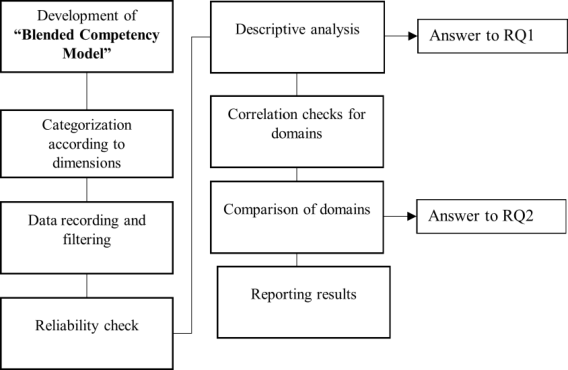
The overall research workflow followed for this study is explained in Figure 1. Statistical analysis was conducted utilizing Python with the use of the standard data analysis library and the analysis focused on addressing the two key research questions. The internal reliability of the seven dimensions was calculated separately for each construct. This evaluated the capability of the single item within the same dimension, which measured a common underlying construct.
Figure 1: Research workflow.
The sample size of the study is relatively small and the nature is exploratory, hence, the Cronbach’s alpha value was interpreted cautiously following the accepted threshold of 0.7 for the human factor (Nunnally and Bernstein, 1994). RQ1 was addressed by a descriptive statistical procedure that records the mean value, median, and standard deviation for each of the dimensions. In order to check the differences and relations among the constructs, a key objective of RQ2, Spearman’s rank-order correlation analysis was applied. Due to the ordinal nature of the data and small sample size, Spearman’s correlation is the perfect statistical tool in this case, as it is robust to normality assumptions and is widely adopted in exploratory human-factor and behavioural research (Bonett and Wright, 2000; Salmon et al., 2009). The crucial part of the work is the development of the blended framework with multiple dimensions covering the technical and human aspects of crane operator training.
RESULTS
The internal consistency of the dimensions was measured using Cronbach’s alpha and all dimensions displayed an acceptable to excellent level of consistency. The alpha values ranged from 0.74 to 0.93, with the highest internal reliability observed for safety behaviour and compliance (α = 0.93) and hazard identification and situational awareness (α = 0.91). The lowest, which was still above the acceptable threshold, was recorded for maintenance and inspection (α = 0.74). These findings determine that the developed dimensions are capable of consistently measuring the same underlying competence domain.
Descriptive statistics were calculated to evaluate the participants’ perception of competence and safety behaviour across the blended-model domains. Mean scores, standard deviations, and minimum and maximum ranges for each dimension are presented in Table 2. Safety behaviour ranked first across all the dimensions (M = 3.51, SD = 0.46), and the responses ranged from 4 to 3, whereas maintenance and inspection had the lowest mean score (M = 2.68), with the response range 3.6 to 1.6.
Table 2: Descriptive statistics results for dimensions.
Table available in the original PDF paper.
Min Max Rank
Model Dimension Mean (M)
Std. Dev (SD)
Safety Behaviour and Compliance (SC) 3.51 0.46 3 4 1 Communication and Team Coordination (CT) 3.45 0.51 2.4 4 2
3.44 0.53 2.28 4 3
Hazard Identification and Situational Awareness (SA) Motivation and Self-Regulation (MS) 3.3 0.36 2.77 3.92 4
Maintenance and Inspection Competence (MI) 2.68 0.54 1.6 3.6 7
Assessment of the Competency and Safety Behaviour of Crane Operator Trainees 7 Communication and team coordination (M = 3.45) and situational awareness (M = 3.44) also recorded higher mean scores. According to the descriptive statistics results, it can be concluded that crane operator trainees perceived stronger competence in behavioural, communicational, and operational dimensions compared to knowledge acquisition and maintenance. By ranking the dimension means, Table 1 presents the differences and the variation across the multiple dimensions within the blended-model framework of this study. The operators recorded different levels of competency for each dimension, which reinforces the need for a multi-dimensional assessment to check the level of competence rather than a single aggregated competence score.
Spearman’s rank-order correlation analysis was conducted to evaluate the interrelationship between the seven analytical dimensions. Table 3 shows the correlation matrix and describes the heatmap of connectivity among the constructs. Safety behaviour competency has the strongest relationship with situational awareness (ρ = 0.93) and knowledge acquisition (ρ = 0.92), whereas operation skills and load handling share a stronger connection with RT (ρ = 0.86) and SC (ρ = 0.85), and moderate correlation was found for communication with other dimensions (ρ = 0.41–0.67). In the heat map, dark grey represents a strong correlation among the dimensions and light grey denotes a weak correlation. According to the participants’ rating, maintenance and inspection have the weakest correlation compared to all other dimensions. Based on the correlation results, a strong relationship exists between knowledge, safety behaviour, situational awareness, motivation, and operational skills, which suggests that competence development is integrated within the blended framework.
Table 3: Spearman’s correlation heatmap.
Table available in the original PDF paper.
SC CT SA MS OL RT MI SC 1 0.57 0.93 0.84 0.85 0.92 0.49
According to the results of Table 2, and in answer to RQ1, after participating in hybrid overhead crane operation training, the participants strongly felt that the training provided them with adequate opportunities to develop their competency level for all the human-factor-based competency dimensions, which is evident in their positive responses. RQ2 is addressed through the ranking in Table 2 and the heat map in Table 3. The rankings reveal that there is a variation in perceived competence across dimensions according to the participants, and the heatmap further shows the strong
association between these dimensions, indicating that competence development in overhead crane operation is multi-dimensional and interconnected rather than isolated.
DISCUSSION
The findings of this paper provide in-depth insights into how overhead crane operators record their perceived competence after completing VR, theory, and practical training sessions when assessed using a blended human-factor- based framework. Overall, the participants recorded moderate to high levels of perceived competence across all dimensions, indicating that the training modes and methods are supportive of competence development. It also points out that competence is not only the accumulation of technical skills; it encompasses knowledge, operational skills, behaviour, and situational awareness (Raven, 2001). Previous research claimed that safe operation in complex socio-technical systems requires compliance with rules, awareness of hazards, and successful coordination with team members (Reason, 1990). The same pattern can be observed in this case study as well, as the participants highly rated dimensions related to behaviour, SA, and communication. The dominance of this dimension suggests the superiority of VR-supported training, where participants get maximum exposure to hazardous scenarios without any real-life risk, and it develops their ability to respond quickly and smoothly in dangerous scenarios (Kinateder et al., 2014).
In contrast, maintenance and inspection skills had the lowest mean score and the weakest correlation with other dimensions. This observation indicates that inspection and maintenance-based tasks require tactile interaction with the equipment and hands-on experience. It can be concluded that conventional crane operation training remains important, while VR and other immersive trainings can be complementary and provide trainees with adequate learning opportunities. The heat map suggests a stronger correlation between safety behaviour and situational awareness, which supports (Endsley, 2015) model conceptualizing safe performance as a process involving perception, comprehension, and decision-making. These outcomes align closely with prior findings in construction and heavy-equipment contexts, and safety-oriented behaviour is closely linked with safe optional choices (Sacks et al., 2013).
From a practical point of view, this study provides evidence that the hybrid training model (a combination of conventional and immersive training) is well suited to addressing behavioural and cognitive competence development for crane operators. Furthermore, the strong interrelationship between the technical and humane dimensions suggests that competence measurement should take a multi-dimensional approach rather than focusing on task completion score-based decision-making.
Limitations and Future Implications Several limitations related to this paper should be acknowledged. It is based on self-reported competence scores and no during-training score was recorded, which makes this study a perceived competence-based one rather
Assessment of the Competency and Safety Behaviour of Crane Operator Trainees 9 than an objectively measured one. Additionally, the sample size was somewhat small, and no pre-training competence level was measured, preventing a direct comparison between pre- and post-training data. Future researchers should incorporate a long-term experimental design for the evaluation of competence development among crane operators. They should also aim to measure objective performance metrics with a relatively larger sample size to further validate the blended framework presented in this work.
CONCLUSION
Despite its limitations, the study demonstrates the strong feasibility of using a blended human-factor-based framework to evaluate the competence of crane operators, which is applicable to operators in many other sectors. The findings related to the different dimensions of competence reflect that crane operators’ competence is not uniform across the technical domains or the safety one, and it depends on the nature of training. The strong interrelationships among the domains emphasize that safe crane operation depends on the integration of technical knowledge, behavioural compliance, self-regulation, and operational skills. Although the paper is exploratory in nature, the findings provide a guideline and established framework for future researchers who are interested in studying competence development and crane training design.
ACKNOWLEDGEMENT
The authors gratefully acknowledge Business Finland for providing the resources and support to conduct this project successfully. The research tool used in this study was the brainchild of the late Ebo Kwegyir-Afful, and the authors would like to extend their heartfelt gratitude towards him.
REFERENCES
Akulov, А., Zhelieznov, K., Zabolotnyi, О., Chabaniuk, E., Shvets, A., 2023. Training simulators for crane operators and drivers. Eng. Today 2, 5–5. https://doi. org/10.5937/engtoday2300003A Bedi, J.K., Rahman, R.A., Din, Z., 2021. Heavy machinery operators: Necessary
competencies to reduce construction accidents. IOP Conf. Ser. Earth Environ. Sci. 641, 012007. https://doi.org/10.1088/1755-1315/641/1/012007 Bonett, D., Wright, T., 2000. Sample size requirements for estimating Pearson, Kendall and Spearman correlations. Psychometrika 65, 23–28. https://doi.org/10.1007/ BF02294183 Cheng, T., Teizer, J., 2013. Real-time resource location data collection and visualization
technology for construction safety and activity monitoring applications. Autom. Constr., Information Technologies in Safety Management 34, 3–15. https://doi. org/10.1016/j.autcon.2012.10.017 Dhalmahapatra, K., Maiti, J., Krishna, O.B., 2021. Assessment of virtual reality based safety training simulator for electric overhead crane operations. Saf. Sci. 139, 105241. https://doi.org/10.1016/j.ssci.2021.105241 Endsley, M.R., 2015. Final reflections: Situation awareness models and measures.
J. Cogn. Eng. Decis. Mak. 9, 101–111. https://doi.org/10.1177/1555343415573911
Fang, Y., Cho, Y., Durso, F., Seo, J., 2017. Assessment of operator’s situation awareness for smart operation of mobile cranes. Autom. Constr. 85, 65–75. https://doi.org/10.1016/j.autcon.2017.10.007 Fang, Y., Teizer, J., Marks, E., 2014. A framework for developing an as-built
virtual environment to advance training of crane operators. https://doi. org/10.1061/9780784413517.004 Herrera-Pérez, V., Salguero-Caparrós, F., Pardo-Ferreira, M. del C., Rubio-Romero, J.C., 2023. Key factors in crane-related occupational accidents in the Spanish construction industry (2012–2021). Int. J. Environ. Res. Public. Health 20. https:// doi.org/10.3390/ijerph20227080 Kinateder, M., Ronchi, E., Nilsson, D., Kobes, M., Müller, M., Pauli, P., Mühlberger,
A., 2014. Virtual reality for fire evacuation research. Presented at the Federated Conference on Computer Scinece and Information Systems, pp. 319–321. https:// doi.org/10.13140/2.1.3380.9284 Larouzee, J., Le Coze, J.-C., 2020. Good and bad reasons: The Swiss cheese model and its critics. Saf. Sci. 126, 104660. https://doi.org/10.1016/j.ssci.2020.104660 Lingard, H., Cooke, T., Zelic, G., Harley, J., 2021. A qualitative analysis of crane
safety incident causation in the Australian construction industry. Saf. Sci. 133, 105028. https://doi.org/10.1016/j.ssci.2020.105028 McClelland, D.C., 1973. Testing for competence rather than for “intelligence.” Am.
Psychol. 28, 1–14. https://doi.org/10.1037/h0034092 Nunnally, J.C., Bernstein, I.H., 1994. Psychometric theory, 3rd ed. McGraw-Hill, New York, NY. Raven, J., 2001. The McClelland/McBer competency models, in: Competence in the
Learning Society. Peter Lang, New York, pp. 225–235. Reason, J., 1990. Studies of human error, in: Human Error. Cambridge University Press, pp. 19–52. https://doi.org/10.1017/CBO9781139062367 Sacks, R., Perlman, A., Barak, R., 2013. Construction safety training using immersive
awareness: Theory, measurement and application to teamwork. https://doi. org/10.1201/9781315577654 Shapira, A., Simcha, M., Goldenberg, M., 2012. Integrative model for quantitative evaluation of safety on construction sites with tower cranes. J. Constr. Eng. Manag. 138, 1281–1293. https://doi.org/10.1061/(ASCE)CO.1943-7862.0000537 Skiba, R., 2020. Best practice standards and methodology for crane operator training
- A global perspective. Song, H., Kim, T., Kim, J., Ahn, D., Kang, Y., 2021. Effectiveness of VR crane training with head-mounted display: Double mediation of presence and perceived usefulness. Autom. Constr. 122, 103506. https://doi.org/10.1016/j. autcon.2020.103506 Tiwari, P., Zhu, W., McSweeney, K., 2026. Comparison of crane safety standards:
A Human factors perspective. IISE Trans. Occup. Ergon. Hum. Factors 0, 1–12. https://doi.org/10.1080/24725838.2025.2612656 Vazirani, N., 2010. Competencies and competency model-A brief overview of its development and application. SIES J. Manag. 7, 121.
Assessment of the Competency and Safety Behaviour of Crane Operator Trainees 11 Wang, X., Dunston, P., Skibniewski, M., 2004. Mixed reality technology
applications in construction equipment operator training. Presented at the 21st International Symposium on Automation and Robotics in Construction. https:// doi.org/10.22260/ISARC2004/0069 Zhou, Z., Irizarry, J., Li, Q., 2013. Applying advanced technology to improve safety management in the construction industry: A literature review. Constr. Manag. Econ. 31, 606–622. https://doi.org/10.1080/01446193.2013.798423 Ziemek, K., 2019. Tower crane simulator for innovative training system using
Read this individual research paper free through the original publisher, or explore the full digital proceedings book.
ISBN 978-1-964867-93-9
Explore this ISBN in the AHFE Bookstore ↗Listed in the July 2026 bookstore catalogue; search by ISBN to confirm current availability · Digital book purchase optional